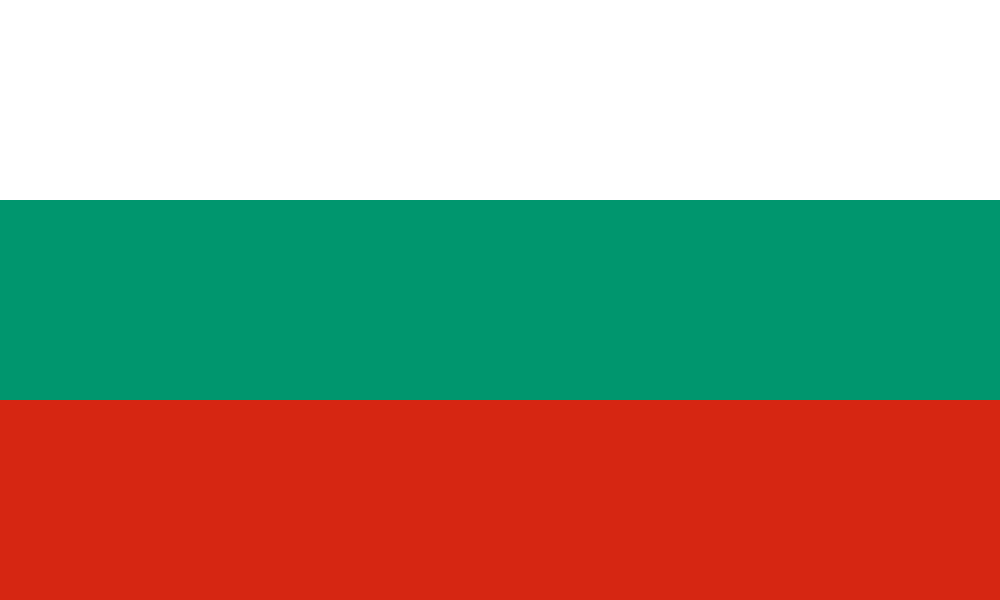
From Balkan revolutionary to head of Soviet Ukraine: the diplomat who became an opposition theorist
"Our misfortune is that we held responsible posts and power turned our heads." Final plea at the 1938 Moscow trial
A pan-European revolutionary of Bulgarian ethnic origin who also held Romanian citizenship, Rakovsky founded the Balkan Social Democratic Federation. As chairman of the Ukrainian Council of People's Commissars from 1919 to 1923 he helped build the Ukrainian Soviet state, and he later served as Soviet ambassador to Britain and France. A Left Opposition theoretician who challenged Stalin's nationalities policy and party bureaucratisation, he was expelled in 1927, admitted his errors to Stalin in 1934 and was readmitted in 1935. Sentenced to 20 years at the Third Moscow Trial in 1938, he was shot at Oryol on 11 September 1941 and rehabilitated on 4 February 1988.
Career timeline
1890–1896Medical studies in Geneva, Berlin, Montpellier; active in European socialist movements
1910Revived Romanian Social Democratic Party; founded Balkan Social Democratic Federation, first secretary
1919–1923Chairman of Sovnarkom of Ukraine; People's Commissar of Foreign and Internal Affairs
1919–1927Member of the Central Committee of the RCP(b); Orgburo member (1919–1920)
1923–1927Plenipotentiary representative of the USSR to Britain (1923–1925) and France (1925–1927)
1927–1935Left Opposition leader; expelled from party, exiled to Astrakhan, Saratov, Barnaul
1934–1937Admitted his errors to Stalin in 1934, readmitted to the party in November 1935; head of scientific institutes administration at RSFSR Health Commissariat
1937–1941Expelled again in 1936, arrested January 1937, Third Moscow Trial 20-year sentence; shot at Oryol on 11 September 1941
The last hetman of Ukraine, installed under German occupation in 1918
On 29 April 1918 in Kyiv, the All-Ukrainian Congress of Landowners rose and unanimously acclaimed Pavlo Skoropadskyi as Hetman of Ukraine with shouts of 'Long live the Hetman!'
A Ukrainian aristocrat and tsarist lieutenant general who commanded a corps in the First World War. In April 1918, backed by the German army that occupied Ukraine after the Treaty of Brest-Litovsk, he overthrew the socialist Central Rada in a coup and was proclaimed Hetman of the Ukrainian State. During his eight-month rule he founded the Ukrainian Academy of Sciences, established universities, and built diplomatic ties, but his pro-landlord agrarian policy and the German occupiers' forced grain requisitions provoked widespread peasant resistance. When Germany collapsed in November 1918, Symon Petliura's Anti-Hetman Uprising drove him from power; he abdicated in December and spent the rest of his life in German exile, refusing to collaborate with the Nazis.
Career timeline
1893Commissioned as an officer in the Chevalier Guard regiment
1904–1905Commanded Cossack units in the Russo-Japanese War, decorated for bravery
1912Promoted to major general, aide-de-camp to Nicholas II
1914–1916Commanded cavalry divisions in WWI, promoted to lieutenant general
1917Commander of 34th Army Corps, Ukrainised it into the 1st Ukrainian Corps
1917.10Elected Otaman of the Free Cossacks
1918.04–12Hetman of the Ukrainian State
1919–1945Exile in Germany, led the Hetmanite movement
First woman to lead a Soviet government, between revolution and terminal illness
As German troops advanced on Kyiv, Bosch refused to abandon the city without a fight. Her comrades had to forcibly evacuate her.
A Bolshevik of German settler background, she became the first woman to head a Soviet government as acting leader of Ukraine's People's Secretariat in 1917. In Swiss exile she opposed Lenin on the national question; later she signed the Left Opposition's Declaration of 46. She died in 1925 after years of incurable illness.
Career timeline
1901Joined RSDLP; active in Bolshevik faction after the 1903 split
1907–1911Underground revolutionary work in Kyiv; secretary of the Kyiv Committee
1912–1914Arrested, exiled to Siberia, escaped via Japan and the US to Switzerland
1914–1917Swiss exile; opposed Lenin on the national question in the 'Baugy group'
1917.04–07Chair of South-Western Regional Party Committee; VI Party Congress delegate
1917.12–1918.03Acting head, People's Secretariat of Ukraine; People's Secretary of Internal Affairs
1918–1919Chair of Penza Party Committee; political commissar on Caspian-Caucasus Front
1923–1924Joined the Left Opposition; signed the Declaration of 46
From Soviet economic planner to independent Ukraine’s first prime minister
In 2016, the man who had signed away the USSR revealed his own grief: 'As a man, I'm ashamed to admit it, but when Crimea was annexed, I cried like a child.'
Vitold Fokin was a Ukrainian Soviet economic official who began as a mining engineer and experienced both the operation of a planned economy and the pressures of state transformation. He led Ukraine’s government around independence while confronting economic crisis and the collapse of the Union. In December 1991, he signed the Belovezha Accords for Ukraine alongside Leonid Kravchuk, helping establish the post-Soviet order. Late in life, his controversial positions in the Donbas negotiations ended his public role.
Career timeline
1954–1963Mining engineer and manager in the Luhansk region
1963–1971Manager in the Donbas anthracite industry
1971–1987Department head and deputy chair of Ukraine’s State Planning Committee
1987–1990Deputy chair of Ukraine’s Council of Ministers and head of the State Planning Committee
1990–1991Chair of the Council of Ministers of the Ukrainian SSR
1991–1992First prime minister of Ukraine
1991Ukrainian signatory of the Belovezha Accords
2020First deputy head of Ukraine’s delegation to the Trilateral Contact Group