A Bosnian politician who embodied a multi-ethnic resistance coalition
When Ustaša leader Ljubomir Kvaternik came to Cazin in the summer of 1941 seeking his support, Pozderac refused even to grant him a meeting.
Nurija Pozderac was a Bosnian Muslim teacher turned politician from the Cazin region who refused the Ustaša regime's demand to collaborate and stood against its persecution of Serbs and Jews. With his wife Devleta he rescued dozens of Jewish refugees, and as a vice president of AVNOJ elected in 1942 he embodied the partisan movement's multi-ethnic character.
Career timeline
- 1910s–1930sTeacher in the Cazin region
- 1935Deputy in the Parliament of the Kingdom of Yugoslavia
- 1941Rejected Ustaša collaboration and joined the National Liberation Movement
- 1942President of the Cazin National Liberation Committee
- 1942Vice president of the AVNOJ Executive Board
- 1943Participant in the Battles of Neretva and Sutjeska
- 1944Posthumously awarded the Order of the People’s Liberation
Yugoslavia's partisan leader who chose non-alignment
The 1948 Cominform split threw Tito's Yugoslavia out of the Soviet bloc and showed that a socialist state could take an independent line, while the dispute was as much a geopolitical struggle in the Balkans as an ideological one.
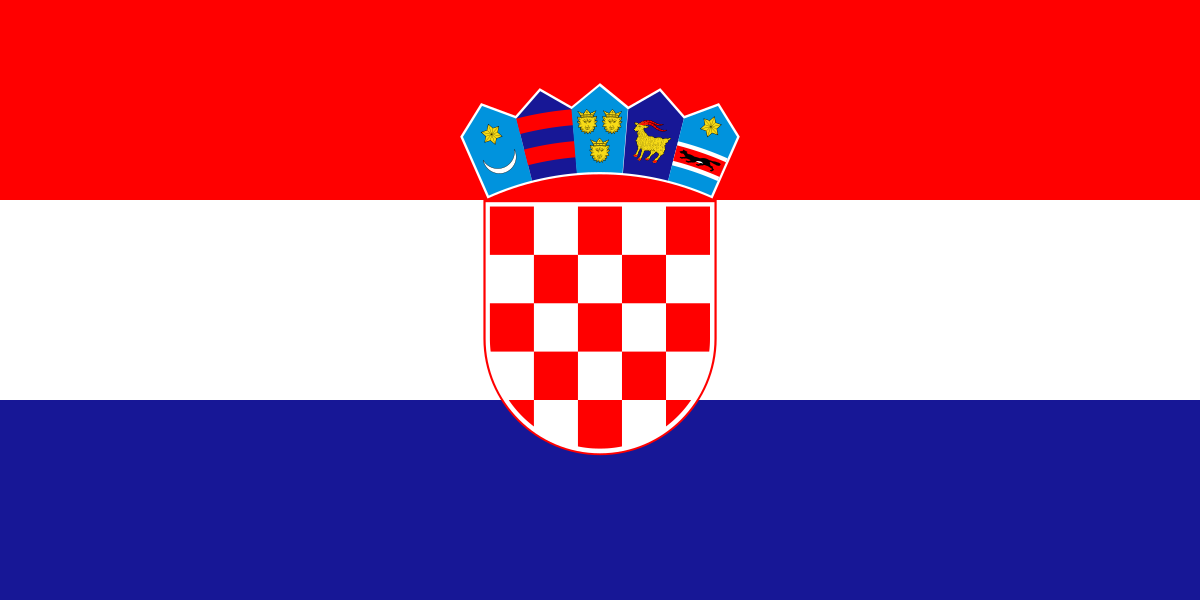
He was born in Kumrovec to a Croat father, Franjo Broz, and a Slovene mother, Marija, and identified as a Croat like his father and neighbours. Wounded and captured by Russian forces while serving as an Austro-Hungarian Army sergeant major in the First World War, he joined the Communist Party in Omsk in 1920 and led the Communist Party of Yugoslavia as General Secretary from 1939. Appointed commander-in-chief of the Partisans in 1941, he led the national liberation struggle through the Second World War and then headed the Yugoslav federation until his death on 4 May 1980 at Ljubljana Medical Centre. After the 1948 Cominform rift, tens of thousands accused of Stalinism were held in forced labour camps such as Goli Otok, where hundreds died.
Career timeline
- 1941–1945Leader of the Yugoslav Partisans and national liberation struggle
- 1945–1980Leader of socialist Yugoslavia
- 1948Break with Stalin and the Cominform
A leader caught between revolutionary national politics and party centralism
After the 1948 break with the Soviet Union, he was arrested as a Soviet spy and disappeared from a Belgrade prison.
Andrija Hebrang was a Yugoslav communist revolutionary and wartime leader of the Communist Party of Croatia who helped organize resistance to occupation and political institutions in liberated territory. After the war he directed economic reconstruction and a heavy-industry development plan, becoming one of Yugoslavia’s most influential figures after Tito. Tensions over Croatian political autonomy and economic strategy brought him into conflict with the party center. After Yugoslavia’s 1948 break with the Soviet Union, he was accused of links to Soviet intelligence, expelled and arrested, and disappeared from a Belgrade prison in 1949.
Career timeline
- 1919Joined the Communist Party of Yugoslavia
- 1925–1928Worked in the Zagreb party organization
- 1941–1944Political secretary of the Central Committee of the Communist Party of Croatia
- 1943–1944Member of the Politburo of the Communist Party of Yugoslavia
- 1944–1946Worked in AVNOJ and administered industry and trade
- 1946–1948Chairman of the Economic Council and Planning Commission
- 1948Expelled from the party, placed under house arrest and arrested
- 1949Disappeared from a Belgrade prison and was recorded as dead
A Stalin supporter at the heart of Tito’s party
At the April 1948 Central Committee meeting, he opposed Tito’s reply to Moscow.
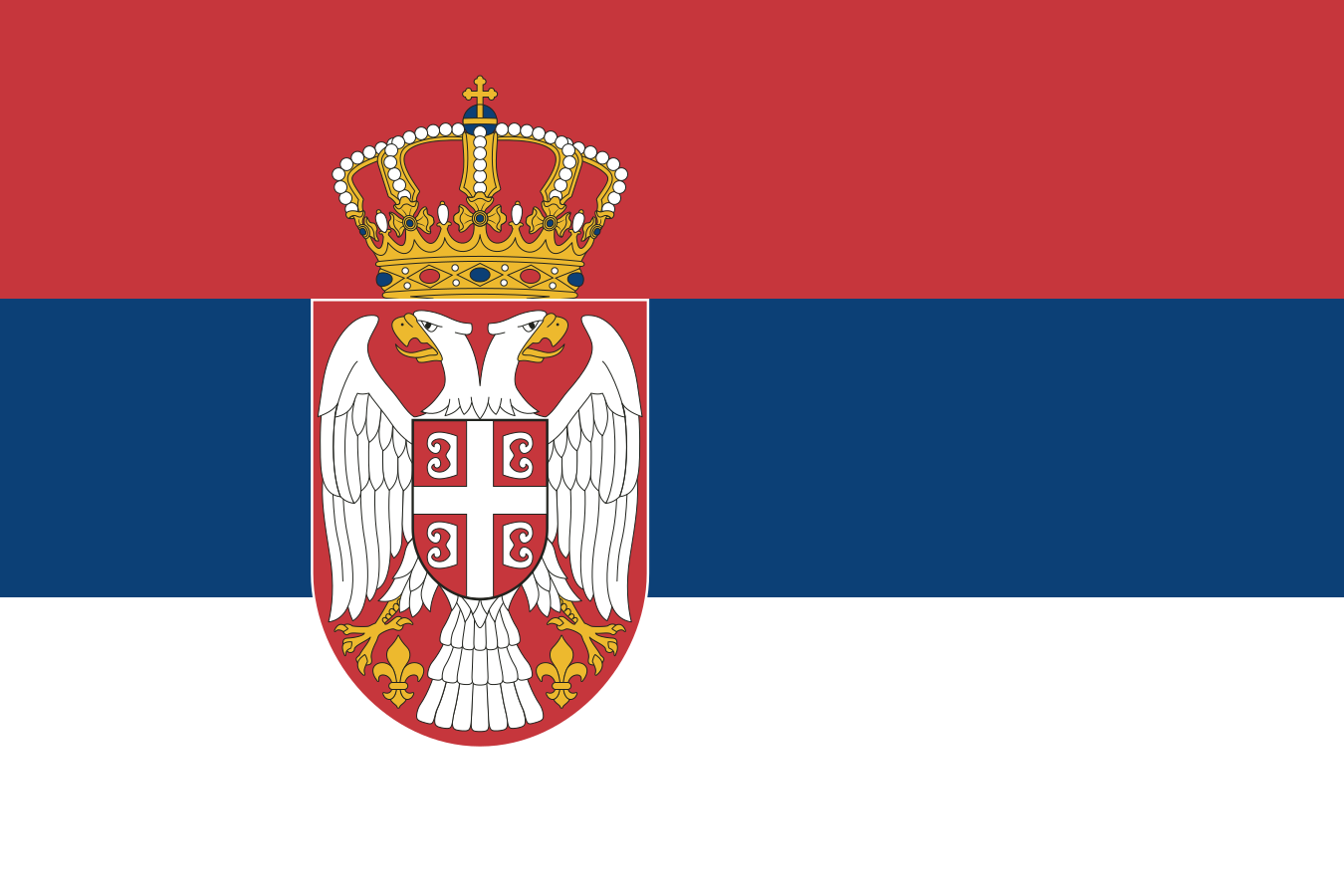
Sreten Žujović was a Serb Yugoslav communist and labour organiser who passed through the First World War and the Yugoslav Partisan struggle. He helped organise the wartime uprising, served with the Supreme Headquarters, and became finance minister after liberation. In the 1948 conflict between Tito and Stalin, he defended the Soviet line as the sole dissenter at the decisive Central Committee meeting, and was removed from the party and office and imprisoned. Released after a public self-criticism in 1950 and later readmitted, he embodied the fracture between revolutionary internationalism and Yugoslav autonomy.
Career timeline
- 1918–1924Labour movement and trade-union organiser after the war
- 1924–1933Joined the Communist Party of Yugoslavia and worked as a party organiser
- 1938–1940Member of the Central Committee of the Communist Party of Yugoslavia
- 1941–1944Partisan command and Supreme Headquarters work in Serbia and Yugoslavia
- 1945–1947Federal Minister of Finance of Yugoslavia
- 1948Supported the Cominform line during the Tito–Stalin split
- 1948–1950House arrest and imprisonment, released after self-criticism
- 1950–1971Readmitted to the party; executive at Borba and an economic institute
The staff officer who organized the Partisan war
In August 1948, his wartime career ended at the border as he tried to reach Romania.
Arso Jovanović was a highly educated officer of the Royal Yugoslav Army who became chief of staff of the Partisan Supreme Headquarters and exercised major operational authority during the Second World War. He became the first Chief of the General Staff of the postwar Yugoslav Army, but sided with the Soviet position in the 1948 Tito–Stalin split and was politically isolated. He died while attempting to cross into Romania, although the official border account and later testimony have left the circumstances contested.
Career timeline
- 1925–1928Cadet, Royal Military Academy lower school, Belgrade
- 1932–1934Student, Royal Military Academy higher school
- 1939Published Tactics of the Infantry Battalion; instructor and commander at the Infantry School
- 1941Commander, Provisional Supreme Command of the Montenegrin uprising
- 1942–1945Chief of Staff, Supreme Headquarters of the Yugoslav Partisan forces
- 1945First Chief of the General Staff of the Yugoslav Army
- 1946–1948Studied at the Voroshilov Higher Military Academy in Moscow
- 1948Supported the Informbiro Resolution; killed while attempting to escape to Romania
Yugoslav partisan-diplomat whom Stalin named a British spy to break off correspondence
Stalin wrote in his March 27, 1948 letter: 'We do not understand why the British spy Velebit continues to remain in the Yugoslav Ministry of Foreign Affairs as the First Deputy Minister.'
A Yugoslav lawyer turned Partisan general and diplomat who served as the Partisans' liaison to Allied military missions during the war and as First Deputy Foreign Minister afterward, negotiating with the Western powers. In his March 27, 1948 letter Stalin singled out Velebit as a 'British spy' and used his continued presence in the foreign ministry as justification for breaking off frank diplomatic correspondence, making the accusation one of the triggers of the Tito-Stalin split. Forced to resign, he was later rehabilitated, serving as ambassador to Rome and London and as Executive Secretary of the UN Economic Commission for Europe, embodying Yugoslavia's independent course through the Cold War.
Career timeline
- 1933PhD in law, University of Zagreb
- 1939Met Tito in Istanbul, joined the KPJ
- 1942–1943Liaison to Allied military missions, Partisan Supreme Command
- 1945–1948First Deputy Foreign Minister of Yugoslavia
- 1951–1952Yugoslav Ambassador to Italy
- 1952–1956Yugoslav Ambassador to the United Kingdom
- 1960–1967Executive Secretary, UN Economic Commission for Europe
Tito's third man, who directed the Cominform purges
Interior minister Ranković wrote after the 1948 split that 'it was impossible to know whom to trust and that one's closest comrades may now be the enemy.'
A Yugoslav communist leader regarded as the third most powerful figure after Tito and Kardelj. In May 1944 he created OZNA, the Partisan security agency; after the war he headed the interior ministry and the State Security Administration (UDBA) and oversaw the anti-Stalinist purges that followed the 1948 Soviet–Yugoslav split, building special camps for Cominformists on Goli Otok and Sveti Grgur in 1949. In Kosovo, the period 1947–1966 is colloquially called 'the Ranković era' for a police-state repression of Albanians; lesser campaigns targeted Hungarians in Vojvodina and Muslims in Sandžak. He opposed federal decentralization and defended centralism, and in 1966 the Brioni plenum removed him from all posts and expelled him from the party. He died in Dubrovnik in 1983.
Career timeline
- 1928Joined the Communist Party of Yugoslavia
- 1929–1935Arrested and imprisoned for communist activity
- 1941–1945Served on Partisan Supreme Staff; founded OZNA (1944)
- 1946–1953Minister of Interior of Yugoslavia and head of UDBA
- 1948–1955Directed anti-Cominform purges; built the Goli Otok camp
- 1963–1966Vice President of Yugoslavia
- 1966Dismissed from all posts at the Brioni plenum; expelled from the party
Chief theoretician of workers' self-management and Tito's closest ideological collaborator
If the workers' parties drown in parliamentarism, everything is done for.
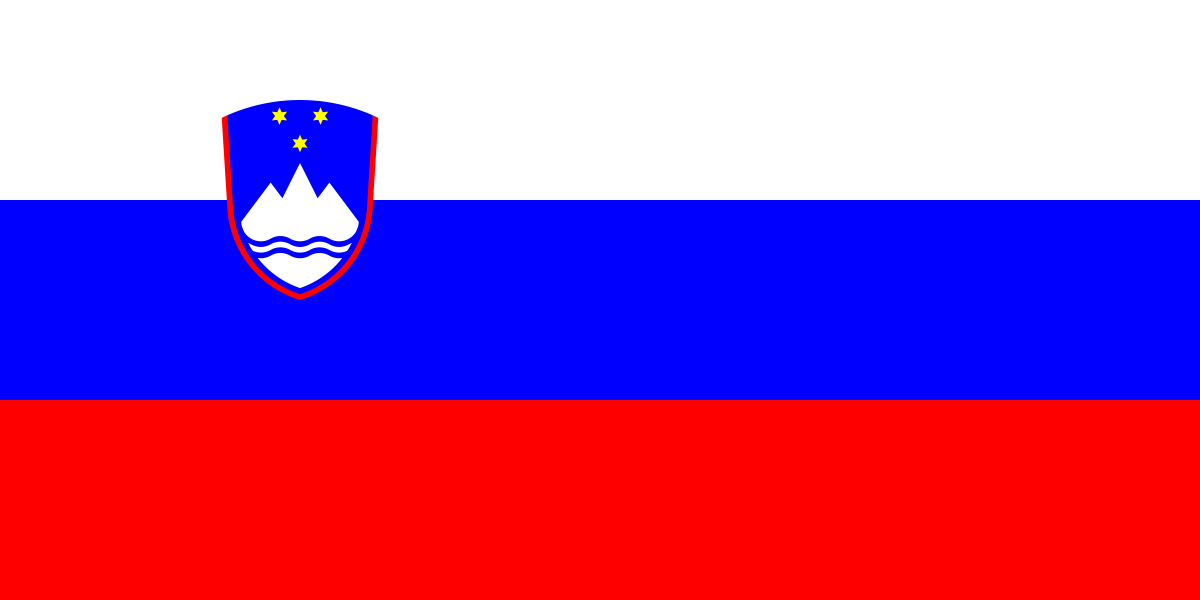
A Slovene communist leader and the chief theoretician of Titoism, he was the principal architect of Yugoslavia's system of workers' self-management. At the founding conference of the Cominform in 1947, he joined Milovan Đilas in delivering the sharpest criticism of the French and Italian Communist Parties for their 'parliamentary illusions' and failure to seize power in 1944–45. After the Tito-Stalin split of 1948, he theorized a decentralized self-management model distinct from Soviet state socialism and, as the main author of the 1974 Yugoslav Constitution, greatly expanded the autonomy of the republics. He remained a central figure in Yugoslavia's collective leadership until his death in 1979, and his constitutional ideas left traces in the successor states after the federation's dissolution.
Career timeline
- 1937–1941Leadership of the Communist Party of Slovenia
- 1941–1945Leadership of the Slovenian Liberation Front and Partisans
- 1945–1953Vice President of Yugoslavia
- 1948–1953Foreign Minister of Yugoslavia
- 1963–1967President of the Federal Assembly of Yugoslavia
- 1974–1979Member of the Presidency of Yugoslavia
- 1950s–1970sArchitect of workers' self-management theory
A communist leader who negotiated republican interests within federal socialism
In Moscow in February 1948, he was among the delegates who heard Stalin denounce Yugoslavia directly.
Vladimir Bakarić was a leading Croatian communist and a central broker of republican interests in federal Yugoslav politics. He helped organize the Partisan movement and the institutions of liberated Croatia during the Second World War, then directed Croatia’s state and party apparatus after the war. In February 1948 he was sent to Moscow with Edvard Kardelj and faced Stalin’s pressure directly, later supporting Tito’s independent course. Bakarić advocated stronger republican powers and self-management socialism, while exercising influence as a cautious leader whose authority remained tied to Tito and the Party’s power structure.
Career timeline
- 1932–1935Joined the revolutionary workers’ movement at Zagreb University and the Communist Party of Yugoslavia in 1933
- 1941–1943Political commissar in the Croatian Partisan liberation movement
- 1944–1969Top leader of the Communist Party and League of Communists of Croatia
- 1945–1953President of the Executive Council of the People’s Republic of Croatia
- 1948Sent to the Moscow meeting with Edvard Kardelj
- 1953–1963Speaker of the Croatian Parliament
- 1974–1983Member of the Presidency of the Socialist Federal Republic of Yugoslavia
A Partisan commander who helped turn insurgent formations into a regular army
On 20 October 1944, Yugoslav and Soviet forces under Dapčević's command entered Belgrade.
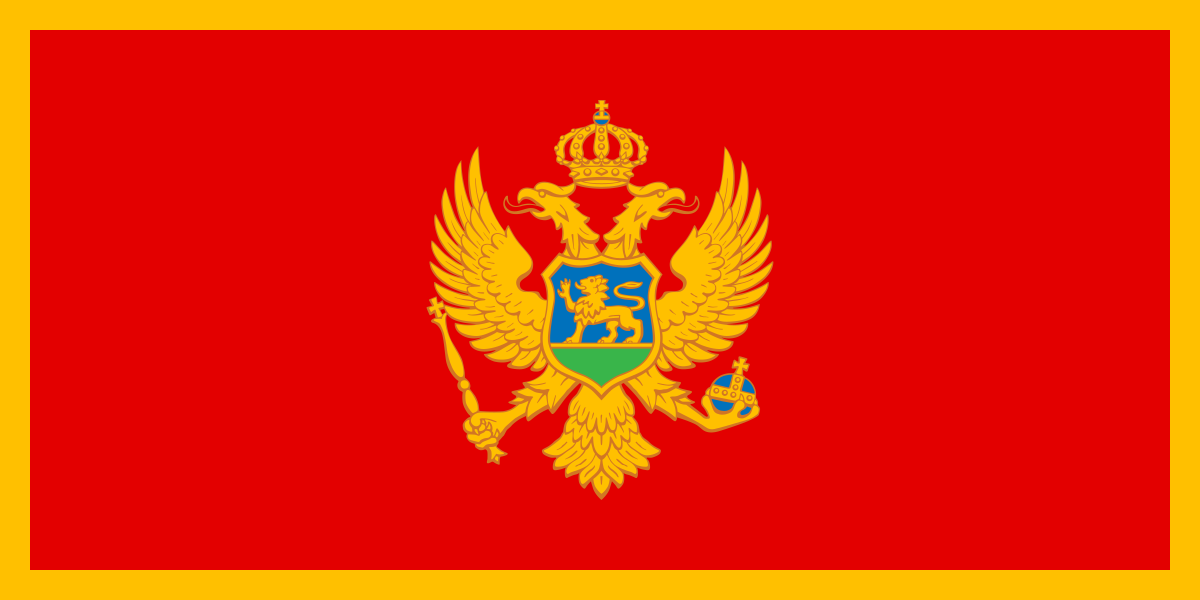
Peko Dapčević was a Montenegrin-Yugoslav communist commander shaped by service in the Spanish Civil War and the Yugoslav People's Liberation War. Rising from the Montenegrin uprising, he commanded divisions and corps before leading the First Army Group alongside Soviet forces in the liberation of Belgrade in 1944. As commander of the First Army in 1945, he directed the breakthrough of the Syrmian Front and the transition from wartime formations to a regular postwar army, later serving as Chief of the General Staff. His career shows both the military capacity of the revolutionary movement and the political tensions of turning it into a state institution.
Career timeline
- 1937–1939Volunteer and company commander, International Brigades of the Spanish Republican Army
- 1941Commander, Lovćen Partisan Detachment, Montenegrin uprising
- 1942Commander, 4th Montenegrin Proletarian Shock Brigade
- 1942–1943Commander, 2nd Proletarian Division
- 1943–1944Commander, 2nd Shock Corps
- 1944Commander, First Army Group, Belgrade operation
- 1945–1949Commander, First Army, then Inspector General of the Yugoslav Army
- 1953–1955Chief of the General Staff, Yugoslav People's Army
 1892–1943
✕ Killed in action
1892–1943
✕ Killed in action