Yomut Turkmen chief who held real power in the Khanate of Khiva in 1918–1920 and fought Soviet rule for more than a decade
Born in 1857 (some sources say 1862), the son of a Yomut Turkmen chief, he served as a village judge (kazi) and water distributor (mirab) and made his name in the Turkmen uprisings of 1912–1916. Appointed commander of the armed forces of Khiva by Asfandiyar Khan in January 1918, he had the khan assassinated, installed the khan’s uncle Sayyid Abdullah as a puppet and took real power. He besieged Petro-Alexandrovsk in November 1918 and in 1919 opened contact with Kolchak’s government, but in early 1920 the Red Army defeated him and he retreated into the Karakum desert. He then repeatedly invaded the Khorezm People’s Soviet Republic and the Turkmen SSR, besieging Khiva in January 1924. He went into exile in Persia and Afghanistan and died near Herat in 1938.
Career timeline
1912–1916Leader in the Turkmen uprisings
1918Commander of the armed forces of the Khanate of Khiva
1918–1920De facto ruler of the Khanate of Khiva
1920–1931Basmachi leader operating from the Karakum, Persia and Afghanistan
An authoritarian state-builder who made sovereignty his political principle
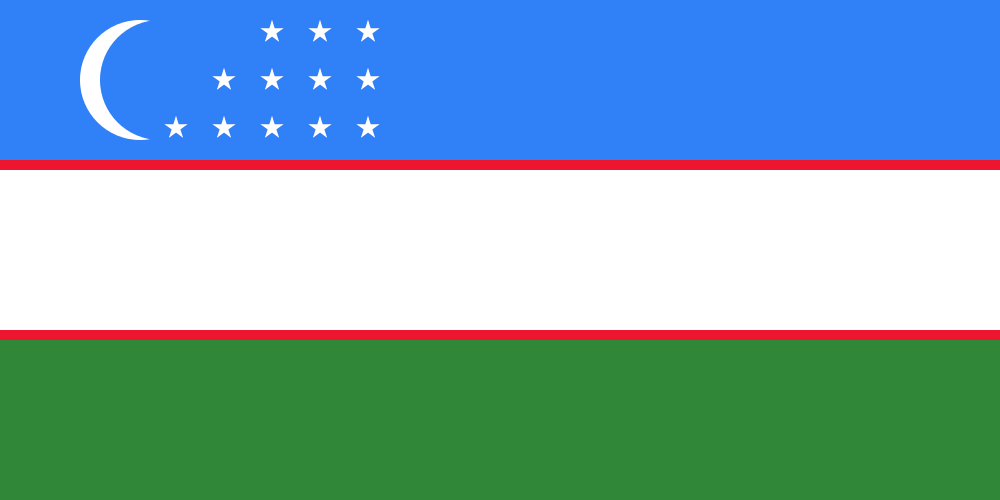
Uzbekistan voted to remain in the Union in 1991, yet Karimov declared independence later that same year.
Islam Karimov was a politician who moved from economic administration in the Soviet system to become Uzbekistan’s first president. During the negotiations over the Union’s future, he placed Uzbekistan’s sovereignty and freedom of choice above preserving a common Soviet state, and after independence made that principle central to state-building. His government pursued industrial capacity and political consolidation, but hardened into authoritarian rule that restricted opposition and the press and responded harshly to Islamist movements and mass protest. Karimov is therefore remembered both as the founder of a sovereign post-Soviet Central Asian state and as a ruler who sacrificed political pluralism to preserve it.
Career timeline
1960–1966Mechanical engineer in Tashkent machinery and aircraft production
1966–1983Economic official in the Uzbek SSR State Planning Committee
1983–1986Minister of Finance of the Uzbek SSR
1986Chairman of the Uzbek SSR State Planning Committee and deputy chairman of its Council of Ministers
1986–1989First secretary of the Communist Party committee in Kashkadarya Region
1989–1991First secretary of the Central Committee of the Communist Party of Uzbekistan
1990–1991President of the Uzbek SSR
1991–2016First President of Uzbekistan
1991–1996Chairman of the People’s Democratic Party of Uzbekistan