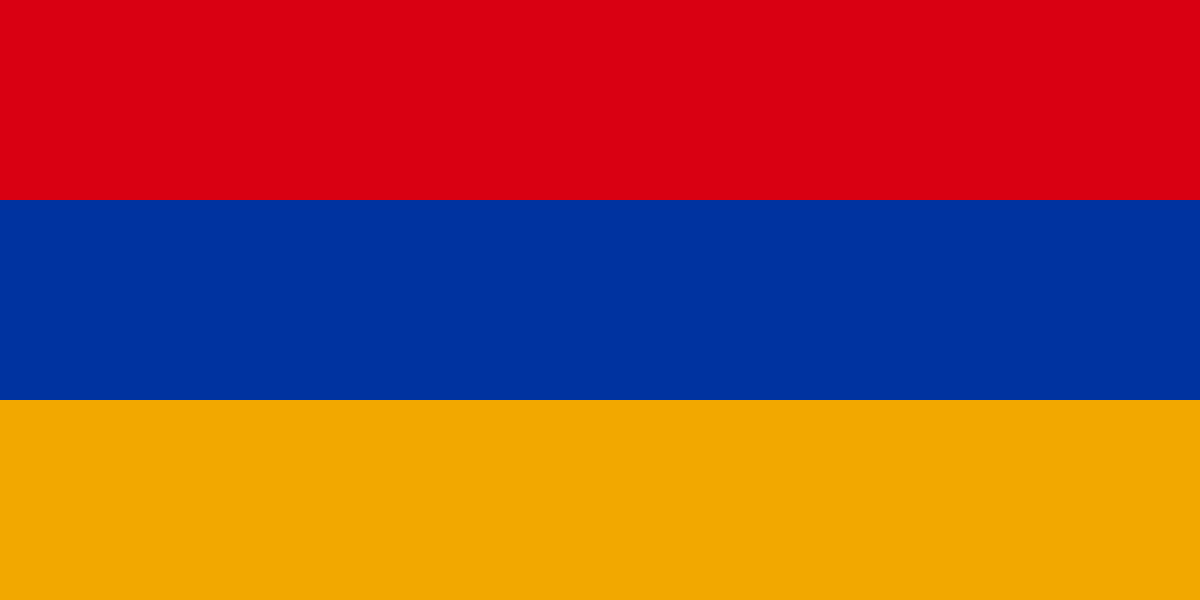
Dashnak foreign minister and prime minister of the First Republic of Armenia who signed the treaties of Batum and Alexandropol
Born in Tbilisi in 1874 to a prominent Armenian family of noble origins, he trained as a doctor, was mayor of Tbilisi from 1910 to 1917 and in 1914 organized the Armenian volunteer detachments. He joined the Dashnaktsutyun in 1917. As foreign minister of the Republic of Armenia he signed the Treaty of Batum in June 1918, and he was prime minister from May 1919 until he resigned after the May Uprising of 1920. On 3 December 1920 a delegation led by him signed the Treaty of Alexandropol with Kâzım Karabekir, but power had already passed to the Soviet authorities and the treaty is held to be invalid. He went into exile in Paris and died there in 1945.
Career timeline
- 1910–1917Mayor of Tbilisi
- 1917Joined the Dashnaktsutyun
- 1918Foreign minister of Armenia; signed the Treaty of Batum
- 1919–1920Prime minister of Armenia
- 1920Signed the Treaty of Alexandropol
- 1921–1945Exile in Paris
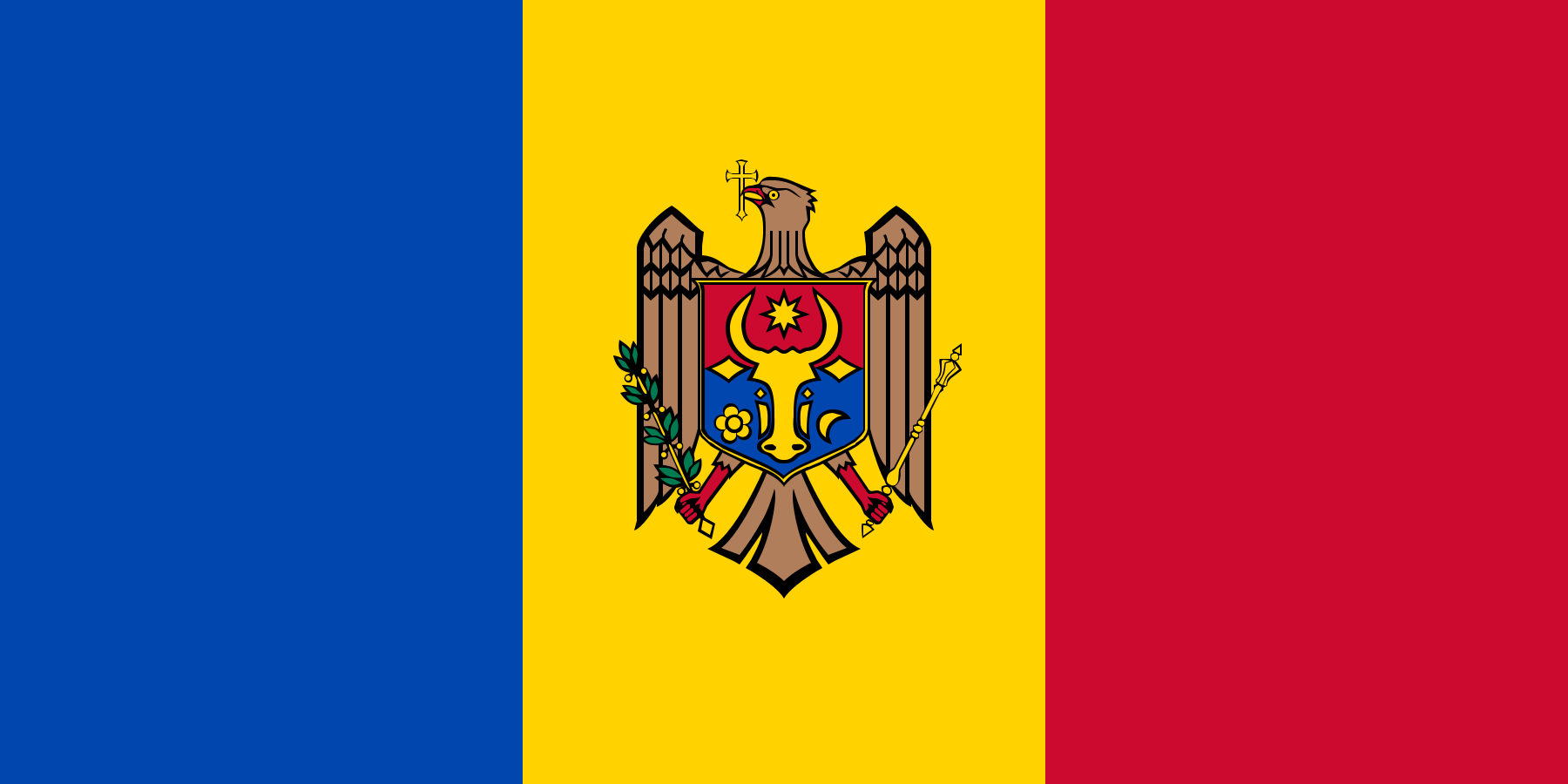
Veteran of the Bessarabian national movement who, as foreign minister of the Moldavian Democratic Republic, championed union with Romania
Born in Răzeni, Bessarabia, in 1876, he graduated from the Chișinău seminary in 1898 and in law from the University of Dorpat in 1903. Arrested as a student for founding an association of Bessarabian students, he later worked as a deputy judge in Bălți and created the town’s first national group. He joined the National Moldavian Party in 1917 and initially won a majority for president of Sfatul Țării, but the post went to Inculeț. As foreign minister in the Erhan and Ciugureanu cabinets in 1917–1918 he sought military aid from Shcherbachev in Iași and campaigned for union. He then served as Minister of Justice under Vaida-Voevod, worked in Paris, London and Geneva for recognition of the union and sat in parliament for the National Party and the National Peasants’ Party. Arrested by the communist authorities in 1950, he died in Sighet Prison in 1954.
Career timeline
- 1903Law degree, University of Dorpat
- 1917–1918Director General for Foreign Affairs of the Moldavian Democratic Republic
- 1919–1920Romanian Minister of Justice (Vaida-Voevod cabinet)
- 1927–1936Head of the Bessarabian branch of ASTRA
- 1950–1954Imprisoned in Sighet Prison
Chairman of the Rada of the Belarusian People’s Republic from 1919 until his death, leading it in exile from Prague
Born in 1879 into the family of a village church deacon in the Grodno Governorate, he graduated from the seminary in Vilnius, worked as a teacher and from 1909 was employed at the Vilnius State Bank. In 1917, as chairman of the Borisov Soviet of Workers’ and Soldiers’ Deputies, he was a delegate to the First All-Belarusian Congress and joined its executive committee. In 1918 he was state controller and then secretary for finance and for trade in the People’s Secretariat, and became one of the leaders of the Socialist Federalist party. He became chairman of the Rada on 13 December 1919, went into exile in 1920 and represented the Rada from Kaunas and Berlin and, from 1923, Prague. In 1921 he organised a conference in Prague that condemned the Peace of Riga, and in 1925 he refused to accept the decision to dissolve the government in exile. He died in Prague in 1928.
Career timeline
- 1902Graduated from the Vilnius seminary; teacher
- 1909Employee of the Vilnius State Bank
- 1917Chairman of the Borisov Soviet of Workers’ and Soldiers’ Deputies
- 1918State controller, then secretary for finance and for trade in the People’s Secretariat
- 1918Secretary of the Rada of the Belarusian People’s Republic
- 1919–1928Chairman of the Rada of the Belarusian People’s Republic
- 1926Editor of the almanac Zamiežnaja Biełaruś
Historian who headed the government of the Belarusian People’s Republic in exile, moved to Soviet Byelorussia and was executed
Born into a landless noble family in the Disna district of the Vilna Governorate in 1883, he had almost no formal schooling. He was active in the Hramada in 1906–1908, was editorial secretary of Nasha Niva and from 1915 openly advocated independence from both Russia and Poland. In 1918 he joined the Rada as a delegate of the Belarusian Council of Vilnius, and in 1919 he led the Belarusian Socialist Revolutionaries. Appointed prime minister in December 1919, he was soon arrested by the Polish authorities; released the following year, he went to Riga and toured European capitals seeking recognition until he stepped down in 1923. In 1927 he moved to Soviet Byelorussia, where he became director of the State Museum and a member of the Academy of Sciences, but he was arrested in 1930, exiled to Saratov and shot in 1938.
Career timeline
- 1909Editorial secretary of Nasha Niva
- 1918Member of the Rada for the Belarusian Council of Vilnius
- 1918Head of the Belarusian representation in Lithuania
- 1919–1923Prime minister of the Belarusian People’s Republic
- 1927–1930Director of the Belarusian State Museum
- 1928Academician of the Belarusian Academy of Sciences
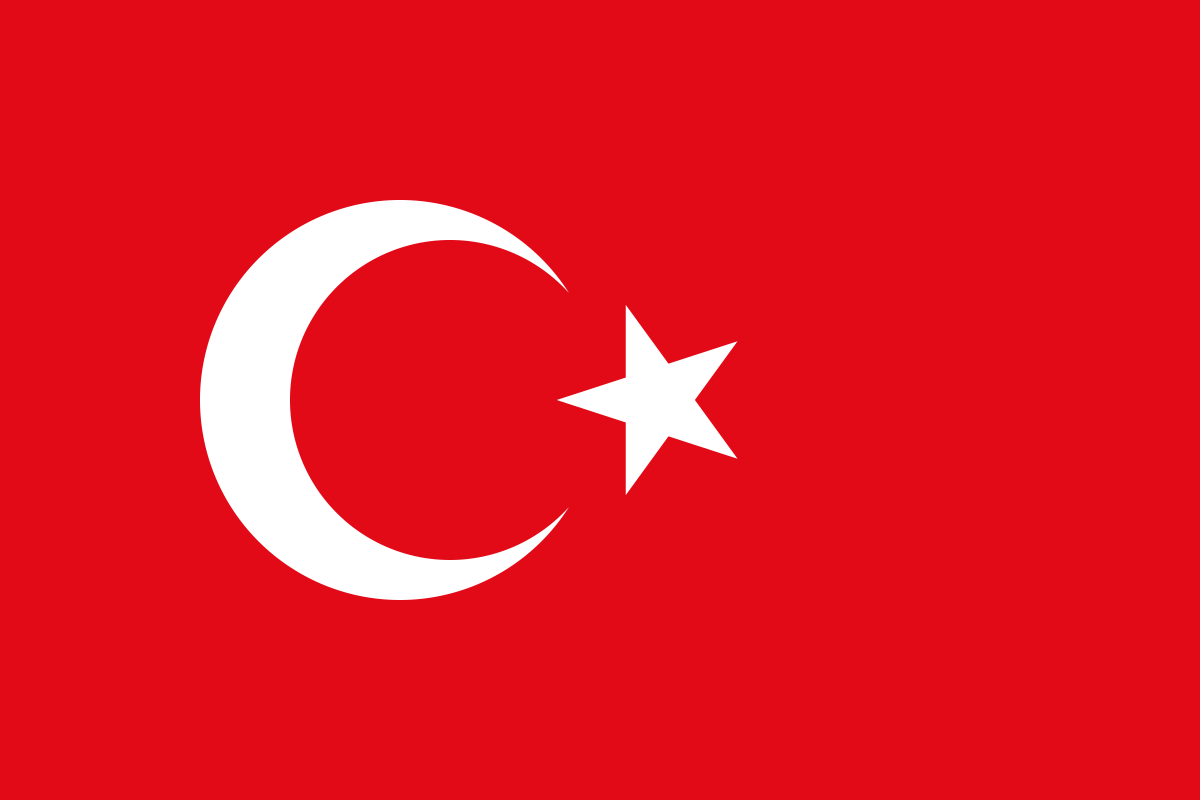
Officer who negotiated the Treaty of Lausanne and succeeded Atatürk as Turkey’s second president
Born in Smyrna, an Ottoman officer, he won the First and Second Battles of İnönü in the War of Independence as chief of the General Staff and commander of the Western Front. As Turkey’s chief negotiator at Lausanne in 1922–1923 he faced down Curzon and replaced the Treaty of Sèvres with the Treaty of Lausanne. As prime minister for most of Atatürk’s presidency he carried out the secularising reforms; after the Sheikh Said revolt he pushed the Turkification of the Kurds, and he is considered one of those responsible for the Dersim massacre. Elected second president in 1938, he took the title “National Chief” and kept Turkey in armed neutrality in the Second World War. After defeat in the 1950 election he handed over power peacefully. He died in 1973.
Career timeline
- 1921First and Second Battles of İnönü
- 1922–1923Chief Turkish negotiator at Lausanne
- 1923–1937Prime minister (twice)
- 1938–1950President of Turkey
- 1961–1965Prime minister
Crimean Tatar politician who ran the military and foreign affairs of the Crimean People’s Republic and led the national movement in exile
Born in 1889 into a family of wealthy peasants in Kizil-Tash in the Yalta district, he met Noman Çelebicihan at the law faculty of Istanbul University. After publishing The Oppressed Crimean Tatar Nation in the 20th Century in 1911 he escaped arrest by studying in Paris, and on his return in 1914 he went through cadet school and became an ensign. In 1917 he briefly edited Millet and became director of military and foreign affairs in the Directory set up by the Qurultay. Driven out by the Bolsheviks in January 1918, he fled to Kyiv; under the German occupation he became foreign minister of Sulkiewicz’s Crimean Regional Government and sought recognition of its independence in Berlin. After the German withdrawal he went to Istanbul, founded the newspaper Emel and supported Prometheism. He took the surname Kırımer in 1934 and died in Istanbul in 1960.
Career timeline
- 1911Published The Oppressed Crimean Tatar Nation in the 20th Century
- 1914Graduated from cadet school; commissioned as an ensign
- 1917–1918Director of military and foreign affairs, Directory of the Crimean People’s Republic
- 1918Foreign minister of the Crimean Regional Government
- 1918–1960Led the Crimean Tatar émigré movement from Istanbul and Europe
Wartime prime minister who declared war on the Soviet Union over the Kassa bombing and approved the deportation of Jews
A lawyer and diplomat from Szombathely, he moved to the foreign ministry in 1922 and headed its press department. He became foreign minister in January 1941 and, after Teleki’s suicide in April, prime minister as well. Seeking to regain lands lost at Trianon, he followed a pro-German line, joined the invasion of Yugoslavia, declared a state of war with the Soviet Union without parliament’s consent after the Kassa bombing in June, and took Hungary into war with Britain and the United States. He pushed through the deportation of “alien” Jews and the Third Jewish Law, and Horthy forced him out in March 1942. Sentenced to death by a People’s Court after the war, he was shot in January 1946.
Career timeline
- 1913–1922Official, Ministry of Culture and Education
- 1922–1941Press chief and diplomat, foreign ministry
- 1941Foreign minister
- 1941–1942Prime minister and foreign minister; war on the USSR
- 1945–1946Sentenced by a People’s Court and executed
Lithuanian officer and envoy in Berlin who founded the Lithuanian Activist Front behind the June Uprising of 1941
Mobilised into the Imperial Russian Army in the First World War, he was the first to enlist in the Lithuanian armed forces after independence in 1918, and on 1 January 1919 his men raised the Lithuanian flag over Gediminas’ Tower in Vilnius. He became Chief of the General Staff in 1925 but had to resign after opposing the 1926 coup. He was envoy to Germany in 1927–1930 and 1938–1941. After the Soviet occupation of 1940 he founded in Berlin the Lithuanian Activist Front, which sought to restore independence by working with the Nazis; named prime minister of the provisional government in 1941, he was held under house arrest by the Germans. In 1944 he was arrested for a memorandum demanding a Lithuanian government. After the war he settled in the United States, working at the Library of Congress. His antisemitic writings have made dedications in his honour controversial.
Career timeline
- 1919Raised the flag over Gediminas’ Tower
- 1925–1926Chief of the Lithuanian General Staff
- 1938–1941Envoy to Germany
- 1940–1941Founded the Activist Front; named provisional prime minister
- 1949Emigrated to the United States