The Menshevik statistician who designed Gosplan's early control figures and balance method, leading voice of genetic planning
December 27, 1929, at the All-Union Conference of Marxist Agrarians. Stalin, from the rostrum, aimed directly at Groman's theory that 'the October Revolution gave the peasantry less than the February Revolution.' When a voice from the audience asked 'Who was it?' Stalin answered: 'It was Groman.' In that moment, genetic planning received its political death sentence.
Statistician and economist, born in Moscow to a German father and Russian mother. Joined the RSDLP in 1898 as a Menshevik, co-authoring the agrarian program; as head of the Penza statistical bureau he developed a multi-phase sampling method. After the February Revolution he chaired the Petrograd food-supply commission, and in 1921 joined Gosplan where he headed the Conjunctural Institute, designing the first Control Figures and the balance method. With Bazarov he championed the genetic planning approach; after Stalin's public condemnation he was arrested in 1930 and as lead defendant in the 1931 Menshevik Trial received ten years, dying in the Suzdal camp.
Career timeline
1894–1908Entered Moscow University; expelled for revolutionary activity; graduated externally 1908
1898–1905Joined RSDLP; stayed Menshevik after 2nd Congress; co-authored agrarian program; began statistical work in exile in Vyatka and Yenisei
1909–1914Headed Penza provincial statistical bureau; developed multi-phase sampling method for peasant household surveys
1917–1918After February Revolution: chairman of Petrograd Soviet food commission and Central Food Administration; after October: Northern Regional Food Administration head
1921–1926Headed Gosplan's Conjunctural Institute; designed first Control Figures and the balance method; formulated 'restorative growth' concept
1926–1929Chaired Gosplan agricultural section; with Bazarov championed genetic planning; publicly condemned by Stalin at All-Union Conference of Marxist Agrarians
1930–1940Arrested in 'Union Bureau of Mensheviks' case; 1931 trial: 10 years; died in Suzdal ITL 1940; rehabilitated 1991
The labour commissar who steered the statification of Soviet trade unions
Arthur Ransome met him soon after his December 1918 appointment and described "a clean-shaven, intelligent young man, whose attention to business methods is reflected in his Commissariat"; Schmidt said the commissariat was controlled directly by the unions.
Born in Saint Petersburg on 17 (29) December 1886, the son of a domestic servant, and listed as German in the Russian-language biography. He joined the RSDLP in 1905 as a railway fitter, worked as a painter in German emigration from 1907 to 1911, and from 1915 served as secretary of the Petrograd committee. After February 1917 he was secretary of the Petrograd Party Committee and the Central Council of Trade Unions and a member of the Military Revolutionary Committee, and was appointed People's Commissar for Labour in November 1917, serving until 1928. He was Deputy Chairman of the USSR Council of People's Commissars from 1928 to 1930; arrested in January 1937, sentenced to death by the Military Collegium on 28 January 1938 and shot the same day, and rehabilitated on 30 July 1957.
Career timeline
1905Joined RSDLP; railway fitter
1907–1911Exiled in Germany; worked as a painter
1912–1914Secretary, Petersburg Union of Metalworkers
1915–1916Secretary, Petrograd Committee of RSDLP(b); repeatedly arrested
1917.02–10Secretary of Petrograd Party Committee & Central Trade Union Council; member of Milrevcom
1917–1918Deputy People's Commissar for Labour, RSFSR
1918–1928People's Commissar for Labour (RSFSR, then USSR from 1923); Presidium member & secretary, AUCCTU
1928–1930Deputy Chairman, Sovnarkom & STO USSR
1930–1931Deputy People's Commissar for Agriculture, USSR
1931–1933Chief Arbitrator, Sovnarkom USSR
1933–1937Chairman, Primorye Regional Planning Commission; local economic posts
The West German economic statesman who shaped currency reform and the social market economy
On 21 June 1948, he announced by radio the abolition of price controls and compulsory rationing for selected manufactured goods.
Ludwig Erhard was an economist and politician who conceived West Germany’s postwar order as a combination of competitive markets and social security. As director of the Bizonal Economic Administration in 1948, he helped prepare monetary reform and, alongside the introduction of the Deutsche Mark, began a staged relaxation of price and production controls that opened the institutional path to recovery. He is often mythologized as the sole architect of the economic miracle, although Allied reform, international conditions, and the recovery of production by workers and firms all mattered, while price liberalization initially raised living costs and provoked working-class resistance. As economics minister and later chancellor, he helped make that order part of West Germany’s political identity, but resigned in 1966 amid recession and the collapse of his coalition.
Career timeline
1919–1922Studied business administration at Nuremberg Business School
1925Received a doctorate in economics from Frankfurt University
1947Led the Bizonal Special Office for Money and Credit
1948–1949Director of the Bizonal Economic Administration
1949–1963West German Federal Minister of Economics, also Vice-Chancellor from 1957
1963–1966Second Federal Chancellor of West Germany
1966–1967Chairman of the Christian Democratic Union
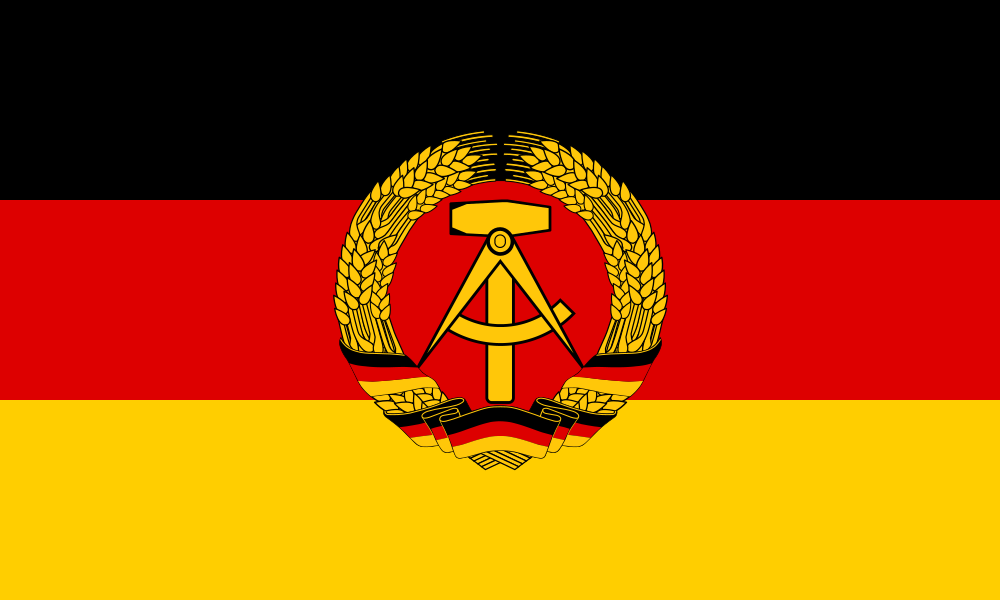
Communist who chaired the German Economic Commission, the forerunner of the GDR government, and led East German economic policy
Born in Feuerbach near Stuttgart, he worked as a metal presser at Bosch and passed through the Spartacists and the USPD into the KPD in 1919, becoming the party’s leading agricultural policy maker in the 1920s. Imprisoned after the Nazis came to power, he emigrated to the Soviet Union and in the Spanish Civil War commanded the XI International Brigade. Interned in France and handed to the Gestapo by Vichy in 1942, he was liberated at Mauthausen. In March 1948 he became chairman of the German Economic Commission (DWK), which carried out the eastern currency reform and the first plans. In the GDR he was a Politburo member, deputy prime minister and chairman of the State Planning Commission; at the Politburo session of 8 July 1953 he recommended replacing Ulbricht, yet kept his posts. Minister of Machine Construction and then of Foreign Trade, he died of a heart attack in 1961.
Career timeline
1919Joined the KPD
1923Head of the KPD agricultural division
1937–1938Commander of the XI International Brigade
1943–1945Mauthausen concentration camp
1948–1949Chairman of the German Economic Commission
1950–1961SED Politburo member; deputy prime minister
1955–1961Minister of Foreign and Inter-German Trade
East German heavy-industry minister who faced the striking workers outside the House of Ministries on 16 June 1953
The son of a coppersmith from Lauterbach in Hesse, he was working underground at seventeen, served in the First World War and in 1918 sat on a soldiers’ council. He joined the USPD in 1920 and the KPD in 1922, becoming the party’s political secretary in Saxony and a Reichstag deputy. Arrested in 1933, he survived the Nazi years in prisons and in concentration camps including Sachsenhausen and Flossenbürg. After the war he was Saxony’s minister for economics and planning, then deputy chairman of the German Economic Commission, and in the GDR minister of industry and of heavy industry. On 16 June 1953 he walked into the crowd outside the House of Ministries and tried to address it from a desk, but was whistled down. In 1958 Ulbricht pushed him out of his offices for a “deviant attitude”, and he turned to writing. He died in East Berlin in 1975.
Career timeline
1922Joined the KPD
1932–1933Reichstag deputy
1933–1945Imprisoned; held in Sachsenhausen and Flossenbürg
1948–1949Deputy chairman of the German Economic Commission
1949–1955Minister of Industry, then of Heavy Industry
East German planner who ran planning in the German Economic Commission and then chaired the State Planning Commission
A shoemaker’s son from Rixdorf, Berlin, he worked as a clerk, studied economics at night and joined the KPD in 1931. Under the Nazis he worked for the illegal paper “Der Rote Wedding” and the party’s military intelligence apparatus until his arrest in 1936; sentenced to six years in prison, he was then held in Sachsenhausen and Mauthausen until 1945. After the war he built up and headed the KPD’s economic department, and from 1947 played a major part in creating the German Economic Commission, where he took charge of planning and drew up the half-year plan of 1948 and the two-year plan of 1949/50. He succeeded Heinrich Rau as chairman of the State Planning Commission (1952–1961), joined the Politburo in 1958 and was deputy premier from 1955 to 1965. Removed as planning chief in 1961, he became the GDR’s permanent representative to Comecon. He died in East Berlin in 1965.
Career timeline
1931Joined the KPD
1936–1945Imprisoned; held in Sachsenhausen and Mauthausen
1947–1949In charge of planning at the German Economic Commission
1952–1961Chairman of the State Planning Commission