The premier who held the gallows in one hand and reform in the other
Addressing the Second Duma on 10 May 1907, he declared to the revolutionaries: "You need great upheavals — we need a Great Russia!"
The imperial premier who crushed the 1905 revolution with field courts-martial while breaking up the peasant commune through agrarian reform to build a new base of support for the regime. Assassinated in 1911.
Career timeline
1906Interior Minister, then premier
1906–1907Field courts-martial against the revolution
1906–1911Agrarian reform: exit from the commune, independent farmers
1907.06The June 3 system: a rewritten franchise tames the Duma
SPD politician who proclaimed the republic from a Reichstag window on 9 November 1918 and became Weimar’s first head of government
On 9 November 1918, he proclaimed Germany a republic from a Reichstag window. In June 1919, he resigned as head of government rather than sign the Treaty of Versailles.
A printer from Kassel who became an SPD journalist and Reichstag deputy, he joined Prince Max of Baden’s cabinet in October 1918. On 9 November, hearing that Liebknecht was about to proclaim a socialist republic, he proclaimed a republic first from a Reichstag window, to Ebert’s fury. A People’s Deputy, he became head of government in February 1919 but resigned in June rather than accept the Treaty of Versailles. He was mayor of Kassel in the 1920s, survived a far-right cyanide attack in 1922, went into exile in 1933 and died in Copenhagen.
Career timeline
1903Entered the Reichstag and served in the leadership of the Social Democratic Party (SPD) parliamentary group.
1917Was elected chairman of the SPD.
1918Became vice president of the Reichstag in June and a Social Democratic minister in Max von Baden’s cabinet in October. Proclaimed the republic from a Reichstag window on 9 November and joined the revolutionary provisional government, the Council of the People’s Deputies.
1919Was appointed head of government of the Weimar Republic on 13 February. On 20 June, he refused to sign the Treaty of Versailles and resigned with his cabinet.
Last chancellor of the German Empire, who sought the armistice, announced the emperor’s abdication and handed power to Ebert
On 9 November 1918, as revolutionary demonstrations spread in Berlin, Max von Baden announced the emperor’s abdication and transferred the chancellorship to Friedrich Ebert.
Heir to the grand-ducal house of Baden and a former Prussian army officer, he won moderates’ respect in the war through Red Cross and prisoner-of-war relief work. Chancellor from 3 October 1918, he brought the SPD into government, asked the Allies for an armistice and carried the constitutional amendment that made the Empire a parliamentary monarchy. On 9 November, with Berlin full of demonstrators, he announced the emperor’s abdication without his consent, handed the chancellorship to Ebert and withdrew. In 1920 he founded the Salem boarding school with Kurt Hahn.
Career timeline
1918.10.03Became German Empire chancellor and brought the SPD and other majority-party representatives into the cabinet.
1918.10Sought an armistice from the Allies and advanced constitutional amendments shifting the Empire toward parliamentary government.
1918.11.09Announced the emperor’s abdication and transferred the chancellorship to Friedrich Ebert.
Social Democratic chancellor whose government accepted the Treaty of Versailles under an Allied ultimatum
Born in Darkehmen in the Province of Prussia, he worked as a lawyer’s clerk, co-founded the office employees’ union and was second chairman of the General Commission of Trade Unions from 1908 to 1918. Elected to the Reichstag for the SPD in 1912, he became labour secretary in Max von Baden’s cabinet in October 1918. When Scheidemann resigned in protest at the Treaty of Versailles in June 1919, Bauer, until then a vocal critic of the treaty, succeeded him and got it through the National Assembly. His government carried out tax reform and extended social insurance, but was forced out in March 1920 over the negotiations conducted with the Kapp putschists. He was later vice-chancellor and treasury minister, and the Barmat corruption scandal cost him his seat in 1925. He died in Berlin in 1944.
Career timeline
1908–1918Second chairman of the General Commission of Trade Unions
A Social Democratic politician of the Weimar Republic who served twice as chancellor.
Müller joined the Social Democratic Party in 1893 and rose to its leadership. As foreign minister from 1919 to 1920, he signed the Treaty of Versailles for Germany. His first chancellorship in 1920 combined the suppression of left-wing uprisings with reforms expanding disability employment, primary education, unemployment benefits and workers’ social protection. He returned as chancellor in 1928 to lead a grand coalition, which collapsed amid the Great Depression and disputes over financing unemployment insurance; he resigned in 1930.
Career timeline
1893Joined the Social Democratic Party of Germany.
1916Elected to the Reichstag of the German Empire.
1919–1920Served as foreign minister and signed the Treaty of Versailles.
1920Served as chancellor.
1928–1930Served as chancellor of the grand coalition.
Non-party chancellor who answered the Ruhr occupation with passive resistance and fell amid hyperinflation
Born to a civil servant’s family in Suhl, he studied law and, as a Treasury official, helped organise Germany’s food supply early in the First World War. In 1917 he joined the Hamburg America shipping line, which he went on to head. In November 1922 he was appointed chancellor by presidential decree without a Reichstag vote, the first Weimar chancellor who belonged to no party, and formed a “business ministry”. When French and Belgian troops occupied the Ruhr in January 1923 he called for passive resistance; paying for it, mostly by printing money, began the run-up to hyperinflation. Amid a wave of strikes his cabinet resigned in August in the face of a no-confidence vote initiated by the SPD. In 1932 he joined in advising Hitler on economics, and he died in January 1933.
The chancellor who made provisional statehood durable
As president of the Parliamentary Council, Adenauer helped present the Basic Law as a provisional settlement rather than a final constitution for a divided Germany.
Konrad Adenauer was a Catholic conservative statesman who helped shape the Federal Republic after the collapse of Nazism and the division of Germany. As president of the Parliamentary Council, he supported a provisional Basic Law rather than a permanent constitution, leaving open the possibility of reunification while establishing democratic institutions in the western zones. As the first Federal Chancellor, he pursued Westbindung, European integration, and a socially regulated market economy, while his anti-communist policy hardened the political division of the Cold War. His career thus joined parliamentary reconstruction with the consolidation of a state whose provisional founding became durable.
Career timeline
1906–1909Deputy mayor of Cologne
1917–1933Lord Mayor of Cologne
1921–1933President of the Prussian State Council
1948–1949President of the Parliamentary Council
1949–1963First Federal Chancellor of the Federal Republic of Germany
1951–1955Federal Minister for Foreign Affairs
1950–1966Chairman of the Christian Democratic Union
Weimar finance minister who founded the CDU in the Soviet zone in 1945 and was deposed for opposing the land reform
The son of a Cologne railway worker, he studied agriculture and from 1911 worked at the International Institute of Agriculture in Rome. A member of the Catholic Centre Party, he became Minister of Food in 1920 and was Minister of Finance from 1922 until the Cuno cabinet resigned in August 1923. Arrested after the Nazis took power, he later served as an economic adviser to the government of Colombia. Back in Germany he joined the resistance around Goerdeler, was arrested after 20 July 1944 and sentenced to death in January 1945, but his wife delayed the execution until the Red Army took Berlin. On 26 June 1945 he became the first chairman of the CDU of Berlin and the Soviet zone; because he refused to agree to the land reform without compensation, SMAD deposed him in December. In the West he founded the German Farmers’ Association and argued for reunification.
Career timeline
1911–1914Department director at the International Institute of Agriculture, Rome
1920Reich Minister of Food
1922–1923Reich Minister of Finance
1945Sentenced to death by a Nazi court
1945Chairman of the CDU in the Soviet zone; deposed in December
First woman to lead a Soviet government, between revolution and terminal illness
As German troops advanced on Kyiv, Bosch refused to abandon the city without a fight. Her comrades had to forcibly evacuate her.
A Bolshevik of German settler background, she became the first woman to head a Soviet government as acting leader of Ukraine's People's Secretariat in 1917. In Swiss exile she opposed Lenin on the national question; later she signed the Left Opposition's Declaration of 46. She died in 1925 after years of incurable illness.
Career timeline
1901Joined RSDLP; active in Bolshevik faction after the 1903 split
1907–1911Underground revolutionary work in Kyiv; secretary of the Kyiv Committee
1912–1914Arrested, exiled to Siberia, escaped via Japan and the US to Switzerland
1914–1917Swiss exile; opposed Lenin on the national question in the 'Baugy group'
1917.04–07Chair of South-Western Regional Party Committee; VI Party Congress delegate
1917.12–1918.03Acting head, People's Secretariat of Ukraine; People's Secretary of Internal Affairs
1918–1919Chair of Penza Party Committee; political commissar on Caspian-Caucasus Front
1923–1924Joined the Left Opposition; signed the Declaration of 46
Kaiser’s successor at the head of the East German CDU, who brought it into line with the SED as deputy prime minister
Born in Frohburg in Saxony, he worked as a journalist, moved through the left-liberal parties, helped found the German Democratic Party in 1918, and sat in the Weimar National Assembly and the Prussian Landtag. He joined the opposition after 1933 and went into hiding after the 1944 attempt on Hitler’s life. In 1945 he co-founded the CDU in the Soviet zone; when the Soviet authorities deposed Jakob Kaiser and Ernst Lemmer in 1947 he became acting chairman, and chairman in 1948. As a co-chairman of the German People’s Council he took part in drafting the GDR constitution, and in 1949 became deputy prime minister and head of the Church Office. A loyal supporter of the SED regime, he pushed out CDU members unwilling to follow the Communists. He died in 1957.
Career timeline
1918Co-founder of the German Democratic Party
1921–1933Member of the Prussian Landtag
1945Co-founder of the CDU in the Soviet zone
1948–1957Chairman of the East German CDU
1949–1957GDR deputy prime minister and head of the Church Office
Christian Democrat who led the CDU in the Soviet zone until SMAD removed him, then became West Germany’s minister for all-German affairs
A bookbinder from Hammelburg in Bavaria, he became a leader of the Catholic trade-union movement and was elected to the Reichstag for the Centre Party in 1933. He joined the resistance against the Nazis, was arrested by the Gestapo in 1938, and went into hiding after the 20 July 1944 plot. After the war he co-founded the CDU in the Soviet zone and became its co-chairman with Ernst Lemmer; as a Christian Socialist he called for the nationalisation of key industries. Critical of the Communists, he and Lemmer were removed as chairmen by the Soviet Military Administration in December 1947, and he moved to West Berlin. He opposed Adenauer’s Western integration in favour of a neutral, united Germany, and was minister for all-German affairs from 1949 to 1957. He died in Berlin in 1961.
Career timeline
1933Reichstag deputy for the Centre Party
1938Arrested by the Gestapo
1945–1947Co-chairman of the CDU in the Soviet zone
The social democrat who became the voice of divided Berlin
“People of the world, look upon this city! You cannot, you must not, forsake us!”
Ernst Reuter was a German politician whose path from social democracy through communism and back reflected the upheavals of twentieth-century Europe. After Nazi persecution and exile in Turkey, he returned to Berlin and joined municipal administration to a practical social-democratic politics. During the Berlin Blockade, he gave West Berliners’ resolve an international voice and helped make the divided city a symbol of freedom and self-government. His career also reveals the tensions of a generation that moved from revolutionary radicalism toward democratic local government.
Career timeline
1912Joined the Social Democratic Party of Germany
1918–1919First chairman of the Volga German Autonomous Soviet Socialist Republic
1921First secretary of the Berlin district of the Communist Party of Germany
1926–1931Berlin city councillor for transport
1931–1933Mayor of Magdeburg
1935–1946Lecturer in urban planning at Ankara University and adviser to the Turkish government
1947Elected mayor of Berlin, without Soviet consent
1948–1953Mayor of West Berlin, Governing Mayor from 1951
Hungarian general who directed the Novi Sad massacre, fled to Germany after his conviction and joined the SS
Born Franz Zeidner into a Transylvanian Saxon family, he served as an artillery and staff officer in the Austro-Hungarian army in the First World War, and between the wars changed his surname to the more Magyar-sounding Feketehalmy-Czeydner. In August 1941 he became commander of the Fifth Corps at Szeged. In January 1942 Chief of Staff Szombathelyi sent him against the partisans in Bačka; villagers there were massacred on his orders, and he organised the Novi Sad massacre. Sentenced to fifteen years by a court martial in January 1944, he fled to Vienna with other convicted officers and volunteered for the SS. As deputy defence minister under the Arrow Cross he signed the death warrant of his critic Endre Bajcsy-Zsilinszky. After the war he was handed via Hungary to Yugoslavia and executed in November 1946.
Career timeline
1910Commissioned lieutenant of artillery
1914–1918Austro-Hungarian artillery and staff officer
1941–1942Commander, Fifth Corps; directed the Bačka massacres
1944Convicted by court martial; fled to Vienna and joined the SS
1944–1945Deputy defence minister under the Arrow Cross
Baltic German Nazi ideologue from Reval who served as Reich Minister for the Occupied Eastern Territories in 1941–1945
Born in 1893 in Reval (Tallinn), in the Governorate of Estonia of the Russian Empire, he studied architecture at the Riga Polytechnical Institute. In 1918 he left for Germany with the retreating German army and in January 1919 joined the German Workers’ Party, eight months before Hitler; in 1923 he became editor of the party newspaper Völkischer Beobachter. In 1930 he published his racial treatise The Myth of the Twentieth Century, and he fed Hitler’s belief in Jewish conspiracies by introducing him to The Protocols of the Elders of Zion. Appointed Reich Minister for the Occupied Eastern Territories on 17 July 1941, he had Hinrich Lohse installed as Reichskommissar for Ostland, though his own authority was severely limited. He saw the Baltic lands as German “Lebensraum”. Found guilty on all four counts at Nuremberg, he was hanged on 16 October 1946.
Career timeline
1919Joined the German Workers’ Party
1923Editor of the Völkischer Beobachter
1930Published The Myth of the Twentieth Century
1941–1945Reich Minister for the Occupied Eastern Territories
The Social Democrat who led a divided state into being
In April 1946, he was elected co-chairman of the newly founded Socialist Unity Party alongside Wilhelm Pieck.
Otto Grotewohl was a Weimar-era Social Democratic politician who voted against Hitler’s Enabling Act and later led the postwar SPD in the Soviet occupation zone. Initially cautious, he helped drive the merger with the Communist Party under Soviet occupation authorities, becoming the SED’s co-chairman in 1946. The merger created the political foundation of East Germany, but it also followed the suppression of free choice within the SPD. As the GDR’s first head of government from 1949, Grotewohl helped build the new state while operating within the limits imposed by Soviet power.
Career timeline
1912Joined the Social Democratic Party of Germany
1920–1926Member of the Brunswick state parliament
1922–1924Brunswick Minister of Justice and Public Education
1925–1933Member of the Reichstag
1945–1946Chairman of the SPD Central Committee in the Soviet occupation zone
1946–1950Co-chairman of the Socialist Unity Party of Germany
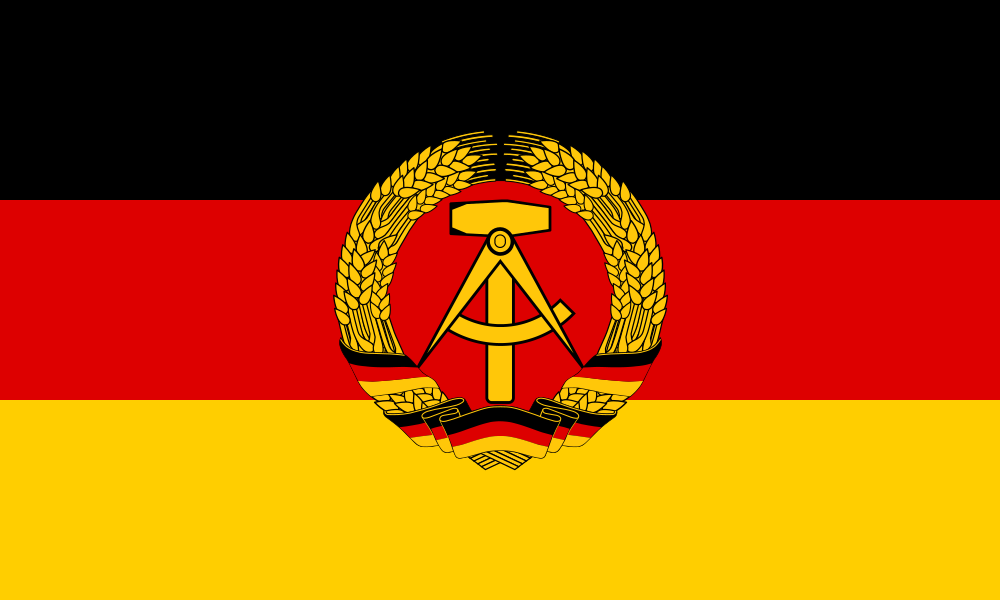
1949–1964Chairman of the Council of Ministers of the GDR
1960–1964Withdrew from active politics because of severe illness
Nazi Gauleiter of Schleswig-Holstein who, as Reichskommissar for Ostland in 1941–1944, ordered the ghettoisation and expropriation of Jews
Born into a peasant family in Schleswig-Holstein, he was severely wounded in the First World War. He joined the Nazi Party in 1923, became Gauleiter of Schleswig-Holstein in 1925 and in 1933 also Oberpräsident of the province. Appointed Reichskommissar for Ostland on 25 July 1941, he shuttled between Riga and Kiel; his decree of 27 July ordered lists of Jews, the yellow badge, the confiscation of their property and their concentration in ghettos. Asked to explain his order forbidding the execution of Jews in Libau (Liepāja), he wrote on 15 November asking whether all Jews were to be liquidated regardless of economic interests, yet he stayed at his post for three more years. He fled Ostland without authorisation on 13 August 1944 and was removed. Sentenced in 1948 to ten years, he was released for ill health in 1951 and died in his home village in 1964.
East German heavy-industry minister who faced the striking workers outside the House of Ministries on 16 June 1953
The son of a coppersmith from Lauterbach in Hesse, he was working underground at seventeen, served in the First World War and in 1918 sat on a soldiers’ council. He joined the USPD in 1920 and the KPD in 1922, becoming the party’s political secretary in Saxony and a Reichstag deputy. Arrested in 1933, he survived the Nazi years in prisons and in concentration camps including Sachsenhausen and Flossenbürg. After the war he was Saxony’s minister for economics and planning, then deputy chairman of the German Economic Commission, and in the GDR minister of industry and of heavy industry. On 16 June 1953 he walked into the crowd outside the House of Ministries and tried to address it from a desk, but was whistled down. In 1958 Ulbricht pushed him out of his offices for a “deviant attitude”, and he turned to writing. He died in East Berlin in 1975.
Career timeline
1922Joined the KPD
1932–1933Reichstag deputy
1933–1945Imprisoned; held in Sachsenhausen and Flossenbürg
1948–1949Deputy chairman of the German Economic Commission
1949–1955Minister of Industry, then of Heavy Industry
Economist and the SED’s chief ideologue until 1958, when he was expelled from the Politburo in the Schirdewan affair
Born in Leipzig, he joined the USPD in 1919 and the KPD in 1920 and worked as an editor on party papers. From 1926 he studied in Moscow at the International Lenin School and the Institute of Red Professors. In exile from 1933 he was Ulbricht’s secretary in Paris; in Moscow he lost his teaching posts in 1936 for alleged deviations, and in the war became chief editor of Moscow Radio’s German service. Returning with the Ackermann Group in 1945, he ran the party’s propaganda and education work, joined the Politburo in 1950 and was Central Committee secretary for propaganda from 1950 to 1955, effectively the party’s chief ideologue. In June 1953 he set up the command in Halle that put down the uprising. After 1956 he opposed the complete collectivisation of agriculture, and in 1958 he was expelled from the Politburo. He then directed the Institute of Economics of the Academy of Sciences.
Career timeline
1920Joined the KPD
1926–1932International Lenin School and Institute of Red Professors, Moscow
1941–1944Chief editor of Moscow Radio’s German service
1950–1958SED Politburo member
1950–1955Central Committee secretary for propaganda
1958–1969Director of the Institute of Economics, Academy of Sciences
East German planner who ran planning in the German Economic Commission and then chaired the State Planning Commission
A shoemaker’s son from Rixdorf, Berlin, he worked as a clerk, studied economics at night and joined the KPD in 1931. Under the Nazis he worked for the illegal paper “Der Rote Wedding” and the party’s military intelligence apparatus until his arrest in 1936; sentenced to six years in prison, he was then held in Sachsenhausen and Mauthausen until 1945. After the war he built up and headed the KPD’s economic department, and from 1947 played a major part in creating the German Economic Commission, where he took charge of planning and drew up the half-year plan of 1948 and the two-year plan of 1949/50. He succeeded Heinrich Rau as chairman of the State Planning Commission (1952–1961), joined the Politburo in 1958 and was deputy premier from 1955 to 1965. Removed as planning chief in 1961, he became the GDR’s permanent representative to Comecon. He died in East Berlin in 1965.
Career timeline
1931Joined the KPD
1936–1945Imprisoned; held in Sachsenhausen and Mauthausen
1947–1949In charge of planning at the German Economic Commission
1952–1961Chairman of the State Planning Commission
A social democrat who made reconciliation a politics of divided cities
After the Wall was built, he said: “The Wall must go, but until it goes, the city must live.”
Willy Brandt was a German social-democratic politician shaped by exile and resistance to the Nazi dictatorship. As Governing Mayor of West Berlin, he defended the city’s morale after the Wall was built and pressed the West to honor its responsibilities, helping popularize the name “Wall of Shame.” As chancellor, he pursued Ostpolitik and “change through rapprochement,” easing Cold War confrontation and earning the 1971 Nobel Peace Prize.
Career timeline
1933–1945Exile and resistance activist against the Nazi dictatorship
1948–1953SPD representative in Berlin
1957–1966Governing Mayor of West Berlin
1964–1987Chairman of the SPD
1966–1969Foreign Minister and Vice Chancellor
1969–1974Federal Chancellor of the Federal Republic of Germany
The chancellor who seized the initiative on the German question with a ten-point unification plan days before Malta
On 28 November 1989, Kohl rose in the Bundestag without having told his allies, or even his own foreign minister. President Bush received Kohl's letter summarizing the Ten-Point Plan just as the chancellor was already speaking in Bonn.
A Christian Democratic Union (CDU) politician who served sixteen years as chancellor of West Germany and reunified Germany, leading both European integration and German reunification. On 28 November 1989, without consulting his allies, he presented a 'Ten-Point Plan' for German unity to the Bundestag; days later, at the Malta summit, the German question dominated the proceedings on his terms. The following year, on 3 October 1990, Germany was reunified; together with French president François Mitterrand, Kohl drove the Maastricht Treaty and the introduction of the euro. He achieved reunification by extending the West German system into the former East, and after his long tenure ended with electoral defeat in 1998, he resigned as CDU honorary chairman amid a party donations scandal.
Career timeline
1959Elected to the Landtag of Rhineland-Palatinate (youngest member)
1969–1976Minister-President of Rhineland-Palatinate
1973–1998Chairman of the Christian Democratic Union (CDU)
1976–1982Leader of the CDU/CSU opposition in the Bundestag
1982–1998Chancellor of the Federal Republic of Germany
1989.11.28Presented the Ten-Point Plan for German unity to the Bundestag
1990.10.03Presided over German reunification
1998Defeated in federal elections; resigned as CDU chairman