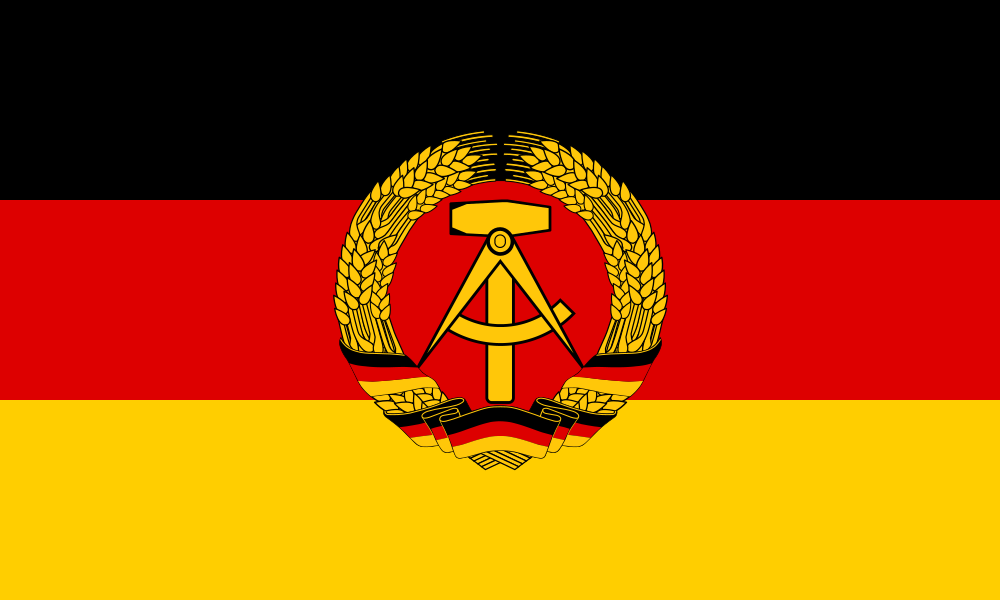
East German chemist who survived a Nazi death sentence and later, expelled from the SED, became a dissident under house arrest
Born in Munich, he studied chemistry in Munich and Berlin and took a doctorate in physical chemistry at the Kaiser Wilhelm Institute. A founder of the resistance group European Union, he was arrested by the Gestapo in 1943 and sentenced to death, but his execution was repeatedly postponed on the grounds that his research was needed, and he survived. After the war he headed Berlin’s Kaiser Wilhelm Institutes until the Americans dismissed him; in 1950 he became professor of physical chemistry at the Humboldt University, a member of the Volkskammer and of the German Peace Committee. On 16 June 1953 he faced the crowd outside the House of Ministries with Fritz Selbmann. His 1963–64 lectures, published as “Dialectics without Dogma”, cost him his party membership and his chair. After protesting Wolf Biermann’s expatriation in 1976 he was put under house arrest. He died in Grünheide in 1982.
Career timeline
1932Joined the KPD
1943Arrested by the Gestapo and sentenced to death
1950Professor of physical chemistry at the Humboldt University
He built the hydrogen bomb, then turned on the system
On 15 December 1986 KGB officers installed a telephone in the Gorky flat; the next day Gorbachev called personally: "You may return to Moscow." Sakharov thanked him and at once raised the release of political prisoners. Nearly seven years of exile ended; he never set down the agenda of conscience.
Father of the Soviet hydrogen bomb and the conscience who laid its privileges down. His decisive break came through the secret letter of 21 July 1967 opposing ABM deployment and the essay "Reflections on Progress, Peaceful Coexistence, and Intellectual Freedom", completed in May 1968 and circulated in samizdat, after which he was removed from weapons research; he denounced the Soviet entry into Czechoslovakia that August. Criticism of the Afghan invasion sent him into internal exile in Gorky in 1980. A single telephone call from Gorbachev brought him back in 1986; he died a people's deputy, still fighting from the rostrum.
Career timeline
1948–1953On the hydrogen bomb project; the 1953 test
1953Full academician at thirty-two
1961Argues against atmospheric testing to Khrushchev’s face
1968Progress, Coexistence and Intellectual Freedom circulates in samizdat
1975Nobel Peace Prize; barred from travel, his wife accepts it
“China’s Sakharov”, the astrophysicist known for the 1986 student protests and his 1989 refuge in the US embassy
Astrophysicist and Chinese dissident who argued that repression of thought damaged both science and society.
An astrophysicist from Beijing, labelled a rightist in 1957 and later rehabilitated, he became vice-president of the University of Science and Technology of China. In 1986 lectures he openly questioned Marxism’s scientific authority and party leadership, was named the spiritual guide of that winter’s student protests, and in 1987 was expelled from the party — a pretext for Hu Yaobang’s fall. In January 1989 he wrote an open letter to Deng Xiaoping asking for Wei Jingsheng’s release; after the crackdown of 4 June he and his wife Li Shuxian took refuge in the US embassy for thirteen months before being allowed to leave. He taught at the University of Arizona and died in 2012.
Career timeline
1984–1987Vice-President of the University of Science and Technology of China