Prague Spring interior minister whose security reforms were undermined by KGB subversion and internal betrayal
On the day of the invasion, Pavel's dismissed deputy Šalgovič helped the KGB arrest Dubček, and the Interior Ministry slipped from its minister's hands.
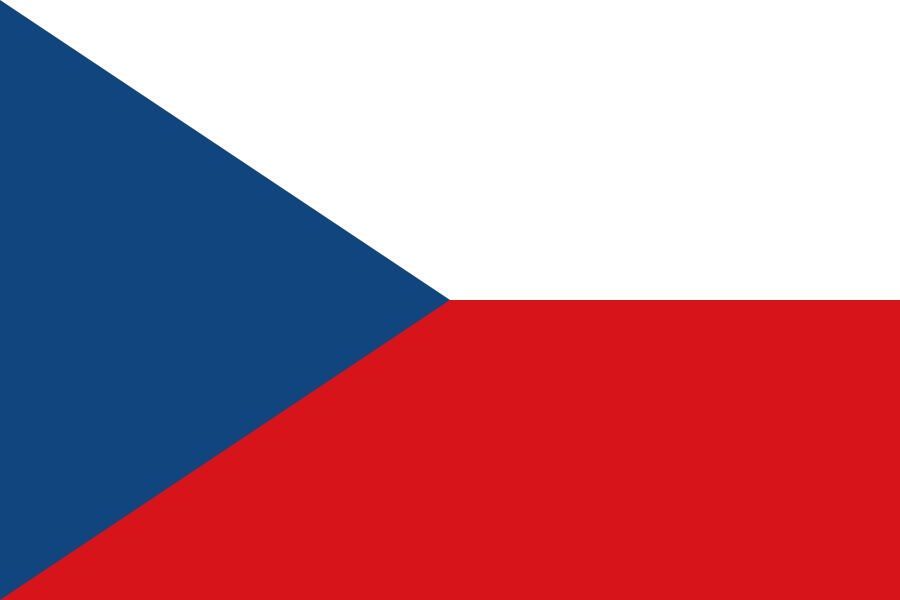
A Czechoslovak communist who fought in the Spanish Civil War and commanded the People's Militia during the 1948 coup, Pavel became deputy interior minister and participated in the regime's repressions. Arrested in 1951, he was tortured and sentenced to 25 years in the Slánský trial, then acquitted in 1955. Returning as interior minister during the 1968 Prague Spring, he pushed to reform the StB and exposed six KGB liaison agents in his ministry, but his deputy Viliam Šalgovič collaborated with the KGB to arrest Dubček during the invasion, collapsing Pavel's reforms.
Career timeline
- 1932Joined Communist Party of Czechoslovakia
- 1935Studied at International Lenin School, Moscow
- 1937–1939Fought in Spanish Civil War; commanded Dimitrov Battalion
- 1947Chief Secretary, Defense and Security Dept, KSČ Central Committee
- 1948Chief of Staff, People's Militia; Deputy Interior Minister
- 1951–1955Arrested, tortured; sentenced to 25 years (1953); acquitted and released (1955)
- 1968.04–08Minister of Interior of Czechoslovakia
- 1968–1973Forced to resign; expelled from KSČ; died under StB surveillance
A police chief who stood between state orders and guns aimed at the people
On 23 October 1956, he refused the order to fire on unarmed demonstrators.
Sándor Kopácsi was a Hungarian police commander who began as a metalworker and anti-Nazi resistance activist, then sought room for reform within the state. As Budapest police chief, he refused on 23 October 1956 to order fire on unarmed demonstrators, cooperated with the uprising, and became deputy commander of the National Guard. Arrested and sentenced to life imprisonment in the Imre Nagy trial, he was released in the 1963 amnesty and later gave the revolution an important insider testimony through his memoir.
Career timeline
- 1944Joined the MOKÁN anti-Nazi resistance
- 1945Joined the Hungarian Communist Party and entered the police
- 1949Director of Internment Affairs, Ministry of the Interior
- 1952–1956Chief of Police of Budapest
- 1956Deputy commander of the National Guard
- 1958Sentenced to life imprisonment in the Imre Nagy trial
- 1963Released in an amnesty
- 1975–2001Emigration to Canada and memoir writing
From border controller to the officer who ordered the Wall opened
“That’s why I gave my people the order: Open the barrier!”
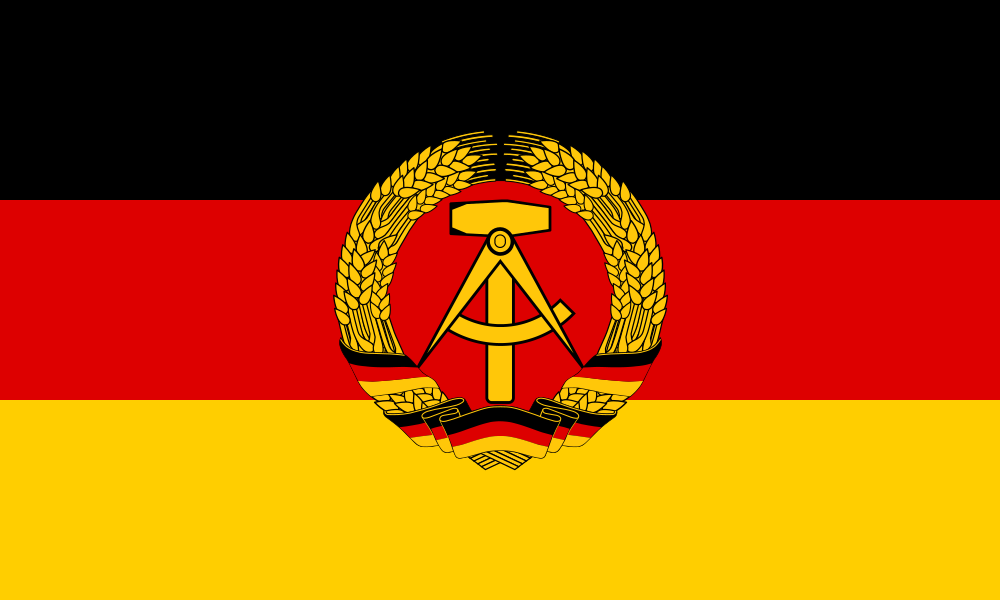
Harald Jäger was a border-control officer who served the East German Ministry for State Security, enforcing the state’s travel controls and intelligence work. On 9 November 1989, without clear direction from his superiors, he faced a growing crowd and the danger of violence at Bornholmer Straße. He belonged to the machinery of control, yet that night he ordered the barrier opened, allowing thousands of East German citizens into West Berlin. He later acknowledged both the GDR’s inner contradictions and the freedom brought by the Wall’s fall.
Career timeline
- 1943Born in Bautzen
- 1961Volunteered for the German Border Police
- 1964–1989Served in the Ministry for State Security passport-control units
- 1976–1981Studied at the Stasi Law College and earned a law degree
- 1989Deputy commander at the Bornholmer Straße crossing
- 1989.11.09Ordered the Bornholmer Straße barrier opened without authorization
- 1990Dismissed during the dissolution of the Stasi