Activities and affiliations

What people did, and whom they served in that activity.

Legislature and state representation · Czechoslovakia people 2

Clear all

Avgustyn Voloshyn

Августин Волошин
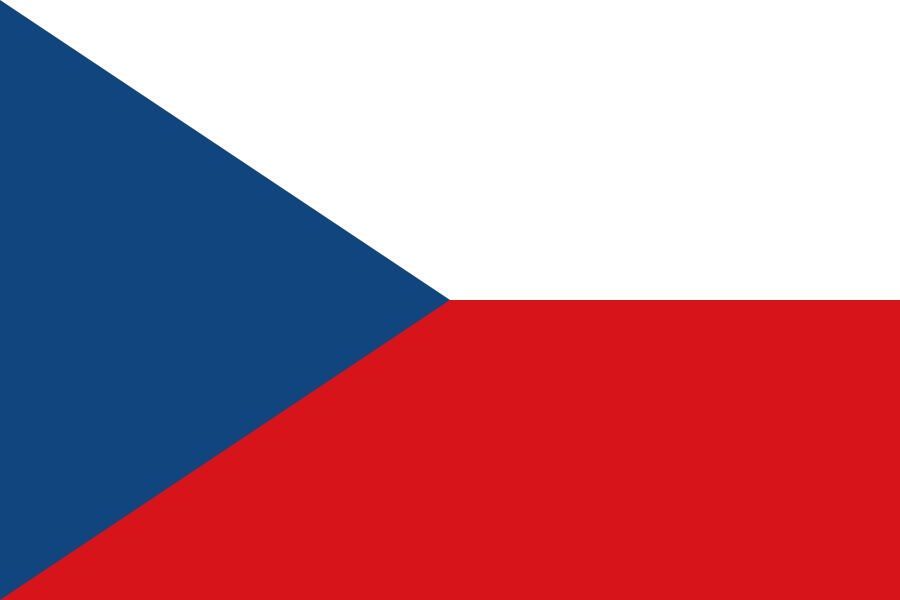

Czechoslovakia Nationalism Czechoslovakia Ukrainian (Carpathian Ruthenia) 1874–1945 ○ Died in Soviet custody

Greek Catholic priest who became president of Carpatho-Ukraine when it declared independence in March 1939

The son of a Greek Catholic priest in Carpathian Ruthenia, then part of Austria-Hungary, he studied at the Ungvár school of theology and at Budapest University and was ordained. In 1918 he became head of the Subcarpathian National Council, which in 1919 asked for the region to join Czechoslovakia. In 1925 he was elected to the parliament in Prague as leader of the Ruthenian National Christian Party, and in October 1938 he was appointed head of the government of the Subcarpathian Autonomous Region. On 15 March 1939 he became president of Carpatho-Ukraine, but the next day Hungary occupied and annexed the region; he fled to Prague and spent the war as a professor at the Ukrainian Free University. Arrested by the NKVD when the Soviet army took Prague in May 1945, he was taken to Moscow and died in Butyrka prison in July.

Career timeline
  • 1900–1917Professor of mathematics, teachers’ institute
  • 1918–1919Head, Subcarpathian National Council
  • 1925Deputy in Prague (Ruthenian National Christian Party)
  • 1938–1939Head of the Subcarpathian autonomous government
  • 1939President of Carpatho-Ukraine
  • 1939–1945Professor, Ukrainian Free University, Prague
  • 1945Arrested by the NKVD; died in Butyrka prison

Andor Jaross

Jaross Andor
Hungary Fascists and Nazis Hungary Hungary 1896–1946 ✕ Executed by firing squad

Hungarian minority leader in Czechoslovakia who, as interior minister in Sztójay’s cabinet in 1944, organised the deportation of Jews

Born in Komáromcsehi, Komárom County (now Čechy, Slovakia), he entered the politics of the Hungarian minority in Upper Hungary, cut off by Trianon, in the early 1920s. He became chairman of the Hungarian National Party in 1933 and a deputy in Prague in 1935, and was general secretary of the United Hungarian Party. From 1938 to 1940 he was Hungary’s minister without portfolio for Upper Hungary, and in 1940 he co-founded the far-right Party of Hungarian Renewal with Béla Imrédy. As interior minister in Sztójay’s cabinet after the German occupation of 1944, he organised the deportation of the Jews with his state secretaries László Baky and László Endre. He resigned under Horthy’s pressure on 17 August. After the war he fled west, was captured by the Americans, handed over to Hungary, sentenced to death by the People’s Tribunal and shot in 1946.

Career timeline
  • 1925–1933Vice-chairman, Hungarian National Party
  • 1933Chairman, Hungarian National Party
  • 1935–1938Member of the Czechoslovak Chamber of Deputies
  • 1938–1940Minister without portfolio for Upper Hungary
  • 1940Co-founded the Party of Hungarian Renewal
  • 1944Interior minister
  • 1946Sentenced by the People’s Tribunal and executed