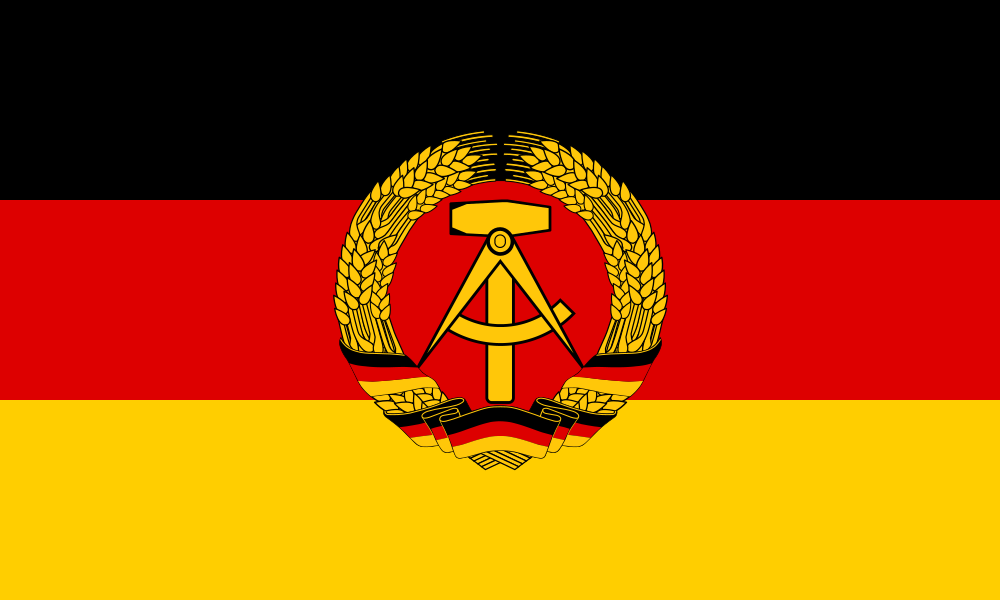
East Germany's 'Master of Fear': the Stasi chief who ruled state security for 32 years
“All this blithering over to execute or not to execute, for the death penalty or against — all rot, Comrades. Execute! And, when necessary, without a court judgment.” — to senior Stasi officers, 1982
A communist militant from Berlin's Wedding district, Mielke fled to the USSR after the 1931 killing of two Berlin policemen and was trained by the NKVD. After the Spanish Civil War he returned in 1945 to help build the GDR's state security apparatus, leading the Stasi from 1957 to 1989 and expanding it into a 90,000-strong surveillance network. The Stasi controlled all of East German society while training armed groups across the Third World and Western Europe, extending socialist-bloc security architecture. He fell with the regime in 1989 and was convicted after reunification for the 1931 murders.
Career timeline
- 1925Joined the KPD
- 1931Fled to USSR after Bülowplatz police murders
- 1936–1939Served in International Brigades, Spain (Captain)
- 1945Returned to Berlin, Police Inspector Lichtenberg
- 1950Deputy Minister of State Security, State Secretary
- 1957–1989Minister for State Security (Stasi chief)
- 1976Full member, SED Politburo
- 1993Convicted of police murders, 6-year sentence
A long-serving architect of Cold War intelligence
At the August 1984 RYaN meeting, he stressed the need to establish the “actual situation” rather than mistake indicators for a Western nuclear attack.
Markus Wolf was a communist official and intelligence chief who, after fleeing Nazi persecution to the Soviet Union, led the foreign intelligence service of East Germany. From 1952 to 1986 he directed the Stasi’s Main Directorate for Reconnaissance, organizing espionage and active measures aimed at West German political, military, and economic institutions. When Soviet leaders expanded Operation RYaN amid fears of a pre-emptive nuclear attack in the early 1980s, Wolf maintained cooperation while exposing a tension between alarmist indicators and the need to establish the actual situation. After German reunification he passed through exile and trial, and used memoirs and public interventions to address responsibility for state security work and the possibility of reforming socialism.
Career timeline
- 1923–1933Grew up in Stuttgart
- 1933–1943Exile in the Soviet Union; studied in Moscow and at the Comintern school
- 1943–1945Editor and announcer for the German-language Moscow radio
- 1949–1951First counsellor at the East German embassy in Moscow
- 1952–1986Head of the foreign intelligence services IWF and HVA
- 1953–1986First deputy minister for state security
- 1986–1990After retirement, wrote memoirs and joined debates on reform
- 1990–2006Exile and trial, then died in Berlin
From border controller to the officer who ordered the Wall opened
“That’s why I gave my people the order: Open the barrier!”
Harald Jäger was a border-control officer who served the East German Ministry for State Security, enforcing the state’s travel controls and intelligence work. On 9 November 1989, without clear direction from his superiors, he faced a growing crowd and the danger of violence at Bornholmer Straße. He belonged to the machinery of control, yet that night he ordered the barrier opened, allowing thousands of East German citizens into West Berlin. He later acknowledged both the GDR’s inner contradictions and the freedom brought by the Wall’s fall.
Career timeline
- 1943Born in Bautzen
- 1961Volunteered for the German Border Police
- 1964–1989Served in the Ministry for State Security passport-control units
- 1976–1981Studied at the Stasi Law College and earned a law degree
- 1989Deputy commander at the Bornholmer Straße crossing
- 1989.11.09Ordered the Bornholmer Straße barrier opened without authorization
- 1990Dismissed during the dissolution of the Stasi