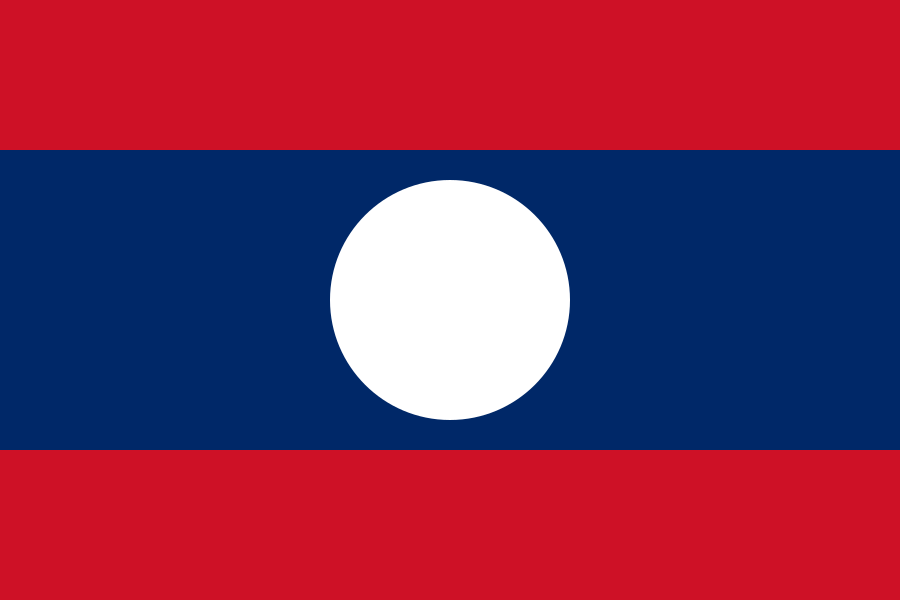
Neutralist leader and the last royal prime minister of Laos
In November 1975 the monarchy's last prime minister, with his half-brother Souphanouvong, went to King Savang Vatthana to ask for his abdication.
A Lao royal and politician who led the neutralist faction and repeatedly headed coalition governments between the right and the Pathet Lao. As the monarchy's last prime minister he led the third coalition government from 1974. In November 1975 he flew with Souphanouvong to Luang Prabang and persuaded King Savang Vatthana to abdicate, then resigned as the National Congress of People's Representatives opened. He remained an adviser to the new government and died in Vientiane in 1984.
Career timeline
- 1945Minister of Public Works, Lao Issara provisional government
- 1951–1954Prime Minister
- 1956–1958Prime Minister (national-reconciliation coalition)
- 1960National Assembly president and prime minister
- 1962Prime minister of the national-union government (Three Princes accord)
- 1974–1975Prime minister of the third coalition government
- 1975Resigned; adviser to the new government
Pathet Lao and the first presidency
The prince who in 1949 told a U.S. diplomat that Laos was a 'classless, Buddhist country in which communist theories had no basis' later became the 'Red Prince' and first president of communist Laos.
A Lao royal and revolutionary leader associated with the Pathet Lao. He participated in coalition and national reconciliation institutions and became the Lao PDR’s first president in 1975. His role differed from Kaysone Phomvihane’s leadership of party and government.
Career timeline
- 1945Foreign minister of the Lao Issara government and commander-in-chief of the Lao liberation army
- 1950Founded and chaired the Lao Freedom Front (Pathet Lao)
- 1956Chairman of the Lao Patriotic Front (Neo Lao Hak Sat)
- 1957–1958Minister for Planning, Reconstruction and Urban Development
- 1962–1963Deputy Prime Minister and Minister of Economy and Planning
- 1974Presided over the National Political Consultative Council
- 1975–1991First president of the Lao PDR (Phoumi Vongvichit acting from 1986)
Royal Lao Army general who led the CIA-backed Hmong army
Sources differ on the endpoint in May 1975: one has 5 May, when he was ordered before Souvanna Phouma to cooperate with the Pathet Lao; another has 14 May, when he left Long Tieng by helicopter as the shelling began.
A Hmong soldier from Nonghet in Xiangkhouang Province, Laos, and the only ethnic Hmong to reach general officer rank in the Royal Lao Army. During the 1960s and 1970s he commanded the CIA-trained and -supported irregular 'Secret Army' based at Long Tieng, fighting the Pathet Lao and the People's Army of Vietnam. Evacuated to Thailand in May 1975 amid the communist takeover, he then emigrated to the United States, settling in California by way of Montana, and became a leader of the Hmong American community, helping halt the forced repatriation of Laotian and Hmong refugees from Thailand in the late 1980s and 1990s. In 1981 he was among the founders of the United Lao National Liberation Front (Neo Hom). Charged in the United States in 2007 with plotting to overthrow the Lao government, he saw all federal charges dropped in 2009.
Career timeline
- 1960년대~1975Major general, Royal Lao Army; commanded the CIA-backed 'Secret Army' based at Long Tieng
- 1975Evacuated to Thailand, then emigrated to the United States
- 1981Among the founders of the United Lao National Liberation Front (Neo Hom)
- 2007~2009Charged in the US under the Neutrality Act; all federal charges dropped