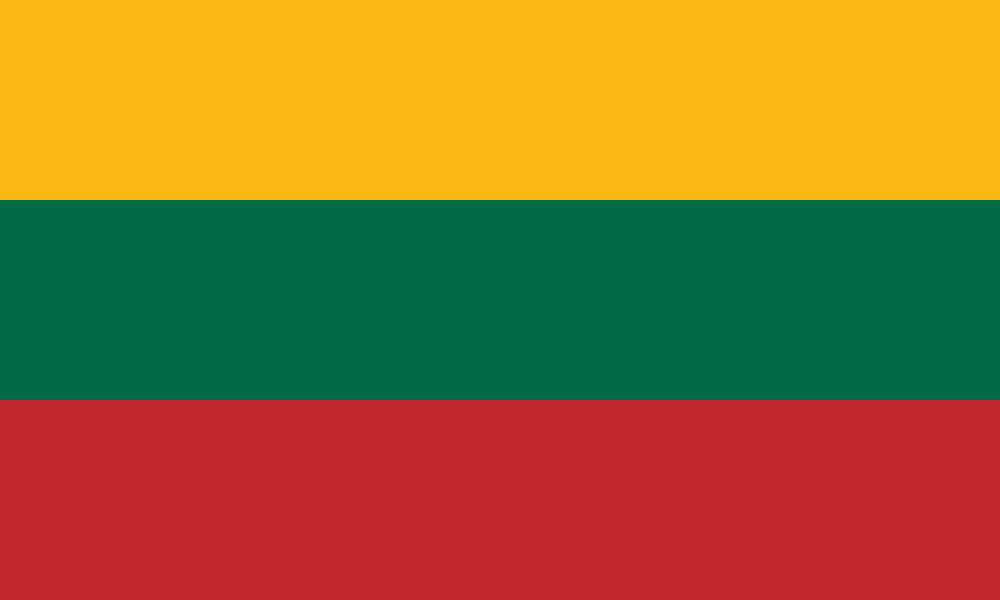
Lithuanian officer and envoy in Berlin who founded the Lithuanian Activist Front behind the June Uprising of 1941
Mobilised into the Imperial Russian Army in the First World War, he was the first to enlist in the Lithuanian armed forces after independence in 1918, and on 1 January 1919 his men raised the Lithuanian flag over Gediminas’ Tower in Vilnius. He became Chief of the General Staff in 1925 but had to resign after opposing the 1926 coup. He was envoy to Germany in 1927–1930 and 1938–1941. After the Soviet occupation of 1940 he founded in Berlin the Lithuanian Activist Front, which sought to restore independence by working with the Nazis; named prime minister of the provisional government in 1941, he was held under house arrest by the Germans. In 1944 he was arrested for a memorandum demanding a Lithuanian government. After the war he settled in the United States, working at the Library of Congress. His antisemitic writings have made dedications in his honour controversial.
Career timeline
- 1919Raised the flag over Gediminas’ Tower
- 1925–1926Chief of the Lithuanian General Staff
- 1938–1941Envoy to Germany
- 1940–1941Founded the Activist Front; named provisional prime minister
- 1949Emigrated to the United States
Officer who founded the Union of Lithuanian Freedom Fighters in 1949 and led the partisan resistance as its chairman
Born in Palanga, he graduated from the War School of Kaunas in 1929 as an artillery officer and studied at the School of Applied Artillery in Fontainebleau, France, in 1936–1938. In the deportations of June 1941 his sister’s whole family was sent to Siberia; under the German occupation he retired rather than serve the Nazis. In 1944 he joined the Lithuanian Territorial Defense Force, and when the Red Army returned he joined the Lithuanian Liberty Army and the partisans, rising to the leadership. In February 1949 he founded the Union of Lithuanian Freedom Fighters and became its chairman, working to unify the partisan units and give their struggle a legal framework. Paralysed by a cerebral haemorrhage in December 1951, he was arrested on 30 May 1953, interrogated in Moscow by Beria and executed in Butyrka prison in 1954. In 2009 he was officially named the fourth President of Lithuania.
Career timeline
- 1929Graduated from the War School of Kaunas; artillery officer
- 1936–1938School of Applied Artillery, Fontainebleau
- 1944Lithuanian Territorial Defense Force, then the partisans
- 1949Chairman of the Union of Lithuanian Freedom Fighters
- 1953Arrested
- 1954Executed in Butyrka prison, Moscow