Activities and affiliations

What people did, and whom they served in that activity.

Monarchs and royalty · Yugoslavia people 2

Clear all

Paul Karađorđević

Pavle Karađorđević


Monarchs and royalty Yugoslavia Yugoslavia Russian 1893–1976 → Died

A regent pressed toward the Axis while trying to keep Yugoslavia out of war

Two days after Yugoslavia joined the Tripartite Pact on 25 March 1941, a military coup removed him from the regency.
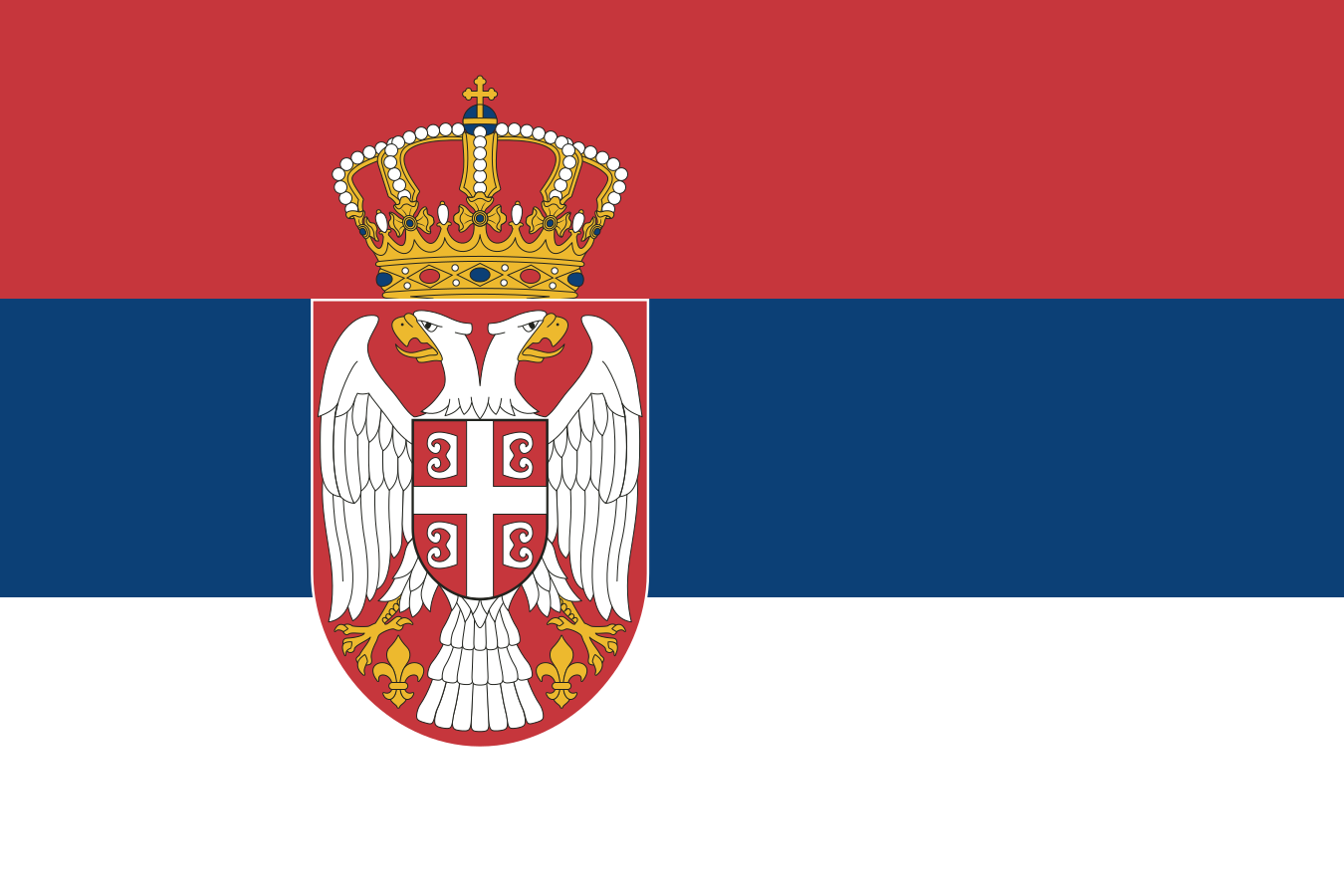
Paul Karađorđević was the prince regent who governed the Kingdom of Yugoslavia for the minor Peter II after the assassination of Alexander I. He sought to soften the legacy of centralised rule and reconcile the state with the Croatian national movement, culminating in the 1939 Cvetković-Maček Agreement and the creation of the Banovina of Croatia. As war spread and British and French guarantees weakened, his attempt to preserve neutrality shifted toward concessions under German pressure, and Yugoslavia’s 1941 accession to the Tripartite Pact triggered a military coup that removed him. He lived in exile after the war, died in 1976, and was rehabilitated by a Serbian court in 2011.

Career timeline
  • 1893Born in St. Petersburg
  • 1912–1921Studied at Christ Church, Oxford; served in World War I
  • 1929Founded and patronised the Museum of Contemporary Art in Belgrade
  • 1934–1939Chairman of the Regency Council of Yugoslavia
  • 1939Advanced the Cvetković-Maček Agreement and Banovina of Croatia
  • 1941Removed in a military coup after Yugoslavia joined the Tripartite Pact

Peter II

Petar II Karađorđević
Monarchs and royalty Yugoslavia Yugoslavia Serbian; maternal Romanian royal family 1923–1970 ○ Died

The last king who carried Yugoslavia’s royal legitimacy into exile

On 27 March 1941, Dušan Simović told him: "Your Majesty, from this moment you will exercise your full sovereign power."

Peter II became king of the Kingdom of Yugoslavia as a child after the assassination of his father, Alexander I, and was its last monarch. The 27 March 1941 coup ended the regency and declared him of age, but the Axis invasion soon forced him to lead a government in exile from London. His crown represented state continuity against occupation, yet the exile government’s divisions and the Partisans’ military and political victory stripped it of an effective base of power. After the monarchy was abolished in 1945, his permanent exile left unresolved the question of Yugoslavia’s political legitimacy.

Career timeline
  • 1934Acceded as king under a regency
  • 1934–1941Nominal king of the Kingdom of Yugoslavia
  • 1941.03.27Declared of age after the coup
  • 1941.04–06Went into exile with the government after the Axis invasion
  • 1941–1945Head of state of the Yugoslav royal government-in-exile in London
  • 1944.09Called on Yugoslav forces to join Tito
  • 1945Deposed when the monarchy was abolished
  • 1945–1970Lived in exile in the United States
  • 1970Died in Denver, United States