The musicologist who led the first nation out of the Soviet Union
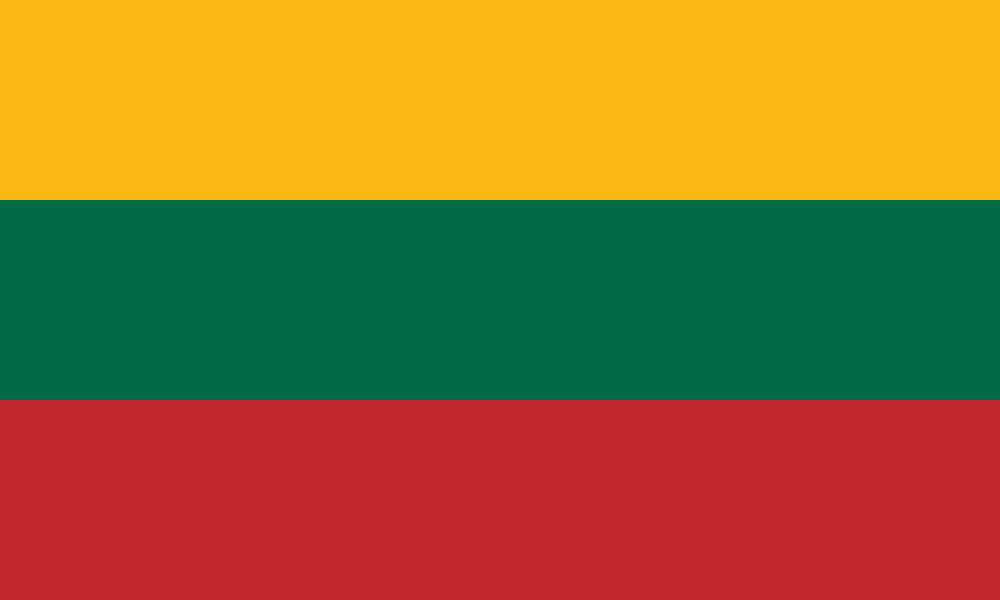
On the night of 11 March 1990, when the act restoring independence passed without a vote against, he declared from the chair that Lithuania was once more an independent state: the first republic to walk out of the USSR, and the Kremlin's first notice of secession.
A Lithuanian musicologist and the leading authority on the painter-composer Ciurlionis, Landsbergis joined the founding of the reform movement Sajudis in 1988 and became its chairman. On 11 March 1990, as chairman of the Lithuanian Supreme Council, he carried the act restoring independence, becoming head of the first republic to declare its departure from the USSR. He held that independence through Moscow's economic blockade and the bloody suppression attempt of January 1991, and later served as speaker of the Seimas and a member of the European Parliament, the patriarch of the Lithuanian right.
Career timeline
1955Graduated from the Lithuanian Conservatory (now Lithuanian Academy of Music and Theatre)
1978–1990Professor at the Lithuanian Conservatory and Vilnius Pedagogical University
1988–1990Chairman of the Sąjūdis Seimas Council
1989–1990People's Deputy of the USSR Congress of People's Deputies
1990–1992Chairman of the Supreme Council of Lithuania (head of state)
1993–2003Chairman of the Homeland Union (Conservative Party)
The Marxist revolutionary who overthrew Portuguese colonial rule and led Mozambique to independence
“The liberation of Africa is the liberation of the continent, or it is nothing.”
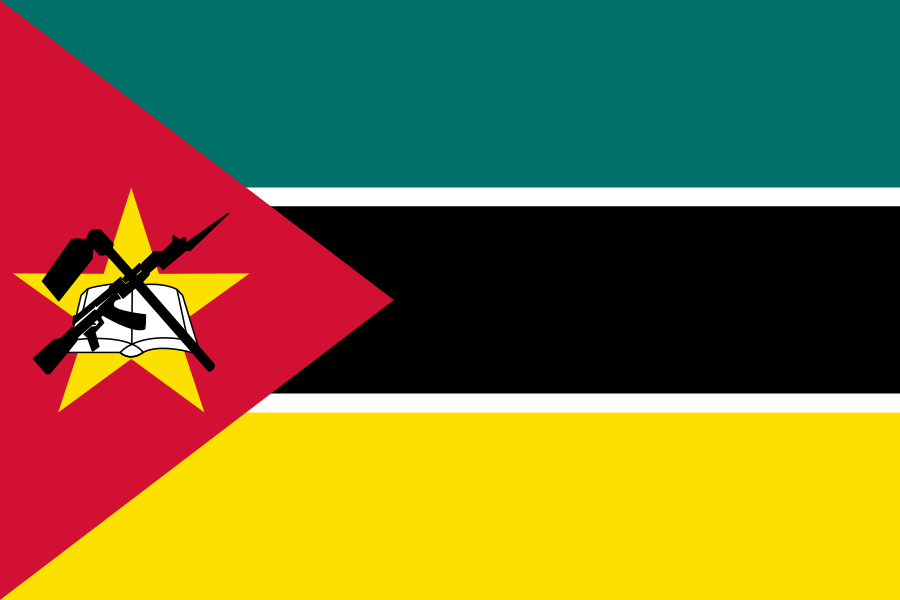
Mozambique's independence leader and first president. As FRELIMO chairman, he waged armed struggle to end Portuguese colonial rule and built a socialist state. A crucial ally of liberation movements against Rhodesia and South African apartheid.
Career timeline
1963Exiled to Tanzania, joins FRELIMO; guerrilla training in Algeria
1966FRELIMO Secretary for Defense
1968Commander-in-chief of the Mozambican liberation army
1970Becomes FRELIMO President; adopts Marxism-Leninism as party ideology
1974Negotiates independence with Portugal's new government — Lusaka Accord
1975–1986First President of the People's Republic of Mozambique
1984Signs the Nkomati non-aggression pact with South Africa
1986.10Killed in plane crash at Mbuzini, South Africa, returning from Zambia
The opposition leader from Pool who ended one-party rule
On 7 November 1988 and 20 November 1989 he wrote to President Sassou Nguesso proposing a national round table on the country's problems.
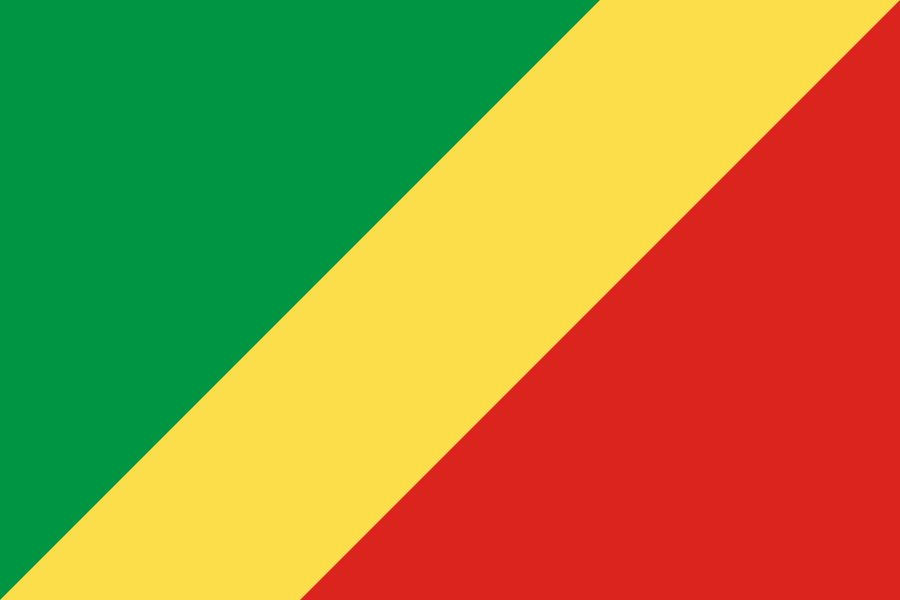
A Congolese politician from Mboloki in Kinkala District, Pool, who founded the Congolese Movement for Democracy and Integral Development (MCDDI) and pressed for a multiparty system while the one-party state still stood. At the 1991 sovereign national conference he opened the parties' addresses and backed André Milongo's election as transitional prime minister, making him a key opposition figure of the democratic transition. He lost the 1992 presidential runoff to Lissouba and, appointed Lissouba's prime minister of national unity during the 1997 civil war, was ousted by Sassou Nguesso's loyalists and went into exile.
Career timeline
1989Founded the Congolese Movement for Democracy and Integral Development (MCDDI); party statutes filed with the Interior Ministry
1991Opened the parties' addresses at the sovereign national conference
1992Second in the first round of the presidential election (20.32%); lost the runoff to Lissouba
1994Elected mayor of Brazzaville
1997Appointed prime minister of national unity by Lissouba; ousted into exile when Sassou Nguesso's loyalists took Brazzaville
2000Sentenced to death in absentia by a Congolese court
2005Returned under amnesty, parliament adopted the amnesty law
At the December 1978 Kratie congress he proclaimed the overthrow of the Pol Pot regime and an independence moving toward socialism, and was elected president of the National Salvation Front.
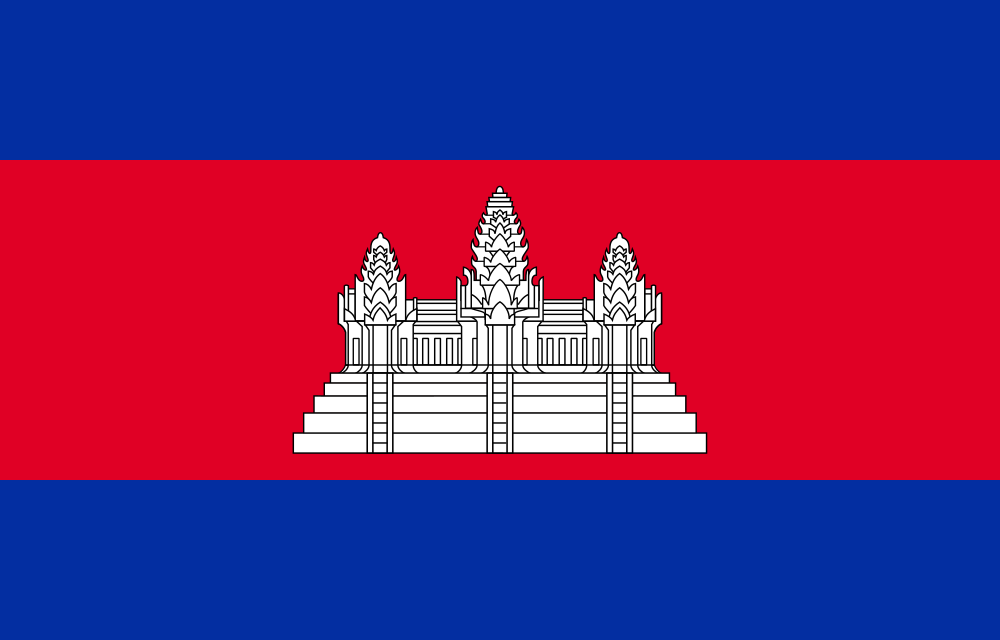
A Cambodian leader who broke with the Khmer Rouge and cooperated with Vietnam. He led the People’s Republic of Kampuchea after the 1979 regime change. Reconstruction combined state, cooperative and household activity while war and international disputes over representation continued.
Career timeline
1979Chairman of the People's Revolutionary Council
1981Chairman of the Council of State and General Secretary of the People's Revolutionary Party
1991Stepped down as party general secretary
1992Stepped down as chairman of the Council of State
A reform-minded party official caught between control and negotiation
On the first day of the strike, he ordered an immediate collection of on-site information, saying the security service reports could not be trusted.
Tadeusz Fiszbach was a Polish United Workers' Party official and diplomat who led the party organization in Gdańsk from 1975. During the August 1980 strike, he opposed a violent solution and entered the first talks with worker representatives, remaining involved on the government side after Mieczysław Jagielski arrived. His conciliatory management nevertheless collided with the party's effort to contain an independent union, and martial law pushed him out of central politics. He later served as deputy marshal of the Sejm and as ambassador to Finland and Latvia.
Career timeline
1959Joined the Polish United Workers' Party
1964–1968Secretary of the Elbląg district party committee
1968–1971Secretary of the Tczew district party committee
1971–1975Secretary of the Gdańsk provincial party committee
1975–1982First Secretary of the Gdańsk provincial party committee
1976–1985Deputy to the Sejm of the Polish People's Republic
1982–1986Counsellor at the Polish Embassy in Helsinki
The Shanghai worker-rebel who rose “like a helicopter” to party vice-chairman, youngest of the Gang of Four
The youngest of the Gang of Four: from a Shanghai mill's militia office he led the November 1966 rebel headquarters and the 1967 Shanghai Commune, was second-ranked CCP vice-chairman by 38, and was seized in the 6 October 1976 coup.
From Jilin, he fought in the Korean War and became a security cadre at a Shanghai cotton mill. In 1966 he led the worker-rebel “Workers’ General Headquarters”, the driving force of the “January Storm” that seized the Shanghai government in 1967, and ran the Shanghai Revolutionary Committee with Zhang Chunqiao and Yao Wenyuan. Picked by Mao as a successor of worker origin, he became party vice-chairman at the Tenth Congress in 1973, mocked as a “helicopter” for his rapid, inexperienced rise. Arrested with the Gang of Four in October 1976, he was sentenced to life in 1981 and died of liver disease in custody in 1992.
Career timeline
1967–1976Vice-chairman of the Shanghai Revolutionary Committee
The diplomat who opened Bulgaria's post-Zhivkov transition
Negotiations after Zhivkov's removal in 1989 marked the start of the dismantling of communist rule in Bulgaria.
A longtime communist foreign-policy leader, he publicly called for change in October 1989, became party general secretary after Todor Zhivkov's removal, and served as head of state in the early negotiated transition to multiparty politics.
Career timeline
1971–1989Bulgarian foreign minister
1989–1990General secretary of the Bulgarian Communist Party
1989–1990Head of state and president during transition
Last First Secretary of the Ukrainian Communist Party on the eve of the Soviet dissolution
Addressing the Central Committee upon his election as First Secretary in June 1990: "We will never return to the days when the party monopolised power. But neither will we allow Ukraine to become a testing ground for political experiments."
A mechanical engineer by training, Gurenko rose from technologist to factory director at the Donetsk Machine-Building Plant before turning to party work in 1976. He served as secretary of the Donetsk Oblast Party Committee and deputy chairman of the Ukrainian SSR Council of Ministers, and took part in the disaster response as deputy chairman of the state commission after the 1986 Chernobyl accident. Backed by Gorbachev, he became First Secretary of the Ukrainian Communist Party Central Committee and a full member of the CPSU Politburo in June 1990, only to resign in August 1991 when party activity was banned after the failed coup. In independent Ukraine he returned to parliament and chaired the economic policy committee, helping reorganize the former communist political current.
Career timeline
1958–1976Donetsk Machine-Building Plant: engineer-technologist → director (1970–1976)
1976–1980Secretary, Donetsk Oblast Committee, Communist Party of Ukraine
1980–1987Deputy Chairman, Council of Ministers, Ukrainian SSR
1986Deputy Chairman, State Commission for the Chernobyl accident
1987–1990Secretary → Second Secretary, CPU Central Committee
1990–1991First Secretary, CPU Central Committee; Member, CPSU Politburo
1998–2006People's Deputy, Verkhovna Rada (3rd–4th convocations); Chairman, Committee on Economic Policy
Vice president who twice remade the leadership, killed by a comrade's guards
On the morning before the meeting, he told Lebanese Communist leader George Hawi, "Today we intend to make specific proposals, and if Ali Nasir rejects them, I'll pull out my gun and shoot myself."
A guerrilla of the National Liberation Front who became a soldier and politician, serving as minister of defense and vice president of the People's Democratic Republic of Yemen. He reorganized the army along Soviet lines and led the 1978 ouster of Salim Rubai Ali and the 1980 removal of Abd al-Fattah Ismail, reaching the core of power. He later opposed Ali Nasir Muhammad's economic liberalization and became a center of the opposition until, shot dead by presidential guards at the Politburo meeting of January 13, 1986, his killing prompted the officer corps to desert the president and ignited the South Yemen civil war.
Career timeline
1963Fought on the Dhale and Radfan fronts of the October 14 revolution
1969Army commander and member of the first Presidential Council
1970Deputy minister of defense
1975Graduated the Soviet General Staff Academy
1978Led the coup that ousted Salim Rubai Ali
1980Vice president and first deputy premier; engineered Ismail's resignation
The last communist leader of East Germany, who succeeded Honecker, opened the Wall, and fell in 50 days
On 9 November 1989, Krenz read the travel regulation draft to the Central Committee, handed the note to Schabowski saying "Here, explain this to the journalists," and hours later the Berlin Wall was open.
Designated as Erich Honecker's successor, Egon Krenz was the last communist leader of East Germany, becoming SED General Secretary after Honecker was ousted in October 1989. Just three weeks into his tenure, he approved the draft travel regulations, read them to the Central Committee on 9 November, and handed the note to Günter Schabowski for announcement at a press conference; that night the Berlin Wall was opened. He promised reforms but never gained public trust, and resigned all his posts by early December. After reunification, he was convicted of manslaughter for the border deaths and served nearly four years of a six-and-a-half-year sentence.
Career timeline
1955Joined the Socialist Unity Party (SED)
1971–1974Chairman of the Ernst Thälmann Pioneer Organisation
1974–1983First Secretary of the FDJ Central Council
1983–1989SED Politburo member, CC Secretary for Security, Youth and Sport
1984–1989Deputy Chairman of the State Council
1989.10–12SED General Secretary
1989.10–12Chairman of the State Council and National Defence Council
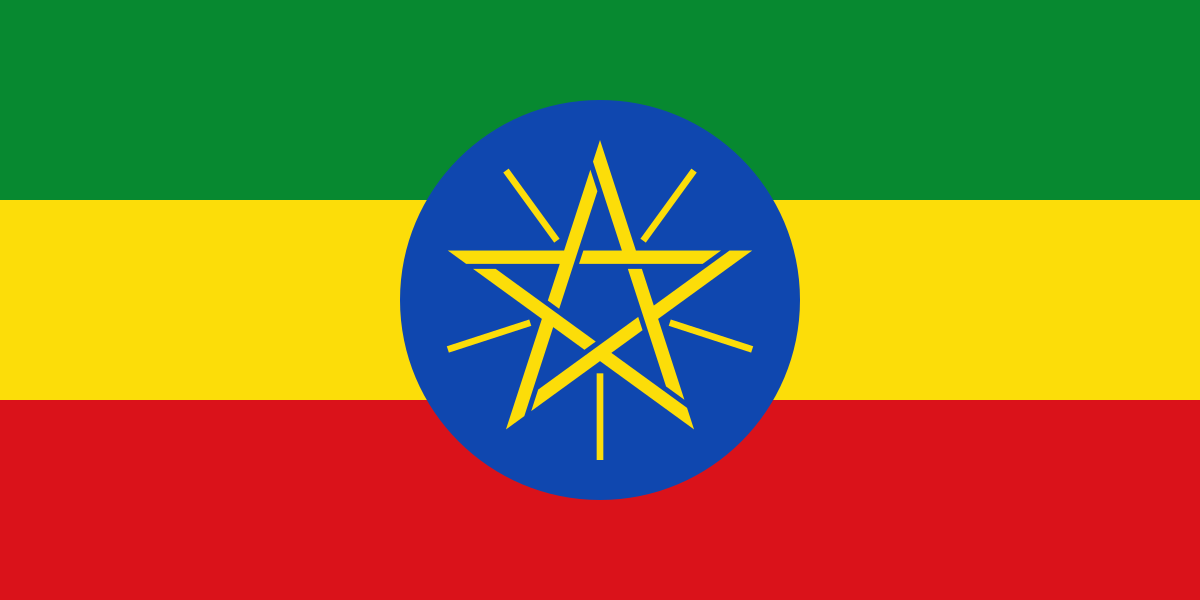
At a Derg meeting he vowed of the aristocrats who called dark-skinned, kinky-haired people slave "Barias": "I shall soon make these ignoramuses stoop and grind corn!"
A leader of Ethiopia’s Derg, the military committee emerging from the 1974 revolution. He consolidated predominance after the 1977 power struggle and led military and party-state institutions. Land reform and state-led development proceeded amid political repression and prolonged war.
Career timeline
1957Graduated Holetta Military Academy, commissioned second lieutenant
1974Derg member (Third Division representative)
1974–1977Deputy chairman of the Derg
1977–1987Chairman of the Derg, head of the military regime
1984–1991General Secretary, Workers' Party of Ethiopia
1987–1991President, People's Democratic Republic of Ethiopia
In July 1980, he joined the government delegation sent with Mieczysław Jagielski to negotiate with striking workers in Lublin.
Zdzisław Kurowski was a Polish politician who rose through the communist youth movement into the middle ranks of the party and state apparatus. His work connected agricultural, youth, and economic administration, first in Białystok and then in the PZPR Central Committee. When strikes spread through Lublin in July 1980, he was sent with Mieczysław Jagielski on the government delegation that negotiated over wages and living conditions. He later remained a manager of the Polish People’s Republic, serving in external economic posts.
Career timeline
1950–1956Activist, Union of Polish Youth
1957–1972Chairman, Union of Rural Youth
1969–1985Deputy, Sejm of the Polish People’s Republic
At his January 1970 swearing-in, Ngouabi vowed "fidelity to the Congolese people, to the revolution, and the Congolese Labour Party."
A military and political leader of Congo-Brazzaville. He led the establishment of the Congolese Labour Party and people’s republic in 1969, organizing Marxist-Leninist one-party institutions. His assassination in 1977 was followed by military-party succession struggles.
Career timeline
1968Led the coup grouping as head of the National Revolutionary Council (CNR)
1968–1977President of the Congo
1969Founded the Congolese Labour Party (PCT)
1969Renamed the country the People's Republic of the Congo, Africa's first Marxist-Leninist state
1974Re-elected chairman of the PCT Central Committee
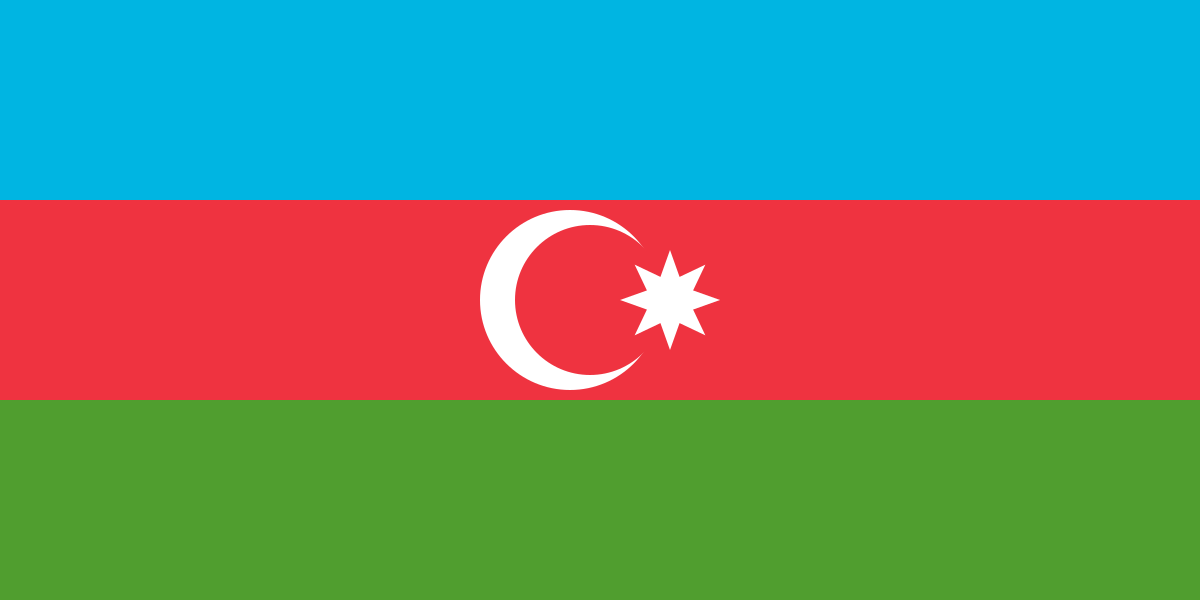
The pan-Turkist dissident who became Azerbaijan's first democratically elected president
On a November 1992 visit to Ankara he visited Atatürk's grave at Anıtkabir and wrote in the memorial book that he was a soldier of Mustafa Kemal Atatürk.
Azerbaijani politician, born 24 June 1938 in Kalaki, Nakhchivan, died 22 August 2000 in Ankara. Trained in Arabic philology at Baku State University, he took a Candidate degree in history in 1969, was known from the 1970s as a Turkist and anti-communist, and was arrested in January 1975 by the State Security Committee, serving until July 1976 at the Qaradagh stone quarry. A founder and chairman of the Popular Front from 1989, he organized a National Defence Council in January 1990 in the crisis that culminated in the anti-Armenian Baku pogrom and Black January. Elected president in June 1992, he was ousted in June 1993 amid Karabakh defeats and Huseynov's revolt; Heydar Aliyev succeeded him. He returned to Baku in 1997 and led the opposition until his death.
Career timeline
1957–1962Entered the Arabic philology department, Faculty of Oriental Studies, Baku State University in 1957; graduation dated 1962 in the Azerbaijani account, conflicting with a 1957 graduation given in an English account
1963–1964Worked as a translator in Egypt
1968–1975Lecturer in the History of Asian and African Countries, Baku State University → arrested January 1975 by the State Security Committee, held until July 1976 at the Qaradagh stone quarry
1976–1992Researcher, then senior researcher and department head, Institute of Manuscripts, Azerbaijan Academy of Sciences, until 16 July 1992
1989–1992Chairman, Azerbaijani Popular Front
1990.01Organized and chaired the National Defence Council in Baku on 12 January 1990
1992–1993President, Republic of Azerbaijan. Elected 7 June 1992, took office 17 June; formally stripped of the office by referendum on 29 August 1993
1997–2000Leader, Azerbaijani Popular Front Party (in opposition). Returned to Baku on 30 October 1997 and led it until his death
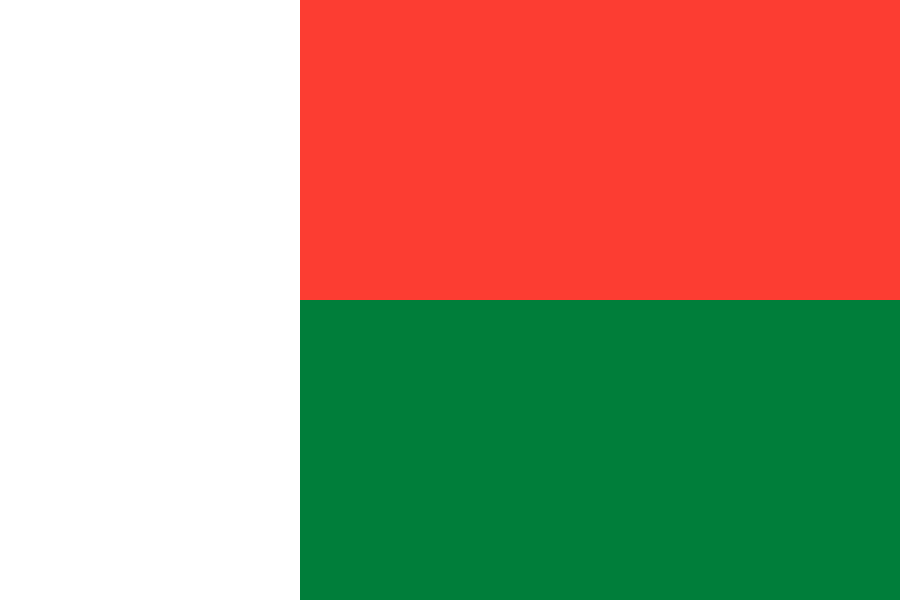
Founder of the MFM, the left party of the 1972 student-revolution generation
As the MFM was at last admitted to the front, Ratsiraka declared, 'There is no longer any reason to exclude the MFM.'
A sociology professor at Madagascar's agricultural college, Rakotonirina entered politics through Monja Jaona's MONIMA and helped organize the May 1972 protests that brought down the Tsiranana regime. In December 1972 he founded the Maoist left party MFM (Militants for Power to the Little People), which championed the poor, peasants and slave-descendants; after Ratsiraka dissolved the party and placed him under house arrest in 1976, he brought the MFM into the FNDR the following year and as head of the CSR's economic commission managed the nationalized enterprises. He later turned to liberalism, led the 1991 pro-democracy movement, and in 2009 was arrested as the prime minister named by the exiled president.
Career timeline
1966Joined MONIMA
1968Head of MONIMA's Antananarivo section
1972Founded the MFM (27 December)
1977–1989CSR member, head of the economic commission
1989Second in presidential election (~20%)
1991–1993Co-president of the transitional recovery committee
1993–1998Member of the National Assembly (Manandriana)
Founder and chief ideologue of the Yemeni Socialist Party, he was South Yemen's de facto leader from 1978 to 1980 and died in the 1986 civil war.
A South Yemeni revolutionary leader central to the Yemeni Socialist Party’s formation in 1978. He left power in 1980 and stayed in the USSR, then returned and opposed Ali Nasir Muhammad. He died during the armed party conflict in 1986.
Career timeline
1963Co-founded the NLF and led its underground fedayeen in Aden
1967Minister of Culture, National Guidance and Yemeni Unity
1969NLF Central Committee Secretary-General, de facto leader
1971Chairman of the Presidium of the Supreme People's Council (head of state)
1978Founded the Yemeni Socialist Party, its first General Secretary
1979Signed the Treaty of Friendship and Cooperation with the USSR
1980Resigned all posts citing health, then moved to Moscow
1985Returned and rejoined the YSP Central Committee as Secretary
Before leaving he declared 'I have made too many concessions already. I will not make any more'; two months later the Aden civil war erupted.
After serving as South Yemen’s prime minister, he became party and state leader in 1980. He favored pragmatic adjustments in foreign relations and economic management, while conflict with Ismail’s faction intensified. He lost power after the 1986 Aden fighting and fled to North Yemen.
Career timeline
1969–1977Minister of Defense
1971–1985Prime Minister of the People's Democratic Republic of Yemen (South Yemen)
1978Chairman of the Presidential Council
1980–1986General Secretary of the Yemeni Socialist Party and Chairman of the Presidium of the Supreme People's Council
1986Ousted, fled to North Yemen
1994Mobilized his supporters on the Sana'a side in the civil war
Ethiopian Marxist leader of MEISON and drafter of the Derg's national-democratic program
His August 1977 arrest and subsequent disappearance mark the Derg's turn from the EPRP onto its own former MEISON collaborators. His death around 1979 is reported by several sources but unconfirmed in date and circumstance.
Ethiopian Marxist politician who led and chaired the All-Ethiopia Socialist Movement (MEISON). Born in Arjo, Welega (Oromia); he studied in France in the early 1960s, taking a Marxism closer to the Soviet model, and after the revolution began he returned and co-founded the Progressive Book Store with Negede Gobeze. In December 1975 the Derg secretly created the Provisional Office for Mass Organizational Affairs (POMOA) and made him chairman; he drafted the Program for the National Democratic Revolution, announced by Mengistu on 20 April 1976. He was captured outside Addis Ababa on 26 August 1977 and held in the Old Gebbi, and Human Rights Watch records that he disappeared after several months in prison. His reported death around 1979 remains unconfirmed in date and circumstance. Also known as Haile Fida Kuma, he is remembered as the 'Father of Qubee Afaan Oromo'.
Career timeline
1968Helped found MEISON at the 8th ESUE congress and organized and led the Oromo students' study group in Europe
1973Published the Oromo grammar Hirmaata Dubbi Afaan Oromoo in Paris, written in qubee
1974–1975Returned to Ethiopia and co-founded the Progressive Book Store with Negede Gobeze
1975.12Appointed chairman of the Derg's secretly created Provisional Office for Mass Organizational Affairs (POMOA)
1976.4Drafted the Program of National Democratic Revolution, whose adoption Mengistu announced on 20 April
1977.8Went underground with the MEISON leadership, was captured on 26 August and detained in the Old Gebbi
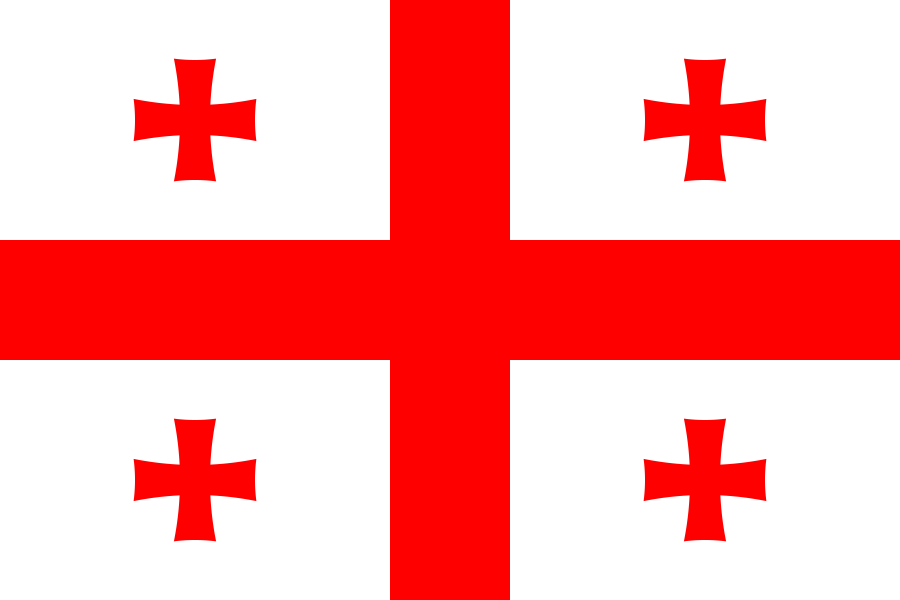
The nationalist dissident who became Georgia's first democratically elected president
"All my life I was in the opposition and fought against the government. Now I am the government": said in an interview after becoming chairman of the newly elected Supreme Council, 1990.
Georgian philologist and dissident, son of the celebrated writer Konstantine Gamsakhurdia. In 1977 he co-founded the Georgian Helsinki Group with Merab Kostava, exposing Soviet human rights abuses to the world, and was repeatedly imprisoned. In April 1989, as co-leader of the Independence Committee, he organized mass peaceful demonstrations and hunger strikes in Tbilisi; the Soviet military's bloody crackdown on them decisively radicalized Georgian opinion toward independence. Leading the Round Table-Free Georgia coalition, he won the first multiparty elections in 1990 and was elected Georgia's first president in May 1991 with 87% of the vote, only to be overthrown in an armed coup seven months later, flee to Chechnya, and die under disputed circumstances in western Georgia in December 1993.
Career timeline
1954Founded the underground youth group Gorgasliani
1963–1977Lecturer in English, Tbilisi State University; researcher, Institute of Literature, Georgian Academy of Sciences
1977–1979Co-founded Georgian Helsinki Group; arrested, imprisoned, released after public recantation
1988–1990Co-chair, Society of St. Ilia the Righteous; co-leader of the Independence Committee
1990–1991Chairman of the Supreme Council of the Republic of Georgia
The Sąjūdis philosopher who launched the 2-million-signature campaign demanding Red Army withdrawal
After a long while of hesitation, I made up my mind to see 'what makes socialism.' After a few years it was absolutely clear.
Lithuanian philosopher and politician who taught philosophy at Vilnius University and edited the cultural journal Kultūros barai. He joined the Lithuanian Communist Party in 1973 but broke with it during perestroika; as a founding member of Sąjūdis (1988), he became the movement's theorist and launched a 2-million-signature campaign demanding the withdrawal of the Red Army from Lithuania. He was a central figure in the trilateral planning of the Baltic Way with the Estonian and Latvian popular fronts, and served as deputy prime minister (1990–1991) in the Landsbergis-Prunskienė cabinet. After independence he founded the Lithuanian Centre Union, served in the Seimas (1992–2000), and opposed EU membership as a surrender of sovereignty.
Career timeline
1957–1962Studied philosophy, Vilnius University
1965–1968Editor, Kultūros barai journal
1973–1989Lecturer in philosophy, Vilnius University
1988–1990Founding member and council member, Sąjūdis
1989–1990People's Deputy, USSR Congress of People's Deputies
1990–1991Deputy Prime Minister of the Republic of Lithuania
Sentenced to death by Ali Nasir Muhammad in the January 1986 clashes, he survived and rose to General Secretary of the Yemeni Socialist Party.
A South Yemeni revolutionary who led the People's Democratic Republic of Yemen through its final years as General Secretary of the Yemeni Socialist Party. An ally of Abdul Fattah Ismail, he survived the January 1986 fighting in Aden, and after Ali Nasir Muhammad's forces were defeated he took over the party and state. He became the first vice-president of unified Yemen in 1990, but resigned in 1993 and proclaimed the short-lived Democratic Republic of Yemen during the 1994 civil war; in exile he led the southern independence movement al-Hirak.
Career timeline
1963Joined the NLF and founded its local committee in Mukalla
1967–1969Minister of Defense
1978Elected Politburo member and Central Committee secretary at the YSP founding congress
1986–1990General Secretary of the YSP, South Yemen's last leader
1990–1993Vice-president of unified Yemen
1994President of the Democratic Republic of Yemen (21 May to 7 July), exiled to Oman after its failure
2009–Leader of the southern independence movement, al-Hirak
A Moscow party organizer at the Soviet Union's end
His life, he later recalled, was divided into a before and after the Communist Party ban.
Yuri Prokofyev was a Soviet party cadre who rose through Moscow's party and administrative organizations. As first secretary of the Moscow City Party Committee, he worked at the point where reform collided with the party's disintegration, and joined the Politburo in 1990. He was involved in the activity of the State Committee on the State of Emergency in 1991 without being a member, then turned to memoir writing and technology enterprises after the Soviet Union and the Communist Party were banned.
Career timeline
1957Pioneer leader at a Moscow school
1960Joined the Communist Party of the Soviet Union
1968Cadre in the Moscow City Party Committee's organizational work
1977–1985Secretary and first secretary of the Kuibyshev District Party Committee in Moscow
1986–1988Secretary of the Moscow City Executive Committee
1988–1989Secretary and second secretary of the Moscow City Party Committee
1989–1991First secretary of the Moscow City Party Committee
1990–1991Member of the CPSU Central Committee and Politburo
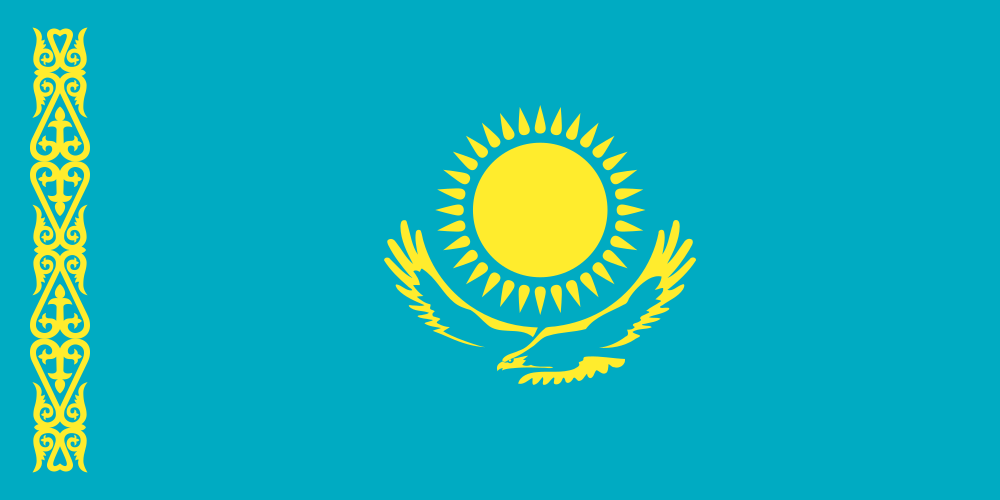
Kazakhstan's thirty-year ruler, defender of the union to its last day
On 8 December 1991 Yeltsin's side telephoned from the Belovezha forest urging him to join; he did not turn his plane. Eight days later his Kazakhstan became the last republic to declare independence, and the union's formal death certificate, the Alma-Ata Protocol, was signed in his capital.
Starting as a blast-furnace worker, Nazarbayev rose through the Kazakh premiership and party first secretaryship to become president of Kazakhstan in 1990, and at Novo-Ogaryovo was the strongest advocate of the new union treaty. Absent from the Belovezha Accords, his Kazakhstan became the last republic to declare independence from the USSR. Ruling for nearly thirty years thereafter, he laid the foundations of the new state through nuclear renunciation, the transfer of the capital and pragmatic multi-vector diplomacy, while leaving behind the charges of authoritarian rule, a personality cult and dynastic corruption. He kept real power after leaving the presidency in 2019, until the unrest of January 2022 ended his era completely.
Career timeline
1960–1969Worker at the Karaganda Metallurgical Combine (blast furnace, casting machines, dispatcher, gasman). Joined CPSU in 1962. Graduated from the Higher Technical School at the Karaganda Metallurgical Combine in 1967.
1969–1973Party and Komsomol work in Temirtau.
1973–1978Secretary of the Party Committee, Karaganda Metallurgical Combine — effectively second-in-command at the 30,000-worker enterprise.
1978–1979Secretary, then Second Secretary, Karaganda Regional Party Committee.
1979–1984Secretary of the Central Committee of the Communist Party of Kazakhstan (industry, transport, communications).
1984–1989Chairman of the Council of Ministers of the Kazakh SSR (Prime Minister). At 44, the youngest head of government of any Soviet republic.
1989–1991First Secretary of the Central Committee of the Communist Party of Kazakhstan. Concurrently President of the Kazakh SSR from 1990. Member of the CPSU Politburo, 1990–1991.
1990–2019President of Kazakhstan (first elected April 1990 as President of the Kazakh SSR; first president after independence, December 1991). Re-elected 1991, 1999, 2005, 2011, 2015. Resigned March 2019.
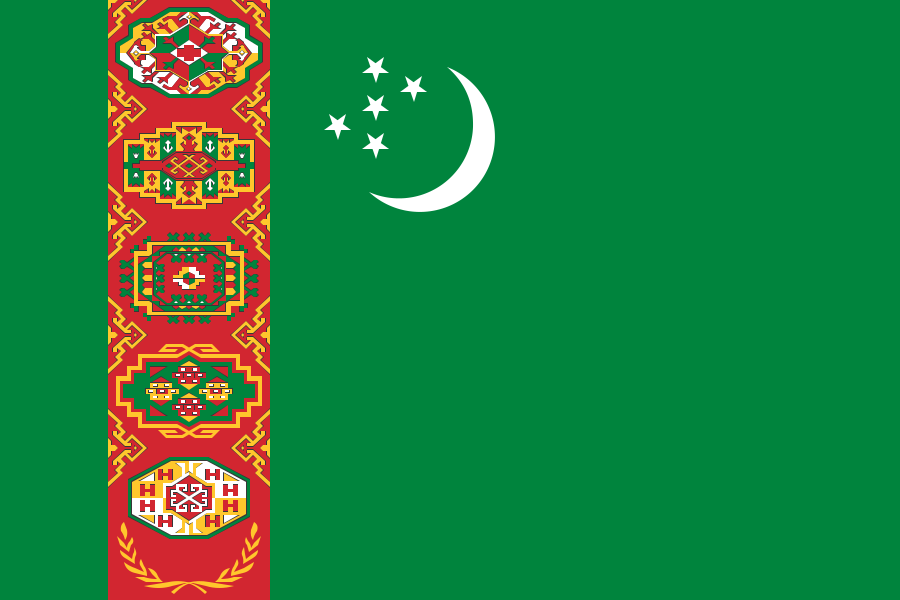
A Turkmen leader who turned late-Soviet rule into personal rule over an independent state
At the 1991 9+1 meetings, he weighed a reworked union against preserving Turkmenistan’s autonomy.
Saparmurat Niyazov was the Soviet-era party and government leader who became independent Turkmenistan’s first president. He led the Turkmen delegation in the 9+1 meetings during the 1991 New Union Treaty process, while the republic’s guarded autonomy limited his role in the negotiations themselves. After independence he invoked neutrality and state sovereignty while concentrating power in the presidency and using the Ruhnama and an extensive personality cult to organize public life. His rule remains a case of post-Soviet state formation fused with authoritarian consolidation.
Career timeline
1962Joined the Communist Party of the Soviet Union
1970–1980Cadre in the Communist Party of Turkmenistan Central Committee
1980–1984First Secretary of the Ashgabat City Party Committee
1985Chairman of the Council of Ministers of the Turkmen SSR
1985–1991First Secretary of the Communist Party of Turkmenistan
1990–1991Chairman of the Supreme Soviet of the Turkmen SSR
1990–2006President of Turkmenistan
1991Head of Turkmenistan’s delegation at the 9+1 New Union Treaty meetings