From Latvian KGB chief to USSR interior minister, a guardian of order shattered in the coup he backed
He took his own life with a pistol in his apartment on 22 August 1991, with an arrest warrant issued. The order of the shots is disputed: prosecutors held he fired first, while Yavlinsky's account and the later investigation concluded his wife fired last.
Born into a family of Latvian communists and a graduate of the Riga Polytechnical Institute, he rose through Komsomol and party work to chair the Latvian KGB in 1980–1984 and lead the Communist Party of Latvia in 1984–1989. As USSR interior minister from December 1990 he pursued a hard line on law and order, and in August 1991 joined the State Emergency Committee (GKChP), mobilizing the interior apparatus behind it. When the coup collapsed he took his own life with a pistol in his Moscow apartment on 22 August 1991.
Career timeline
1960Engineer, Riga Electromechanical Plant
1961–1969Secretary then First Secretary, Proletarsky District Komsomol, Riga; First Secretary, Latvian Komsomol CC
1970–1974Secretary, All-Union Komsomol CC; Inspector, CPSU CC
1974–1976Head of Organizational-Party Work, Latvian CP CC; First Secretary, Riga City Committee
1976–1980Department head, KGB Inspectorate; First Deputy Chairman, Latvian KGB
1980–1984Chairman, KGB of the Latvian SSR (Major-General)
1984–1988First Secretary, CC of the Communist Party of Latvia
1988–1990Chairman, CPSU Party Control Committee; Candidate Politburo member (Sep 1989–Jul 1990)
1990–1991Minister of Internal Affairs, USSR; Security Council member (from Mar 1991)
Constitutional Assembly chairman and first elected mayor of Saint Petersburg
"Volodya, just don't turn to bronze" — last words to Putin, February 2000
Anatoly Sobchak was a legal scholar and democratic reformer who became the first democratically elected mayor of Saint Petersburg (1991–1996) and co-authored the 1993 Constitution of the Russian Federation as chairman of the Constitutional Assembly. A popular Leningrad State University law professor whose students included Vladimir Putin and Dmitry Medvedev, he was elected to the Congress of People's Deputies in 1989 and co-chaired the Inter-Regional Deputies Group alongside Andrei Sakharov and Boris Yeltsin. During the August 1991 coup he organized resistance in Leningrad, negotiating with the military commander to keep troops off the streets and rallying 200,000 citizens on Palace Square. Corruption allegations forced him into exile in Paris from 1997 until Putin, then prime minister, secured his return in 1999.
Career timeline
1989–1990USSR People's Deputy
1989–1990Co-chair, Inter-Regional Deputies Group (with Sakharov & Yeltsin)
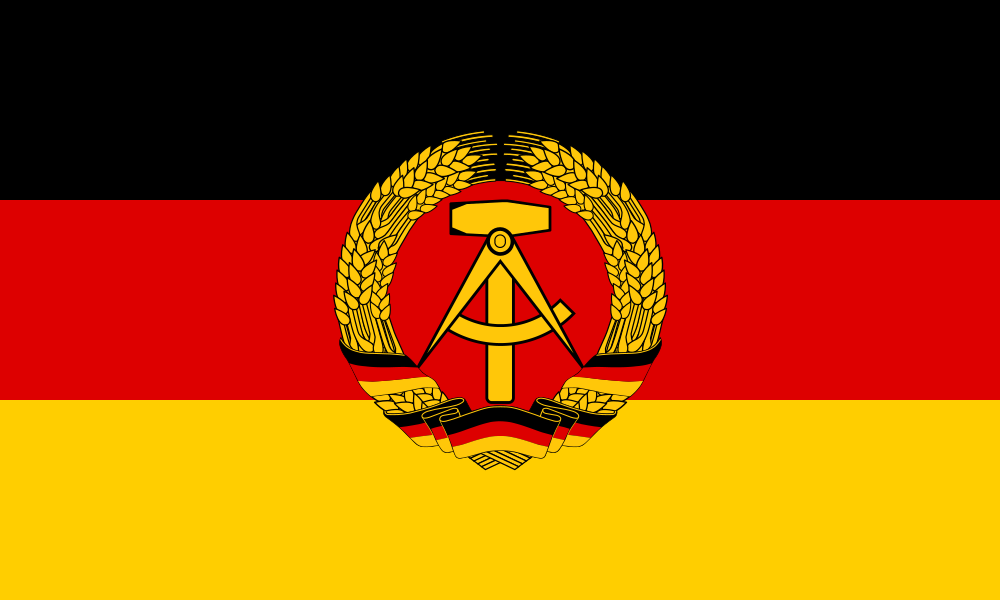
The last communist leader of East Germany, who succeeded Honecker, opened the Wall, and fell in 50 days
On 9 November 1989, Krenz read the travel regulation draft to the Central Committee, handed the note to Schabowski saying "Here, explain this to the journalists," and hours later the Berlin Wall was open.
Designated as Erich Honecker's successor, Egon Krenz was the last communist leader of East Germany, becoming SED General Secretary after Honecker was ousted in October 1989. Just three weeks into his tenure, he approved the draft travel regulations, read them to the Central Committee on 9 November, and handed the note to Günter Schabowski for announcement at a press conference; that night the Berlin Wall was opened. He promised reforms but never gained public trust, and resigned all his posts by early December. After reunification, he was convicted of manslaughter for the border deaths and served nearly four years of a six-and-a-half-year sentence.
Career timeline
1955Joined the Socialist Unity Party (SED)
1971–1974Chairman of the Ernst Thälmann Pioneer Organisation
1974–1983First Secretary of the FDJ Central Council
1983–1989SED Politburo member, CC Secretary for Security, Youth and Sport
1984–1989Deputy Chairman of the State Council
1989.10–12SED General Secretary
1989.10–12Chairman of the State Council and National Defence Council
The last Soviet premier and an August coup participant
Eight days after taking office, on the evening of 22 January 1991, Pavlov ordered 50- and 100-ruble notes exchanged for new bills within three days, with only 1,000 rubles per person swapped immediately. Days earlier he had publicly promised that no monetary reform would take place.
He graduated from the Moscow Finance Institute in 1958 and worked in the finance ministries of the RSFSR and the USSR, joining the CPSU in 1962 and heading Gosplan's finance, cost and price department from 1979 to 1986. He chaired the USSR State Committee on Prices from 1986 to 1989 and served as Minister of Finance until 14 January 1991, when Gorbachev appointed him premier as the Council of Ministers became the Cabinet of Ministers and its head was retitled Prime Minister. In August 1991 he was one of the organizers of the State Committee on the State of Emergency; on 22 August Gorbachev relieved him of the premiership, and he was arrested on 23 August and held at Matrosskaya Tishina prison, with the Supreme Soviet confirming his resignation on 28 August.
The last Politburo member who tried to save the USSR and went to prison for it
Attributed to Shenin after the coup's defeat and reported according to media data, the GKChP members made the main mistake: having said 'A,' they did not say 'B' and all the rest of the alphabet.
Born in 1937 in Stalingrad Oblast, he was convicted in 1958 of violating safety rules after two workers died at his construction site, receiving a one-and-a-half-year sentence and being released early after nine and a half months. He joined the CPSU in 1962 and served as First Secretary of the Achinsk city committee (1974-1977), party adviser in Afghanistan (1977-1983), first secretary of the Krasnoyarsk kraikom (1987-1990). As CC secretary and Politburo member from 1990 he oversaw organizational-party work and was called the third man in the CPSU after Gorbachev and Ivashko, supported the GKChP and on 18 August 1991 flew to Gorbachev at Foros, and was arrested on 23 August 1991. Released on health grounds in October 1992 and amnestied in February 1994, he died aged 71 on 28 May 2009.
Career timeline
1962Joined the CPSU
1974–1977First Secretary, Achinsk City Party Committee
1977–1983Second Secretary, Khakass Obkom → Party adviser, Afghanistan
1985–1987First Secretary, Khakass Oblast Committee
1987–1990First Secretary, Krasnoyarsk Krai Committee
1990–1991Politburo member & CC Secretary, organizational-party work
First and only Vice President of the USSR and the face of the August 1991 coup
To KGB chairman Kryuchkov during the August 1991 coup: 'Understand my character—if even one person dies, I won't be able to live.'
After serving as First Secretary of the Gorky Oblast Komsomol and chairman of the USSR Committee of Youth Organizations (1968–1980), Yanayev became VTsSPS chairman, a Politburo member and CC Secretary in 1990. That December Gorbachev forced through his election as the USSR's first vice president. In August 1991, as the face of the GKChP, he declared himself acting president citing Gorbachev's 'illness'. The coup failed within three days and he was arrested. Amnestied in 1994, he published the memoir Last Battle for the USSR and spent his remaining years in academia.
Career timeline
1959–1963Mechanised-agriculture detachment chief → Selkhoztekhnika branch manager, Gorky Oblast
1966–1968First Secretary, Gorky Oblast Komsomol
1968–1980Chairman, USSR Committee of Youth Organizations
The economist who exposed Soviet growth statistics as an 84-fold exaggeration and recalculated the real record
"The resulting economic mechanism combined all the worst features of both command and market economies": his verdict on the 1965 reform.
He was an economist who began recalculating Soviet official statistics using independent methods in the 1970s, arriving at the explosive finding that national income had grown not by the official 84.4 times but by only 6.6 times between 1928 and 1985. His 1987 article 'The Crooked Figure,' co-authored with Vasily Selyunin in Novy Mir, caused a sensation across Soviet society. He went on to write a multi-volume Economic History of Russia in the Modern Era, offering a dispassionate analysis of the achievements and failures of the Soviet planned economy; of the 1965 Kosygin reform he delivered the verdict that it 'combined all the worst features of both command and market economies.'
Career timeline
1959Graduated from Leningrad Institute of Finance and Economics
1959–1962Economist at industrial enterprises, Riga
1965–1973Lecturer, Novosibirsk State University
1979–1986Lecturer, Institute for Advanced Training, Iskitim
1986–1991Head of Economic Laboratory, Tuva Complex Department, Siberian Branch of the USSR Academy of Sciences
1992Doctor of Economics, Central Economic-Mathematical Institute
1995–현재Professor, Novosibirsk State Technical University
2003–2011Published Economic History of Russia in the Modern Era, vols. 1–3
Tereshkova's backup cosmonaut, the physically strongest candidate Kamanin judged too reserved for the spotlight
"We decided it was worth trying": after she and her fiancé, skydiving instructor Sergey Kiselev, discussed the secret-police recruitment offer at their favorite café until closing time.
A mechanical engineer and nationally ranked parachutist, she was one of five women selected in 1962 for the Soviet Union's first female cosmonaut group. She trained as Valentina Tereshkova's primary backup for the Vostok-6 flight; Nikolai Kamanin rated her the best physically among the candidates but judged her too introverted for the worldwide propaganda role the first woman in space would have to play. Later she prepared with Valentina Ponomaryova for what would have been the first all-female spacewalk on Voskhod, but the mission was cancelled; after the women's group disbanded in 1969, she spent her career as a researcher at the Cosmonaut Training Center and earned a Candidate of Psychological Sciences degree.
Career timeline
1954–59Graduated Ural Polytechnic Institute, mechanical engineering
1955–62National parachute team, Master of Sport (1959), ~700 jumps
1959–62Engineer, Uralenergomontazh design bureau
1962.3Selected for women's cosmonaut group; completed cosmonaut training
1963.5Primary backup to Tereshkova for Vostok-6
1964–67Graduated Zhukovsky Air Force Engineering Academy; pilot-cosmonaut-engineer
1966Trained with Ponomaryova for Voskhod all-female spacewalk (cancelled)
1969–91Researcher and senior researcher at TsPK; Candidate of Psychological Sciences (1980); retired as Colonel
Amid the 1998 financial crisis, Yeltsin offered him the premiership. Maslyukov refused: "I'm ready to work as Primakov's first deputy." The last steward of the Soviet planned economy chose the work he could do over the power he could seize.
Born in Leninabad, Tajikistan, he trained as an engineer and rose through Izhevsk defense plants to become a core technocrat of Soviet military industry. As Gosplan chairman (1988–1991) and Politburo member (1989–1990), he was the last steward of the planned economy. After the USSR's collapse, he served as First Deputy Prime Minister under Yevgeny Primakov (1998–1999), managing the response to the 1998 financial crisis, and later as a Communist Party deputy in the State Duma until his death in 2010, a rare figure who bridged the Soviet planning elite and post-Soviet industrial politics.
Career timeline
1960s–1970sRises as a technocrat in defense industry and state planning organs
1980sWorks in military-industrial and planning bodies in late Soviet industrial policy
1988–1991Chairman of Gosplan during the dismantling of the planned economy
1991 이후Continues in Russian politics and economic administration after 1991
1998–1999Participates in Russian crisis-era economic policy
An economist who carried price theory into the transition to a market economy
Through the 500 Days programme, he pushed his research on price formation toward a plan for transforming the Soviet economy into a market.
Nikolai Petrakov was a Soviet economist who used mathematical analysis to study price formation and the balancing of costs, output, and incomes in a planned economy. He pursued market mechanisms and price reform, and in 1990 joined Stanislav Shatalin and Grigory Yavlinsky as a co-author of the 500 Days programme. The programme sought to move the Soviet economy toward a market through privatization, price liberalization, and a transfer of authority to the republics, placing Petrakov’s research and policy work at the junction of economic modelling and urgent political choice. He later founded the Institute for Market Problems and led research on market transition and economic policy.
Career timeline
1959Graduated from the Faculty of Economics, Moscow State University
1963Earned a Candidate of Economic Sciences degree for research on industrial profitability and pricing
1970–1989Professor of economics at Moscow State University
1972Earned a Doctor of Economic Sciences degree for research on pricing in a planned economy
1984–1990Corresponding member, then full member, of the USSR Academy of Sciences
1990Economic aide to the General Secretary of the CPSU Central Committee, then to the President of the USSR
1990Co-author of the Shatalin-Yavlinsky 500 Days programme
1990–2014Founder and first director of the Russian Academy of Sciences Institute for Market Problems
Architect of women's and family policy in the perestroika era, the fourth woman ever on the Politburo
“I simply refuse to be limited. I would not tolerate it for a minute.” — pushing back against being pigeonholed as the Politburo's 'woman's issues' token
Galina Semyonova was one of only four women in Soviet history to serve as a full member of the CPSU Politburo. As a Central Committee secretary in the late Gorbachev period, she was responsible for family, women's, and demographic policy. For a decade from 1981, she edited Krestyanka (Peasant Woman), transforming the magazine's content toward fashion, family, and culture and raising its circulation from 6 million to 22 million, connecting with the daily lives of millions of Soviet women. Elevated to the Politburo and Secretariat at the 28th Party Congress in 1990, she drove Central Committee resolutions to improve women's social standing and pushed for a new State Committee on Family and Women's Affairs. During the August 1991 coup, she was one of the few in the party leadership who refused to recognize the authority of the GKChP putschists.
The union leader whose arrest sparked the Wujek strike
When news of his arrest reached Wujek on 13 December 1981, the miners decided not to work until he returned.
Jan Ludwiczak was a miner and chairman of the Wujek mine works committee of Poland's Independent Self-Governing Trade Union Solidarity. His detention became the immediate trigger for the miners' strike against martial law and their demand for the release of detained union activists. After his release, he endured demotion and surveillance while distributing underground publications at the mine, and in 1989 helped prepare Solidarity's restoration.
Career timeline
1937Born in Pecna near Poznań
1954Graduated from the Railway Vocational School in Poznań
1958–1959Served in the Mining Military Corps in Katowice
1965–1990Worker at the Wujek coal mine in Katowice
1980Vice-chairman of Wujek Solidarity's Founding Committee
1980–1981Chairman of Wujek Solidarity's works committee
1981–1982Arrested and interned, released in December 1982
1989Chairman of Wujek Solidarity's Temporary Founding Committee
At a Derg meeting he vowed of the aristocrats who called dark-skinned, kinky-haired people slave "Barias": "I shall soon make these ignoramuses stoop and grind corn!"
A leader of Ethiopia’s Derg, the military committee emerging from the 1974 revolution. He consolidated predominance after the 1977 power struggle and led military and party-state institutions. Land reform and state-led development proceeded amid political repression and prolonged war.
Career timeline
1957Graduated Holetta Military Academy, commissioned second lieutenant
1974Derg member (Third Division representative)
1974–1977Deputy chairman of the Derg
1977–1987Chairman of the Derg, head of the military regime
1984–1991General Secretary, Workers' Party of Ethiopia
1987–1991President, People's Democratic Republic of Ethiopia
The chief engineer who refused to believe the reactor was destroyed and kept pumping water into its ruins
He smashed his glasses and cut his wrists with the shards, forcing the court to postpone his trial.
Nikolai Fomin was a Soviet nuclear engineer who joined the Chernobyl plant in 1972 and rose to chief engineer in 1981. Arriving at the plant shortly after the April 26, 1986 explosion, he refused to accept reports that the reactor was destroyed and ordered water to be pumped into the wreckage of Unit 4 for hours, while sending a subordinate on a reconnaissance mission that delivered a fatal radiation dose. Arrested after the disaster, he was sentenced to 10 years but was released early after a pre-trial suicide attempt and subsequent confinement in a psychiatric hospital; he later worked at the Kalinin Nuclear Power Plant before retiring.
Career timeline
1972Started at Chernobyl NPP
1981–1986Chief Engineer, Chernobyl NPP
1987Sentenced to 10 years; imprisoned
1988Transferred to psychiatric hospital; released early
A historian whose break with communism led to conservative anti-communism
Declassified Moscow archives prompted a new examination of the Soviet role in the Spanish Civil War.
Ronald Radosh is an American historian and writer who grew up in a Communist family and passed through the Communist Party USA and the New Left. Reexamining the Rosenberg case led him to revise his earlier belief in their innocence and consolidated his turn toward anti-communist conservatism. With Mary Habeck and Grigory Sevostianov, he edited Spain Betrayed, using Moscow archives to present a critical interpretation of Soviet policy and Comintern influence in the Spanish Civil War.
Career timeline
1937Born in New York City
1950년대Grew up and became active around the Communist Party USA
1960년대Participated in anti-Vietnam War activism and the New Left
1970년대Researched and wrote on modern American history and conservatism
1983Co-authored The Rosenberg File
2001Co-edited Spain Betrayed, analyzing Soviet policy in the Spanish Civil War
2000년대Worked as a researcher and writer at the Hudson Institute
"The traditions of chekism must be eradicated, must cease to exist as an ideology" — the last chairman of the KGB, in his 1992 memoir Deliverance from the KGB.
A construction engineer turned Gorbachev loyalist, Bakatin served as Soviet interior minister (1988–1990) and, after the failed August 1991 coup, as the last chairman of the KGB. Appointed to succeed coup-plotter Vladimir Kryuchkov, he stripped foreign intelligence, communications, and border troops from the agency and restructured the remainder into a smaller presidential security service. His handover of KGB listening-device blueprints from the US embassy in Moscow to American officials in December 1991 brought furious charges of treason from Russian conservatives.
Career timeline
1960–73Construction engineer and manager, Kemerovo
1973–85Party posts in Kemerovo; CPSU Central Committee inspector
1985–87First Secretary, Kirov Oblast Committee
1987–88First Secretary, Kemerovo Oblast Committee
1988–90Minister of Internal Affairs of the USSR
1991.3–8Member, Security Council under the President of the USSR
1991.8–11Chairman of the KGB (last)
1991.11–92.1Head, Inter-republican Security Service (MSB)
The last-generation secretary who rebuilt the Russian Communist Party
On 25 October 1991 Kuptsov met Yeltsin at the Kremlin and urged him to rescind the ban on the Russian Communist Party. Yeltsin refused; Kuptsov then spent a year and a half as the underground First Secretary, steering the party to its reconstituting congress.
A metallurgical engineer who rose from a Vologda collective farm and steel mill through the party ranks, he served as First Secretary of the Vologda Regional Committee (1985–1990). In 1990 he was brought to Moscow as a CPSU Central Committee Secretary, heading the department for socio-political organizations and helping found the Communist Party of the RSFSR. Elected its First Secretary in August 1991 to replace the hardline Ivan Polozkov, he refused to endorse the GKChP coup but was nonetheless investigated for 'complicity.' After Yeltsin banned the party, Kuptsov kept its organizational skeleton alive underground and steered the February 1993 reconstituting congress that became the CPRF, then served eleven years as Zyuganov's first deputy chairman while the new Russian Communist Party consolidated.
Career timeline
1955–1958Collective farm worker, reading-room manager, and military service, Vologda Oblast
1958–1974Rolling-mill operator, foreman, and party committee secretary, Cherepovets Metallurgical Plant
1974–1979First Secretary, Cherepovets City Party Committee
1979–1984First Secretary, Vologda City Party Committee
1984–1985Second Secretary, Vologda Regional Party Committee
1985–1990First Secretary, Vologda Regional Party Committee
1989–1991People's Deputy of the USSR
1990–1991CPSU CC Secretary for socio-political organizations
1991.8–11First Secretary, CP RSFSR Central Committee
1993–2004First Deputy Chairman, CPRF Central Committee
1995–2011Deputy, State Duma of the Russian Federation (2nd–5th convocations)
At the launch pad: "Hey, sky! Take off your hat!" — quoting Mayakovsky, June 16, 1963.
The first woman to fly solo in space: aboard Vostok-6 in 1963, the textile-worker 'Chaika' orbited Earth 49 times over 71 hours alone, a symbol of proletarian women's liberation through science. Later became the first woman general in Russian military history.
Career timeline
1954–60Tire factory and textile mill worker; graduated evening and technical schools
1959–61Parachute training at Yaroslavl aeroclub (90 jumps)
1962.3Selected for women's cosmonaut group (5 candidates)
1963.6.16–19Vostok-6: first woman in space, 71-hour solo flight
1966–89USSR Supreme Soviet deputy; Presidium member 1974–89
1968–87Chairwoman, Committee of Soviet Women
1969Graduated Zhukovsky Academy with honors; Candidate of Technical Sciences, professor
1971–90Member, CPSU Central Committee
1987–92Chair, Union of Soviet Societies for Friendship Abroad
2011–현재State Duma deputy, United Russia
1995/2025Major General, later Lieutenant General — first woman general in Russia
A field enforcer of the Soviet Union's final crisis
After Black January, he personally led the Nagorno-Karabakh Organizing Committee as Moscow's man on the ground.
Viktor Polyanichko was a Soviet party organizer and political adviser who carried Moscow's policy into local power structures in Afghanistan and the South Caucasus. As Second Secretary of the Azerbaijan Communist Party, he sought to restore Baku's authority after Black January and led the Nagorno-Karabakh Organizing Committee, combining party administration with coercive force. He is remembered both as an attempted broker in a collapsing federation and as Moscow's hard-line intermediary in a conflict that deepened beyond Soviet control. After the Soviet Union's collapse he became head of an interim administration at deputy-prime-minister rank in Russia, and was assassinated in North Ossetia in 1993.
Career timeline
1959–1964First Secretary, Orsk City Komsomol Committee
Central banker of the Soviet collapse and Russian transition
On "Black Tuesday," October 11, 1994, the ruble crashed 27% in a single day on the Moscow exchange. Three days later Gerashchenko's Central Bank drove the rate back almost to where it started, crushing the speculators. As a fellow banker put it: "The banks realized the Central Bank could show its teeth."
The only person in Russian history to head the country's main bank four times: twice as Gosbank chairman and twice as Bank of Russia chairman. Appointed Gosbank chairman in 1989, he managed the monetary system through the Soviet collapse. As the Bank of Russia's first chairman in 1992, he carried out the 1993 currency reform. Recalled during the 1998 financial crisis, he negotiated with the IMF and stabilized the ruble, serving into the early Putin presidency. After retiring, he served as a State Duma deputy for the Rodina bloc and ran for president.
Career timeline
1960s–1970sRises through Soviet foreign banking and international finance
1980sMoves through foreign-trade banking into Gosbank leadership
1988–1991Gosbank chairman during late-Soviet monetary strain and republic-level financial fragmentation
1991 이후Handles transition-era financial crises in the Russian central bank
1998 이후Returns as central-bank head after the Russian financial crisis
The last chairman of the KGB of the Ukrainian SSR, who went on to serve the security services of three states: USSR, Ukraine, and Russia
Like the title of his memoir, he served in the special services of three states — the USSR, Ukraine, and Russia. In 1994 he refused Yeltsin's demand to block the amnesty for the October 1993 prisoners, resigned, and said he had kept his oath as a Russian officer to the people.
Nikolai Golushko was a Soviet state security officer who rose through the KGB's Fifth Directorate, responsible for ideological counterintelligence and the suppression of dissent, to become the last chairman of the KGB of the Ukrainian SSR (1987–1991). After the dissolution of the USSR, he briefly headed Ukraine's Security Service (SBU) before moving to Russia, where he served as Minister of Security and Director of the Federal Counterintelligence Service (FSK), making him one of the rare figures to have led security agencies in three states. He resigned as Russia's security minister in early 1994 after clashing with President Yeltsin over the amnesty for participants in the October 1993 crisis, and later published a memoir titled In the Special Services of Three States.
Technocrat who ran Soviet heavy machine-building in its late decades
When Ustinov ordered mortar production at his plant, his minister Afanasyev warned: 'Make one and I hand you to the prosecutor.' Velichko organized a 'heroic storm,' delivered them, and recalled it as 'nervous, not to say absurd, conditions.'
A technocrat who rose from lathe operator to director of Leningrad's Bolshevik plant, Velichko served as minister for energy, heavy, and transport machine-building (1975–1991) and First Deputy Chairman of the USSR Council of Ministers (1991). His ministries built the Atommash nuclear complex, reactor systems for over a dozen nuclear plants, ICBM ground equipment, and the Buran shuttle launch complex. When other industrial ministries faltered in the late 1980s, his proved resilient enough that the government twice consolidated troubled ministries under his leadership. After the Soviet collapse he remained an industrial elder, chairing Tyazhenergomash and advising on Russian industrial policy.
Gorbachev's last agriculture Politburo member: operational chief of perestroika farm policy
In August 1991, when the GKChP was formed, Stroev refused to recognise it — one of the few perestroika-era Politburo members who did not side with the coup.
Stroev began as a collective-farm shepherd in the Oryol countryside and graduated from the Michurinsk Horticultural Institute, a classic Soviet agricultural technocrat. Over three decades he rose through the Oryol party apparatus to become oblast first secretary in 1985, and in 1989 Gorbachev brought him to Moscow as Central Committee Secretary for Agriculture, adding Politburo membership in 1990. As the operational chief of perestroika farm policy, he oversaw the reorganisation of the agro-industrial complex and the response to a deepening food crisis, and he refused to endorse the GKChP during the August 1991 coup. After the Soviet collapse he reinvented himself as a post-Soviet regional heavyweight, serving as governor of Oryol Oblast (1993–2009) and chairman of the Federation Council (1996–2001).
Career timeline
1973–1984Secretary for Agriculture, Oryol Oblast Party Committee
1984–1985Instructor, CPSU Central Committee
1985–1989First Secretary, Oryol Oblast Party Committee
1986–1991Member, CPSU Central Committee
1989–1991CPSU Central Committee Secretary (Agriculture)
In July 1980, he joined the government delegation sent with Mieczysław Jagielski to negotiate with striking workers in Lublin.
Zdzisław Kurowski was a Polish politician who rose through the communist youth movement into the middle ranks of the party and state apparatus. His work connected agricultural, youth, and economic administration, first in Białystok and then in the PZPR Central Committee. When strikes spread through Lublin in July 1980, he was sent with Mieczysław Jagielski on the government delegation that negotiated over wages and living conditions. He later remained a manager of the Polish People’s Republic, serving in external economic posts.
Career timeline
1950–1956Activist, Union of Polish Youth
1957–1972Chairman, Union of Rural Youth
1969–1985Deputy, Sejm of the Polish People’s Republic

 1937–1991
✕ Suicide, shooting order disputed
1937–1991
✕ Suicide, shooting order disputed