Marx's son-in-law, author of The Right to Be Lazy, first socialist deputy in the French parliament
"Healthy in body and mind, I end my life before pitiless old age which has taken from me my pleasures and joys one by one." — Suicide letter, 25 November 1911
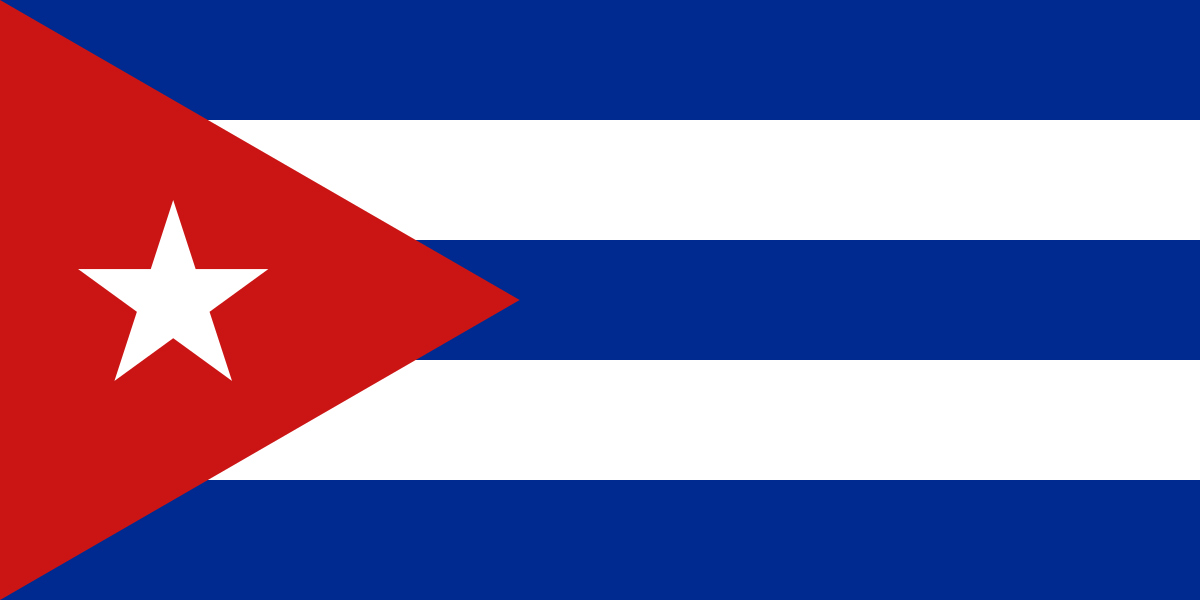
French Marxist theorist born in Cuba. Co-founded the French Workers' Party (POF) with Jules Guesde and systematized economic determinism as a historical method. In his later years, defended revolutionary Marxism against Jean Jaurès's reformism.
Career timeline
- 1864–1865Studied medicine in Paris; joined French section of First International as a Proudhonian anarchist
- 1866–1868Moved to London, frequented Marx household; General Council member, corresponding secretary for Spain
- 1868Married Laura Marx, Karl Marx's second daughter
- 1871–1872Fled to Madrid after Commune's fall; propagated Marxism via La Emancipación, fought anarchist dominance in Spanish section
- 1880Co-founded French Workers' Party (POF) with Jules Guesde; serialized first draft of The Right to Be Lazy in L'Égalité
- 1882–1891Returned to Paris as POF's leading theorist; led strikes and electoral campaigns, repeatedly imprisoned
- 1891Elected from Lille as first socialist deputy in French parliament — campaigned from prison
- 1890s–1905Defended orthodox Marxism against Jaurès's reformism; published major works on economic determinism, origins of property
- 1908–1911Retired from active politics after Toulouse unity congress; wrote memoirs of Karl Marx
Veteran founder of French Marxist socialism who entered the Union sacrée government in 1914
After war began in 1914, Guesde left the socialist antiwar camp and entered the French government as minister without portfolio. At Stuttgart in 1907 he had rejected special antiwar measures apart from the socialist struggle; wartime office brought that position into government practice.
A journalist exiled for supporting the Paris Commune, he drafted the programme of the French Workers’ Party with Marx in 1880 and became the standard-bearer of French Marxism. He long opposed the reformist Jaurès and took part in founding the unified Socialist Party (SFIO) in 1905. At Stuttgart in 1907 he argued that class struggle would abolish war and that no special anti-war action was needed. In August 1914, seeing France itself in danger, he joined the Union sacrée government as a minister without portfolio and stayed until 1916.
Career timeline
- 1880Drafted the French Workers’ Party programme with Karl Marx; the party adopted it at its founding congress in November.
- 1907At the Second International’s Stuttgart Congress, presented the French minority’s resolution rejecting special antiwar measures apart from the general socialist struggle.
- 1914–1916Entered the French government as minister without portfolio after war broke out and served until 1916.
Leader who took the SFIO majority into the Comintern at Tours in 1920, founding the French Communist Party, and ran L’Humanité
At the 1920 Tours Congress, he backed SFIO affiliation with the Comintern, led the majority split, and helped found the French Communist Party. Arrested in 1923 for opposing France’s Ruhr occupation, he was cleared by the Senate sitting as a High Court.
Born in Paimpol in Brittany, he joined Guesde’s French Workers’ Party in 1891 and the unified SFIO in 1905, and from 1918 ran L’Humanité for the rest of his life. As his supporters swung towards the October Revolution after the war, he led the vote to join the Comintern at the Tours congress of 1920 and became a founder of the French Communist Party. He was jailed in 1923 for denouncing the French occupation of the Ruhr. A deputy and senator, he remained the party’s elder statesman until his death in 1958.
Career timeline
- 1892Joined the Gironde section of the French Workers’ Party, founded by Jules Guesde and Paul Lafargue.
- 1905Took part in the founding congress of the unified Socialist Party (SFIO) and became its propaganda delegate.
- 1918Elected director of L’Humanité, which he led until his death in 1958.
- 1920At the Tours Congress, supported SFIO affiliation with the Comintern and helped found the French Section of the Communist International (SFIC), predecessor of the French Communist Party.
- 1923Arrested for opposing France’s Ruhr occupation and brought before the Senate sitting as a High Court; it ruled there was no case to answer.
- 1936Elected senator for the Seine, becoming the first senator from the French Communist Party.