People of the Revolution and the USSR

Activity
Affiliation(set)
Position(set)
Citizenship
Background
Era
GlossarySocialist Revolutionary Party (PSR/SR)

Pan Halippa

Pan Halippa

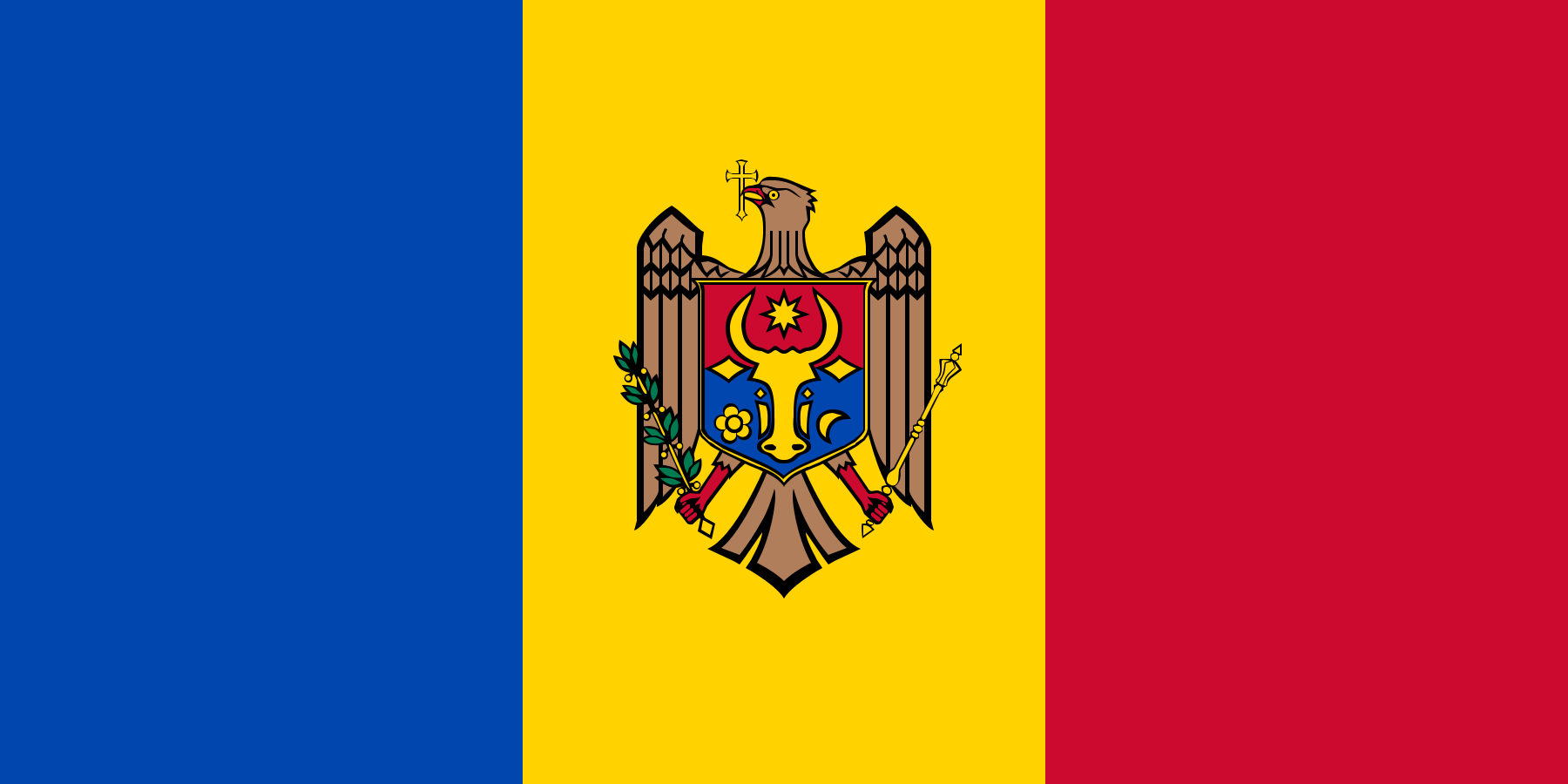
Journalist and politician who, as vice-president and later president of Sfatul Țării, led the movement for Bessarabia’s union with Romania

Born to poor peasants in Cubolta, Bessarabia, in 1883, he graduated from the Chișinău seminary and entered the University of Yuryev, but as a Socialist Revolutionary had to quit after the 1905 revolution. Sought by the Tsarist authorities after printing the hymn “Deșteaptă-te, române!”, he took refuge in Iași and studied there in 1908–1912. From 1913 he published the newspaper Cuvânt moldovenesc in Chișinău, writing unceasingly for union, and in 1917 he founded the Moldovan National Party. He was elected first vice-president, then president of Sfatul Țării. After 1918 he served as minister for Bessarabia and in other posts and joined the National Peasants’ Party; in 1924 he accused the Romanian government of turning Bessarabia into an “inferno”. Arrested in 1950, he was sentenced in the Soviet Union to 25 years’ hard labour, was held until 1957 and died in 1979.

Career timeline
  • 1908–1912Studies at the Faculty of Letters and Philosophy, University of Iași
  • 1913Launches the newspaper Cuvânt moldovenesc
  • 1917Founds the Moldovan National Party
  • 1917–1918Vice-president, then president of Sfatul Țării
  • 1919–1920Romanian Minister and Secretary of State for Bessarabia
  • 1927Romanian Minister of Public Works
  • 1950–1957Arrest and imprisonment (Sighet, Soviet hard labour, Aiud)

Ahmet-Zaki Validi

Әхмәтзәки Вәлиди

Leader of the Bashkir national movement who proclaimed Bashkir autonomy, commanded the Bashkir Army and took it over to the Soviet side

Born in 1890 in Kuzyanovo, Ufa province, he taught Turkic history at the Qasimiya madrasa in Kazan. In 1917 he joined the Socialist Revolutionaries and was elected to the Constituent Assembly; with Sharif Manatov he organised the Bashkir Central Shuro, proclaimed Bashkir autonomy and became commander of the Bashkir Army. Arrested by the Bolsheviks in February 1918 and freed in April, he fought alongside Dutov and Kolchak, but in February 1919 took his troops over to the Soviet side. He became chairman of the Bashrevkom in 1920, resigned in June in protest at the curtailing of autonomy and led the Basmachi movement in Turkestan. He emigrated in 1923, became a Turkish citizen in 1925, a professor at Istanbul University and a doctor of the University of Vienna, and died in Istanbul in 1970.

Career timeline
  • 1909–1915Teacher at the Qasimiya madrasa in Kazan
  • 1915–1917Bureau supporting the Muslim deputies of the State Duma
  • 1917–1919Deputy chairman of the Bashkir Central Shuro; commander of the Bashkir Army
  • 1919–1920Military commissar and deputy chairman of the Bashrevkom; chairman in 1920
  • 1920–1923Leader of the Basmachi movement in Turkestan
  • 1927Chair of Turkish History, Istanbul University
  • 1935Doctor of philosophy, University of Vienna