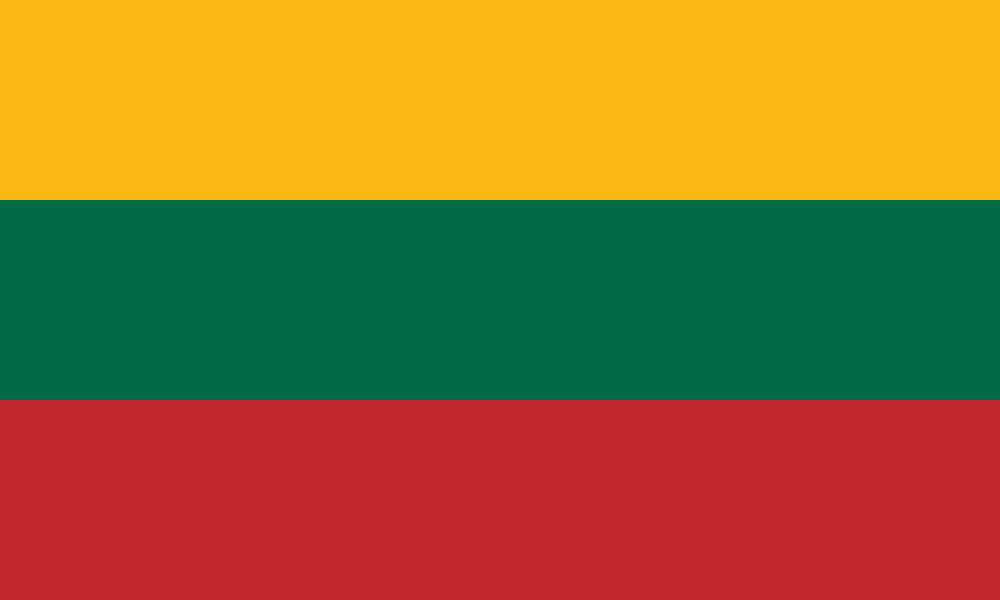
Lithuania's first president who led the declaration of independence, later leader of the 1926 coup
Before leaving the presidential palace he declared, "I do not want to make Lithuania a bolshevik country with my own hands."
Chairman of the Lithuanian Council, he signed the 1918 declaration of independence and as first president from 1919 led the governments that fought the Red Army, Bermondt's troops and the Poles. He built an authoritarian regime after the 1926 coup and, fleeing the Soviet occupation of 1940, died in a fire in the United States in 1944.
Career timeline
- 1902Graduated in law from St. Petersburg University; journalist and national activist in Vilnius
- 1917Chairman of the Council of Lithuania
- 1918Signed the Act of Independence (16 February)
- 1919First President of Lithuania
- 1925Chairman of the Lithuanian Nationalist Union
- 1926Led the December coup; returned as president and ruled with authoritarian powers
Lithuania's first prime minister, later leader of the far-right Iron Wolf
Dissolving the Seimas in 1928, he quipped that he had promised to hold elections but had made no promise about the year.
Prime minister and foreign minister of Lithuania's first cabinet in November 1918, he later fought the Vilnius question in Paris and at the League of Nations. Prime minister again after the 1926 coup, he led the far-right Iron Wolf, broke with Smetona and died in a Soviet prison in 1942.
Career timeline
- 1910Master's degree in history and philology, St. Petersburg University
- 1916Professor at Perm University; joined the Party of National Progress
- 1918First prime minister and foreign minister (Nov); head delegate to the Paris Peace Conference
- 1918–1920Foreign minister in successive cabinets
- 1926Member of the Third Seimas; prime minister and foreign minister after the December coup
- 1928Border treaty with Germany; de facto leader of the far-right Iron Wolf
- 1929Ousted by President Smetona and exiled
- 1934–1938Imprisoned after the failed coup; exiled to France in 1938
Lithuanian officer and envoy in Berlin who founded the Lithuanian Activist Front behind the June Uprising of 1941
Mobilised into the Imperial Russian Army in the First World War, he was the first to enlist in the Lithuanian armed forces after independence in 1918, and on 1 January 1919 his men raised the Lithuanian flag over Gediminas’ Tower in Vilnius. He became Chief of the General Staff in 1925 but had to resign after opposing the 1926 coup. He was envoy to Germany in 1927–1930 and 1938–1941. After the Soviet occupation of 1940 he founded in Berlin the Lithuanian Activist Front, which sought to restore independence by working with the Nazis; named prime minister of the provisional government in 1941, he was held under house arrest by the Germans. In 1944 he was arrested for a memorandum demanding a Lithuanian government. After the war he settled in the United States, working at the Library of Congress. His antisemitic writings have made dedications in his honour controversial.
Career timeline
- 1919Raised the flag over Gediminas’ Tower
- 1925–1926Chief of the Lithuanian General Staff
- 1938–1941Envoy to Germany
- 1940–1941Founded the Activist Front; named provisional prime minister
- 1949Emigrated to the United States
Officer who founded the Union of Lithuanian Freedom Fighters in 1949 and led the partisan resistance as its chairman
Born in Palanga, he graduated from the War School of Kaunas in 1929 as an artillery officer and studied at the School of Applied Artillery in Fontainebleau, France, in 1936–1938. In the deportations of June 1941 his sister’s whole family was sent to Siberia; under the German occupation he retired rather than serve the Nazis. In 1944 he joined the Lithuanian Territorial Defense Force, and when the Red Army returned he joined the Lithuanian Liberty Army and the partisans, rising to the leadership. In February 1949 he founded the Union of Lithuanian Freedom Fighters and became its chairman, working to unify the partisan units and give their struggle a legal framework. Paralysed by a cerebral haemorrhage in December 1951, he was arrested on 30 May 1953, interrogated in Moscow by Beria and executed in Butyrka prison in 1954. In 2009 he was officially named the fourth President of Lithuania.
Career timeline
- 1929Graduated from the War School of Kaunas; artillery officer
- 1936–1938School of Applied Artillery, Fontainebleau
- 1944Lithuanian Territorial Defense Force, then the partisans
- 1949Chairman of the Union of Lithuanian Freedom Fighters
- 1953Arrested
- 1954Executed in Butyrka prison, Moscow