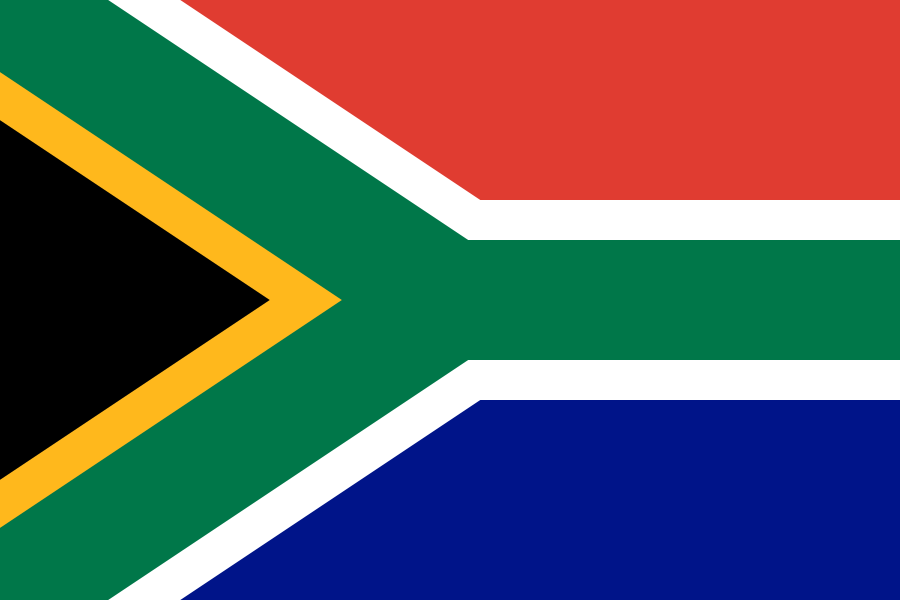
Soldier-statesman who was twice prime minister of the Union of South Africa and went to Budapest as the Entente’s envoy in April 1919
Born to Afrikaner parents in the British Cape Colony, he studied law at Cambridge. He fought as an officer in a commando unit in the Second Boer War and played a key role in negotiating the Treaty of Vereeniging in 1902. He led the creation of the Union of South Africa in 1910, was responsible as defence minister for the Union Defence Force in the First World War and joined the Imperial War Cabinet in London in 1917. At the Paris Peace Conference of 1919 he championed the League of Nations, and on 4 April he went to Budapest, offering Béla Kun’s government a neutral zone more favourable than the Vix note and the lifting of the blockade; when Kun rejected the terms he ended the talks. He was prime minister of the Union of South Africa in 1919–1924 and 1939–1948 and became a field marshal in 1941. He died of a heart attack in 1950.
Career timeline
1899–1902Commando officer in the Second Boer War
1910Creation of the Union of South Africa; interior, mines and defence minister
1917Imperial War Cabinet
1919Delegate at the Paris Peace Conference; envoy to Budapest
1919–1924Prime minister of the Union of South Africa
1939–1948Prime minister of the Union of South Africa
A wartime commander who confronted the limits of long-range air supply
Before the 1944 Warsaw airlift, he warned that the mission offered little military prospect and would incur heavy losses, but it went ahead.
James Thom Durrant was a South African Air Force officer and pilot who commanded reconnaissance and bomber formations in Africa and the Mediterranean during the Second World War. In 1944 he led No. 205 Group RAF from Italy during the Warsaw Uprising airlift, exposing the tension between military feasibility and political obligation in a mission constrained by extreme distance, night flying and enemy defences. After the war he became Director-General of the South African Air Force, but resigned amid conflict with the National Party government’s de-Anglicisation policy and the defence minister.
Career timeline
1933–1934Completed the South African Air Force Permanent Force Cadet Course and qualified as a pilot
1940–1941Commanding officer, No. 40 Squadron SAAF, East Africa
1941–1942Commanding officer, No. 24 Squadron SAAF, Western Desert campaign
1942–1944Commanding officer, No. 3 Bomber Wing SAAF, North Africa, Sicily and Italy
1944–1945Commander, No. 205 Group RAF, directing the Warsaw airlift from bases in Italy
1945–1946Air officer commanding, No. 231 Heavy Bomber Group RAF, Far East
1946–1952Director-General of the South African Air Force