People of the Revolution and the USSR

Christian Georgievich Rakovsky

Христиан Георгиевич Раковский

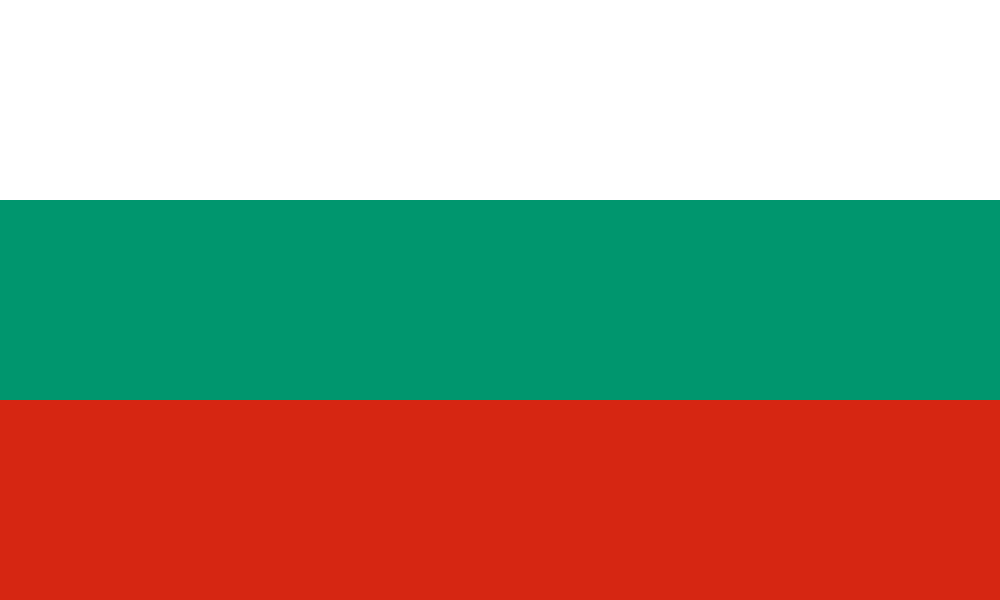
From Balkan revolutionary to head of Soviet Ukraine: the diplomat who became an opposition theorist

"Our misfortune is that we held responsible posts and power turned our heads." Final plea at the 1938 Moscow trial

A pan-European revolutionary of Bulgarian ethnic origin who also held Romanian citizenship, Rakovsky founded the Balkan Social Democratic Federation. As chairman of the Ukrainian Council of People's Commissars from 1919 to 1923 he helped build the Ukrainian Soviet state, and he later served as Soviet ambassador to Britain and France. A Left Opposition theoretician who challenged Stalin's nationalities policy and party bureaucratisation, he was expelled in 1927, admitted his errors to Stalin in 1934 and was readmitted in 1935. Sentenced to 20 years at the Third Moscow Trial in 1938, he was shot at Oryol on 11 September 1941 and rehabilitated on 4 February 1988.

Career timeline
  • 1890–1896Medical studies in Geneva, Berlin, Montpellier; active in European socialist movements
  • 1910Revived Romanian Social Democratic Party; founded Balkan Social Democratic Federation, first secretary
  • 1919–1923Chairman of Sovnarkom of Ukraine; People's Commissar of Foreign and Internal Affairs
  • 1919–1927Member of the Central Committee of the RCP(b); Orgburo member (1919–1920)
  • 1923–1927Plenipotentiary representative of the USSR to Britain (1923–1925) and France (1925–1927)
  • 1927–1935Left Opposition leader; expelled from party, exiled to Astrakhan, Saratov, Barnaul
  • 1934–1937Admitted his errors to Stalin in 1934, readmitted to the party in November 1935; head of scientific institutes administration at RSFSR Health Commissariat
  • 1937–1941Expelled again in 1936, arrested January 1937, Third Moscow Trial 20-year sentence; shot at Oryol on 11 September 1941

Vasily Aleksandrovich Dinkov

Василий Александрович Динков
Soviet Union state institutions Soviet communism Soviet Union Bulgaria 1924–2001 ○ Natural causes

The gas and oil minister who made the USSR the world's largest gas producer

Reassigned from Gas to Oil Minister in 1985, he told a colleague: "All the same, in my soul I'm a gas man. Nothing to be done about it."

Born into an ethnic Bulgarian peasant family, Dinkov served as a reconnaissance scout in the Great Patriotic War and afterwards chaired a kolkhoz in Krasnodar. Graduating from the Azerbaijan Industrial Institute, he rose from oilfield engineer to Minister of the Gas Industry in 1981. He tripled gas output and completed the Urengoy–Pomary–Uzhgorod transcontinental pipeline (4,450 km), linking Siberian fields to Western Europe. Shifted to Oil Industry Minister in 1985, he oversaw the USSR's peak crude production of 624 million tons in 1988, still the highest annual output of any single country. After retirement he served on the Gazprom board, guiding the gas industry through its market transition.

Career timeline
  • 1942–1947Red Army reconnaissance scout, Great Patriotic War
  • 1947–1954Kolkhoz chairman in Krasnodar; graduated Azerbaijan Industrial Institute
  • 1954–1962Engineer at Krasnodarneft and Abinneft oil administrations
  • 1962–1965Head of Krasnodar Main Gas Pipelines → first General Director of Kubangazprom
  • 1966–1970Head of Glavgazdobycha, Ministry of the Gas Industry of the USSR
  • 1970–1981Deputy Minister → First Deputy Minister of the Gas Industry of the USSR
  • 1981–1985Minister of the Gas Industry of the USSR
  • 1985–1989Minister of the Oil Industry of the USSR
  • 1979–1989Deputy of the USSR Supreme Soviet (Turkmen SSR)
  • 1986–1990Member of the CPSU Central Committee