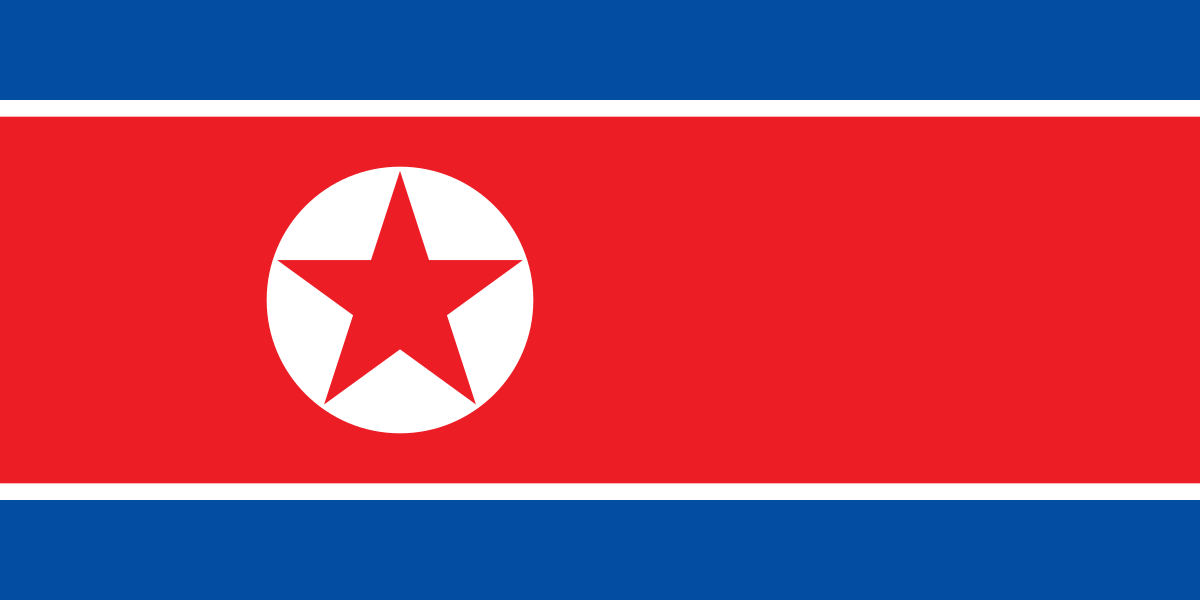
People of the Revolution and the USSR

Kim Won-bong

김원봉

Heroic Corps founder who evolved from anarchist bombings to DPRK cabinet, lone figure spanning the Korean revolutionary spectrum

On first meeting Kim Ik-sang in Beijing, Kim Won-bong told him: 'Freedom is won by our strength and our blood… We must be the first to shed it.' Kim Ik-sang joined the Heroic Corps on the spot and weeks later walked into the Japanese Government-General building in Seoul and threw a bomb.

Anarchist militant who founded the Heroic Corps (Ŭiyŏltan) in 1919 and led a six-year campaign of bombings and assassinations against Japanese colonial authorities. After military training at the Whampoa Academy, he founded the Korean National Revolutionary Party (1935) to build a united front, commanded the Korean Volunteer Corps, and later joined the Provisional Government as Deputy Commander of the Korean Liberation Army and Minister of Military Affairs. Following liberation he pursued left-right cooperation, but after Yeo Un-hyeong's assassination he joined the 1948 North-South talks and remained in the DPRK as State Inspection Commissioner and Minister of Labor until his purge in 1958. His trajectory, from anarchist bombings to united-front politics to DPRK cabinet, makes him the only figure to span the entire Korean revolutionary spectrum.

Career timeline
  • 1919Founded the Heroic Corps, became its leader (Ŭibaek)
  • 1926Enrolled in Whampoa Military Academy, 4th class
  • 1935Founded the Korean National Revolutionary Party
  • 1938Organized the Korean Volunteer Corps, became commander
  • 1944Minister of Military Affairs, Provisional Govt.; Deputy Commander, Korean Liberation Army
  • 1948State Inspection Commissioner, DPRK
  • 1952Minister of Labor, DPRK
  • 1957Vice Chairman, SPA Standing Committee

Choe Yong-gon

최용건
Democratic People’s Republic of Korea Communism North Korea North Korea 1900–1976 ○ Illness

The Manchurian guerrilla who became the KPA's first commander and the DPRK's nominal head of state

In December 1955, Choe Yong-gon presided over the trial of Pak Hon-yong and sentenced him to death, rejecting pleas for clemency from Mao Zedong and Zhou Enlai.

After military training at Yunnan and Whampoa academies, he led anti-Japanese guerrilla war in Manchuria as chief of staff of the 2nd Route Army and commander of the 7th Army of the Northeast Anti-Japanese United Army, forming the Manchurian trio with Kim Il Sung and Kim Chaek. Returning in 1945, he played the decisive role in converting Cho Man-sik's Korean Democratic Party to a communist line; upon the DPRK's founding in 1948 he became its first Minister of National Defence and Chief Commander of the Korean People's Army, the KPA's senior field commander during the Korean War. From 1957 to 1972 he chaired the Supreme People's Assembly Standing Committee, the DPRK's nominal head of state, and served as the regime's diplomatic face abroad. He received a state funeral at his death in 1976 and was interred in the Patriotic Martyrs' Cemetery.

Career timeline
  • 1923–1924Graduated from Yunnan Military Academy
  • 1925–1927Instructor at Whampoa Military Academy
  • 1936–1940Chief of Staff, 2nd Route Army & Commander, 7th Army, Northeast Anti-Japanese United Army
  • 1942–1945Deputy Chief of Staff, 88th Special Brigade, Soviet Far East
  • 1946–1955Chairman, Central Committee of the Korean Democratic Party
  • 1948–1957Minister of National Defence & Chief Commander, Korean People's Army
  • 1957–1972Chairman, Standing Committee of the Supreme People's Assembly
  • 1972–1974Vice President of the DPRK