People of the Revolution and the USSR

Jan Smuts

Jan Christian Smuts
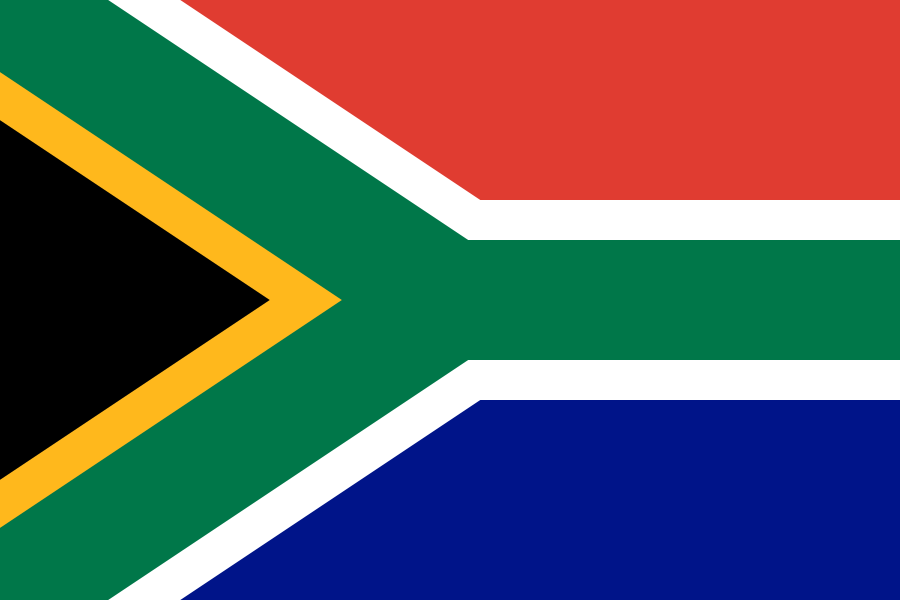
South Africa state institutions South Africa South Africa (Afrikaner) 1870–1950 ○ Heart attack

Soldier-statesman who was twice prime minister of the Union of South Africa and went to Budapest as the Entente’s envoy in April 1919

Born to Afrikaner parents in the British Cape Colony, he studied law at Cambridge. He fought as an officer in a commando unit in the Second Boer War and played a key role in negotiating the Treaty of Vereeniging in 1902. He led the creation of the Union of South Africa in 1910, was responsible as defence minister for the Union Defence Force in the First World War and joined the Imperial War Cabinet in London in 1917. At the Paris Peace Conference of 1919 he championed the League of Nations, and on 4 April he went to Budapest, offering Béla Kun’s government a neutral zone more favourable than the Vix note and the lifting of the blockade; when Kun rejected the terms he ended the talks. He was prime minister of the Union of South Africa in 1919–1924 and 1939–1948 and became a field marshal in 1941. He died of a heart attack in 1950.

Career timeline
  • 1899–1902Commando officer in the Second Boer War
  • 1910Creation of the Union of South Africa; interior, mines and defence minister
  • 1917Imperial War Cabinet
  • 1919Delegate at the Paris Peace Conference; envoy to Budapest
  • 1919–1924Prime minister of the Union of South Africa
  • 1939–1948Prime minister of the Union of South Africa

Chris Hani

Chris Hani
South African Communist Party (SACP) Communism South Africa South Africa 1942–1993 ✕ Assassinated

The SACP leader who kept the revolutionary flame alive after laying down arms

“We are negotiating to create better conditions for socialism. I am a communist.” — Interview shortly before his assassination, 1993

General Secretary of the South African Communist Party and Chief of Staff of Umkhonto we Sizwe, he led the left wing of the liberation movement from armed struggle through the turn to negotiations. His assassination by a far-right immigrant in 1993 nearly derailed South Africa's democratic transition, but instead galvanized the final agreement on the 1994 elections.

Career timeline
  • 1957Joined ANC Youth League at age 15
  • 1959–1961Studied English, Latin and classics at Fort Hare University
  • 1961Joined the South African Communist Party
  • 1962Joined Umkhonto we Sizwe (MK)
  • 1963Arrested; fled to Lesotho; adopted the name Chris
  • 1967–1969Zimbabwean War of Liberation: joint MK-ZIPRA operations
  • 1969Co-signed the 'Hani Memorandum' criticizing ANC/MK leadership
  • 1974Elected to ANC National Executive Committee
  • 1982MK Chief of Staff; directed guerrilla operations from Lusaka
  • 1990Returned permanently to South Africa after ANC unbanning
  • 1991.12Elected SACP General Secretary, succeeding Joe Slovo
  • 1993.04.10Shot dead outside his Boksburg home by a far-right immigrant