Last Emir of Bukhara, driven into exile in Afghanistan by the Red Army in 1920
Born in Bukhara in 1880, the son of Emir Abdulahad Khan, he was sent at thirteen to Saint Petersburg, where he spent three years at the Nicholas Cadet Corps studying government and military affairs, and on his return governed Nasaf and Karmana. In 1911 he became the twelfth and last emir of the Manghit dynasty. He began his reign with reforms against bribery and unauthorised taxation, but soon sided with the traditionalists, and after 1917 he repressed the reformers, the Young Bukharans among them. He repulsed the Bolshevik attack led by Kolesov in March 1918, but during the Bukhara operation at the end of August 1920 he fled via Dushanbe to Kabul. In exile he cooperated with the British in the hope of regaining power and is said to have supported the Basmachi; he died in Kabul in 1944.
Career timeline
1896Confirmed by the Russian government as Crown Prince of Bukhara
Lakai tribal chief who fought for the restoration of the Emir of Bukhara as the leading Basmachi commander in eastern Bukhara
Born around 1889 in the village of Koktash in the Emirate of Bukhara, the youngest son of an elder of the Uzbek Lakai tribe, he became bek of his tribe in 1920 and entered the service of Emir Said Alim Khan. After the emir fled he rallied the tribes of eastern Bukhara and led the Basmachi in the name of the emir’s restoration. Championing Islamic conservatism, he drove the Jadids from the movement’s ranks and was so suspicious of Enver Pasha that he once arrested him. After withdrawing to Afghanistan in 1926 he kept raiding across the border and also fought Afghan government troops. Captured while crossing the Kafirnigan River on Soviet territory in June 1931, he was taken to Tashkent and shot on 31 August. Uzbekistan’s Supreme Court rehabilitated him in 2021.
Career timeline
1920Bek of the Lakai tribe in the service of the Emir of Bukhara
1921–1925Led the armed struggle in eastern Bukhara for the emir’s restoration
1926–1931Raids into Soviet territory from bases in Afghanistan
An authoritarian state-builder who made sovereignty his political principle
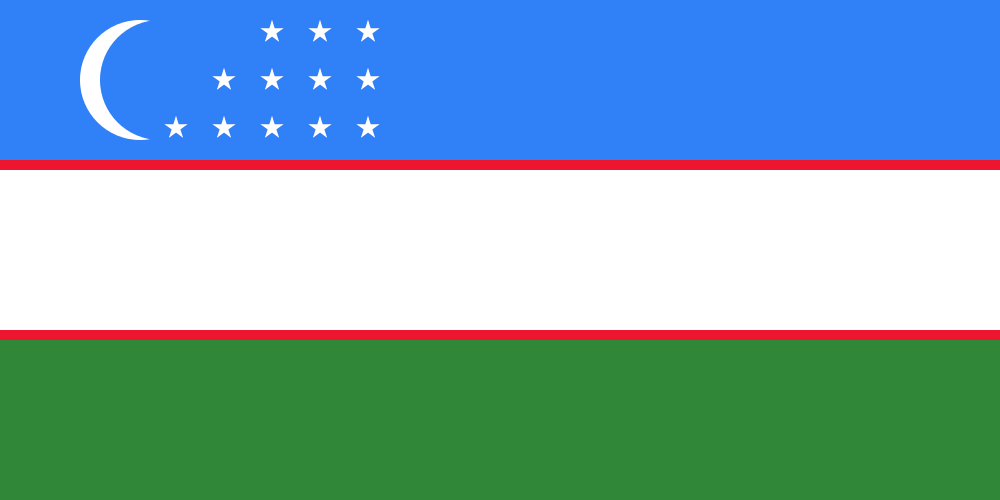
Uzbekistan voted to remain in the Union in 1991, yet Karimov declared independence later that same year.
Islam Karimov was a politician who moved from economic administration in the Soviet system to become Uzbekistan’s first president. During the negotiations over the Union’s future, he placed Uzbekistan’s sovereignty and freedom of choice above preserving a common Soviet state, and after independence made that principle central to state-building. His government pursued industrial capacity and political consolidation, but hardened into authoritarian rule that restricted opposition and the press and responded harshly to Islamist movements and mass protest. Karimov is therefore remembered both as the founder of a sovereign post-Soviet Central Asian state and as a ruler who sacrificed political pluralism to preserve it.
Career timeline
1960–1966Mechanical engineer in Tashkent machinery and aircraft production
1966–1983Economic official in the Uzbek SSR State Planning Committee
1983–1986Minister of Finance of the Uzbek SSR
1986Chairman of the Uzbek SSR State Planning Committee and deputy chairman of its Council of Ministers
1986–1989First secretary of the Communist Party committee in Kashkadarya Region
1989–1991First secretary of the Central Committee of the Communist Party of Uzbekistan
1990–1991President of the Uzbek SSR
1991–2016First President of Uzbekistan
1991–1996Chairman of the People’s Democratic Party of Uzbekistan