People of the Revolution and the USSR

Faizulla Gubaidullayevich Khodzhayev

Файзулла Губайдуллаевич Ходжаев

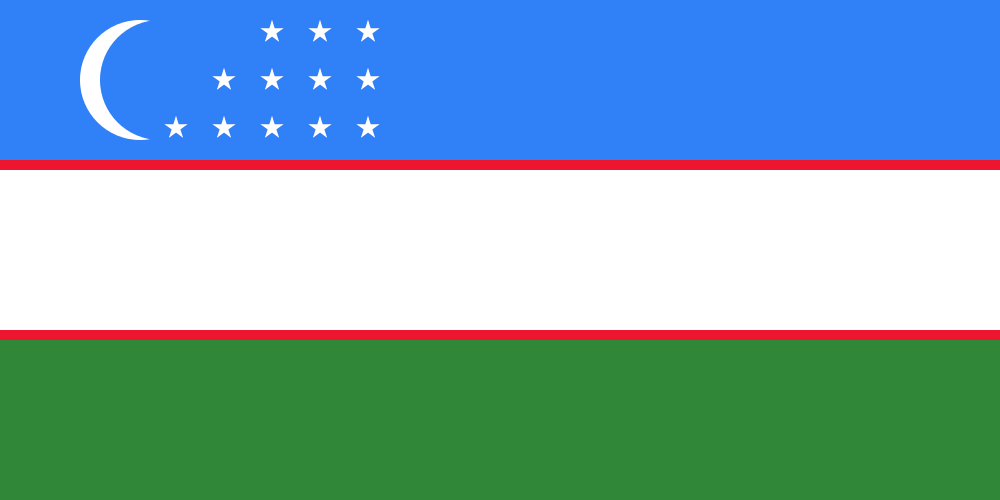
Soviet Union Soviet communism Soviet Union Uzbekistan 1896–1938 ✕ Executed

Son of a Bukharan merchant who rose from the Jadid reform movement to become the first head of government of Soviet Uzbekistan

Russian diplomat Alexander Barmine recalled: "Fayzulla Khodzhayev, called the 'Lenin of the Uzbeks,' was small, wiry, and full of consuming energy, in spite of the malaria which often gave his face a greenish tinge. He enjoyed life, and could laugh gaily beneath a crushing load of work. He knew his people, was a great orator, and was much loved."

Born to a wealthy merchant family in Bukhara, Khodzhayev was sent to Moscow at age 11 and confronted the gap between traditional society and modern Europe. He joined the Jadid movement in 1916, co-founded the Young Bukharan Party, and after a failed 1918 coup against the Emir, fled to Tashkent under a death sentence. In 1920 he became Chairman of the Council of People's Nazirs of the Bukharan PSR, and in 1924 the first Chairman of the Council of People's Commissars of the Uzbek SSR, leading Central Asia's national delimitation and integration into the USSR. He opposed Stalin's cotton monoculture drive, lost influence, and was arrested in 1937, sentenced to death at the Third Moscow Trial.

Career timeline
  • 1916Joined the Jadid movement, co-founded the Young Bukharan Party, member of its underground Central Committee
  • 1918Failed coup against the Emir; fled to Tashkent; sentenced to death in absentia
  • 1919–1920Organized the Bureau of Revolutionary Young Bukharans in Tashkent; edited Uchqun
  • 1920–1924Chairman, Council of People's Nazirs, Bukharan People's Soviet Republic
  • 1924–1937Chairman, Council of People's Commissars of the Uzbek SSR (first)
  • 1925–1937Chairman of the CEC of the USSR from the Uzbek SSR
  • 1937–1938Dismissed and arrested; sentenced to death at the Third Moscow Trial; executed 15 March 1938

Akmal Ikramovich Ikramov

Акмаль Икрамович Икрамов
Soviet Communist Party and Bolsheviks Soviet communism Soviet Union Uzbekistan 1898–1938 ✕ Executed

First ethnic Uzbek to head the CP of Uzbekistan, who drove collectivization and cotton monoculture before the Great Purge destroyed him

"I am now a stripped, human-like beast." Recorded as Ikramov's last word at the Third Moscow Trial in March 1938, though other sources give the variant "you have turned me into an animal," so the exact wording is not settled.

Born in September 1898 in Tashkent into an Uzbek peasant family. He joined the Bolsheviks in February 1918, led party organs in Turkestan during the Civil War, and was secretary of the CC of the CP of Turkestan in 1921–1922. After studying at Sverdlov Communist University from 1922, he sat on the Orgburo that founded the CP of Uzbekistan in 1924–1925. From 1929 he was First Secretary, the first ethnic Uzbek in the post, and drove forced collectivization, making Uzbekistan the USSR's main cotton supplier. Elected to the all-Union Central Committee in 1934, he was dismissed in 1937, arrested on 20 September 1937, sentenced to death at the Third Moscow Trial in March 1938 and shot. Fully rehabilitated and restored to the party in June 1957.

Career timeline
  • 1918–1920Teacher and inspector, Namangan education; head of rural work, Fergana oblast committee
  • 1920–1921Deputy chairman Namangan revkom, chairman Muslim Bureau, executive secretary Fergana and Syrdarya oblast committees
  • 1921–1922Head of organization department and secretary, CC CP of Turkestan
  • 1922–1924Studied at Sverdlov Communist University, Moscow
  • 1924–1929Orgburo for founding CP Uzbekistan; secretary Tashkent oblast; CC second secretary; editor of Kommunist
  • 1929–1937First Secretary, CC CP Uzbekistan — drove collectivization and cotton monoculture
  • 1934–1937Member, CC VKP(b) — sole ethnic-minority member
  • 1937–1938Dismissed and arrested; sentenced to death at Third Moscow Trial; executed