His name 'Rafiq' means 'comrade' in Arabic. When Gorbachev elevated him to chairman of the Soviet of Nationalities, Ukrainian Komsomol leader Valeriy Tsybukh dubbed him 'Gorbachev's personal Rafiq.'
Born the son of a farm laborer, he rose through the Tashkent city party and the republic foreign ministry to become First Secretary of the Uzbek Communist Party in 1988. Tasked with stabilizing the republic after the Rashidov cotton scandal, he earned Gorbachev's confidence and was elevated the following year to chairman of the Soviet of Nationalities. An Uzbek who reached the highest federal tier, he presided over the multinational Union's final parliament as the state itself dissolved around him.
Career timeline
1950s–1970sRises through Uzbek republic diplomatic and party administration
1986–1988First Secretary of the Uzbek Communist Party after Rashidov, managing the post-scandal republic
1989–1991Chairman of the Soviet of Nationalities, the last representative line during the Union’s collapse
1991His office disappears amid the August coup and dissolution of the Union
after 1991Lives in Russia after 1991 as a late-Soviet republic elite figure
An authoritarian state-builder who made sovereignty his political principle
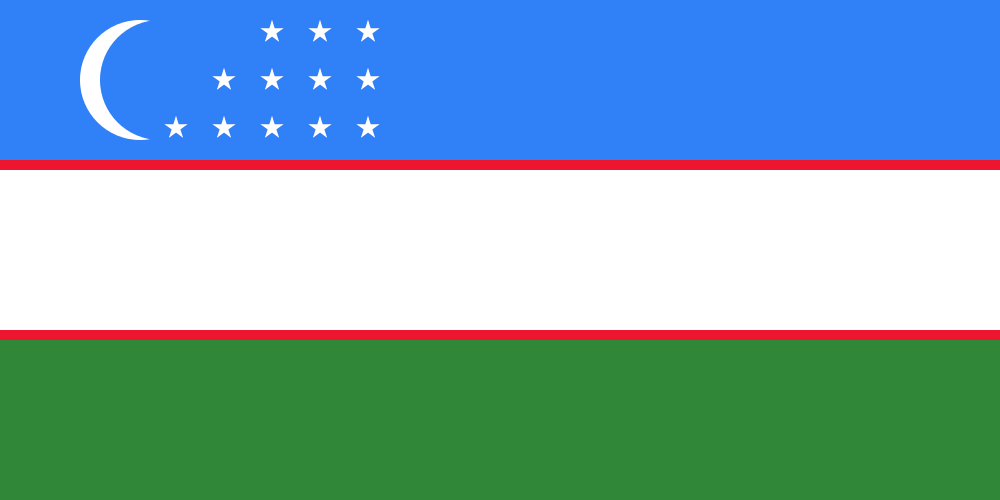
Uzbekistan voted to remain in the Union in 1991, yet Karimov declared independence later that same year.
Islam Karimov was a politician who moved from economic administration in the Soviet system to become Uzbekistan’s first president. During the negotiations over the Union’s future, he placed Uzbekistan’s sovereignty and freedom of choice above preserving a common Soviet state, and after independence made that principle central to state-building. His government pursued industrial capacity and political consolidation, but hardened into authoritarian rule that restricted opposition and the press and responded harshly to Islamist movements and mass protest. Karimov is therefore remembered both as the founder of a sovereign post-Soviet Central Asian state and as a ruler who sacrificed political pluralism to preserve it.
Career timeline
1960–1966Mechanical engineer in Tashkent machinery and aircraft production
1966–1983Economic official in the Uzbek SSR State Planning Committee
1983–1986Minister of Finance of the Uzbek SSR
1986Chairman of the Uzbek SSR State Planning Committee and deputy chairman of its Council of Ministers
1986–1989First secretary of the Communist Party committee in Kashkadarya Region
1989–1991First secretary of the Central Committee of the Communist Party of Uzbekistan
1990–1991President of the Uzbek SSR
1991–2016First President of Uzbekistan
1991–1996Chairman of the People’s Democratic Party of Uzbekistan