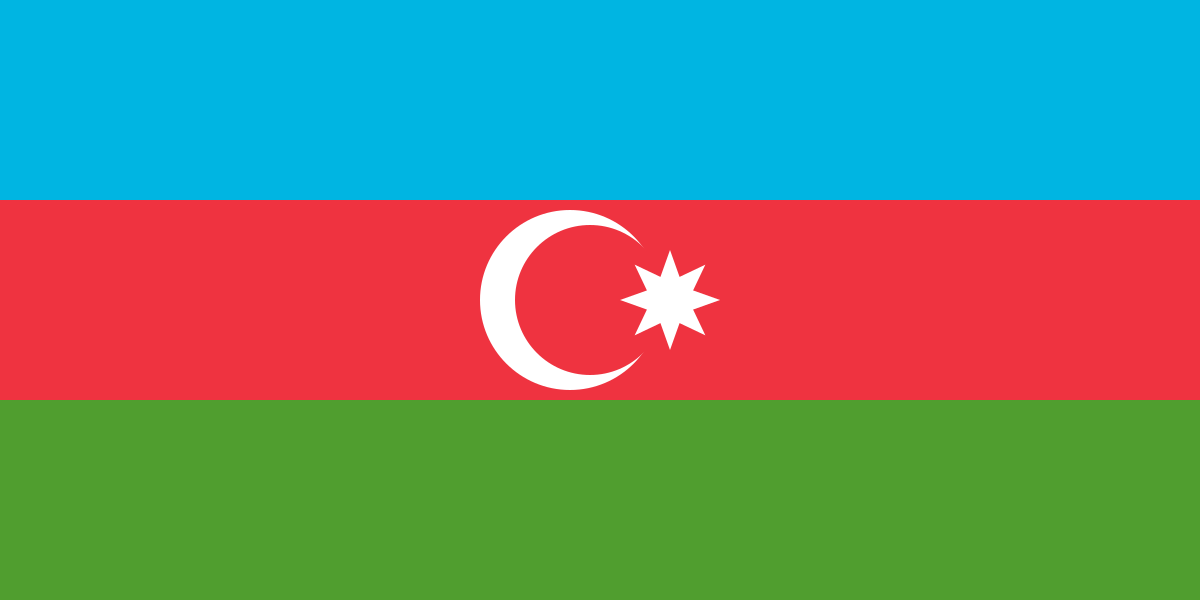
Stalin-era party boss who ruled Azerbaijan for two decades
His statements at trial were said to have been only a few sentences, one of them: "What ruined me was my faith in Stalin."
First Secretary of the Azerbaijan Communist Party from 1933 to 1953, governing the republic for two decades. A former Cheka/GPU/OGPU chairman and People's Commissar of Internal Affairs, he led the mass repression of the republic's party, state and cultural cadres during the Great Terror, and was executed by shooting in May 1956 after Beria's fall.
Career timeline
1917Joined Bolsheviks (Mar 1917 or 1918 — disputed); deputy chairman, Quba Revolutionary Committee
1918–1920Russian Civil War: regimental commander, divisional military commissar, chairman of Revolutionary Military Tribunal
1921–1927Chairman of Cheka/GPU/OGPU and People's Commissar of Internal Affairs, Azerbaijan SSR
1929–1930Chairman of GPU/OGPU, Azerbaijan SSR (second term)
1932–1933Chairman, Council of People's Commissars, Azerbaijan SSR
1933–1953First Secretary, CC of Communist Party of Azerbaijan (20 yrs); concurrently First Secretary of Baku City Committee until 1950
1953Candidate member, CPSU Presidium (Mar–Jul); Chairman, Council of Ministers, Azerbaijan SSR
1954–1956Arrested Mar 1954; death sentence Apr 1956, shot in May 1956 (sources give 26 May or 7 May)
"Comrade Stalin, you were imprisoned by enemies, but I was imprisoned by our own."
Born to a Jewish oil worker's family in Baku, he rose from engineer to People's Commissar of Armaments in 1939. Arrested and tortured just before the war, he was summoned by Stalin after the German invasion and appointed Commissar of Ammunition, quadrupling shell production by war's end. After the war, he led the First Main Directorate alongside Kurchatov, building the administrative and industrial foundation of the Soviet atomic bomb project, and later oversaw hydrogen bomb development. He was one of the very few awarded the Hero of Socialist Labor three times.
Career timeline
1930sRises through defense-industry and armaments production administration
1941Arrested, then released after the war begins to return to ammunition production
1941–1945Ammunition commissar directing mass production of shells and munitions
1945–1953Handles atomic-bomb project administration in the First Main Directorate
after 1953Survives after Beria’s fall because of atomic-production expertise
Metallurgy administrator of Stalinist industrialization
In 1930, appointed head of ferrous metallurgy at 28, he asked Ordzhonikidze to send him to the factory floor instead. He chose the furnace over the desk — and became the Soviet Union's master of steel.
An Armenian from Shusha, he trained at the Moscow Mining Academy and on the shop floor of the Elektrostal plant. Rising through the Special Steel Trust, he moved through defense industry and shipbuilding before becoming commissar for ferrous metallurgy in 1940. During the war he evacuated southern and central metal plants beyond the Urals and directed specialty steel production for tanks, aircraft and ammunition, earning the Hero of Socialist Labor title in 1943. After the war he led reconstruction as Deputy Premier and Minister of Ferrous Metallurgy, while also overseeing uranium supply for the Soviet atomic project. In 1938 his German internship nearly cost his life on suspicion of being a 'German spy,' but Stalin personally intervened.
Career timeline
1920s–1930sRises through metallurgy and heavy-industry administration
1939–1940As shipbuilding commissar, manages a key armaments production base
1940–1953Manages wartime production across ferrous metallurgy, shipbuilding and transport machinery
1949–1956Minister of ferrous metallurgy, involved in postwar heavy-industry reconstruction
1956–1958Moves to ambassador to Japan, shifting from production administration to diplomacy
Soviet theoretical physics titan who founded the 'Landau school' and pioneered quantum fluid dynamics
He rated physicists on a logarithmic scale by achievement: class 1 was Bohr, Heisenberg, Dirac. Einstein alone was class 0.5. He once placed himself at 2.5, later promoting himself to 1.5.
Soviet theoretical physicist. He founded the 'Landau school' in Kharkov, selecting disciples through his rigorous Theoretical Minimum exam, and pioneered condensed matter physics with his theories of superfluidity and Fermi liquids. His Course of Theoretical Physics with Lifshitz set the global textbook standard.
Career timeline
1932–1937Head of Theoretical Department, UFTI · Professor at Kharkov University
1937–1968Head of Theoretical Department, Institute for Physical Problems, Moscow
1943–1947Professor of Low-Temperature Physics, Moscow State University
1945–1953Participant in the Soviet atomic project · Three Stalin Prizes
1946Elected full member (academician) of the USSR Academy of Sciences
1962Nobel Prize in Physics for 'pioneering theories of condensed matter, especially liquid helium'