People of the Revolution and the USSR

Franz Ferdinand

Franz Ferdinand

Austria state institutions Monarchy and royalism Austria Austria 1863–1914 ✕ Assassinated in Sarajevo

Heir presumptive of Austria-Hungary whose assassination in Sarajevo in 1914 was the immediate cause of the First World War

Born in Graz, the eldest son of Archduke Karl Ludwig, the younger brother of Emperor Franz Joseph, he became heir presumptive after Crown Prince Rudolf’s suicide in 1889 and his father’s death in 1896. His morganatic marriage to Sophie Chotek was allowed only after he renounced his descendants’ rights to the throne. He exerted great influence over the armed forces and in 1913 became their inspector general. Clericalism, anti-democratic views and anti-Hungarianism were the cornerstones of his politics; he advocated more autonomy for the empire’s Slav peoples, but urged caution towards Serbia for fear of conflict with Russia. On 28 June 1914 he and his wife were assassinated in Sarajevo by Gavrilo Princip, setting off the July Crisis and the war.

Career timeline
  • 1896Heir presumptive of Austria-Hungary
  • 1900Morganatic marriage to Sophie Chotek
  • 1913Inspector general of the armed forces
  • 1914.06.28Assassinated in Sarajevo

Bogd Khan

Богд хаан
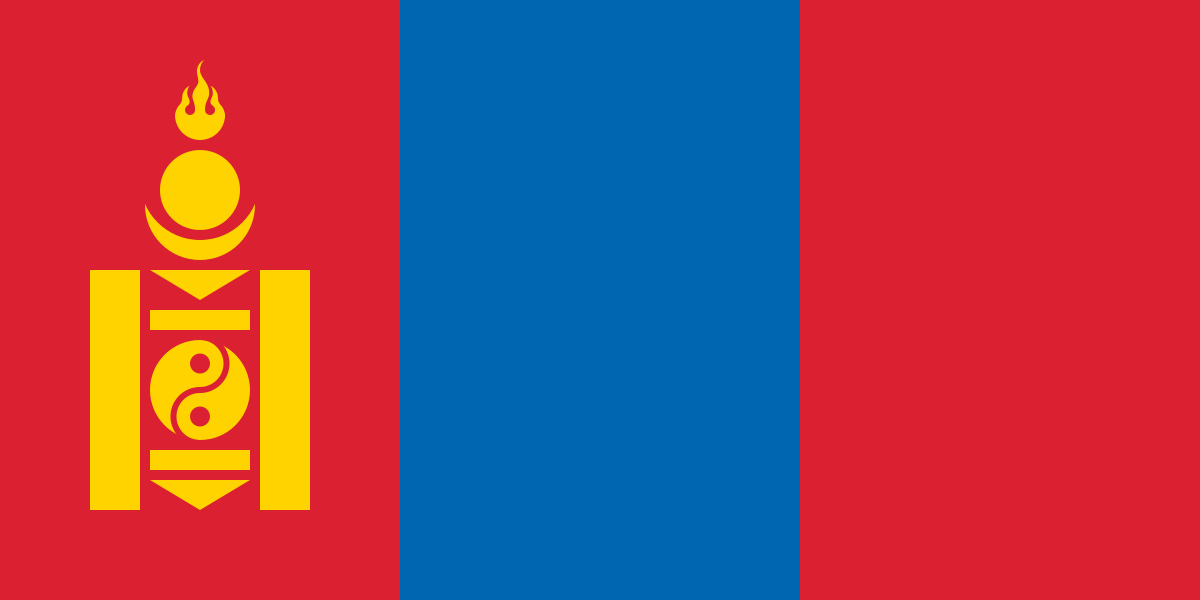
Monarchy and royalism Mongolia Mongolia (Tibetan) 1869–1924 ○ Natural death

The Tibetan-born reincarnate lama enthroned as the last great khan of Mongolia

'The princes feared him, the common people loved him.'

Born in Lhasa, Tibet, the 8th Jebtsundamba Khutuktu was, after the Dalai and Panchen Lamas, the highest living incarnation in Mongolian Buddhism. When the Qing dynasty collapsed in 1911, Mongol nobles enthroned him on 29 December as the 'Bogd Khan' ('Holy Ruler') of a new theocratic state. Stripped of power when China abolished autonomy in 1919, he was reinstated as a limited monarch after the 1921 revolution and died of throat cancer on 20 May 1924, ending the monarchy. The first and last great khan of Outer Mongolia since the late 17th century, he held Mongols together amid upheaval through his religious charisma.

Career timeline
  • 1874Arrived in Urga (Ih Hüree), recognized as head of Mongolian Buddhism
  • 1911Enthroned as Bogd Khan on 29 December
  • 1919Lost power as China abolished autonomy
  • 1921Reinstated as limited monarch after the People's Revolution
  • 1924Died of throat cancer, ending the monarchy