A lawyer-statesman who held White Siberia together through compromise
He told Kolchak that the government’s authority, and Kolchak’s own, was falling with every passing hour.
Pyotr Vologodsky was a lawyer and statesman shaped by Siberian regionalism and the Socialist Revolutionary movement, advocating local self-government and legal reform before 1917. In 1918 he led Siberia’s anti-Bolshevik government and managed compromises among right-wing, socialist, and regionalist forces. He remained head of government after Kolchak’s seizure of power, criticized the crisis produced by military arbitrariness and administrative weakness, and resigned in 1919 before emigrating to China.
Career timeline
1887–1897Clerk, judge, and assistant prosecutor in Siberian judicial institutions
1897–1917Tomsk attorney and member of the city duma
1902–1907Leader in Tomsk Socialist Revolutionary organization and Siberian regionalism
1917Tomsk provincial commissar and senior chairman of the Omsk court chamber
1918.01–06Minister of Foreign Affairs in the Provisional Government of Autonomous Siberia
1918.06–11Chairman of the Provisional Siberian Government
1918.11–1919.11Chairman of the Council of Ministers of the Russian Government
1920–1925Exile in China, working in legal and émigré affairs
The Comintern's first secretary, who taught Mussolini and branded him traitor
"I had never seen a more wretched human being" — on first meeting Mussolini in Lausanne
Russian-born Italian socialist. First secretary of the Comintern, she taught Mussolini Marxism and publicly denounced him as a traitor when he embraced fascism. She broke with Bolshevism in 1922 and led Italy's maximalist socialist faction.
Career timeline
1897Left Russia for Brussels; earned a doctorate in philosophy and literature at the New University
1900Joined the Italian Socialist Party (PSI); organised immigrant textile workers
1912–1914PSI Central Committee member and Avanti! editor; worked alongside Mussolini
1915–1916Participated in the Zimmerwald and Kienthal anti-war conferences
1917Returned to Russia and joined the Bolshevik Party
1919–1920First secretary of the Comintern; organised the 1st and 2nd Congresses
1922–1930Broke with Bolshevism; returned to Italy to lead the PSI maximalist faction
1930–1945Led the PSIm (Maximalist Socialist Party); anti-fascist work in Swiss, French, and US exile
Russian anarchist intellectual who theorized anarchist synthesis and chronicled the revolution the Bolsheviks suppressed
In Golos Truda, 1917: 'Once their power has been consolidated and legalized, the Bolsheviks… will start running the life of the country and of the people from the top. They will develop an authoritarian political and state apparatus that will crush all opposition with an iron fist.'
Russian anarchist intellectual and leading theorist of the Makhnovshchina. Editor of Golos Truda in Petrograd, co-founder of the Nabat Confederation in Ukraine, and chairman of the Makhnovist Military Revolutionary Council, he developed the theory of anarchist synthesis to unite communist, individualist, and syndicalist anarchists. After exile from Soviet Russia in 1922, he wrote The Unknown Revolution, the definitive anarchist history of 1917–1921, and opposed the Platformist centralization pushed by his comrade Makhno.
Career timeline
1904Drops out of St. Petersburg University law faculty; joins Socialist Revolutionary Party; organizes workers' study groups
1905Participates in Bloody Sunday march and helps form the St. Petersburg Soviet; imprisoned at Peter and Paul Fortress
1907Arrested by Okhrana, deported to Siberia; escapes and flees to France
1911Becomes anarchist under Apollon Karelin's influence; joins Brotherhood of Free Communists in Paris
1915–1916Flees anti-war persecution in France to USA; edits Golos Truda in New York
1917Returns to Petrograd after February Revolution; relaunches Golos Truda as leading anarcho-syndicalist organ
1918–1920Co-founds Nabat Confederation in Ukraine; chairs Makhnovist Military Revolutionary Council; arrested twice by Cheka
1922Exiled from Soviet Russia after hunger strike and Profintern delegate intervention
1924–1939Moves to Paris at Sébastien Faure's invitation; contributes to Anarchist Encyclopedia; writes for anarchist periodicals in five languages
1940Completes The Unknown Revolution in Marseille while living in poverty
1945Dies of tuberculosis in Paris; buried at Père Lachaise near Nestor Makhno
The behind-the-scenes organizer who wove international anarcho-syndicalism from Amsterdam 1907 to the IWMA
February 1921. Behind Kropotkin's coffin, 20,000 anarchists filled Moscow's streets — the last anarchist demonstration permitted in Soviet Russia. Schapiro and Berkman had organized the funeral commission.
The key linchpin of international anarcho-syndicalism. As secretary of the Amsterdam International, he built a cross-continental network; during the Revolution he worked within the Bolshevik state while maintaining his anarchist critique. Expelled in 1922, he co-founded the IWMA in Berlin.
Career timeline
1901–1907Active in London's Jewish anarchist movement; Arbeter Fraynd group member; runs Jubilee Street Club
1907Delegate to Amsterdam International Anarchist Congress; elected International Bureau secretary, edits its Bulletin
1915Signs International Anarchist Manifesto on the War; breaks with Kropotkin's pro-Allied position
1917–1920Returns to Russia; Golos Truda editor; works for Commissariats of Jewish Affairs and Foreign Affairs
1921Organizes Kropotkin's funeral; co-authors The Russian Revolution and the Communist Party; negotiates prisoner release at RILU congress
1922Arrested in Moscow; freed by international protest campaign and permanently expelled from Soviet Union
1922–1932Co-founds IWMA in Berlin, secretariat secretary; publishes Rabochii Put' for clandestine distribution in Russia
1932–1939Mediates CNT-FAI conflict in Barcelona; edits La Voix du Travail in France; emigrates to New York
1945–1946Edits New Trends journal in New York; dies of heart failure
Communist who led the Bavarian Soviet Republic in 1919 and was shot after its fall
On 13 April 1919, Leviné became chair of Munich’s Executive Board, calling for a Red Army and the overcoming of capitalism. After the Soviet Republic was suppressed, he was executed in June.
Born to a Jewish merchant family in St Petersburg, he moved to Germany with his mother after his father’s death and studied at Heidelberg. He returned to Russia to take part in the revolution of 1905 and was imprisoned. In Germany he worked in the USPD and the Spartacus League, and in 1919 the KPD sent him to Munich. When the KPD replaced Toller’s council government on 13 April he became its leader, raising a Red Army and putting factories under workers’ control. Captured after Munich fell in May, he was sentenced to death by a court martial and shot in Stadelheim prison on 5 June.
Career timeline
1905Returned to Russia to take part in the revolution and was exiled to Siberia.
1918–1919Helped found the Spartacus League in Berlin and worked in the Communist Party of Germany (KPD).
1919Sent by the KPD to Munich to organize its local branch and help establish the council republic, he became chair of its Executive Board on 13 April and led the republic.
1919Captured after the republic’s suppression, he was sentenced to death and shot at Stadelheim Prison on 5 June.
Appealing for return in 1921, he declared: “Soviet power is the only power representing Russia and its people.”
Yakov Slashchov was a Russian imperial officer who became a White general and a central commander in the defence of Crimea during the Civil War. Taking the Perekop Isthmus at the end of 1919, he repelled repeated Red Army attacks in early 1920 and kept Wrangel's Crimean base alive with limited forces. Reports of harsh repression and looting under his command stand alongside his battlefield reputation, exposing the violence of White rule. After exile, he returned to Soviet Russia and taught tactics, embodying the uneasy absorption of defeated military expertise into the new state.
Career timeline
1905Graduated from the Pavlovsk Military School; ensign in the Life Guards Finland Regiment
1911–1917Studied at the Nicholas Military Academy; taught tactics at the Page Corps
1917Commander of the Moscow Guards Regiment
1918Joined the Volunteer Army; chief of staff to Shkuro and commander in Kuban formations
1919Commander of the 4th Infantry Division and the 3rd Army Corps of the Armed Forces of South Russia
1919–1920Commander of the Crimean defence; operated the Perekop Isthmus fortifications
1922–1929Tactics instructor at the Soviet Vystrel higher officers' courses
Buryat revolutionary, drafter of Mongolia's 1924 constitution, victim of the Great Terror
At the third party congress in August 1924, as leader of the leftist faction he joined the rightists led by Dambadorj in accusing Danzan of representing bourgeois interests and dealing with American and Chinese firms; Danzan and Bavaasan were sentenced and shot within twenty-four hours.
A Buryat from Transbaikalia, he was elected first chairman of the Buryat-Mongol Central National Committee (Burnatskom) in April 1917 and helped lay the foundations of Buryat autonomy. In 1920 he became secretary of the Mongol-Tibet section of the Comintern's Far Eastern Secretariat. After the 1921 revolution he served until 1925 as chairman of Mongolia's Revolutionary Military Council, a government adviser, a member of the MPRP Central Committee presidium and a deputy in the Great and Small Khural. He helped draft the 1924 constitution and argued for the non-capitalist path at the third party congress, where he also joined in denouncing Danzan. Arrested in Moscow on 19 June 1937 (custody records date it 19 July), he was sentenced in 1938; sources disagree on the sentencing date and on when and where he was executed. A review of his case began in 1955 and he was rehabilitated in 1957.
Career timeline
1917Elected first chairman of the Buryat-Mongol Central National Committee (Burnatskom)
1918Elected in absentia as education minister of the Provisional Siberian Government
1920Secretary of the Mongol-Tibet section, Comintern Far Eastern Secretariat
1921–1925Chairman of Mongolia's Revolutionary Military Council, government adviser, member of the MPRP Central Committee presidium, deputy in the Great and Small Khural
1924Helped draft the constitution; joined in denouncing Danzan at the third party congress
1926–1930Studied at the Red Professors' Institute
1927–1934Research and teaching at the Communist University of the Toilers of the East (KUTV), professor of political economy from November 1934
The pianist-turned-revolutionary who drove the KPD's ultra-left turn, and became the anti-Stalinist left's perpetual dissident
“Comrade Maslow, who is playing at Leftism and wishes to exercise himself 'hunting Centrists,' has more zeal than sense.” — Lenin, singling him out by name in his 'Letter to the German Communists' (14 August 1921).
Born into a Ukrainian Jewish merchant family, he abandoned a concert-pianist career to study physics under Einstein and Planck, then the First World War radicalized him into the KPD's founding. As Ruth Fischer's lifelong partner he took the party chairmanship in 1924 and drove 'Bolshevisation', a break with the united front and a one-sided crusade against Social Democracy, until Stalin and Thälmann displaced and expelled him in 1926, leaving him a lifelong anti-Stalinist dissident.
Career timeline
1919Founding member of the KPD; agitates among Russian POWs for the Spartacus League
1920–1923KPD Central Committee; leads Berlin left wing with Fischer; foreign-affairs editor, Die Rote Fahne
1924–1925KPD chairman; drives 'Bolshevisation' and the party's ultra-left turn
1924–1926Arrested by German authorities; sentenced to 4 years, released July 1926 due to failing health
1926Expelled from the KPD for opposing Stalin and Thälmann; backs the United Opposition
1928Co-founds the Leninbund with Urbahns and Fischer; soon resigns
1934–1937Works closely with Trotsky; active in the Fourth International movement's International Secretariat
1937–1941Exile in Paris and Cuba; breaks with Trotsky, founds Marxist-Leninist International Group
The Comintern's first envoy who midwifed the Chinese Communist Party
In 1920 Shanghai, discussing party-building with Chen Duxiu, he diagnosed: "The new-thought movement in China is surging but too complex — Anarchism, syndicalism, Social Democracy, guild socialism, a chaos without a mainstream. People write articles and speak empty words but take absolutely no practical action. This can never propel the Chinese revolution forward."
The Comintern's first envoy to China, who in 1920 worked with Li Dazhao and Chen Duxiu to lay the foundation for the Chinese Communist Party. After his recall, he became a founder of Soviet sinology in Moscow.
Career timeline
1913–1918Emigrated to US and Canada; joined Socialist Party of America
1918Joined RCP(b) in Vladivostok
1919–1920Captured by Whites, exiled to Sakhalin; escaped via prisoner uprising
1920–1927ECCI Far Eastern Dept head & China representative; assisted CCP founding
1926Chairman, Comintern Far Eastern Bureau in Shanghai
1927–1929Economic work in Irkutsk
1929–1934Oriental studies in Moscow; Profintern Pacific Secretariat secretary
1934–1953Professor, Moscow State University; Academy of Sciences researcher; sinology publications
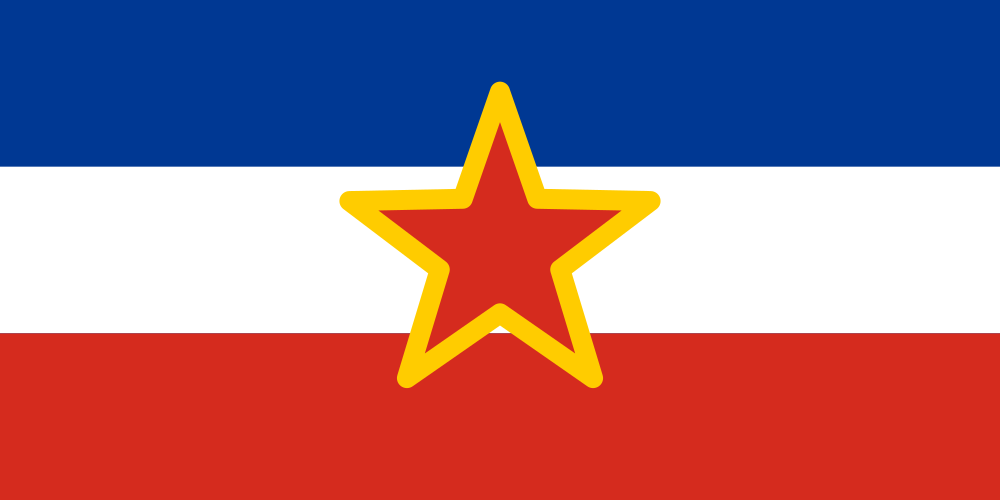
A regent pressed toward the Axis while trying to keep Yugoslavia out of war
Two days after Yugoslavia joined the Tripartite Pact on 25 March 1941, a military coup removed him from the regency.
Paul Karađorđević was the prince regent who governed the Kingdom of Yugoslavia for the minor Peter II after the assassination of Alexander I. He sought to soften the legacy of centralised rule and reconcile the state with the Croatian national movement, culminating in the 1939 Cvetković-Maček Agreement and the creation of the Banovina of Croatia. As war spread and British and French guarantees weakened, his attempt to preserve neutrality shifted toward concessions under German pressure, and Yugoslavia’s 1941 accession to the Tripartite Pact triggered a military coup that removed him. He lived in exile after the war, died in 1976, and was rehabilitated by a Serbian court in 2011.
Career timeline
1893Born in St. Petersburg
1912–1921Studied at Christ Church, Oxford; served in World War I
1929Founded and patronised the Museum of Contemporary Art in Belgrade
1934–1939Chairman of the Regency Council of Yugoslavia
1939Advanced the Cvetković-Maček Agreement and Banovina of Croatia
1941Removed in a military coup after Yugoslavia joined the Tripartite Pact
The only non-Bolshevik on all three leading Comintern bodies. And author of the first critical Stalin biography.
Ten days after the Bolsheviks seized power, the twenty-two-year-old Souvarine wrote on 17 November 1917: "It is to be feared that, for Lenin and his friends, the 'dictatorship of the proletariat' must be the dictatorship of the Bolsheviks and their leader. This could become a calamity for the Russian working class, and eventually, for the world proletariat. […] What we wish is agreement among socialists to organise a stable power that truly becomes the power of the people and not the power of a man." — 'La Commune maximaliste,' *Ce qu'il faut dire*, No. 78
The only non-Bolshevik to serve on all three leading Comintern bodies. Expelled in 1924 for defending Trotsky, he turned independent anti-Stalinist and published the first critical biography of Stalin (1935), remaining a pioneering Sovietologist throughout his life.
Career timeline
1914Mobilised into the French Army; experiences trench warfare on the Western Front
1916Joins the SFIO and writes for the anti-war minority paper *Le Populaire*; adopts pseudonym 'Souvarine'
1919Joins the Committee for the Third International; distributes Comintern propaganda across Europe
1920.05Arrested in government crackdown on 'anarchist plot'; writes *Bulletin Communiste* from La Santé prison
1920.12Tours Congress: Souvarine motion adopted, creating the French Communist Party (SFIC); named honorary president
1921–1924Member of the ECCI, Presidium, and Secretariat — the only non-Bolshevik on all three leading Comintern bodies
1924Defends Trotsky at the 13th Bolshevik Congress; expelled from the Comintern and the French Communist Party
1926First publishes Lenin's Testament in France, received from Krupskaya via Christian Rakovsky
1927–1935Breaks with Trotsky, analysing the USSR as state-capitalist; organises the Democratic Communist Circle (CCD)
1935Publishes *Staline, aperçu historique du bolchévisme* — the first critical biography of Stalin
1935Founds the Institute of Social History — French branch of the Amsterdam-based IISH
1939.05Predicts the Molotov–Ribbentrop Pact 100 days in advance in *Le Figaro*
1940–1947Arrested by the Vichy regime, freed through an officer's intervention, exiles to the USA; returns to Paris in 1947
1947–1976Edits *Est & Ouest* and *Le Contrat Social* — leading voice of anti-Stalinist left Sovietology during the Cold War