Commander of the West Russian Volunteer Army who led German Freikorps against Riga
Refusing Yudenich's order to join the Narva front, in October 1919 he proclaimed himself 'representative of Russian state power' and marched on Riga.
A Russian cavalry officer who styled himself 'Prince Avalov', he gathered tens of thousands of German Freikorps men who refused to leave Latvia into the West Russian Volunteer Army and attacked Riga in October 1919, only to be repelled. In exile he led a Russian fascist organization in Berlin and died in New York in 1973.
Career timeline
1901Enlisted as kapellmeister in the 1st Argun Regiment
1904–1905Fought in the Russo-Japanese War; awarded the Cross of St George
1918Head of recruitment and counterintelligence, Southern Army, Kiev
1919.04Formed a volunteer detachment at the Salzvedel POW camp
1919.07Formed the Count Keller detachment at Mitava
1919.09Proclaimed himself CinC of the West Russian Volunteer Army; marched on Riga in October
1925Published memoirs 'In the Struggle against Bolshevism'
1933Founded the Russian National-Socialist Movement (ROND)
On 25 July 1943, the king dismissed Mussolini as prime minister and had him arrested.
A socialist journalist turned nationalist during the First World War, Mussolini founded fascism as a movement claiming to overcome class conflict through the nation. After the March on Rome made him prime minister in 1922, he used political violence and institutional change to transform liberal Italy into a one-party dictatorship. Colonial war, alliance with Nazi Germany, and entry into the Second World War brought military defeat and political collapse. Overthrown in 1943, he headed the German-backed Italian Social Republic in the north until partisans captured and executed him in 1945.
Career timeline
1912Editor of the Italian Socialist Party paper Avanti!
1919Founded the Fasci Italiani di Combattimento
1921Leader of the National Fascist Party
1922–1943Prime Minister of the Kingdom of Italy
1925–1943Fascist dictator, Il Duce
1940–1943Directed Italy’s entry into and conduct of the Second World War
Gendarmerie officer whose detachment murdered two Népszava journalists and who joined King Charles’s 1921 return attempt
Born in Marosvásárhely, he became gendarmerie commander of Sopron after the fall of the Soviet Republic. On 17 February 1920 officers of his detachment murdered Béla Somogyi and Béla Bacsó of Népszava as a warning to Horthy’s opponents, and at the regency vote in March his troops kept “order” in the National Assembly. In August 1921 he refused to evacuate Sopron, opening the way for the town to remain in Hungary. That October he and other legitimist officers urged King Charles to seize power and escorted his armoured trains towards Budapest, but were defeated at Budaörs; he was amnestied and pensioned off. In 1932 he founded the Hungarian National Fascist Party under joint leadership with Pál Prónay.
Career timeline
1919Gendarmerie commander of Sopron
1920His officers murder Somogyi and Bacsó
1921Refuses to evacuate Sopron
1921King Charles’s second return attempt; Battle of Budaörs
Right-radical officer who organised the Szeged National Army and as prime minister in 1932–1936 steered Hungary towards Italy and Germany
Born in Murga, Tolna County, the son of the village schoolmaster, he served as an Austro-Hungarian officer in the First World War. In Szeged in 1919 he founded the paramilitary MOVE and played a leading role in organising Horthy’s National Army, and in 1921 he led the armed opposition to King Charles’s return. He became defence minister in Bethlen’s government in 1929 and prime minister in 1932. He aligned with Mussolini, signing the Rome Protocols in 1934, and as the first foreign head of government to visit Hitler concluded a trade agreement with Germany. He died of illness in Munich in 1936.
Commander of Einsatzkommando 3 who directed the murder of Lithuania’s Jews and tallied it in the Jäger Report
Born in Schaffhausen, Switzerland, he moved to Germany with his father at the age of three. He won the Iron Cross First Class in the First World War, managed an orchestrion factory in Waldkirch and joined the Nazi Party in 1923, becoming known as “Waldkirch’s Hitler”; he joined the SS in 1932. From July 1941 to September 1943 he commanded Einsatzkommando 3 of Einsatzgruppe A in Kaunas, which with Lithuanian help shot Jewish men, women and children indiscriminately and carried out the Ninth Fort massacres of November 1941. On 1 December 1941 he wrote a report keeping an almost daily tally of 137,346 executions. Sent back to Germany in late 1943 after a nervous breakdown, he lived after the war as a farm hand until his report came to light in 1959; arrested, he hanged himself while awaiting trial.
Commander of the Waffen-SS IX Mountain Corps who led the German forces in the siege of Budapest and refused to surrender
He joined the army in 1907 and in the First World War served as a General Staff officer, including with the German military mission in Constantinople. Moving to the police in 1919, he headed Chile’s Carabineros and became inspector general of police schools, then joined the SS and served on Himmler’s staff. He commanded the SS Polizei Division from late 1939 and the VI SS Army Corps (Latvian) from 1943. Appointed commander of the IX SS Mountain Corps in Budapest in December 1944, he led the German forces in the siege from 24 December 1944 to 11 February 1945 and refused all invitations to surrender, setting off a long and bloody siege. Taken prisoner by the Soviets after the failed breakout, he was sentenced in 1949 to 25 years, released in 1955 and killed in a traffic accident at Bielefeld in 1971.
Career timeline
1907–1919German army officer and General Staff officer
1919Joined the police
1928Chief of the Chilean Carabineros
1936Inspector General of Police schools
1939–1940Commander, SS Polizei Division
1943–1944Commander, VI SS Army Corps (Latvian)
1944–1945Commander, IX SS Mountain Corps; defence of Budapest
1945–1955Soviet prisoner; sentenced to 25 years in 1949
In summer 1942, Hitler split Army Group South into Groups A and B to strike at Caucasus oil and the Volga at the same time, a decision that led to the encirclement and destruction of the Sixth Army.
Adolf Hitler (1889–1945) was born in Braunau am Inn, Austria-Hungary, and held Austrian citizenship by descent; he moved to Munich in 1913 and falsely registered as stateless. He joined the German Workers' Party in 1919, led it from 1921, and dictated Mein Kampf in prison after the failed 1923 Munich putsch. Released from Austrian citizenship in 1925, he remained stateless until he acquired German citizenship in 1932. Appointed chancellor on 30 January 1933, he used the Enabling Act of 23 March 1933 to build a dictatorship and became head of state on 2 August 1934 after Hindenburg's death. His regime was responsible for the genocide of about six million Jews and the deliberate killing of an estimated 19.3 million civilians and POWs. He died by suicide in Berlin on 30 April 1945.
Career timeline
1889–1918Born in Austria; served in the German Army during the First World War
1919Joined the German Workers' Party and entered politics
1921Leader of the National Socialist German Workers' Party
1923–1924Failed Munich putsch; dictated Mein Kampf in prison
1933Chancellor of Germany; established Nazi dictatorship
1934–1945Führer and head of state; directed the Second World War
1942Split Army Group South into Groups A and B, directing the Stalingrad and Caucasus offensives
Hungarian general who directed the Novi Sad massacre, fled to Germany after his conviction and joined the SS
Born Franz Zeidner into a Transylvanian Saxon family, he served as an artillery and staff officer in the Austro-Hungarian army in the First World War, and between the wars changed his surname to the more Magyar-sounding Feketehalmy-Czeydner. In August 1941 he became commander of the Fifth Corps at Szeged. In January 1942 Chief of Staff Szombathelyi sent him against the partisans in Bačka; villagers there were massacred on his orders, and he organised the Novi Sad massacre. Sentenced to fifteen years by a court martial in January 1944, he fled to Vienna with other convicted officers and volunteered for the SS. As deputy defence minister under the Arrow Cross he signed the death warrant of his critic Endre Bajcsy-Zsilinszky. After the war he was handed via Hungary to Yugoslavia and executed in November 1946.
Career timeline
1910Commissioned lieutenant of artillery
1914–1918Austro-Hungarian artillery and staff officer
1941–1942Commander, Fifth Corps; directed the Bačka massacres
1944Convicted by court martial; fled to Vienna and joined the SS
1944–1945Deputy defence minister under the Arrow Cross
Prime minister who swung Hungary towards Germany and drafted the Second Jewish Law, then fell over his own Jewish ancestry
Born to a Catholic family in Budapest, he was an economist in the finance ministry who became Gömbös’s finance minister in 1932 and president of the National Bank in 1935. Prime minister from May 1938, he turned foreign policy towards Germany and Italy from that autumn, and under him the First Vienna Award returned southern Slovakia to Hungary. He pressed for a dictatorial reorganisation and the Second Jewish Law, but resigned in February 1939 when opponents exposed his Jewish ancestry. In 1940 he founded the pro-fascist Party of Hungarian Renewal, and after the German occupation of 1944 he served in Sztójay’s cabinet. Sentenced to death by a People’s Tribunal, he was shot in 1946.
Career timeline
1928–1932Director, Hungarian National Bank
1932–1935Finance minister under Gömbös
1935–1938President, Hungarian National Bank
1938–1939Prime minister; introduced the Second Jewish Law
1940–1944Founder and leader, Party of Hungarian Renewal
1944Minister of economic coordination under Sztójay
Austrian chancellor who shut down parliament, built the Fatherland Front dictatorship and was assassinated in a Nazi coup in 1934
Born to a poor peasant family in Lower Austria, he studied law at the University of Vienna and served for 37 months on the Italian front in the First World War. Working for the Lower Austrian Peasants’ Union he became known as an agrarian expert, and he was appointed minister of agriculture and forestry in 1931 and federal chancellor in May 1932. In March 1933 he shut out parliament and ruled by emergency decree, banned the Communists, the Nazis and then the Social Democrats, and built a one-party dictatorship under the Fatherland Front modelled largely on Italian Fascism. He crushed the socialist movement in the civil war of February 1934 and in March signed the Rome Protocols with Mussolini and Gömbös. On 25 July 1934 he was shot dead in the Chancellery during an attempted Nazi coup.
A legion commander who carried battlefield success into White politics
After capturing Yekaterinburg, Gajda set up his headquarters in the very Ipatiev House where the Romanovs had been murdered by the Bolsheviks less than a week earlier.
Radola Gajda was a Czechoslovak Legion commander who rose to prominence in the First World War and the Russian Civil War, later becoming a general and politician in interwar Czechoslovakia. In 1918 he led the Legion's eastern group, seizing the railway from Novonikolaevsk to Irkutsk and pressing the argument for armed struggle over neutrality. He joined Kolchak's White forces, lost his command, and returned home to serve as acting chief of the general staff before leading the National Fascist Community. His military anti-Bolshevism became fascist politics in Czechoslovakia, while during the Nazi occupation he aided resistance networks.
Career timeline
1910–1911Served in the Austro-Hungarian Army
1915–1916Officer in the Montenegrin Army
1917Company and regimental commander, Czechoslovak Legion
1918Commander, Legion eastern group, directing the capture of Irkutsk and Yekaterinburg
1918–1919Commander of Kolchak's Siberian Army
1922–1926Divisional commander and acting chief of the Czechoslovak General Staff
1927–1939Leader of the National Fascist Community and parliamentarian
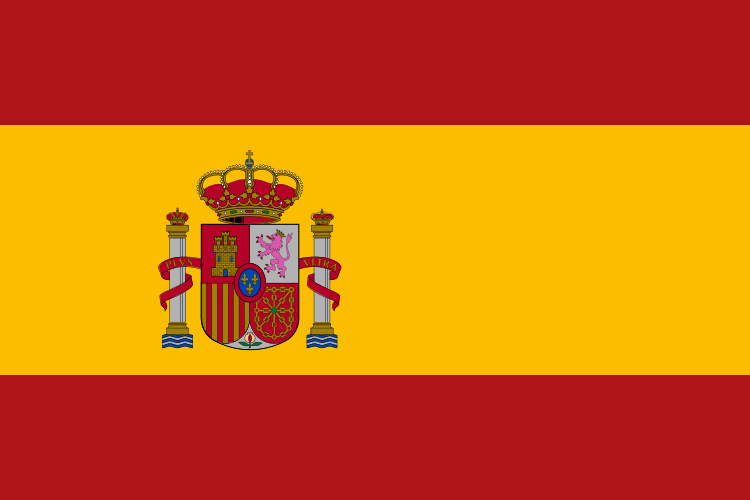
The general who turned the rising into victory and ruled Spain for thirty-six years as Caudillo
The last war communiqué of 1 April 1939, signed in his own hand: “Today, with the Red Army captive and disarmed, the national troops have reached their final military objectives. The war is over.” Thirty-six years of dictatorship began.
A career officer who made his name in the colonial war in Morocco and became the youngest general in Europe at thirty-three. His use of the Army of Africa to crush the Asturian miners in 1934 fixed him in the eyes of the right as the restorer of order, and in July 1936 he joined the rising, flew from the Canaries to Morocco and, with German and Italian transports, ferried the Army of Africa to the mainland. In October he was made commander-in-chief and head of state of the rebel zone, and the Unification Decree of 1937 fused the Falange and the Carlists into a single National Movement under his personal rule. Victory in 1939 was followed by mass execution and imprisonment under the Law of Political Responsibilities, costing tens of thousands of lives. He declared non-belligerence in the Second World War while sending the Blue Division to the Eastern Front, and broke out of postwar isolation with the Pact of Madrid and the Concordat of 1953. The growth that followed the Stabilization Plan of 1959 became another pillar of the regime; he named Juan Carlos his successor in 1969, and with his death in 1975 the regime itself began to come apart.
Career timeline
1892Born into a naval family in Ferrol, Galicia
1907–1910Trained at the Toledo Infantry Academy
1912–1926Fought in the colonial war in Morocco, second-in-command of the Spanish Legion, brigadier general at thirty-three
1928–1931Director of the Zaragoza military academy until the Republic removed him
1934.10Used the Army of Africa to crush the Asturian miners' rising
1935–1936Rose to chief of the general staff, then was posted to the Canary Islands by the Popular Front government
1936.07.18–19Joined the rising, flew to Morocco in the chartered Dragon Rapide and organized the airlift of the Army of Africa
1936.10.01Proclaimed Generalísimo and head of state of the rebel zone at Burgos
1937.04.19Fused the Falange and the Carlists into a single National Movement by decree
1939.04.01Declared the war over and began mass execution and imprisonment under the Law of Political Responsibilities
1940–1943Met Hitler at Hendaye, declared non-belligerence and sent the Blue Division to the Eastern Front
1953–1955Signed the Pact of Madrid with the United States and a Concordat with the Vatican; UN membership in 1955 ended his isolation
1959Abandoned autarky with the Stabilization Plan and entered the years of high growth
1969–1973Named Juan Carlos his successor; in 1973 his prime minister Carrero Blanco was assassinated by ETA
1975.11.20Died in Madrid; buried at the Valley of the Fallen until his exhumation in 2019
Baltic German Nazi ideologue from Reval who served as Reich Minister for the Occupied Eastern Territories in 1941–1945
Born in 1893 in Reval (Tallinn), in the Governorate of Estonia of the Russian Empire, he studied architecture at the Riga Polytechnical Institute. In 1918 he left for Germany with the retreating German army and in January 1919 joined the German Workers’ Party, eight months before Hitler; in 1923 he became editor of the party newspaper Völkischer Beobachter. In 1930 he published his racial treatise The Myth of the Twentieth Century, and he fed Hitler’s belief in Jewish conspiracies by introducing him to The Protocols of the Elders of Zion. Appointed Reich Minister for the Occupied Eastern Territories on 17 July 1941, he had Hinrich Lohse installed as Reichskommissar for Ostland, though his own authority was severely limited. He saw the Baltic lands as German “Lebensraum”. Found guilty on all four counts at Nuremberg, he was hanged on 16 October 1946.
Career timeline
1919Joined the German Workers’ Party
1923Editor of the Völkischer Beobachter
1930Published The Myth of the Twentieth Century
1941–1945Reich Minister for the Occupied Eastern Territories
A Luftwaffe chief who organized Nazi war and plunder
In August 1940, redirecting the air offensive toward London and civilian cities gave the RAF time to recover.
Hermann Göring rose from a First World War fighter ace to a central power-holder in Nazi Germany and commander-in-chief of the Luftwaffe. He helped build dictatorship and the machinery of aggressive war by directing the Prussian police, the creation of the Gestapo, rearmament, and wartime economic mobilization. During the Battle of Britain in 1940, he overestimated the Luftwaffe and was involved in shifting attacks from the RAF's struggling airfields and fighter defences toward British cities, giving Fighter Command time to recover. After the war, the Nuremberg Tribunal condemned him as a major war criminal, and he committed suicide on the eve of his execution.
Nazi Germany’s foreign minister, he played a key role in negotiating the German-Soviet nonaggression pact.
Joachim von Ribbentrop served as Germany’s foreign minister from 1938 to 1945. He played a key role in negotiating the 1939 German-Soviet nonaggression pact, which made possible Germany’s invasion of Poland that September. He also directed diplomatic efforts to persuade Axis partners to deport Jews to German killing centers and to hand over their Jewish citizens in Germany to deportation. The International Military Tribunal convicted him on all four counts and sentenced him to death; he was hanged on October 16, 1946.
Nazi Party leader and Hitler’s deputy, sentenced to life imprisonment at the Nuremberg trials.
Hess joined the Nazi Party in 1920 and became a close associate of Hitler. He was appointed deputy party leader in 1933, and in 1939 Hitler placed him second after Hermann Göring in the line of succession. In May 1941 he flew alone to Scotland in an attempt to negotiate an end to the war with Britain; the British government rejected his proposals and held him as a prisoner of war. After the war, the Nuremberg tribunal convicted him of crimes against peace and sentenced him to life imprisonment, which he served at Spandau Prison.
SS special-unit commander implicated in the Wola massacre
Waffen-SS commander of a unit recruited from convicted criminals; from 1940 he led it in anti-partisan operations in occupied Poland and Belarus, massacring civilians on a mass scale.
Nazi German SS officer and war criminal. From 1940 he commanded the special unit bearing his name, which committed war crimes in Poland and Belarus. During the suppression of the 1944 Warsaw Uprising, his formation participated in the massacre of civilians in Wola. His command responsibility belongs within the history of Nazi occupation policy and the SS and police command structure.
Career timeline
1913Enlisted in the Württemberg Army as a machine gunner; rose to lieutenant in World War I and received the Iron Cross in both classes.
1919–1921Joined the Freikorps and helped crush the German Revolution, workers' uprisings, strikes and communist revolts by force.
1922–1934Took a doctorate in political science at Frankfurt and joined the Nazi Party, but in 1934 was imprisoned for a sexual offence involving a minor and theft, expelled from the party and stripped of his doctorate and military honours.
1937–1939Served with the Condor Legion in the Spanish Civil War, was wounded three times, and on the strength of that service had his 1934 conviction annulled and his party membership restored in 1940.
1940Took command of the Oranienburg poacher unit recruited from convicted poachers; renamed Sonderkommando Dirlewanger, it was assigned guard and anti-partisan duties in occupied Poland.
1943Expansion of the unit to regimental size was authorized, and in Belarus it conducted anti-partisan operations that massacred civilians on a mass scale.
1944Took part in suppressing the Warsaw Uprising and the Wola massacre, and was then deployed against the Slovak National Uprising.
1945Was seriously wounded fighting Soviet forces near Guben in February and sent to the rear; in April he deserted and went into hiding.
Higher SS and Police Leader who directed the mass shootings at Kamianets-Podilskyi, Babi Yar and Rumbula
The son of a textile factory owner in Hornberg in the Black Forest, he fought as an officer in the First World War. He joined the Nazi Party in 1929 and the SS in 1930, and from 1933 was police president and head of the political police in Brunswick. Chosen by Himmler in June 1941 as Higher SS and Police Leader for southern Russia and Ukraine, he controlled all Einsatzgruppen killings in his area and used his method in the mass shootings at Kamianets-Podilskyi (23,600 killed) and Babi Yar (33,771 killed). Moved to Ostland in November with orders to complete the extermination of Riga’s Jews, he watched over two days as 25,000 people were killed at Rumbula. Taken prisoner fighting the Red Army in April 1945, he was sentenced to death at the Riga trial and hanged in Riga on 3 February 1946.
Career timeline
1914–1918German army officer and pilot
1929–1930Joined the Nazi Party and the SS
1932–1945Reichstag deputy
1933–1938Police president and head of political police, Brunswick
1941Higher SS and Police Leader, southern Russia and Ukraine
Interior Ministry state secretary who in 1944 ran the ghettoisation and deportation of Hungary’s Jews with László Baky
Born into a wealthy Abony family, he served as a hussar officer in the First World War and after the fall of the Soviet Republic joined counter-revolutionary groups such as MOVE, noted for his extreme cruelty. Chief magistrate of Gödöllő from 1923 and deputy lord-lieutenant of Pest county from 1938, he called the anti-Jewish laws too mild and imposed his own restrictions, such as banning Jews from beaches. After the German occupation in 1944 he became state secretary under Interior Minister Andor Jaross with far-reaching powers to ghettoise and deport the Jews, and with László Baky helped Eichmann deport over 400,000 Hungarian Jews between May and July. Removed in September, he returned under the Arrow Cross as commissioner for civil administration in the operational areas. Captured by US forces after fleeing in 1945, he was handed back, sentenced to death and hanged in 1946.
Career timeline
1915–1918Hussar officer
1919–1921Active in counter-revolutionary groups
1923–1938Chief magistrate of Gödöllő
1938–1944Deputy lord-lieutenant of Pest county
1944Administrative state secretary, Interior Ministry
1944–1945Commissioner for civil administration in the operational areas
1946Sentenced by the People’s Tribunal and executed
A Fascist power broker who helped bring down Mussolini
At 2 a.m. on 25 July 1943, the Grandi motion passed 19–8 and shattered Mussolini’s grip on power.
Dino Grandi was a leading Italian Fascist and diplomat who exercised power at the centre of the regime. As foreign minister and ambassador in London, he pursued a cautious diplomatic line toward war, but he also bore responsibility for administering the Fascist state and its policies. After the Allied invasion of Sicily, he drafted and organized the vote on the July 1943 motion calling on the king to resume constitutional command of the armed forces, helping bring about Benito Mussolini’s removal. He went into exile and was later sentenced to death in absentia by the Italian Social Republic’s Fascist tribunal.
Career timeline
1915–1919Served in World War I, studied law and economics, and began legal practice
1920–1922Leader in the Bologna Fascist movement and the National Fascist Party leadership
1924–1929Undersecretary of the Interior and Foreign Affairs
1929–1932Italian Minister of Foreign Affairs
1932–1939Italian ambassador to the United Kingdom
1939–1943Minister of Justice and president of the Chamber of Fasces and Corporations
1943Drafted and organized the Grand Council motion that removed Mussolini
1944Sentenced to death in absentia by the Italian Social Republic tribunal
Hungarian minority leader in Czechoslovakia who, as interior minister in Sztójay’s cabinet in 1944, organised the deportation of Jews
Born in Komáromcsehi, Komárom County (now Čechy, Slovakia), he entered the politics of the Hungarian minority in Upper Hungary, cut off by Trianon, in the early 1920s. He became chairman of the Hungarian National Party in 1933 and a deputy in Prague in 1935, and was general secretary of the United Hungarian Party. From 1938 to 1940 he was Hungary’s minister without portfolio for Upper Hungary, and in 1940 he co-founded the far-right Party of Hungarian Renewal with Béla Imrédy. As interior minister in Sztójay’s cabinet after the German occupation of 1944, he organised the deportation of the Jews with his state secretaries László Baky and László Endre. He resigned under Horthy’s pressure on 17 August. After the war he fled west, was captured by the Americans, handed over to Hungary, sentenced to death by the People’s Tribunal and shot in 1946.
Career timeline
1925–1933Vice-chairman, Hungarian National Party
1933Chairman, Hungarian National Party
1935–1938Member of the Czechoslovak Chamber of Deputies
1938–1940Minister without portfolio for Upper Hungary
1940Co-founded the Party of Hungarian Renewal
1944Interior minister
1946Sentenced by the People’s Tribunal and executed
Nazi Gauleiter of Schleswig-Holstein who, as Reichskommissar for Ostland in 1941–1944, ordered the ghettoisation and expropriation of Jews
Born into a peasant family in Schleswig-Holstein, he was severely wounded in the First World War. He joined the Nazi Party in 1923, became Gauleiter of Schleswig-Holstein in 1925 and in 1933 also Oberpräsident of the province. Appointed Reichskommissar for Ostland on 25 July 1941, he shuttled between Riga and Kiel; his decree of 27 July ordered lists of Jews, the yellow badge, the confiscation of their property and their concentration in ghettos. Asked to explain his order forbidding the execution of Jews in Libau (Liepāja), he wrote on 15 November asking whether all Jews were to be liquidated regardless of economic interests, yet he stayed at his post for three more years. He fled Ostland without authorisation on 13 August 1944 and was removed. Sentenced in 1948 to ten years, he was released for ill health in 1951 and died in his home village in 1964.
Nazi Party propaganda chief and minister who promoted antisemitism and dictatorship.
Joseph Goebbels was a Nazi Party propaganda leader who headed the party organization in Berlin from 1926 and became its propaganda chief in 1930. Appointed minister of propaganda by Hitler in 1933, he brought the press, film, radio, and cultural life under Nazi ideological control and promoted antisemitism and persecution of Jews. He was a chief instigator of the November 1938 pogrom and later campaigned for total war.
Career timeline
1926–1945Nazi Party Gauleiter for Berlin
1930–1945Nazi Party propaganda chief
1933–1945Minister of Public Enlightenment and Propaganda
Arrow Cross leader installed by Germany as 'Leader of the Nation' in 1944
Born a soldier's son in Kassa (now Košice), he served as an officer in the First World War and joined the General Staff in 1925. In the early 1930s he turned to politics as a prophet of 'Hungarism' and the restoration of pre-Trianon borders, left the army in 1935 and founded the Hungarian National Socialist Party in 1937. While imprisoned in 1938 he was proclaimed leader of the Arrow Cross Party, which won 30 seats in the 1939 election. When Germany removed Horthy in October 1944 he became head of state, restarted the deportation of Jews that Horthy had halted, and his militias massacred Jews in Budapest. Captured by American troops in Austria in May 1945, he was sentenced to death by the People's Tribunal and hanged in March 1946.
Career timeline
1915–1918Austro-Hungarian Army officer in the First World War
1925–1935Hungarian General Staff officer
1937Founded the Hungarian National Socialist Party