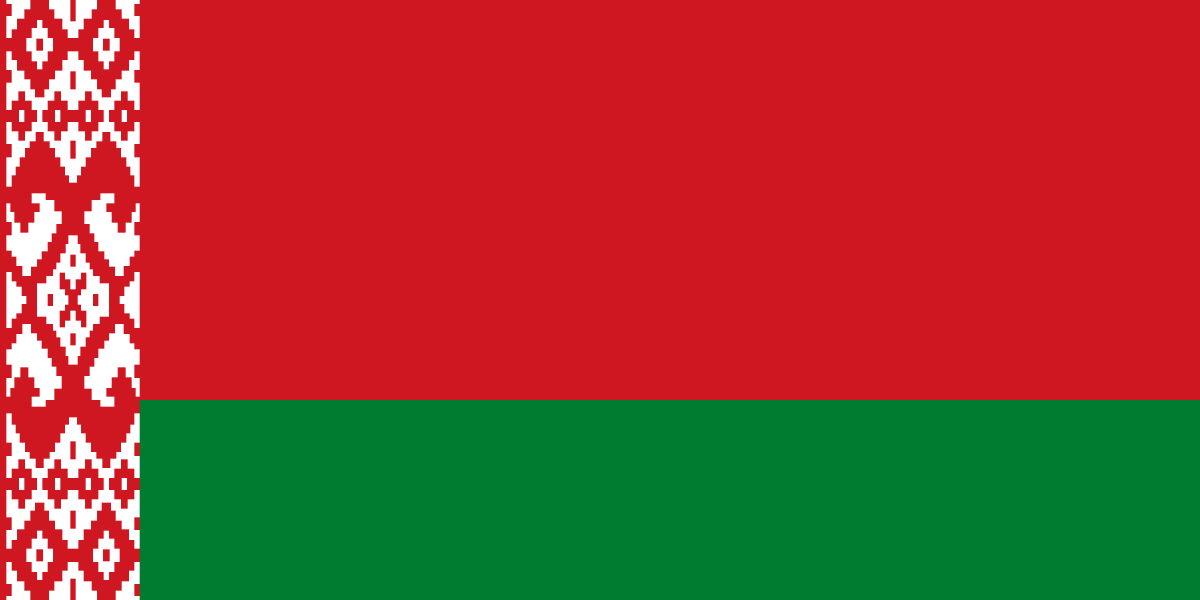
Worker-poet known as Tsishka Hartny who headed the first Soviet government of Byelorussia
Born into a peasant family in Kapyl in 1887, he worked as a tanner, joined the Hramada in 1904 and wrote for Nasha Niva. From 1913 he worked in Petrograd factories and wrote poetry under the pen name Tsishka Hartny. In 1918, as secretary of the Belarusian National Commissariat, he campaigned for a Belarusian republic against Vilgelm Knorin and Alexander Myasnikov and won the support of Lenin and Stalin. From 1 January to 3 February 1919 he headed the Provisional Workers’ and Peasants’ Government of the Socialist Soviet Republic of Byelorussia. He later ran publishing and cultural institutions and became an academician, but was expelled from the party in 1931, arrested in 1936 and died in 1937 in a psychiatric hospital in Mogilev; some accounts say he took his own life.
Career timeline
1913Worker at the Vulkan plant in Petrograd
1918Secretary of the Belarusian National Commissariat
1919Head of the Provisional Workers’ and Peasants’ Government of the Socialist Soviet Republic of Byelorussia
1920–1931Member of the Central Executive Committee of the BSSR
1928Academician of the Academy of Sciences of the BSSR
In November 1938 her husband sent luminal to her sanatorium bed. Days later she was dead of an overdose.
Born Yevgenia Feigenberg to a merchant family in Gomel, she married Yezhov in 1931 after earlier marriages to Khayutin and the diplomat Gladun. In the 1930s she ran the illustrated magazine USSR in Construction as deputy editor in all but name, and kept a Moscow salon frequented by Babel, Sholokhov, Eisenstein and other figures of the cultural world; in 1933 she and Yezhov adopted a daughter, Natalia. As her husband's fall approached in 1938 her close friends were arrested one after another and denunciations of her own past reached the leadership. Admitted to a sanatorium in severe depression, she died on 21 November 1938 of an overdose of the sleeping drug luminal her husband had sent her. She was buried at the Donskoye cemetery.
Career timeline
1920sPublishing and journalism work
1930sDeputy editor of USSR in Construction, editor in all but name
In the first weeks after Auschwitz was liberated, Vorontsov's images of survivors and the camp turned immediate observation into international evidence.
Alexander Vorontsov was a Soviet documentary cameraman and director whose work carried the experience of war into recorded images. In the first weeks after the liberation of Auschwitz, he filmed survivors and the camp with the 1st Ukrainian Front crew, contributing footage to the film Osventsim and to Soviet evidence presented at Nuremberg. After the war he continued as a cameraman and director at the Central Studio for Documentary Films, linking frontline record-making to the institutions of peacetime Soviet cinema.
Career timeline
1939–1941Mechanic and assistant cameraman at Mosfilm
1942Graduated from the camera department of VGIK
1942Joined the Red Army; cameraman at the Novosibirsk newsreel studio
1943–1945Frontline cameraman with the 1st Ukrainian Front film group
1945Cameraman for Osventsim
1945–1989Cameraman and director at the Central Studio for Documentary Films
A writer who recorded the Soviet century through voices of testimony
“I've been searching for a literary method that would allow the closest possible approximation to real life.”
Svetlana Alexievich is a Belarusian writer and journalist who built a literature of collective memory by shaping testimonies from people who lived through war and social upheaval in Russian. War's Unwomanly Face and Zinky Boys brought the experiences of women and soldiers, often obscured by official heroic narratives, into view; Voices from Chernobyl recorded the human consequences of the 1986 disaster through survivors, bereaved families, and liquidators. Her work accepts the tension between documentary record and literary construction while placing individual voices at the center of historical understanding, and she received the 2015 Nobel Prize in Literature.
Career timeline
1965–1967Schoolteacher and local newspaper reporter
1972Graduated in journalism from Belarusian State University
1973–1976Reporter for Rural Newspaper
1976–1984Head of nonfiction and essay section at Nyoman