From Comintern Negro Bureau chief to architect of Pan-African independence, the revolutionary journalist who broke with empire
"Pan-Africanism or Communism?" — rejecting Cold War binaries, his final book insisted African liberation must chart its own course
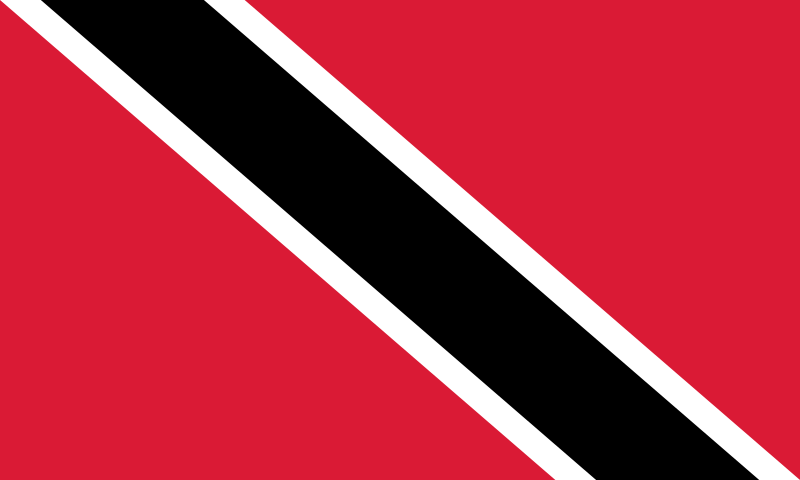
Trinidad-born Pan-Africanist theorist and journalist. Appointed head of the Profintern's Negro Bureau in Moscow in 1929, he led organising efforts among colonial workers. But he broke with the USSR in 1934 when Soviet diplomacy prioritised alliance with the colonial powers over liberation movements. From London he chaired the International African Service Bureau and organised the 1945 Manchester Pan-African Congress, setting the agenda for postwar decolonisation. As Kwame Nkrumah's closest advisor, he helped shape Ghana's independence and the vision of African unity.
Career timeline
- 1903Born in Arouca, Trinidad as Malcolm Ivan Meredith Nurse
- 1924–1927Studies at Fisk and Howard Universities; joins CPUSA (1927)
- 1929Reports to Comintern in Moscow; appointed head of Profintern's Negro Bureau; elected to Moscow City Soviet
- 1930Organises ITUCNW in Hamburg; edits monthly The Negro Worker
- 1933–1934Deported from Germany after Nazi takeover; breaks with Comintern over USSR's shift on colonial policy; expelled February 1934
- 1934–1945Settles in London; chairs IASB; organises 1945 Manchester Pan-African Congress
- 1947–1957Advisor to Nkrumah; publishes The Gold Coast Revolution (1953); supports Ghana's independence
- 1957–1959Moves to Ghana as Nkrumah's advisor on African affairs; dies in London 1959; ashes interred at Christiansborg Castle
The investigative journalist who exposed apartheid, the communist revolutionary who endured 117 days of solitary confinement
“In prison you see only the moves of the enemy. Prison is the hardest place to fight a battle.” — 117 Days (1965)
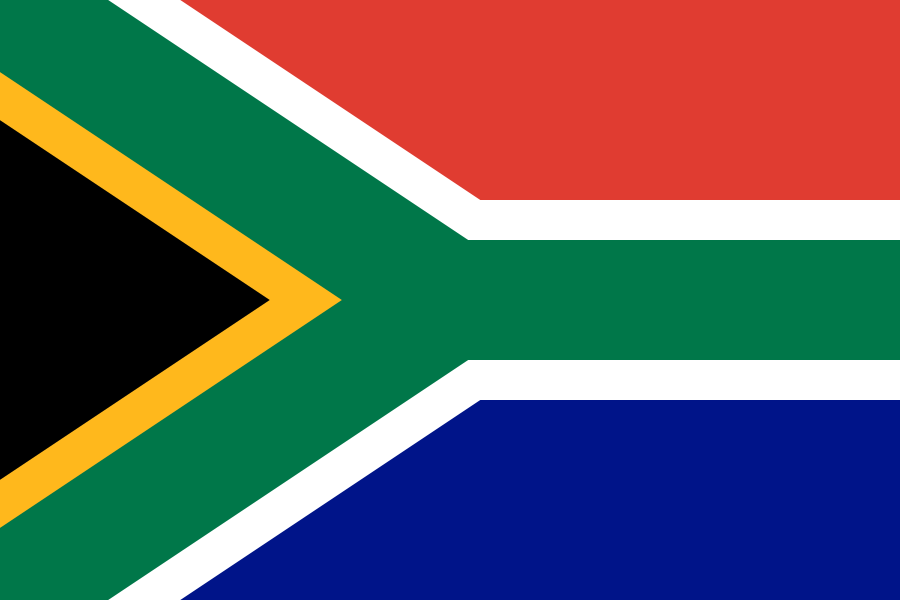
White anti-apartheid activist and journalist who worked within the SACP and ANC. As editor-in-chief of the progressive Guardian, she exposed racial segregation and served on the Freedom Charter drafting committee. A Treason Trial defendant, she became the first white woman detained under the Ninety-Day Law; her solitary confinement produced the memoir 117 Days. In exile she became a scholar of African liberation movements and was assassinated in Maputo by an apartheid police parcel bomb.
Career timeline
- 1946BA Social Science, University of the Witwatersrand; co-founded Federation of Progressive Students
- 1946–1950sEditor-in-chief of The Guardian; after its banning, relaunched as Clarion, New Age, and others
- 1949Married Joe Slovo
- 1953Helped found the Congress of Democrats (COD), the Congress Alliance's white wing
- 1955Freedom Charter drafting committee member; banned from attending the Congress of the People at Kliptown
- 1955Editor of the radical political journal Fighting Talk
- 1956–1961Treason Trial defendant alongside 155 others; all acquitted
- 1963First white woman detained under the Ninety-Day Law; 117 days solitary confinement; later wrote 117 Days
- 1964Exiled to London; active in the British Anti-Apartheid Movement
- 1964–1970sEdited biographies of Mandela, Mbeki, and Odinga; researched African liberation movements
- 1970Published The Barrel of a Gun: Political Power in Africa and the Coup d'état
- 1972–1978Research Fellow at Manchester; lecturer in development studies at Durham
- 1978–1982Research director, Centre of African Studies, Eduardo Mondlane University, Maputo
- 1982.08.17Assassinated by a South African Police parcel bomb; presidents and ambassadors from 34 countries attended her funeral