Aristocratic statesman who led Hungary’s delegation to the Paris peace talks in 1920 and pleaded for revising Trianon at the League
A count born in Vienna, he entered parliament in 1877 and was a leading orator for half a century. As education minister in 1906–1910 he drafted the Apponyi laws of 1907, which imposed Hungarian-language teaching on non-Hungarian schools. He led the Hungarian delegation at the Paris peace talks in January 1920 and spoke on 16 January, without changing the terms, and in March lost the regency vote to Horthy. Thereafter, as a legitimist opposition deputy and Hungary’s representative at the League of Nations, he denounced the injustice of the Trianon borders. He died in Geneva in 1933, where he had come for the Disarmament Conference.
Career timeline
- 1877Enters parliament
- 1906–1910Education minister; Apponyi laws of 1907
- 1920Heads the peace delegation in Paris
- 1920Loses the regency vote to Horthy
- 1923–1933Representative at the League of Nations
German admiral who built the High Seas Fleet to rival the Royal Navy, set off a naval arms race and urged unrestricted U-boat war
Born in Küstrin in Brandenburg, the son of a lawyer, he was State Secretary of the Imperial Naval Office from 1897 to 1916 and turned the modest Imperial Navy into a world-class force that could threaten the Royal Navy. The Fleet Acts of 1898–1912, built on his “risk theory”, gave Germany the second-largest navy in the world, but started a costly naval arms race and pushed Britain closer to France. He saw sea power as a “palliative against” the Social Democrats. When the High Seas Fleet could not break Britain’s blockade, he became an outspoken advocate of unrestricted submarine warfare, and resigned in March 1916. In 1917 he co-founded and chaired the far-right Fatherland Party, which opposed a negotiated peace, and after the war sat in the Reichstag for the German National People’s Party. He died in 1930.
Career timeline
- 1897–1916State Secretary of the Imperial Naval Office
- 1898–1912Built the High Seas Fleet through the Fleet Acts
- 1917Co-founder and chairman of the German Fatherland Party
- 1924–1928Reichstag deputy for the DNVP
Defender of the Dual Monarchy who was Hungary’s wartime prime minister and was killed by soldiers on the day of the Aster Revolution
The son of Kálmán Tisza, prime minister from 1875 to 1890, he grew up in a Calvinist family of untitled lower nobility and studied in Budapest, Heidelberg and Berlin. He entered parliament for the Liberal Party in 1886, was prime minister of Hungary twice, in 1903–1905 and 1913–1917, and Speaker of the House in 1912–1913. The most zealous adherent of the Dual Monarchy with Austria, he opposed universal suffrage and the break-up of the great estates. In July 1914 he alone at first opposed war with Serbia, but in the end supported it. Asked to resign by the reforming King Charles, he stepped down in May 1917. On 31 October 1918, during the Aster Revolution, he was killed by soldiers who broke into his home in Budapest.
Career timeline
- 1886Liberal Party member of parliament
- 1903–1905Prime minister of Hungary
- 1910Founded the National Party of Work
- 1912–1913Speaker of the House of Representatives
- 1913–1917Prime minister of Hungary
Transylvanian aristocrat who, as prime minister in 1921–1931, consolidated the Horthy regime with a restricted franchise and a League loan
Scion of an old Transylvanian noble family, he entered parliament as a liberal in 1901. He joined the counter-revolution in Szeged in 1919 and became prime minister in April 1921, after King Charles’s first return attempt. He founded the Unity Party, secured its victories by restoring the open ballot in the countryside with the Franchise Act of 1922, concluded a pact with the Social Democrats, and stabilised the economy through League of Nations membership and a loan. He resigned in the Depression in 1931 and in 1941 opposed war with the Soviet Union. Arrested by the Soviets in 1945, he died in a Moscow prison in 1946.
Career timeline
- 1901Enters parliament as a liberal
- 1919Joins the Szeged counter-revolution
- 1921–1931Prime minister
- 1921Bethlen–Peyer Pact
- 1922Founds the Unity Party; Franchise Act
- 1924League of Nations loan
- 1945–1946Arrested by the Soviets; dies in a Moscow prison
Weimar finance minister who founded the CDU in the Soviet zone in 1945 and was deposed for opposing the land reform
The son of a Cologne railway worker, he studied agriculture and from 1911 worked at the International Institute of Agriculture in Rome. A member of the Catholic Centre Party, he became Minister of Food in 1920 and was Minister of Finance from 1922 until the Cuno cabinet resigned in August 1923. Arrested after the Nazis took power, he later served as an economic adviser to the government of Colombia. Back in Germany he joined the resistance around Goerdeler, was arrested after 20 July 1944 and sentenced to death in January 1945, but his wife delayed the execution until the Red Army took Berlin. On 26 June 1945 he became the first chairman of the CDU of Berlin and the Soviet zone; because he refused to agree to the land reform without compensation, SMAD deposed him in December. In the West he founded the German Farmers’ Association and argued for reunification.
Career timeline
- 1911–1914Department director at the International Institute of Agriculture, Rome
- 1920Reich Minister of Food
- 1922–1923Reich Minister of Finance
- 1945Sentenced to death by a Nazi court
- 1945Chairman of the CDU in the Soviet zone; deposed in December
- 1948President of the German Farmers’ Association
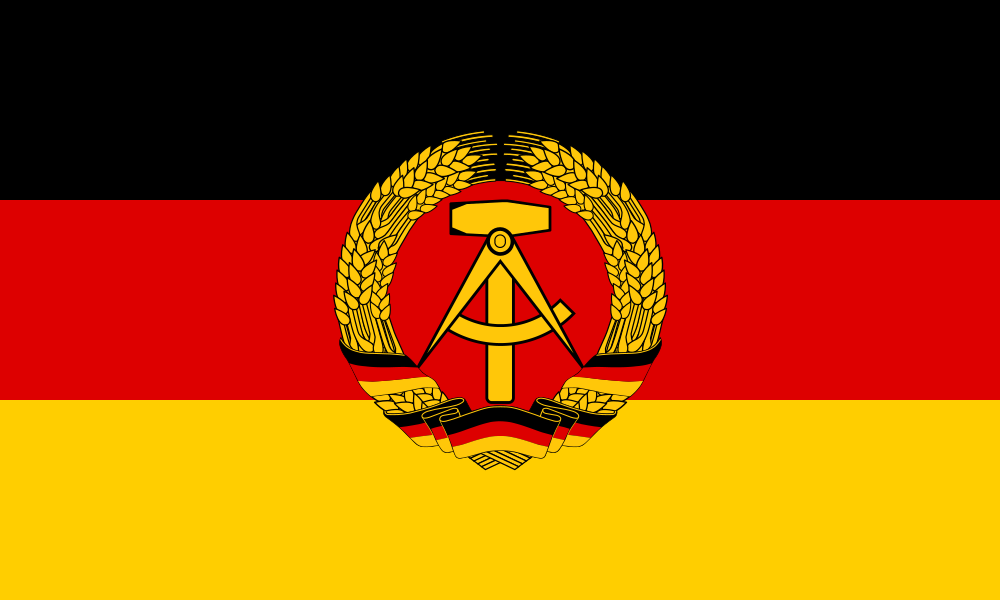
Kaiser’s successor at the head of the East German CDU, who brought it into line with the SED as deputy prime minister
Born in Frohburg in Saxony, he worked as a journalist, moved through the left-liberal parties, helped found the German Democratic Party in 1918, and sat in the Weimar National Assembly and the Prussian Landtag. He joined the opposition after 1933 and went into hiding after the 1944 attempt on Hitler’s life. In 1945 he co-founded the CDU in the Soviet zone; when the Soviet authorities deposed Jakob Kaiser and Ernst Lemmer in 1947 he became acting chairman, and chairman in 1948. As a co-chairman of the German People’s Council he took part in drafting the GDR constitution, and in 1949 became deputy prime minister and head of the Church Office. A loyal supporter of the SED regime, he pushed out CDU members unwilling to follow the Communists. He died in 1957.
Career timeline
- 1918Co-founder of the German Democratic Party
- 1921–1933Member of the Prussian Landtag
- 1945Co-founder of the CDU in the Soviet zone
- 1948–1957Chairman of the East German CDU
- 1949–1957GDR deputy prime minister and head of the Church Office