The priest who led the march, and ended a double agent
After Bloody Sunday, Gapon wrote: "We no longer have a tsar. Today a river of blood divides him from the Russian people. It is time for the Russian workers to begin the struggle for the people's freedom without him."
On January 9, 1905, he led 150,000 workers in a petition march to the Winter Palace, where troops opened fire. He survived to write "We no longer have a Tsar," but when his double game with the police came to light, SR combatants hanged him the next year.
Career timeline
1902–1904Organizes the police-sponsored Assembly of Factory Workers
1905.01.09Leads the Winter Palace petition march, Bloody Sunday
1905–1906Exile; contacts with the revolutionary parties
1906His police ties exposed; hanged by SR combatants
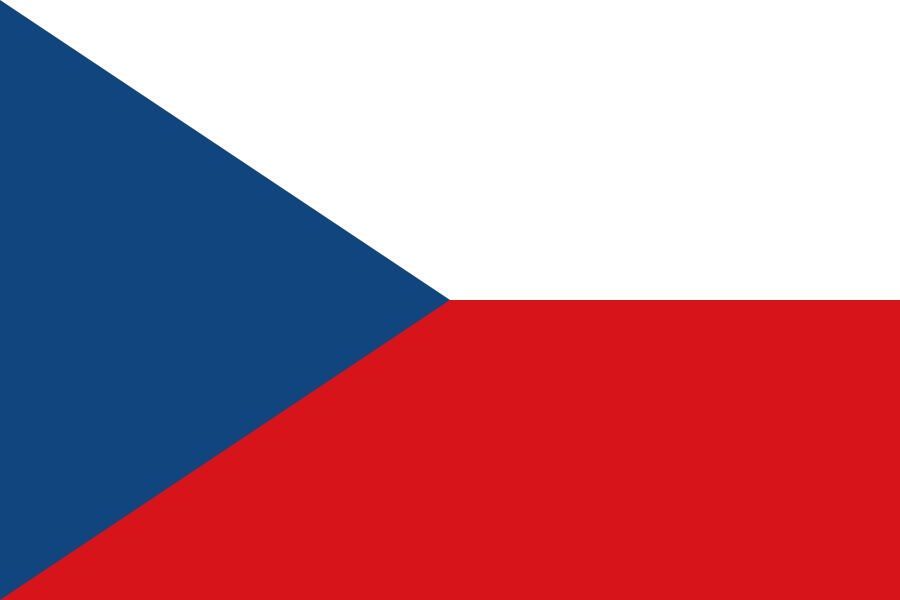
Greek Catholic priest who became president of Carpatho-Ukraine when it declared independence in March 1939
The son of a Greek Catholic priest in Carpathian Ruthenia, then part of Austria-Hungary, he studied at the Ungvár school of theology and at Budapest University and was ordained. In 1918 he became head of the Subcarpathian National Council, which in 1919 asked for the region to join Czechoslovakia. In 1925 he was elected to the parliament in Prague as leader of the Ruthenian National Christian Party, and in October 1938 he was appointed head of the government of the Subcarpathian Autonomous Region. On 15 March 1939 he became president of Carpatho-Ukraine, but the next day Hungary occupied and annexed the region; he fled to Prague and spent the war as a professor at the Ukrainian Free University. Arrested by the NKVD when the Soviet army took Prague in May 1945, he was taken to Moscow and died in Butyrka prison in July.
Career timeline
1900–1917Professor of mathematics, teachers’ institute
1918–1919Head, Subcarpathian National Council
1925Deputy in Prague (Ruthenian National Christian Party)
1938–1939Head of the Subcarpathian autonomous government