Legendary Soviet spymaster who headed KGB illegal intelligence for 12 years
"We don't want this, but we must." — Yuri Andropov to Drozdov on the telephone, just before the assault on Amin's palace, 27 December 1979
A leading Soviet intelligence officer, Yuri Drozdov joined the KGB in 1956 and built the USSR's overseas intelligence network through postings in East Germany, China, and the United States. From 1979 to 1991 he headed Directorate S, the KGB's illegal intelligence arm within the First Chief Directorate, overseeing the global network of deep-cover 'illegals' operating under false identities. In December 1979 he commanded Operation Storm-333, the 43-minute special forces assault on Afghan president Hafizullah Amin's Tajbeg Palace that opened the Soviet-Afghan War; drawing on that experience, he founded the elite KGB spetsnaz unit Vympel in 1981. He is also remembered for posing as the 'German cousin' of captured Soviet spy Rudolf Abel to facilitate the famous 1962 prisoner exchange on the Glienicke Bridge for downed U-2 pilot Francis Gary Powers.
Career timeline
1943–1945Red Army, 1st Belorussian Front; entered Berlin
1945–1952Soviet Army artillery officer, Germany and Baltic Military District
1952–1956Graduated Military Institute of Foreign Languages (German, English)
1956–1957Transferred to KGB; illegal intelligence training
1957–1963KGB liaison to Stasi, East Berlin; illegal operative roles
1964–1968KGB resident in Beijing during the Cultural Revolution
1968–1975Central apparatus of PGU; deputy chief of Directorate S
1975–1979KGB resident in New York, under cover as deputy UN representative
1979–1991Deputy chief of PGU KGB; head of Directorate S (illegal intelligence); founded Vympel
Architect of KGB ideological counterintelligence, 45-year Chekist under 12 chiefs
"We in the KGB contributed quite a bit to perestroika because without it the Soviet Union could not move ahead."
Bobkov served 45 years in Soviet state security under twelve chiefs, designing the KGB's ideological counterintelligence apparatus as head of the Fifth Directorate to surveil and suppress dissidents, religious activists, and nationalists. In old age he acknowledged responsibility for exiling Sakharov, and after the Soviet collapse he ran security analysis for oligarch Vladimir Gusinsky's Most Group.
Career timeline
1942–1945Red Army, Western & Baltic fronts, wounded twice
1946Graduated Leningrad SMERSH school, MGB central apparatus
1956Dept. chief, KGB 4th Directorate (ideological counterintelligence)
1961Deputy chief, KGB 2nd Chief Directorate (counterintelligence)
1969–1983Chief, KGB 5th Chief Directorate (ideological → constitutional)
The Arabist premier who turned his plane around over the Atlantic
"The first demonstration to the world that Russia cannot be spoken to from a position of strength" — Russian analysts on Primakov's Atlantic turnaround, March 1999
The USSR's leading Arabist and a pragmatist who spanned intelligence, diplomacy, and high politics. After serving as Pravda's Middle East correspondent, he directed IMEMO and the Institute of Oriental Studies, and became a candidate Politburo member in 1989. As head of the KGB First Chief Directorate in 1991 he founded Russia's SVR foreign intelligence service. As Foreign Minister he championed a multipolar 'Primakov Doctrine,' and as Prime Minister in 1999 he famously turned his plane back over the Atlantic upon learning of NATO's bombing of Yugoslavia.
Career timeline
1953–62State Radio Arabic desk; researcher, IMEMO
1962–70Pravda Middle East correspondent, based in Cairo
1970–77Deputy director, IMEMO; secret Middle East missions
1977–85Director, Institute of Oriental Studies, USSR Academy of Sciences
1985–89Director, IMEMO; Academician, USSR Academy of Sciences
1989–90Candidate Politburo member; Chairman, Soviet of the Union
1991Head, PGU KGB → Central Intelligence Service → SVR director
1996–98Foreign Minister of Russia; Primakov Doctrine
1998–99Prime Minister of Russia; Atlantic turnaround
The KGB operational deputy who bridged foreign intelligence and counterintelligence
On the afternoon of 18 August 1991, Defence Minister Yazov ordered Airborne Forces commander Grachev to execute the Kremlin's coup plan — adding: "Coordinate with KGB Deputy Chairmen Grushko and Ageev."
A Soviet intelligence officer who commanded both the PGU (foreign intelligence) and VGU (counterintelligence), the KGB's two operational main directorates. Born to a turner's family in Taganrog, he graduated from MGIMO and began as a diplomat in Norway before joining the KGB in 1960, rising through Oslo residency to chief of the 3rd (Anglo-Scandinavian) Department and First Deputy Chief of the PGU. In 1989, under Vladimir Kryuchkov, he took charge of the Second Chief Directorate (counterintelligence) as Deputy Chairman, and in January 1991 became First Deputy Chairman, the KGB's top operational post. He was arrested for participating in the August 1991 GKChP coup, suffered two heart attacks in detention, and was released on health grounds before being amnestied in 1994.
Career timeline
1954–1960Soviet Ministry of Foreign Affairs, Embassy in Norway
1960–1961Graduated KGB School No. 101, assigned to 3rd Department, PGU KGB
1968–1971Deputy Resident, KGB Oslo (political intelligence)
1971–1972Resident, KGB Oslo
1975–1980Chief, 3rd Department, PGU KGB (UK & Scandinavia)
1983–1989First Deputy Chief, PGU KGB
1989–1991Deputy Chairman of KGB, Chief of Second Chief Directorate (counterintelligence)
From KGB eavesdropping chief to head of leadership security, the man who pulled the coup's trigger
Gorbachev recalled: "Yeltsin felt uneasy, as if someone were eavesdropping. His instinct was correct. Plekhanov, head of the 9th Directorate, had prepared the room."
Andropov's personal secretary who rose to command the KGB 12th Department (eavesdropping, phone taps, mail interception) for thirteen years before heading the 9th Directorate guarding the party leadership. On Kryuchkov's orders, he pre-wired the Novo-Ogaryovo meeting room for 29 July 1991, and the recording of Gorbachev, Yeltsin and Nazarbayev agreeing to purge the hardliners reached the plotters, detonating the August coup. On the day of the coup he flew to Foros and physically admitted the conspirators into Gorbachev's dacha; arrested when it collapsed, he was amnestied in 1994.
Career timeline
1965–1967Secretary to CPSU Central Committee Secretary Andropov
1970–1983Head, KGB 12th Department: eavesdropping, phone taps, mail interception
1983–1990Head, KGB 9th Directorate: protection of party and state leadership
1990–1991Head, KGB Protection Service; Collegium member
1991.7.29Wired the Novo-Ogaryovo meeting room; recording leaked to plotters
1991.8–1994Joined coup at Foros; arrested; Matrosskaya Tishina; amnestied
Creator of OMON and the last communist prime minister of Russia, defeated by Yeltsin
Inside the MVD they called him "Tishayshy" — the Quietest One. As organized crime grew, the minister said little and did less, until Gorbachev replaced him.
A mining engineer from Buryatia, Vlasov rose through the Komsomol and party apparatus to become first secretary in the Chechen-Ingush ASSR and Rostov Oblast, a classic Soviet party careerist. Appointed USSR interior minister in January 1986, he created the special-purpose police units (OMON) but was criticized for passivity against organized crime and replaced by Vadim Bakatin after less than three years. Shifted to RSFSR prime minister in October 1988, where he lost the Supreme Soviet chairmanship to Boris Yeltsin in May 1990 by a vote of 535–467. He embodied the old party apparatus trying to adapt to perestroika, and was overtaken by forces neither he nor the system could manage.
Career timeline
1954–1955Mine foreman, Cheremkhovo Mine No. 5; Komsomol Cheremkhovo city committee dept. head then second secretary
1955–1961Second secretary then first secretary, Irkutsk Oblast Komsomol
1961–1965First secretary, Ziminsky District CPSU, Irkutsk; second secretary, Irkutsk Industrial Oblast CPSU; first deputy chair, Irkutsk Oblast Executive Committee
1965–1972Secretary then second secretary, Yakut Oblast CPSU
An intelligence officer whose restraint mattered at the nuclear brink
Seeing unusual Soviet nuclear readiness, he advised against raising NATO's alert level.
Leonard H. Perroots was a U.S. Air Force general and military intelligence specialist whose career intersected with the management of nuclear danger late in the Cold War. As assistant chief of staff for intelligence, U.S. Air Forces in Europe, during Able Archer 83 in 1983, he observed unusual Soviet nuclear readiness but advised against raising NATO alert levels, avoiding a potentially dangerous escalation. He later directed the Defense Intelligence Agency and left a significant retrospective account of the war scare, illustrating how intelligence judgment can shape decisions at the nuclear brink.
Career timeline
1955Commissioned in the U.S. Air Force
1970년대Air Force command and intelligence assignments
1982–1984Assistant Chief of Staff for Intelligence, U.S. Air Forces in Europe
1983Advised against escalating NATO alert levels during Able Archer 83
1984–1985Deputy Chief of Staff for Intelligence, U.S. Air Force
1985–1988Director of the Defense Intelligence Agency
Youngest KGB general turned its highest-ranking defector-critic
"I like Americans very much. But after seven months here I am convinced more than ever that the Communist system is better than yours." — 24-year-old KGB officer Kalugin, posing as a Fulbright scholar to Newsweek, 1959.
A KGB Major General who, as the youngest general in the agency's history, headed foreign counterintelligence (Directorate K) and directed Cold War espionage against the United States. He broke with the service in the late 1980s, publicly denouncing its corruption, backed Yeltsin during the 1991 coup, and emigrated to the US, where his memoirs exposed the inner workings of the KGB.
Career timeline
1952–1956KGB Foreign Languages Institute, Leningrad
1956–1958Higher Intelligence School No. 101, KGB
1958–1959Operational trainee, Columbia University under Fulbright cover
1960–1964Operative, KGB New York residency (Radio Moscow cover)
1965–1970Deputy resident / acting chief, KGB Washington residency
1971–1973Deputy head, 2nd Service (later Directorate K), First Chief Directorate
1973–1980Head, Directorate K (foreign counterintelligence), First Chief Directorate
1980–1987First deputy chief, KGB Leningrad Directorate
1990Elected People's Deputy, Supreme Soviet of the USSR
On August 19, 1991, the day the GKChP coup began, Shebarshin 'demonstratively' played tennis all day.
The last chief of the KGB First Chief Directorate, a career officer who built decades of field experience in Pakistan, India, and Iran. He kept his distance from the August 1991 coup, served a single day as acting KGB chairman after its failure before Boris Yeltsin blocked him, and later chronicled Soviet foreign intelligence's final chapter in his memoirs.
Career timeline
1958–1962Interpreter and Third Secretary, Soviet Embassy in Pakistan
1962Joined KGB First Chief Directorate, trained at School No. 101
1964–1968KGB intelligence officer under diplomatic cover, Pakistan
1971–1977Deputy rezident, then rezident, KGB India
1979–1983KGB rezident in Iran
1983–1987Deputy chief, then chief, Information-Analytical Directorate, PGU KGB
1987–1989Deputy chief of PGU KGB (Middle East and Africa)
1989–1991Deputy Chairman of the KGB and Chief of the First Chief Directorate
From Latvian KGB chief to USSR interior minister, a guardian of order shattered in the coup he backed
He took his own life with a pistol in his apartment on 22 August 1991, with an arrest warrant issued. The order of the shots is disputed: prosecutors held he fired first, while Yavlinsky's account and the later investigation concluded his wife fired last.
Born into a family of Latvian communists and a graduate of the Riga Polytechnical Institute, he rose through Komsomol and party work to chair the Latvian KGB in 1980–1984 and lead the Communist Party of Latvia in 1984–1989. As USSR interior minister from December 1990 he pursued a hard line on law and order, and in August 1991 joined the State Emergency Committee (GKChP), mobilizing the interior apparatus behind it. When the coup collapsed he took his own life with a pistol in his Moscow apartment on 22 August 1991.
Career timeline
1960Engineer, Riga Electromechanical Plant
1961–1969Secretary then First Secretary, Proletarsky District Komsomol, Riga; First Secretary, Latvian Komsomol CC
1970–1974Secretary, All-Union Komsomol CC; Inspector, CPSU CC
1974–1976Head of Organizational-Party Work, Latvian CP CC; First Secretary, Riga City Committee
1976–1980Department head, KGB Inspectorate; First Deputy Chairman, Latvian KGB
1980–1984Chairman, KGB of the Latvian SSR (Major-General)
1984–1988First Secretary, CC of the Communist Party of Latvia
1988–1990Chairman, CPSU Party Control Committee; Candidate Politburo member (Sep 1989–Jul 1990)
1990–1991Minister of Internal Affairs, USSR; Security Council member (from Mar 1991)
"The traditions of chekism must be eradicated, must cease to exist as an ideology" — the last chairman of the KGB, in his 1992 memoir Deliverance from the KGB.
A construction engineer turned Gorbachev loyalist, Bakatin served as Soviet interior minister (1988–1990) and, after the failed August 1991 coup, as the last chairman of the KGB. Appointed to succeed coup-plotter Vladimir Kryuchkov, he stripped foreign intelligence, communications, and border troops from the agency and restructured the remainder into a smaller presidential security service. His handover of KGB listening-device blueprints from the US embassy in Moscow to American officials in December 1991 brought furious charges of treason from Russian conservatives.
Career timeline
1960–73Construction engineer and manager, Kemerovo
1973–85Party posts in Kemerovo; CPSU Central Committee inspector
1985–87First Secretary, Kirov Oblast Committee
1987–88First Secretary, Kemerovo Oblast Committee
1988–90Minister of Internal Affairs of the USSR
1991.3–8Member, Security Council under the President of the USSR
1991.8–11Chairman of the KGB (last)
1991.11–92.1Head, Inter-republican Security Service (MSB)
The last chairman of the KGB of the Ukrainian SSR, who went on to serve the security services of three states: USSR, Ukraine, and Russia
Like the title of his memoir, he served in the special services of three states — the USSR, Ukraine, and Russia. In 1994 he refused Yeltsin's demand to block the amnesty for the October 1993 prisoners, resigned, and said he had kept his oath as a Russian officer to the people.
Nikolai Golushko was a Soviet state security officer who rose through the KGB's Fifth Directorate, responsible for ideological counterintelligence and the suppression of dissent, to become the last chairman of the KGB of the Ukrainian SSR (1987–1991). After the dissolution of the USSR, he briefly headed Ukraine's Security Service (SBU) before moving to Russia, where he served as Minister of Security and Director of the Federal Counterintelligence Service (FSK), making him one of the rare figures to have led security agencies in three states. He resigned as Russia's security minister in early 1994 after clashing with President Yeltsin over the amnesty for participants in the October 1993 crisis, and later published a memoir titled In the Special Services of Three States.
The highest-ranking KGB officer to defect, and the key source on the 1983 war scare
My colleagues in the PR Line regarded RYAN with some skepticism, yet none wanted to lose face at the Centre by contradicting the First Chief Directorate's assessment.
The highest-ranking KGB officer ever to defect to the West, a colonel of the First Chief Directorate who for eleven years from 1974 doubled as MI6 agent "Ovation". As London rezident he was the key source who relayed Operation RYAN and the Soviet leadership's alarm over Able Archer 83 to British and American intelligence, testimony widely credited with easing the nuclear danger of 1983. Betrayed by CIA mole Aldrich Ames, he was recalled to Moscow, drugged and interrogated, then smuggled out in the boot of a diplomatic car in 1985 and sentenced to death in absentia for treason.
Career timeline
1962Graduated MGIMO, joined Directorate S (illegals), First Chief Directorate
The Deputy Prosecutor General whose TV broadcast lit the fuse of the Sumgait pogrom
On 27 February 1988, on Central Television, he named the two youths killed in the Askeran clash as Azerbaijanis; that night the Sumgait pogrom erupted.
A Soviet military jurist of Belorussian birth, Alexander Katusev was appointed Deputy Prosecutor General of the USSR in 1987 and led high-profile corruption investigations in Uzbekistan. His name entered history on 27 February 1988, when he appeared on Central Television and named two Azerbaijani youths killed in a clash near Askeran, specifying their nationality; the broadcast became the immediate spark for the Sumgait pogrom that evening. As Chief Military Prosecutor (1989–1991), he investigated and debunked the Panfilov Twenty-Eight myth in his essay 'Another's Fame,' but was forced into retirement after the August coup.
Career timeline
1950sGraduated Dneprodzerzhinsk Metallurgical School, worker at Dnieper Metallurgical Combine
1965Graduated Kharkov Law Institute
1966Investigator, garrison procuracy, Transbaikal Military District
c. 1970s–1987Investigator, senior investigator, head of investigation departments, chief of Main Investigation Directorate, USSR Procuracy
1987–1989Deputy Prosecutor General of the USSR
1989–1991Chief Military Prosecutor and Deputy Prosecutor General of the USSR
From border controller to the officer who ordered the Wall opened
“That’s why I gave my people the order: Open the barrier!”
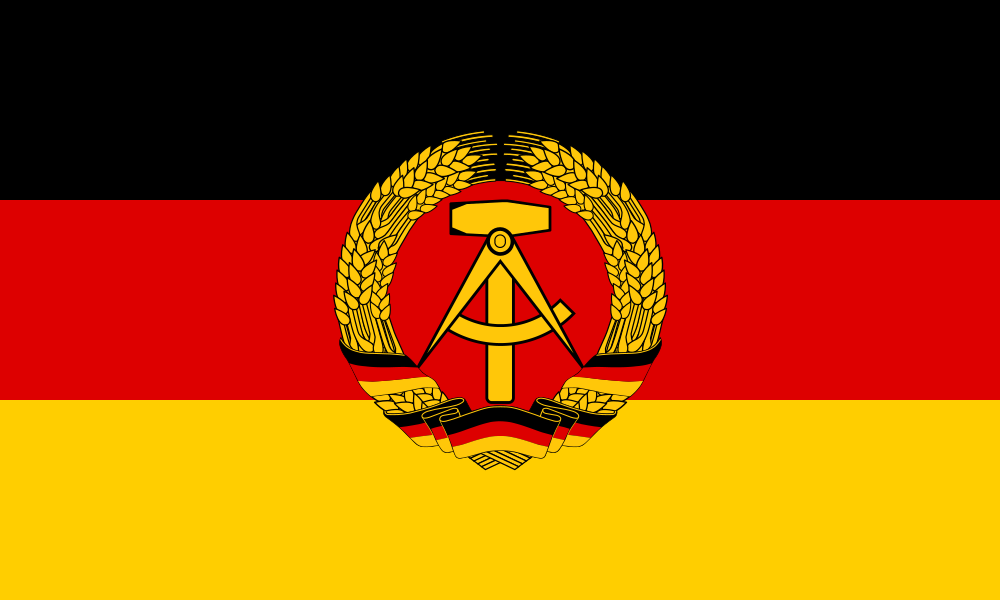
Harald Jäger was a border-control officer who served the East German Ministry for State Security, enforcing the state’s travel controls and intelligence work. On 9 November 1989, without clear direction from his superiors, he faced a growing crowd and the danger of violence at Bornholmer Straße. He belonged to the machinery of control, yet that night he ordered the barrier opened, allowing thousands of East German citizens into West Berlin. He later acknowledged both the GDR’s inner contradictions and the freedom brought by the Wall’s fall.
Career timeline
1943Born in Bautzen
1961Volunteered for the German Border Police
1964–1989Served in the Ministry for State Security passport-control units
1976–1981Studied at the Stasi Law College and earned a law degree
1989Deputy commander at the Bornholmer Straße crossing
1989.11.09Ordered the Bornholmer Straße barrier opened without authorization
On the night of June 13, 1938, Lyushkov arrived at Border Detachment 59 in field uniform with decorations, told the outpost commander that he was meeting an agent alone on the other side, then crossed the border and surrendered to the Japanese.
Born in Odessa, he served in the Soviet state security organs and from the 1920s held senior Cheka, OGPU and NKVD posts in Ukraine, Moscow and the Far East. In 1930 he carried out an industrial espionage mission against the Junkers company in Germany, and in 1936-1937 he headed the Azov-Black Sea and then the Far East NKVD, directing mass arrests and executions of the Great Purge. While Far East NKVD chief in 1937 he took part in the forced deportation of 171,781 Soviet Koreans to Central Asia, the USSR's first mass ethnic deportation, with estimates of deaths ranging from about 16,500 to 50,000. In June 1938 he realised he was about to be arrested, crossed into Manchukuo and surrendered to the Japanese with a mass of Soviet military intelligence, and in August 1945 he was shot by his Japanese handlers as Soviet troops closed on Dalian.
Career timeline
1919Political commissar, 14th Red Army
1920Odessa Cheka operative
c.1930Industrial espionage at Junkers, Germany
1937–1938NKVD chief, Far East; Commissar 3rd Class
KGB security officer who commanded border troops under Andropov
After the 1969 Sino-Soviet border clashes, Soviet border troop strength nearly doubled within three years — an expansion Kozlovsky oversaw.
A Soviet KGB official who supervised the Chief Directorate of Border Troops (GUPV) under Yuri Andropov, playing a key role in tightening border enforcement and internal control during the Brezhnev era. His career embodies the institutionalised security function of the KGB in the late Soviet period.
Career timeline
1968–1979Deputy Chairman of the KGB, Head of the Chief Directorate of Border Troops (GUPV)
Founder of North Korea's state security and enforcer of its political repression
Arrival dates conflict: Russian Wikipedia and Lankov say 1946 (Lankov: September), English Wikipedia says October 1945. By 1947 he already headed the state protection (political police) department, and Lankov considers it likely he was the first head of North Korean state security.
A Koryo-saram from the Russian Empire whose birthplace is undocumented and whose birth year sources give as 1912, 1913 or 1914. He worked in the Soviet NKVD and intelligence agencies. Russian Wikipedia and Lankov date his arrival to 1946, English Wikipedia to October 1945. By 1947 he already headed the state protection (political police) department, and in September 1948 became Deputy Minister of Internal Affairs and Director of the Political Security Bureau, though Lankov holds he was never again allowed to control the political police. He held the security portfolio as Minister of Social Security (March/May 1951) and Interior Minister until November 1960. Russian Wikipedia describes him both as organizer of the North's repression system and as an executor who carried out the leadership's directives. Of the Soviet faction, he escaped the purges and died on 18 July 1992.
Career timeline
1937–1944Deported to Kazakhstan, then investigator in Kzyl-Orda and prosecutor's office work in Kzyl-Orda and Taldy-Kurgan oblasts, 1942–1944 (Russian Wikipedia); joined the party in 1940. Lankov says his record before 1946 is undocumented
1947Head of the state protection (political police) department, Interior Bureau, North Korean People's Committee (Lankov). English Wikipedia has him as Director-General of the Interior Affairs Bureau from May 1947, which does not fit the bureau-under-ministry structure after 1948
1948년 9월–1951년 2/3월Deputy Minister of Internal Affairs and Director of the Political Security Bureau (English Wikipedia). Per Lankov he was afterwards never allowed to control the political police again
1951년 3월/5월–1952년Minister of Social Security (the Political Security Bureau was reorganized as the Ministry of Social Security). March per English Wikipedia and the Encyclopedia of Korean Culture; May per English Wikipedia's Ministry of Social Security article
1952년 10월–1960년 11월Minister of Interior (the Ministry of Social Security was merged back into the Ministry of Internal Affairs)
1956년 8월As Minister of Internal Affairs during the August faction incident mobilized the police to monitor Pyongyang and led the investigation of the 'factionalists' (English Wikipedia). The same article also records a claim that he was abroad at the time
1956–1980Member of the WPK Central Committee (elected April 1956; reelected November 1970 and October 1980)
1960년 11월–1972년Deputy Director of the Central Court; from November 1966 information director of the party Liaison Bureau
1972년 12월–1992년President of the Central Court (reappointed 1982 and 1986, in office until his death)