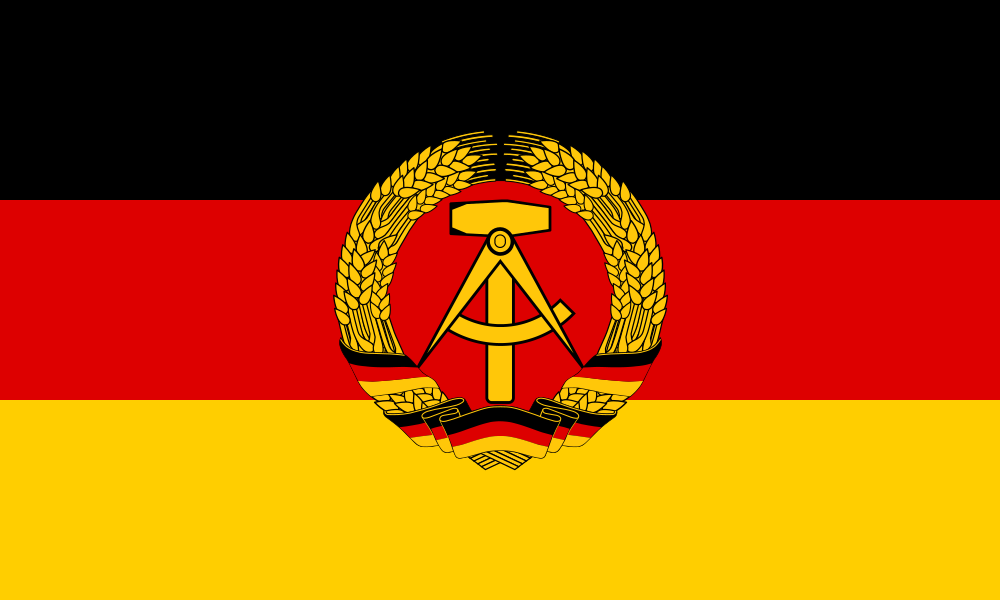
German Social Democratic and Independent Social Democratic politician who headed Berlin police in 1918
“I got my job from the Revolution, and I shall give it up only to the Revolution.”
A trained mechanic, Eichhorn worked for the Social Democratic Party before joining the Independent Social Democratic Party in 1917. After the November Revolution of 1918, he became Berlin police president and pursued a policing policy favorable to left-wing political groups. On 4 January 1919, the Prussian cabinet tried to dismiss him and replace him with Social Democrat Eugen Ernst. Mass demonstrations and a general strike opposed the move, followed by occupations and armed clashes that became the January uprising.
Career timeline
- 1893Became a full-time Social Democratic Party official and worked as an editor in Dresden
- 1903–1911Member of the Reichstag for Baden's 9th constituency
- 1908–1917Head of the Berlin Social Democratic press office
- 1917Joined the Independent Social Democratic Party
- 1918–1919Served as Berlin police president
- 1919–1920Member of the Weimar National Assembly for Berlin
- 1920–1925Joined the Communist Party of Germany and served in the Reichstag
First East German Minister for State Security, purged in 1953 after trying to replace Ulbricht
Born in Gelsenkirchen to a gendarmerie sergeant’s family, he trained as a teacher and was a military leader of the Red Ruhr Army during the Kapp Putsch of 1920. As a GRU agent and Comintern military adviser he co-organised the Guangzhou Uprising in China, and in the Spanish Civil War, as “Gomez”, he led the International Brigades. He returned to Germany in 1947, joined the SED, and in 1950 became the first Minister for State Security and a Politburo member, building up the Stasi. After the uprising of June 1953 he moved to replace Ulbricht with Herrnstadt, but once Ulbricht had Khrushchev’s backing he lost his ministry and all his posts in July and was expelled from the party. He worked as a translator, died in East Berlin in 1958 and was rehabilitated after 1990.
Career timeline
- 1920Red Ruhr Army leader during the Kapp Putsch
- 1927–1930Comintern military adviser in China
- 1936–1938International Brigades commander in Spain (“Gomez”)
- 1950–1953GDR Minister for State Security; Politburo member
- 1953Stripped of all posts and expelled from the SED
The spy who stole the war’s timetable in Tokyo
“The world war… exerted the deepest influence on my entire life. Whatever other factors may have affected me, it was solely because of this war that I became a communist.” — from his 1927 autobiography
A Soviet intelligence officer who worked under cover as a German correspondent in Tokyo. He warned of Operation Barbarossa and confirmed Japan's southward turn, enabling Siberian divisions to be thrown into the Moscow front. Executed in 1944; made a Hero of the Soviet Union in 1964.
Career timeline
- 1925–1929Comintern, then Red Army intelligence
- 1930–1933The Shanghai network
- 1933–1941Tokyo: the correspondent the German embassy trusted
- 1941.05–06Warns of Barbarossa; ignored
- 1941.09“Japan will not strike north”, the basis for moving the Siberian divisions
- 1941.10Arrested
- 1944.11Hanged in Tokyo
East Germany's 'Master of Fear': the Stasi chief who ruled state security for 32 years
“All this blithering over to execute or not to execute, for the death penalty or against — all rot, Comrades. Execute! And, when necessary, without a court judgment.” — to senior Stasi officers, 1982
A communist militant from Berlin's Wedding district, Mielke fled to the USSR after the 1931 killing of two Berlin policemen and was trained by the NKVD. After the Spanish Civil War he returned in 1945 to help build the GDR's state security apparatus, leading the Stasi from 1957 to 1989 and expanding it into a 90,000-strong surveillance network. The Stasi controlled all of East German society while training armed groups across the Third World and Western Europe, extending socialist-bloc security architecture. He fell with the regime in 1989 and was convicted after reunification for the 1931 murders.
Career timeline
- 1925Joined the KPD
- 1931Fled to USSR after Bülowplatz police murders
- 1936–1939Served in International Brigades, Spain (Captain)
- 1945Returned to Berlin, Police Inspector Lichtenberg
- 1950Deputy Minister of State Security, State Secretary
- 1957–1989Minister for State Security (Stasi chief)
- 1976Full member, SED Politburo
- 1993Convicted of police murders, 6-year sentence
A long-serving architect of Cold War intelligence
At the August 1984 RYaN meeting, he stressed the need to establish the “actual situation” rather than mistake indicators for a Western nuclear attack.
Markus Wolf was a communist official and intelligence chief who, after fleeing Nazi persecution to the Soviet Union, led the foreign intelligence service of East Germany. From 1952 to 1986 he directed the Stasi’s Main Directorate for Reconnaissance, organizing espionage and active measures aimed at West German political, military, and economic institutions. When Soviet leaders expanded Operation RYaN amid fears of a pre-emptive nuclear attack in the early 1980s, Wolf maintained cooperation while exposing a tension between alarmist indicators and the need to establish the actual situation. After German reunification he passed through exile and trial, and used memoirs and public interventions to address responsibility for state security work and the possibility of reforming socialism.
Career timeline
- 1923–1933Grew up in Stuttgart
- 1933–1943Exile in the Soviet Union; studied in Moscow and at the Comintern school
- 1943–1945Editor and announcer for the German-language Moscow radio
- 1949–1951First counsellor at the East German embassy in Moscow
- 1952–1986Head of the foreign intelligence services IWF and HVA
- 1953–1986First deputy minister for state security
- 1986–1990After retirement, wrote memoirs and joined debates on reform
- 1990–2006Exile and trial, then died in Berlin