Historian who wrote Ukraine as a distinct historical subject, and chairman of the Central Rada
In March 1917 the Central Rada elected him chairman in absentia while he was still in exile in Moscow, and his return raised hope for uniting the democratic forces.
The historian whose History of Ukraine-Rus wrote Ukraine as a distinct historical subject, he chaired the Central Rada in 1917 and 1918. He returned to Soviet Ukraine in 1924 and died under surveillance in 1934.
Career timeline
1890Graduated Kyiv University, gold medal for graduation thesis
1894Professor of history at Lviv University
1897Chairman of the Shevchenko Scientific Society (1897–1913)
1917Chairman of the Central Rada (1917–1918), elected in absentia
1919Founded the Ukrainian Sociological Institute in Vienna
1924Returned to Soviet Ukraine, academician of VUAN
1929Full member of the USSR Academy of Sciences
1931Arrested on charges of counter-revolutionary activity
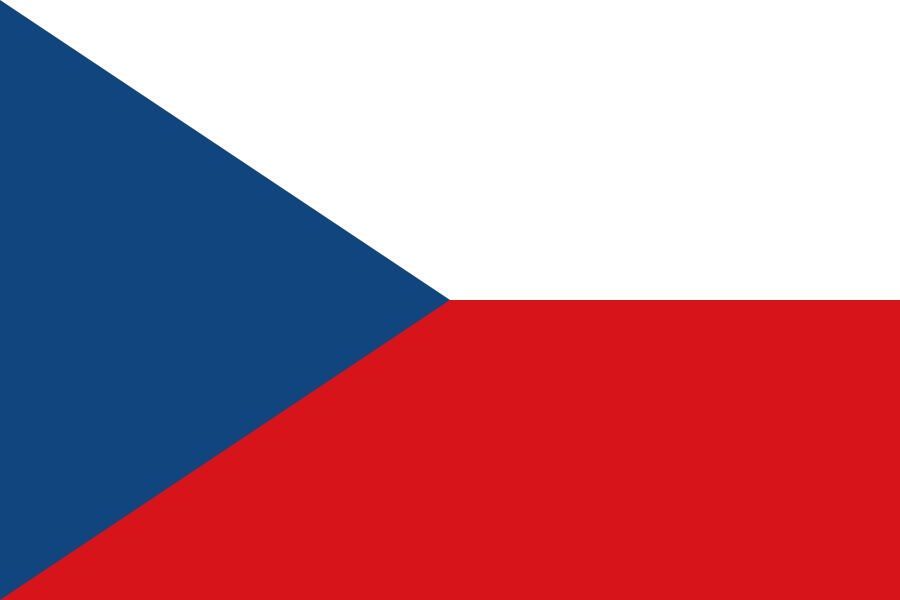
Greek Catholic priest who became president of Carpatho-Ukraine when it declared independence in March 1939
The son of a Greek Catholic priest in Carpathian Ruthenia, then part of Austria-Hungary, he studied at the Ungvár school of theology and at Budapest University and was ordained. In 1918 he became head of the Subcarpathian National Council, which in 1919 asked for the region to join Czechoslovakia. In 1925 he was elected to the parliament in Prague as leader of the Ruthenian National Christian Party, and in October 1938 he was appointed head of the government of the Subcarpathian Autonomous Region. On 15 March 1939 he became president of Carpatho-Ukraine, but the next day Hungary occupied and annexed the region; he fled to Prague and spent the war as a professor at the Ukrainian Free University. Arrested by the NKVD when the Soviet army took Prague in May 1945, he was taken to Moscow and died in Butyrka prison in July.
Career timeline
1900–1917Professor of mathematics, teachers’ institute
1918–1919Head, Subcarpathian National Council
1925Deputy in Prague (Ruthenian National Christian Party)
1938–1939Head of the Subcarpathian autonomous government
Pioneer of Ukrainian national communism, the original 'Shumskyism'
In April 1926, Shumsky met Stalin privately in Moscow for over two hours, demanding Kaganovich's replacement by Ukrainian Vlas Chubar and accelerated Ukrainization. Stalin's resulting Politburo letter condemned 'Shumskyism' as nationalist deviation — a watershed in the suppression of Ukrainian national communism.
A symbol of Ukrainian national communism and the prototype of 'Shumskyism': the demand for substantive republican autonomy against Moscow's centralism. A Borotbist who rose to the CP(b)U Politburo, he drove the de-Russification of Ukraine's cities and proletariat and the promotion of Ukrainian cadres as People's Commissar of Education (1924–1927). His 1926 confrontation with Stalin led to his condemnation for 'nationalist deviation' and removal from all posts; his name became shorthand for the suppression of Ukrainian autonomy within the Soviet system. Arrested in 1933, he endured the Solovki camps and Krasnoyarsk exile before the NKVD murdered him upon release in 1946; rehabilitated in 1958.
Career timeline
1908Joined the Ukrainian Social Democratic Spilka
1917–1919Left-wing UPSR leader, then Borotbist Central Committee member
1919People's Commissar of Education, Ukrainian SSR (first term)
1920Led Borotbist merger into CP(b)U; Politburo & Orgburo member, Comintern ECCI member
1921–1923Plenipotentiary of the Ukrainian SSR to Poland
1924–1927People's Commissar of Education (second term); led Ukrainization drive
1927Condemned for 'Shumskyism'; rector in Leningrad
1933–1946Arrested, imprisoned, exiled; killed by NKVD upon release (rehabilitated 1958)
The communist propagandist who became Ukraine's first president and signed the Soviet Union out of existence
It was a long road we walked to Belavezha. It was not by accident; it was our deliberate choice because we had no other option.
A party man who spent three decades climbing the propaganda and ideology apparatus of the Ukrainian Communist Party, Kravchuk pivoted to 'national communism' after becoming chairman of the Supreme Soviet in 1990. At the Novo-Ogaryovo negotiations he insisted on a confederation, not a federation, and delayed the signing of the new Union Treaty until September; after the August 1991 coup collapsed, he presided over Ukraine's Declaration of Independence on 24 August. Elected Ukraine's first president on 1 December 1991, he signed the Belavezha Accords with Yeltsin and Shushkevich a week later, formally ending the Soviet Union. His presidency saw the surrender of Ukraine's nuclear arsenal and a deep economic slump, but he stepped down after a peaceful electoral defeat and remained active in politics as a deputy.
Career timeline
1958–1970From political-economy teacher to head of agitation and propaganda, Chernivtsi region
1970–1980Rose through CC CPU agitation and propaganda department
1980–1988Head of CC CPU agitation and propaganda department
1988–1989Head of CC CPU ideology department
1989–1990.06CC CPU secretary, Politburo member, second secretary
1990.07–1991.08Chairman of Supreme Soviet of Ukraine; presided over independence declaration
1991.12–1994.07First President of Ukraine; signed Belavezha Accords; lost to Kuchma
1994–2006People's Deputy, parliamentary leader of SDPU(o)
Ukrainian SSR head of state during Chernobyl who pushed the evacuation of 526,000 children from Kyiv against Moscow's resistance
Recalling the interior deputy minister's report on the morning of 26 April 1986: 'The fire was put out, everything is fine. The people? Some are having a wedding, some are gardening, some are fishing in the Pripyat River.'
As Chairwoman of the Presidium of the Supreme Soviet of the Ukrainian SSR during the Chernobyl disaster, she defied Moscow's directives and oversaw the evacuation of 526,000 children from Kyiv and contaminated zones in just five days. Born the daughter of a miner in Kryvyi Rih, she rose through Komsomol and the deputy ministry of education to become the republic's formal head of state in 1985, spending her tenure navigating between central information control and the realities on the ground. In 1989 she refused to sign the resolution banning the People's Movement of Ukraine (Rukh), and after retirement led children's and women's welfare foundations while maintaining a sympathetic view of the Soviet system and a critical stance toward independent Ukraine.
Career timeline
1954–1957Pioneer leader, geography teacher, school Komsomol secretary in Kryvyi Rih
1957–1962Secretary of Kryvyi Rih city Komsomol, then Dzerzhinsky district party committee
1962–1969Secretary and department head, Komsomol Central Committee of Ukraine
1969–1972Deputy Minister of Education, Ukrainian SSR
1975–1985Deputy Chair, Presidium of the Supreme Soviet, Ukrainian SSR
1985–1990Chair of the Presidium, Supreme Soviet, Ukrainian SSR (head of state)
1985–1989Deputy Chair, Presidium of the Supreme Soviet, USSR