Lenin’s oldest friend and most principled adversary
In 1918 Martov published an exposé revealing that Stalin had been expelled from the party in 1907. Stalin sued him for libel, and the revolutionary tribunal sentenced Martov to 'public censure.'
He built Iskra alongside Lenin, then split with him in 1903 over a single clause on party membership and led the Mensheviks. After October he stayed, fighting to keep a legal opposition alive, and in 1920 was permitted to leave. He died of tuberculosis in Berlin. It is told that the dying Lenin asked after him.
Career timeline
1895Co-founds the Petersburg League of Struggle with Lenin
1900–1903On Iskra; leads the Mensheviks after the split
1914–1917Anti-war internationalist
1917–1920Leads the Menshevik Internationalists; tries legal opposition
War minister among the Three Pashas who took the Ottomans into the war and was a main perpetrator of the Armenian genocide
Born in Constantinople, he joined the Committee of Union and Progress and became a hero of the Young Turk Revolution of 1908. After the 1913 coup he became war minister and ruled the empire with Talat and Djemal as the Three Pashas. He took the Ottomans into the First World War in alliance with Germany, and after losing most of his army at Sarıkamış in December 1914 blamed the defeat on the Armenians. He was a main perpetrator of the Armenian, Greek and Assyrian genocides. After the defeat he fled and was sentenced to death in absentia. He worked with the Bolsheviks, then in 1921 in Central Asia went over to the Basmachi rebels, and was killed fighting the Red Army in 1922.
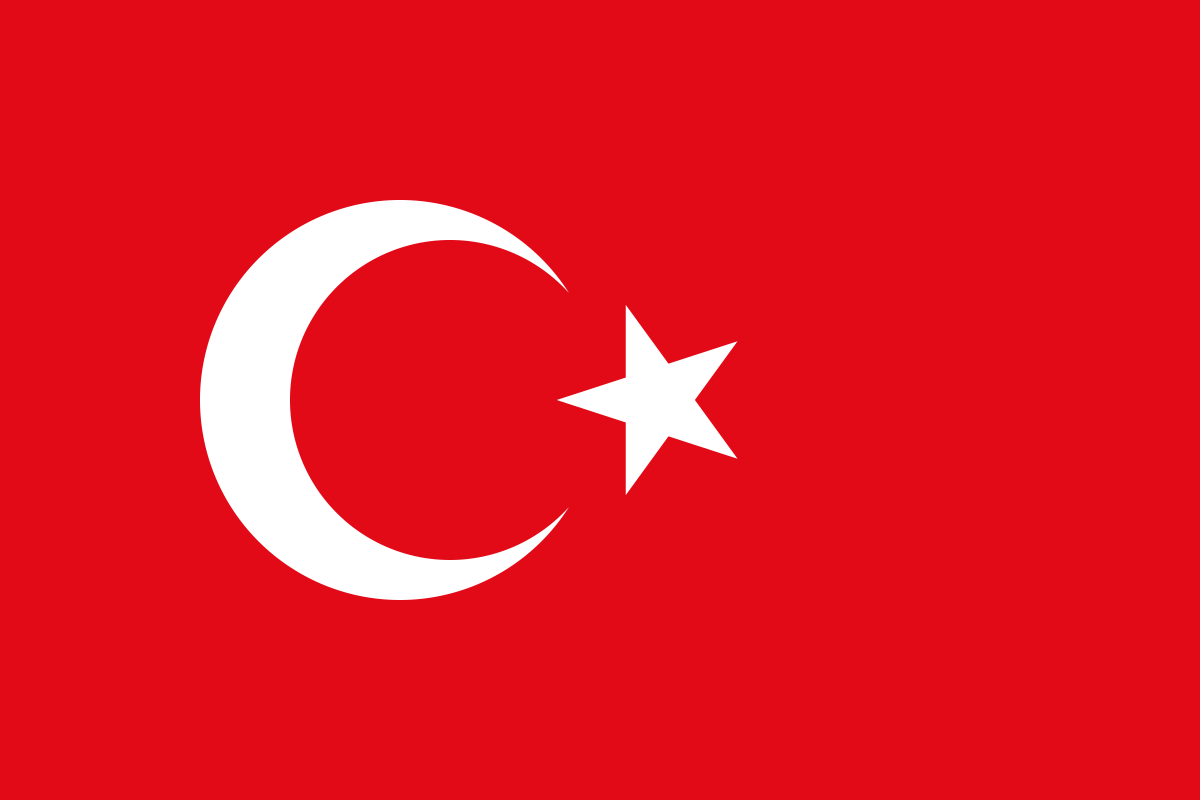
Gallipoli commander who led the national movement and founded the Republic of Turkey as its first president
Born in Salonica, he joined the Young Turk movement and made his name defending Gallipoli in the First World War. After the defeat he landed at Samsun in May 1919 to organise the national movement against occupation, and in 1920 convened the Grand National Assembly in Ankara. With gold and arms from the Bolshevik government he defeated the Greek army, and the Treaty of Lausanne recognised the victory. In these years the ethnic cleansing of Anatolia’s Armenians and Greeks was completed through massacres, deportations and population exchange. He abolished the sultanate in 1922 and in 1923 became the first president of the republic, pursuing secularising reforms and Turkification under one-party rule. He died in 1938.
Career timeline
1915Commander of the 19th Division at Gallipoli
1919Landed at Samsun and organised the national movement
1920Speaker of the Grand National Assembly in Ankara
1921–1922Victories at the Sakarya and Dumlupınar
1923–1938First president of the Republic of Turkey
Eastern Front commander of the Turkish War of Independence who invaded Armenia in 1920 and imposed the Treaty of Alexandropol
Born in Istanbul in 1882, he graduated at the top of his class from the Ottoman Military College and fought at Gallipoli, at Kut and on the Caucasus front in the First World War. Joining Mustafa Kemal’s national movement, he commanded the Eastern Front in the War of Independence. He invaded Armenia in September 1920 and took Kars and Alexandropol; during the campaign his army displaced and massacred tens of thousands of Armenian civilians. He signed the Treaty of Alexandropol in December and the Treaty of Kars in 1921. In 1924 he founded the Progressive Republican Party, the first opposition party, which was closed; elected speaker of the Grand National Assembly in 1946, he died in office in 1948.
Career timeline
1915Commander of the 14th Division at Gallipoli
1918Commander of the 15th Army Corps, Erzurum
1920Invasion of Armenia; signed the Treaty of Alexandropol
1921Signed the Treaty of Kars
1924–1925Founder and leader of the Progressive Republican Party
“Father of Soviet operational art”: architect of deep operations doctrine
“In military affairs, literally nothing failed to interest him. Triandafillov was invariably full of cheer, energy, and creative enthusiasm.” — Marshal Aleksandr Vasilevsky, The Cause of My Whole Life (1975)
A Pontic Greek born in Kars Oblast, he rose from tsarist staff-captain to Deputy Chief of the Red Army Staff. His two seminal works (1926, 1929) established 'operational art' as a distinct domain between strategy and tactics and laid the theoretical foundations for deep operations doctrine. His vision shaped the Red Army's interwar doctrinal reforms and became the doctrinal basis for Soviet victory in WWII. Killed in an air crash on duty in 1931 at thirty-seven, his ashes rest in the Kremlin Wall.
Career timeline
1914–1917Conscripted; Moscow Praporshchik School; company and battalion commander, 6th Finnish Rifle Regt; staff-captain
1917–1918Elected by soldiers as regimental then 7th Army commander; outlawed by Kerensky and Petlyura
1918–1923Joined Red Army; brigade commander in Civil War; graduated Military Academy with distinction
1924–1928Head of First (Operational) Dept, then Operational Directorate, Red Army Staff — Frunze's pick
1926The Scale of Operations of Modern Armies — foundational text of operational art
1928–1931Deputy Chief of Staff, Red Army (commanded 2nd Rifle Corps 1929–30)
1929The Nature of the Operations of Modern Armies — definitive deep operations theory
1931Killed in air crash on duty; ashes interred in Kremlin Wall
The Turkish revolutionary poet who survived a 28-year sentence with verse: giant of 20th-century letters who fused modernism and communism
“Bury me under a plane tree in any village cemetery in Anatolia” — his last wish, Moscow, 1963
Born in Ottoman Salonica, Nâzım Hikmet encountered Mayakovsky and Lenin in 1921 and became a lifelong communist, returning to Turkey to pioneer free verse and transform its poetry. From "835 Lines" to the 16,000-line epic "Human Landscapes from My Country," his vast body of work sang the lives of ordinary people and the War of Independence. A military court sentenced him to 28 years; he served 12, his imprisonment sparking a global campaign by Picasso, Sartre, and Robeson. After escaping to the USSR in 1951 he spent 13 years in the peace movement and anti-colonial solidarity. His poetry is translated into over 50 languages; UNESCO declared 2002 the 'Year of Nâzım Hikmet.'
Career timeline
1913Publishes first poem, "Feryad-ı Vatan" (The Cry of the Homeland)
1918Graduates from the Ottoman Naval Academy; serves as naval officer
1921Travels to Anatolia to join the War of Independence; meets Mustafa Kemal
1922–1924Studies at KUTV, Moscow; joins the Bolshevik Party
1924–1925Returns to Turkey; edits Aydınlık, organ of the illegal Turkish Communist Party
1929Publishes "835 Lines" — revolutionises Turkish poetry with free verse
1933–1935First imprisonment for "Gece Gelen Telgraf"; writes "The Epic of Sheikh Bedreddin" in Bursa Prison
1938–1950Sentenced to 28 years for inciting mutiny; serves 12 years across four prisons
1939–1960Writes 16,000-line epic "Human Landscapes from My Country" in prison
1950Amnestied after international campaign and hunger strike; awarded International Peace Prize
1951–1963Exiled in the USSR; Bureau member of World Peace Council, anti-colonial and anti-war activism
1963.06.03Dies of a heart attack at his dacha in Peredelkino; buried at Novodevichy Cemetery
The investigator who became Armenia's security minister at thirty-one
Extracting a confession from poet Titian Tabidze in 1937, Krimyan recorded his sole co-conspirator: 17th-century folk hero Saakadze — a name every Georgian knew except the interrogator.
Born into a working-class family in Kars in 1913, Krimyan entered the security organs at eighteen as a trainee with the Transcaucasian GPU. He rose fast inside the Georgian NKVD in Tbilisi during the Great Terror, becoming chief of its Investigative Department, and led the 1937 investigation of Ivan Orakhelashvili. Appointed Armenia's Minister of State Security in 1945 at just thirty-one, he was removed in 1947 for 'un-party behavior' and demoted to Ulyanovsk. Dismissed from the organs entirely in 1951 over illegal arrests and interrogation methods, he was swept up after Beria's fall, tried at Tbilisi, and shot in 1955.
Career timeline
1932–1935Trainee in the Economic Department of the Transcaucasian GPU, then authorized officer
1935–1937Senior operative, then assistant section chief, UGB NKVD of the Georgian SSR
1937–1938Section chief, UGB NKVD of the Georgian SSR
1938–1940Deputy chief, then chief, of the Investigative Department, NKVD of the Georgian SSR
1940–1941Deputy chief of the NKVD Administration for Lvov Oblast
1941–1943Deputy chief of the NKGB and NKVD Administration for Yaroslavl Oblast
1943–1945Chief of the NKGB Administration for Yaroslavl Oblast
1945–1947People's Commissar, then Minister, of State Security of the Armenian SSR
1947–1950Chief of the MGB Administration for Ulyanovsk Oblast
1951–1953Head of the personnel department, Ministry of Food Industry of the Armenian SSR