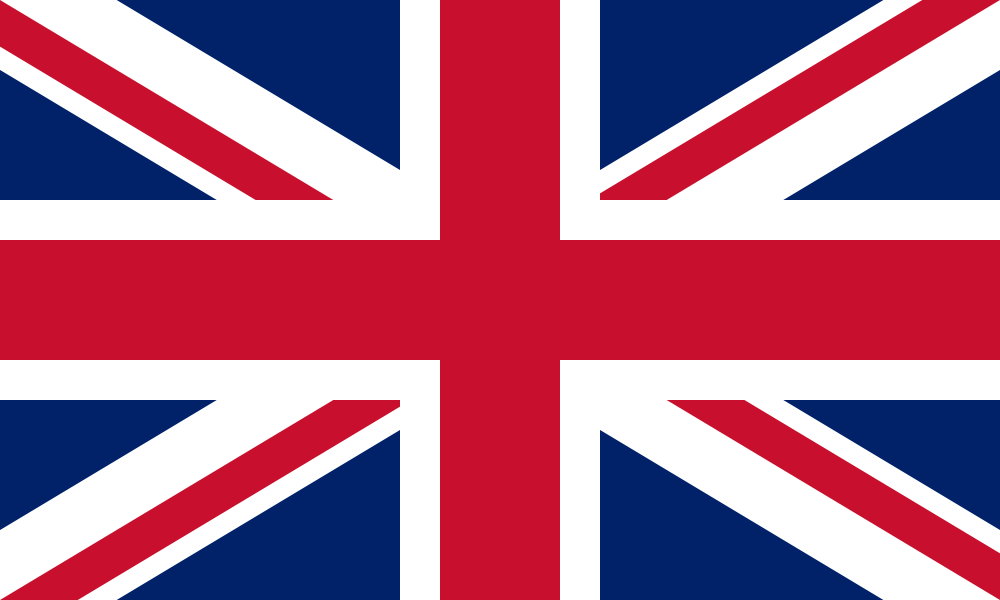
On 1 June 1794 Howe commanded the Channel Fleet against the French fleet escorting a grain convoy, capturing seven ships. Known as the Glorious First of June, the battle links directly to the site's French Revolutionary Wars event entry.
Royal Navy officer and politician. Born in London in 1726, he served in the War of the Austrian Succession and won renown in the 1759 Battle of Quiberon Bay during the Seven Years' War, then commanded the North American station and served as a peace commissioner during the American War of Independence. He was First Lord of the Admiralty in 1783 and again from December 1783 to 1788, and in the French Revolutionary Wars commanded the Channel Fleet, defeating the French fleet at the battle of 1 June 1794. During the 1797 Spithead mutiny he restored peace within twelve hours by direct persuasion rather than repression. He died on 5 August 1799.
Career timeline
1739Entered the navy aboard the fifth-rate HMS Pearl
1746Promoted to post-captain
1758Inherited the Irish peerage after his brother George Howe was killed
1776–1778North American naval commander and peace commissioner
1783–1788First Lord of the Admiralty
1788Created Earl Howe
1793–Channel Fleet commander in the French Revolutionary Wars
General who commanded the French at Valmy, Marshal of the Empire
At Valmy on 20 September 1792 Kellermann joined Dumouriez with the Army of the Centre at Dumouriez's request and placed his artillery on the western slopes. He steadied infantry shaken by an exploding ammunition cart and rallied them with the cry 'Vive la Nation'; the Prussians withdrew.
French soldier born in Strasbourg on 28 May 1735. His family, of Saxon origin, had settled in Strasbourg and was ennobled in his grandfather's generation. He entered the royal army in 1750 (or 1752), fought in the Seven Years' War, and became a brigadier in 1788, making him the only Marshal of the Empire to reach general rank under the old regime. Favourable to the Revolution of 1789, he commanded the Army of the Centre at Valmy on 20 September 1792 and drove back the Prussians, earning the name 'the victor of Valmy'. Arrested in November 1793 on suspicion of disloyalty, he spent 13 months in prison during the Terror and was released and reinstated after Robespierre's fall. Marshal in 1804 and Duke of Valmy in 1808, he voted in the Senate for Napoleon's abdication in 1814 and became a peer under Louis XVIII. He died in Paris in 1820.
Career timeline
1750Entered the French royal army (1750 or 1752)
1788Promoted maréchal de camp (brigadier)
1792Commanded the Army of the Centre at the battle of Valmy
1799Senator
1804Appointed Marshal of the Empire (19 May)
1808Created Duke of Valmy (3 June)
1814Voted for Napoleon's abdication in the Senate; peer of France under the Restoration
Bourbon prince who commanded the émigré Army of Condé
A Bourbon prince du sang who fled Revolutionary France and commanded the émigré Army of Condé against it.
A Bourbon prince of Condé, Louis Joseph left France soon after the Revolution began. He organized and commanded the émigré Army of Condé, which fought Revolutionary France alongside foreign monarchies. He returned to France after Napoleon’s fall.
Career timeline
1736–1740Born a cadet of the House of Bourbon; succeeded as Prince of Condé in 1740 on his father Louis Henri I's death.
1753Married Charlotte de Rohan at Versailles, consolidating his position at court.
1750년대–1760년대Served as Grand Maître de France under Louis XV and Louis XVI and fought in the Seven Years' War as a general.
1791Based at Coblenz, where he organized and led an émigré counter-revolutionary corps.
1792–1801Commanded the Army of Condé alongside Austria, later in British and Russian service; the corps was disbanded in 1801.
1814–1818Returned to Paris after Napoleon's defeat, resumed his court duties under Louis XVIII, and died in 1818.
French Revolutionary general and statesman who defected to Austria in 1793
He saved the Revolution at Valmy and Jemappes in 1792, but after defeat at Neerwinden on 18 March 1793 he tried to march on Paris and handed the Convention's envoys over to Austria before crossing to the Austrian side. That defection buried the Girondins.
A general and politician of the French Revolutionary Wars. An officer of the royal army in the Seven Years' War, he later commanded the port of Cherbourg. After the Revolution he joined the Jacobin Club, and with Girondin backing he became foreign minister in March 1792, pushed for the declaration of war on Austria and briefly served as war minister. After a conflict with Louis XVI he resigned, then took command of the Army of the North and, with Kellermann, defeated the Prussians at Valmy (20 September 1792) and won at Jemappes (6 November 1792). Beaten at Neerwinden on 18 March 1793, he attempted to march on Paris, dissolve the Convention and restore the 1791 constitution and constitutional monarchy; lacking the army's support he went over to the Austrian side. He died in Britain after years of exile, and his name is inscribed on the Arc de Triomphe in Paris.
Career timeline
1739Born at Cambrai; sources disagree, recording 25, 26 or 27 January.
1792Backed by the Girondins, became foreign minister, pushed for the declaration of war on Austria and briefly served as war minister.
1792As commander of the Army of the North, won at Valmy (20 September) and Jemappes (6 November).
1793Defeated at Neerwinden on 18 March and defected to the Austrian side in April.
Radical journalist and publisher of L’Ami du peuple
A physician and scientific writer before the Revolution, he founded L'Ami du peuple in September 1789. Elected to the National Convention in September 1792, he was acquitted by the Revolutionary Tribunal in April 1793 and helped bring down the Girondins. Corday killed him on 13 July 1793.
Originally a physician and scientific writer, Marat published the newspaper L’Ami du peuple during the Revolution. His fierce attacks on alleged counter-revolutionaries and the Girondins made him a radical voice linked to Parisian popular politics and the Mountain. He was assassinated by Charlotte Corday in July 1793.
Career timeline
1743–1789Worked as a physician and scientific writer, publishing experimental studies on optics, electricity and light and political works such as The Chains of Slavery (1774). He received an MD from the University of St Andrews.
1777Appointed in June as physician to the bodyguard of the Comte d'Artois (later Charles X).
1783Resigned his court appointment in April to concentrate on scientific research.
1789When the King called the Estates General in 1788, he abandoned his scientific and medical career and entered revolutionary polemic, anonymously publishing Offrande à la Patrie in February 1789.
1789Launched his own newspaper, the Publiciste parisien, on 12 September, renaming it L'Ami du peuple four days later.
1791After the Champ de Mars massacre and the ensuing crackdown on the radical press, his paper was seized and its printing formes broken up, yet he kept publishing; about 500 issues appeared in 1791.
1792Elected to the National Convention in September. After the fall of the monarchy on 10 August he was appointed one of the Paris Commune's adjoint administrators on its Committee of Surveillance, signed its September circular, and has been credited with drafting it.
1793Indicted on Girondin initiative, he became the first representative of the people tried before the Revolutionary Tribunal in April; defending himself without counsel, he was acquitted.
1793Played an active part in the insurrection of 31 May–2 June that brought down the Girondins, presiding over the Convention and helping determine which deputies were to be arrested.
1793Assassinated on 13 July: Charlotte Corday, a Girondin sympathiser, stabbed him in the chest while he sat in a medicinal bath.
Writer who demanded women’s civil and political rights
She demanded abolition of slavery and the death penalty, and her 1791 Declaration of the Rights of Woman claimed voting rights and legal equality for women. The Revolutionary Tribunal condemned her to death in 1793.
Born Marie Gouze, she was a French playwright and political writer. She criticized slavery and in her 1791 Declaration of the Rights of Woman and of the Female Citizen demanded legal equality, public speech and political participation for women. The declaration challenged exclusions in existing declarations; it was not enacted legislation. She opposed revolutionary violence and the power of the Montagnards, and was sentenced to death by the Revolutionary Tribunal and executed in 1793.
Career timeline
1765Married Louis-Yves Aubry, a caterer in Montauban, in a marriage the chronology describes as forced
1766Her son Pierre Aubry was born; after her husband's death soon after, she took the name Olympe de Gouges
1770Moved to Paris, completed her education, and frequented literary salons
1784Published the autobiographical 'Mémoire de Madame de Valmont'
1785Her slavery-critical play 'Zamore et Mirza' entered the Comédie française repertoire but was not performed
1788Published 'Lettre au peuple', advocating free expression, divorce, sex equality, and abolition of slavery and the death penalty
1789Intervened in the revolutionary debates with posters and pamphlets
1791Published 'Les Droits de la femme' containing the Declaration of the Rights of Woman; the Legislative Assembly refused to examine it
1792After the fall of the monarchy she joined the moderate Girondins, opposed the Terror, and attacked Robespierre
1793Imprisoned in July for writings considered counter-revolutionary; the Revolutionary Tribunal condemned her to death in November
His Death of Marat, depicting his friend Jean-Paul Marat after Charlotte Corday assassinated him on 13 July 1793, became a leading image of the Revolution. After Napoleon's fall the painting long disappeared from public view before its rediscovery.
French painter born in Paris in 1748 and died in Brussels in 1825. He was the preeminent Neoclassical painter of his era, winning fame in the 1780s with The Oath of the Horatii, and an active supporter of the French Revolution and friend of Robespierre as a member of the Jacobin Club. As a deputy to the National Convention he voted for the execution of Louis XVI, and as a member of the Committee of General Security he took part in the Reign of Terror. After Robespierre's fall he was imprisoned twice in 1794 and 1795, then released. After the Empire was proclaimed in 1804 he became Napoleon's court painter and painted The Coronation of Napoleon. After Napoleon's fall in 1815 he lived in exile in Brussels, where he died. His pupils included Girodet, Gérard, Gros and Ingres.
Career timeline
1784Won fame with The Oath of the Horatii
1789–1794Supported the Revolution; deputy to the National Convention and member of the Committee of General Security
1794–1795Imprisoned twice after Robespierre's fall
Clergyman and political theorist of Third Estate sovereignty
Amid the 1788–1789 Estates-General crisis he identified the Third Estate with the whole nation, and later ended the Directory through the coup of 18 Brumaire.
A clergyman and political theorist, Sieyès linked the Third Estate to the nation in his 1789 pamphlet What Is the Third Estate? He helped bring the National Assembly into being and later sat with the Plain in the National Convention. Near the end of the Directory he participated in the coup of Brumaire and helped establish the Consulate.
Career timeline
1775–1788Secretary and deputy to the bishop of Tréguier, then vicar general and chancellor of the diocese of Chartres; sat in the Estates of Brittany.
1789Published What Is the Third Estate?; as a Third Estate deputy he pushed for the National Assembly and joined the drafting of the Declaration of the Rights of Man.
1792–1795Sat in the National Convention, voted for the death of Louis XVI, and served on a diplomatic mission to The Hague in 1795.
1799Made a Director in May; helped lead the coup of 18 Brumaire and became a provisional Consul of the Consulate.
1799–1830Served in the Sénat conservateur, was expelled from the Academy after the Restoration, left for Brussels, and returned to France after the July Revolution.
1836Died in Paris aged 88; unpublished manuscripts credit him with the first use of the term sociologie.
French writer and author of the Manifesto of the Equals
A radical writer of the revolutionary era whose 1796 Manifesto of the Equals demanded real equality and community of property beyond equality in law.
A French writer who also worked as a lawyer and librarian, Maréchal wrote the 1796 Manifesto of the Equals. It demanded equality in everyday life and common enjoyment of property, beyond equality written into law. Although associated with Babeuf’s movement, the text is Maréchal’s work. Its formulations should not all be treated as the leadership’s agreed programme or as enacted policy. It helps trace connections, as well as differences, between revolutionary egalitarianism and later socialism.
Career timeline
1770Appointed assistant librarian at the Mazarin Library in Paris, where he built his classical erudition.
1788His Almanach des Honnêtes Gens was condemned to be burned by the Parlement of Paris, and he was imprisoned for three months; afterwards he published anonymously.
1790–1792As chief editor of Révolutions de Paris he led an anticlerical campaign and published articles opposing the war.
1793–1796Met Babeuf and wrote the 1796 Manifesto of the Equals, sitting on the conspiracy's secret directorate of public safety.
1801Proposed a bill forbidding the teaching of reading to women; his De la vertu appeared posthumously in 1807.
Enragé priest who demanded controls on subsistence prices
The leading spokesman of the Enragés, he demanded action against the wealthy in the name of poor Parisians' survival, presented the Enragés' programme to the Convention in 1793, and was arrested amid Montagnard and Jacobin attacks.
A priest and radical activist in Paris’s Gravilliers section, Roux became a leading figure among the Enragés. He attacked food monopoly and speculation, demanded forceful price controls and economic equality, and presented the Enragés’ programme to the Convention in 1793. Arrested after attacks from Montagnard and Jacobin leaders, he died by suicide in prison.
Career timeline
1791Elected to the Paris Commune.
1793When food-price riots broke out in Paris, he defended such direct action.
1793Presented the Enragés' programme to the Convention: the 25 June address demanding taxation of necessities and punishment of speculators.
1793Arrested in August, released, then rearrested on 5 September and interned at Sainte-Pélagie.
1794On being sent before the Revolutionary Tribunal, he tried twice to kill himself in prison and died on 10 February.
Leading Girondin orator in the National Convention
On 31 December 1792 he urged an appeal to the people in the trial of Louis XVI and failed; days later a letter he had signed reached the king's enemies as evidence of treason.
A Bordeaux lawyer, Vergniaud became a celebrated orator in the Legislative Assembly and National Convention. He supported the war policy, spoke for the Girondins, and voted for death in the trial of Louis XVI. Arrested after the purge of the Girondins in June 1793, he was executed with other Girondin deputies.
Career timeline
1789Appointed by Bordeaux as an administrator of the Gironde department.
1791.03.29Served as director of the jury at the Gironde criminal court.
1791.08.31Elected deputy to the Legislative Assembly for the Gironde.
1791.10.30Elected president of the Legislative Assembly.
1792.08.10Presided as the Tuileries was stormed and had the king suspended.
1793.01.10Elected president of the National Convention.
1793.01.16Voted for the death of Louis XVI.
1793.06.02Decreed for arrest with the Girondin deputies.
The mathematician who organized the army of the Revolution
As the Committee of Public Safety member in charge of personnel and troop movements from 1793, he created fourteen armies and contributed to Jourdan's victory at Wattignies in autumn 1793. Mass conscription raised the army from roughly 645,000 in mid-1793 to about 1.5 million by September 1794.
French mathematician, military officer and politician, born at Nolay in Burgundy in 1753 and dead at Magdeburg in 1823. Elected to the Legislative Assembly in 1791 and to the National Convention in September 1792, from 1793 he handled personnel and troop movements on the Committee of Public Safety, directing conscription and organization and steering France's military successes of 1793–94, for which he was called the 'Organizer of Victory'. Known as an honest administrator and a convinced republican, he broke with Robespierre and helped bring about his overthrow on 9 Thermidor in 1794, and was one of the five initial directors of the Directory. Ousted in the Coup of 18 Fructidor in 1797, he went into exile; Napoleon made him Minister of War in 1800, but he opposed the imperial coronation and withdrew from public life. Exiled by the Second Bourbon Restoration, he died in exile.
Career timeline
1791–1792Deputy, Legislative Assembly; Deputy, National Convention
1793–1795Member, Committee of Public Safety; military organization and operations
1795–1797Director of the Directory
1800Minister of War
1815Minister of the Interior during the Hundred Days
Girondin journalist and deputy who championed revolutionary war
In 1791–92 he led the Legislative Assembly's push for war against Austria, which led to the declaration of war in April 1792. Sentenced on 30 October 1793, he was guillotined the next day.
A journalist and deputy in the Legislative Assembly and National Convention, Brissot also participated in antislavery activism. In 1791–92 he became the chief advocate of foreign war in the name of defending and extending the Revolution and emerged as a leading Girondin. He was arrested after the Girondins’ fall in June 1793 and later executed.
Career timeline
1770년대~1780년대Trained as a law clerk, then worked as a journalist contributing to the Mercure de France and the Courier de l'Europe.
1788년Founded the antislavery Society of the Friends of the Blacks and served as its secretary.
1789년Elected a member of the Paris municipality and founded the Patriote français, which he edited until 1793.
1791년 10월~1792년 9월Sat in the Legislative Assembly for Seine and, on the diplomatic committee, shaped much of France's foreign policy.
1792년 9월~1793년 10월Represented Eure-et-Loir in the National Convention; arrested in June 1793 and executed that October.
French king deposed and tried during the Revolution
The National Convention ruled on 3 December 1792 that it would try Louis XVI itself; convicted of high treason by vote, he was guillotined on 21 January 1793.
King of France from 1774, Louis XVI summoned the Estates-General in 1789 amid a fiscal crisis. He accepted the Constitution of 1791, but the Flight to Varennes and foreign war deepened distrust of the crown. The monarchy was suspended in 1792; the National Convention convicted him and he was executed in January 1793.
Career timeline
1774–1792King of France from 1774 until the monarchy was abolished in September 1792.
1789Summoned the Estates-General amid fiscal crisis and, after the storming of the Bastille, recognized the National Assembly’s legislative authority.
1791His flight to Varennes failed in June; he accepted the constitution, and a constitutional monarchy was declared in September.
1792Arrested in the insurrection of 10 August and held in the Temple; on 21 September the National Convention abolished the monarchy.
1792–1793The National Convention ruled on 3 December that it would try him; trial opened on 11 December and he was convicted of high treason.
1793Executed by guillotine on 21 January at the Place de la Révolution in Paris.
Committee of Public Safety member allied with Robespierre
A lawyer elected to the Legislative Assembly in 1791 and the National Convention in 1792, he joined the Committee of Public Safety in 1793. Working with Robespierre and Saint-Just, he drafted the Law of 22 Prairial, which stripped defendants of counsel and sharply increased executions.
A lawyer and deputy in the Legislative Assembly and National Convention, Couthon joined the Mountain. On the Committee of Public Safety he worked closely with Robespierre and Saint-Just and played a central role in the Law of 22 Prairial, which sharply restricted defendants’ rights. Arrested on 9 Thermidor, he was executed with Robespierre.
Career timeline
1787Member, Provincial Assembly of Auvergne
1791Deputy for Puy-de-Dôme in the Legislative Assembly
1792Deputy for Puy-de-Dôme in the National Convention
1793Member of the Committee of Public Safety
1793Representative on mission to the Army of the Alps and Rhône-et-Loire; took Lyon
1793President of the National Convention
1794Rapporteur of the Law of 22 Prairial
1794Arrested on 9 Thermidor; guillotined on 28 July
Convention deputy who bridged the Plain and Committee of Public Safety
As the Committee of Public Safety's voice, he presented its reports on war, mass mobilization and revolutionary government to the Convention. Nicknamed 'the Anacreon of the Guillotine', he joined Robespierre's fall in 1794, then was impeached for the Terror.
A deputy to the Estates-General and National Convention, Barère sat with the Plain in 1792. From 1793 he served on the Committee of Public Safety and acted as a principal spokesman, presenting reports on war, mass mobilization, and revolutionary government. He joined the move against Robespierre in 1794 but was later impeached for his role in the Terror.
Career timeline
1789Elected deputy to the Estates-General by the estates of Bigorre.
1791–1792Served as a judge of the newly instituted Court of Cassation (October 1791 – September 1792).
1792Elected to the National Convention for Hautes-Pyrénées, presided over the Convention, and chaired the trial of Louis XVI.
1793–1794Elected to the Committee of Public Safety and served throughout its existence, presenting its reports on war, mass mobilization, and revolutionary government to the Convention.
1794Joined the Thermidorian coup that brought down Robespierre.
1795Decreed arrested and deported for the Terror; after Oléron and Saintes he escaped on 26 October and hid in Bordeaux.
1799Amnestied by Napoleon; under the First Empire he worked as a writer.
1815Sat in the Chamber of Deputies during the Hundred Days, then was banished for life as a regicide after the Bourbon Restoration.
1830–1841Returned to France, served Louis Philippe under the July Monarchy, and died on 13 January 1841.
Revolutionary journalist whose Le Père Duchesne spoke to a sans-culotte readership
Founder of Le Père Duchesne, which became the voice of the Parisian sans-culottes, and a leading figure behind the fall of the Girondins in 1793; pressed radical dechristianisation, was arrested with his followers in March 1794 and guillotined on 24 March.
A journalist of the French Revolution and deputy prosecutor of the Paris Commune. The earthy, popular language of Le Père Duchesne, founded in 1790, gave him influence among sans-culotte readers and he became prominent in the Cordeliers Club. In 1793 he attacked the Girondins and supported stronger economic controls and dechristianisation. The “Hébertists” were not a formal party but a label for overlapping newspaper, Cordelier, and Commune networks. After a failed call for insurrection, revolutionary government arrested him and he was executed on 24 March 1794.
Career timeline
1790Founded the popular revolutionary newspaper Le Père Duchesne
1791–1792Prominent Cordelier; deputy prosecutor of the Paris Commune
1793Attacked the Girondins and backed sans-culotte demands and dechristianisation
1794.03Arrested after a failed call for insurrection; executed on 24 March
Count of Artois who led émigré royalism during the Revolution
At his 1825 coronation at Reims he tried to revive the royal touch, asserting the sacredness of monarchy; in July 1830 his ordinances dissolved the chamber and censored the press, and the Paris rising forced his abdication on 2 August.
Louis XVI’s younger brother, the Count of Artois left France soon after the fall of the Bastille in 1789. Abroad he promoted Bourbon restoration and became a political centre of émigré royalism. He succeeded as Charles X in 1824 and was overthrown by the July Revolution of 1830.
Career timeline
1765Death of his father, the Dauphin Louis
1773Married Marie Thérèse of Savoy
1789Left France on 17 July, three days after the storming of the Bastille
1791–1792Set up a court-in-exile in the Electorate of Trier and prepared a counter-revolutionary invasion
1814Acted as Lieutenant General of the realm during the Bourbon Restoration
1824–1830King of France; crowned at Reims in 1825
1830Issued the July Ordinances; abdicated on 2 August
Jacobin politician who argued for subsistence rights and revolutionary government
On 9 Thermidor, 27 July 1794, Convention deputies arrested him with about 90 others; he was executed without trial.
A lawyer and National Convention deputy during the French Revolution, Robespierre served on the Committee of Public Safety. His 1792 speech on subsistence placed access to necessities first while recognizing legitimate property and trade. His February 1794 report defended virtue and terror as principles of revolutionary government. This was a participant’s justification of repression; decisions made by the Convention and its committees cannot all be treated as his personal orders. He was executed after his defeat at Thermidor.
Career timeline
1789Elected deputy to the Estates-General for Artois
1780Graduated in law and was admitted to the Arras bar
1792Elected deputy to the National Convention
1793–1794Served on the Committee of Public Safety, a leading figure of the revolutionary government
Royal Navy admiral who destroyed the French fleet at the Nile
Commanding the British fleet as Rear-Admiral of the Blue at Aboukir Bay in August 1798, he destroyed the French fleet that had escorted Napoleon's army to Egypt: the French flagship Orient exploded, and of the 17 French ships engaged only two ships of the line and two frigates escaped.
British Royal Navy officer. Born in 1758 at the rectory of Burnham Thorpe, Norfolk, he entered the navy through his uncle Maurice Suckling's influence, served in the West Indies and the Mediterranean, lost the sight of one eye at Calvi in 1794 and his right arm at Santa Cruz de Tenerife in 1797, destroyed the French fleet at Aboukir Bay on 1–3 August 1798, stranding Napoleon's army in Egypt, defeated Denmark at Copenhagen in 1801, and was killed at Trafalgar in 1805.
Career timeline
1794Lost the sight of one eye at Calvi
1797Lost his right arm at Santa Cruz de Tenerife
1798Destroyed the French fleet at the Battle of the Nile
French Revolutionary and Napoleonic Wars commander, Marshal of the Empire
At the Second Battle of Zurich in 1799 he led the Army of Helvetia to defeat Korsakov's Austro-Russian force, and in 1800 he held Genoa for about sixty days, tying down Austrian troops so Bonaparte could win at Marengo.
Commander of the French Revolutionary and Napoleonic Wars. He was born Andrea Massena on 6 May 1758 in Nice, then the County of Nice in the Kingdom of Sardinia. He began as an enlisted soldier in the royal Italian regiment, reached the highest rank open to a commoner in 1784, and became a brigade general in August 1793 and a general of division on 20 December 1793. On 19 May 1804 he became one of the first eighteen Marshals of the Empire created by Napoleon, and he was made Duke of Rivoli in 1808 and Prince of Essling in 1809, though some sources record January 1810. He died of tuberculosis in Paris on 4 April 1817, aged 58.
Career timeline
1758Born in Nice
1784Senior non-commissioned rank (adjudant) in the royal Italian regiment
1793Brigade general in August; general of division on 20 December
1799Commander of the Army of Helvetia; victory at the Second Battle of Zurich
1800Commander of the Army of Italy; defence of Genoa
1804Appointed Marshal of the Empire
1808Duke of Rivoli
1809Prince of Essling (some sources record January 1810)
1810Invasion of Portugal; defeated by Wellington at Bussaco
1811Relieved of his command on 11 May
1815Naturalised French by Louis XVIII on 20 January
A peddler and sacristan from Le Pin-en-Mauges, he took up arms in March 1793 over conscription and the clergy's civil constitution; the Vendéan chiefs elected him generalissimo at Saumur on 12 June 1793. Mortally wounded storming Nantes on 29 June, he died on 14 July.
A peddler from Anjou and devout Catholic, Cathelineau joined the anti-conscription rising of 1793. He helped unite peasant forces and was chosen as the first generalissimo of the Catholic and Royal Army. He died from a gunshot wound received during the attack on Nantes.
Career timeline
1793. 3. 12.After the rising at Saint-Florent-le-Vieil, he gathered neighbours and marched on Jallais, followed by twenty-seven men.
1793. 3. 13.He fought his first battle at Jallais, seizing the château and a cannon, then took Cholet with Stofflet.
1793. 4. 23. – 5. 5.He seized Beaupréau and won the Battle of Thouars.
1793. 5. 16. – 6. 9.Defeated at Fontenay-le-Comte, he retaliated by taking Montreuil-Bellay and Saumur.
1793. 6. 12.After the capture of Saumur, the assembly of Vendéan chiefs proclaimed him generalissimo of the Catholic and Royal Army.
1793. 6. 29.Leading some 40,000 men in the storming of Nantes, he was mortally wounded by a shot from a window.
1793. 7. 14.Carried to Saint-Florent-le-Vieil, he died of his wounds.
Revolutionary leader associated with the Cordeliers and Indulgents
From Cordeliers orator to minister of justice after the monarchy fell on 10 August 1792, and a disputed figure in responsibility for the September Massacres. He sat on the first Committee of Public Safety in 1793, later led the Indulgents demanding an end to the Terror, and was guillotined in 1794.
A prominent Cordelier, Danton became minister of justice after the monarchy fell in August 1792. He rallied support for defence of the Republic and served on the first Committee of Public Safety in 1793. Later associated with calls to moderate the Terror and stabilize the Revolution, he clashed with the ruling committee and was executed in April 1794.
Career timeline
1789–1792Rose to prominence in the radical politics of the Cordeliers district, earning the nickname 'the Thunderer', and became president of the Cordeliers Club in 1790.
1792Became minister of justice after the fall of the monarchy on 10 August and appealed for resistance in his 2 September 'daring' speech.
1793Backed the creation of the Revolutionary Tribunal in March and was appointed to the first Committee of Public Safety on 6 April.
1793–1794After losing his committee seat in June, he became the leading Indulgent demanding an end to the Terror, and was tried and executed in April 1794 on charges of conspiracy and venality.
Feuillant politician and advocate of judicial reform
One third of the triumvirate of which the Assembly said, “What Duport thinks, Barnave says, Lameth does”, he led the 1791 Feuillant split, arguing the Revolution was over and the constitutional order should be stabilised.
A magistrate and National Assembly deputy, Duport promoted jury trial and criminal-justice reform. He formed the “triumvirate” with Barnave and Lameth and helped organize the Feuillants in 1791. After the monarchy fell in 1792 he went into exile and died in Switzerland.
Career timeline
1778Admitted as an advocate in the Parlement de Paris, and appointed a councillor in that same parlement, remaining in office until 1790.
1787–1788Founded the "Parti des nationaux" in 1787, demanding that the Estates-General be convened, and in 1788 organised the Société des Trente against the distinction between the three orders.
1789Elected deputy for the Paris nobility to the Estates-General on 13 May; in late June joined the Third Estate among the 47 liberal nobles.
1789–1791Formed the "triumvirate" with Barnave and Alexandre de Lameth in the Constituent Assembly, and as rapporteur of the criminal jurisprudence committee advanced the reform of the judiciary (report of 29 March 1790) and the introduction of the jury (8 February 1791); presided over the Assembly from 14 to 26 February 1791.
1791Led the Feuillant split in July, was the chief architect of the decree of 27 September granting full emancipation to the Jews, and took part in the 24 September revocation of the rights of free men of colour.
1792After the fall of the monarchy on 10 August he left his post as president of the criminal tribunal of the Seine, was arrested, then released and fled into exile via England and Switzerland.
1798Forced abroad again after the 18 Fructidor coup (4 September 1797), he died of tuberculosis at Gais in Switzerland.