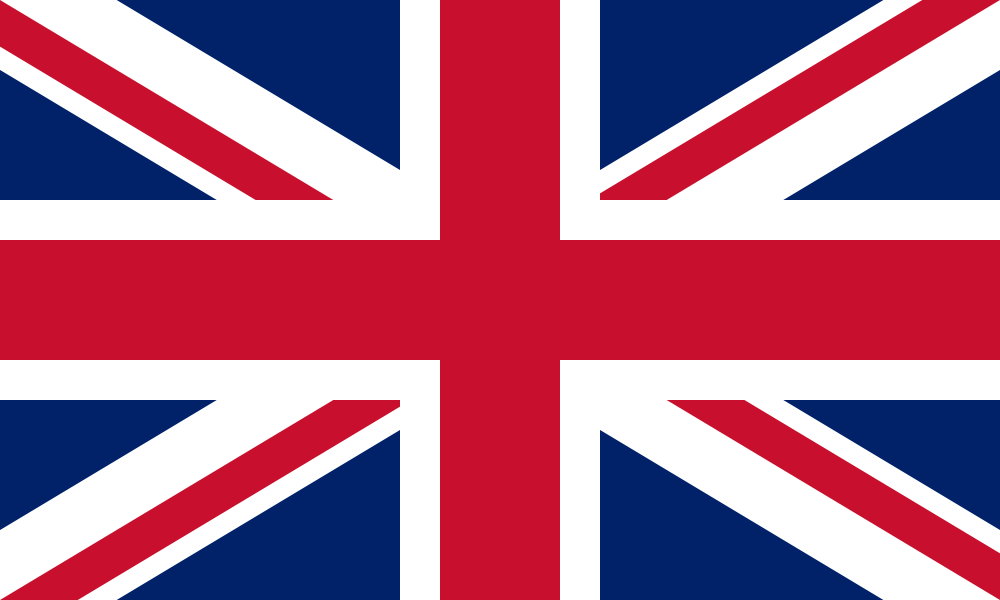
On 1 June 1794 Howe commanded the Channel Fleet against the French fleet escorting a grain convoy, capturing seven ships. Known as the Glorious First of June, the battle links directly to the site's French Revolutionary Wars event entry.
Royal Navy officer and politician. Born in London in 1726, he served in the War of the Austrian Succession and won renown in the 1759 Battle of Quiberon Bay during the Seven Years' War, then commanded the North American station and served as a peace commissioner during the American War of Independence. He was First Lord of the Admiralty in 1783 and again from December 1783 to 1788, and in the French Revolutionary Wars commanded the Channel Fleet, defeating the French fleet at the battle of 1 June 1794. During the 1797 Spithead mutiny he restored peace within twelve hours by direct persuasion rather than repression. He died on 5 August 1799.
Career timeline
1739Entered the navy aboard the fifth-rate HMS Pearl
1746Promoted to post-captain
1758Inherited the Irish peerage after his brother George Howe was killed
1776–1778North American naval commander and peace commissioner
1783–1788First Lord of the Admiralty
1788Created Earl Howe
1793–Channel Fleet commander in the French Revolutionary Wars
Royal Navy admiral who destroyed the French fleet at the Nile
Commanding the British fleet as Rear-Admiral of the Blue at Aboukir Bay in August 1798, he destroyed the French fleet that had escorted Napoleon's army to Egypt: the French flagship Orient exploded, and of the 17 French ships engaged only two ships of the line and two frigates escaped.
British Royal Navy officer. Born in 1758 at the rectory of Burnham Thorpe, Norfolk, he entered the navy through his uncle Maurice Suckling's influence, served in the West Indies and the Mediterranean, lost the sight of one eye at Calvi in 1794 and his right arm at Santa Cruz de Tenerife in 1797, destroyed the French fleet at Aboukir Bay on 1–3 August 1798, stranding Napoleon's army in Egypt, defeated Denmark at Copenhagen in 1801, and was killed at Trafalgar in 1805.
Career timeline
1794Lost the sight of one eye at Calvi
1797Lost his right arm at Santa Cruz de Tenerife
1798Destroyed the French fleet at the Battle of the Nile
Social reformer who emphasized education and cooperation
In A New View of Society (1816) Owen argued that “any general character may be given to any community by the application of proper means,” a principle he later tested at New Lanark and New Harmony.
A Welsh-born British manufacturer and social reformer, Owen sought to improve working, living and educational conditions at New Lanark. In A New View of Society he argued that environment and education form human character. He later pursued cooperative and communal experiments. Marx and Engels’ classification of Owen as a utopian socialist is a later, polemical interpretation. His early reform proposals should be distinguished from the International Working Men’s Association’s emphasis on workers’ self-emancipation.
Career timeline
1792Became manager of the Piccadilly Mill in Manchester.
1800Bought the New Lanark mills with partners in 1799 and managed them from January 1800.
1824–1827Led the New Harmony community experiment in Indiana, which was dissolved in 1827.
1828Settled in London, championing cooperatives, the trade union movement and child labour legislation.
1832Opened the National Equitable Labour Exchange, based on labour notes.
1834Briefly led the Grand National Consolidated Trades Union before its collapse in 1834.
1835Formed the Association of all Classes of all Nations and served as its first leader.
Former miner who founded the British Labour Party and opposed the First World War to the end, urging an anti-war general strike
Elected to Parliament in 1892 after organising miners, Hardie helped lead the Independent Labour Party and the new Labour movement. At the outbreak of the First World War, he campaigned against the conflict.
Born into poverty in Scotland and working in the pits from about the age of ten, he rose as a miners’ organiser to become in 1892 the first working-class member of parliament. He founded the Independent Labour Party in 1893 and became Labour’s first parliamentary leader in 1906, supporting women’s suffrage and Indian self-rule. At Copenhagen in 1910 he proposed a general strike in the arms industries to prevent war. He attended the Brussels Bureau meeting of July 1914 and opposed the war until his death in 1915.
Career timeline
1881Led the first strike of Lanarkshire miners.
1892Elected for West Ham as an Independent Labour candidate and entered Parliament.
1893Helped form the Independent Labour Party and was elected its first chairman and leader.
1906Elected Labour leader in the House of Commons; resigned in 1908.
1914–1915Campaigned as a pacifist against the First World War.
British Labour organizer and politician who led the international disarmament effort.
Henderson worked as an iron foundryman and became active in the trade-union movement. He helped establish the Labour Representation Committee in 1900, chaired the conference that formed the Labour Party in 1906, and served as party secretary from 1911 to 1934, building its organization and broadening its base. He was president of the Board of Education in 1915–16, home secretary in 1924, and foreign secretary from 1929 to 1931. Elected president of the League of Nations Disarmament Conference in 1932, he pursued international negotiations even as the conference ultimately failed; his work for peace and disarmament earned him the 1934 Nobel Peace Prize.
Career timeline
1900Helped establish the Labour Representation Committee
1906Chaired the conference that formed the Labour Party
1911–1934Served as Labour Party secretary
1915–1916Served as president of the Board of Education
1924Served as home secretary
1929–1931Served as foreign secretary
1932Was elected president of the League of Nations Disarmament Conference
Politician who gave up the Labour chairmanship in 1914 over war credits and later became Britain’s first Labour prime minister
He resigned as Labour chairman in 1914 over Britain’s entry into the war and war spending; in 1931 he led a national government and lost Labour’s support.
Born into poverty in Lossiemouth, Scotland, he became an organiser of the Independent Labour Party and Labour and was chairman of the party from 1911. When Labour backed the government’s war credits in August 1914 he resigned the chairmanship and was fiercely attacked for his opposition to the war. In 1924 he became Britain’s first Labour prime minister and recognised the Soviet Union, returning as prime minister in 1929. Forming a National Government with the Conservatives in the crisis of 1931, he was expelled from Labour. He died at sea in 1937.
Career timeline
1893Joined the Independent Labour Party and worked as a journalist in London.
1906Elected MP for Leicester.
1911Became chairman of the parliamentary Labour group.
1924Became Britain’s first Labour prime minister.
1929Led a second minority Labour government and included opposition leaders in a national government amid rising unemployment.
The appeasement architect whose bid to avoid war helped open the way to it
Returning from Munich in 1938, he declared the agreement to mean “peace for our time.”
Neville Chamberlain was a British Conservative politician whose career combined domestic administrative reform with finance before he became prime minister. Seeking to avoid another European war and gain time for rearmament, he pursued appeasement, but the strategy failed to restrain Nazi Germany's expansion. His government's acceptance of the Munich settlement in 1938, and its limited response to Soviet proposals for collective security, formed part of the international conditions surrounding the 1939 crisis and the Nazi-Soviet Pact. After declaring war on Germany following the invasion of Poland, he resigned in 1940 amid criticism of the Norway campaign.
Career timeline
1911–1915Birmingham city councillor; chair of the Town Planning Committee
1915Lord Mayor of Birmingham
1916–1917Director of National Service
1923–1924Minister of Health; Chancellor of the Exchequer
1924–1929Minister of Health
1931–1937Chancellor of the Exchequer
1937–1940Prime Minister of the United Kingdom
1938–1939Led the Munich settlement and appeasement policy toward Germany
Britain's wartime prime minister who divided Europe with Stalin on a half-sheet of paper
Churchill's memoir account of the October 1944 Moscow meeting: 'I wrote on a half-sheet: Romania, Russia 90%… I pushed this across to Stalin. He took his blue pencil, made a large tick, and passed it back.' Soviet authorities denied in 1958 that Stalin accepted such a proposal.
A British statesman, army officer and writer, Churchill was born in 1874 at Blenheim Palace into the wealthy aristocratic Spencer family, of mixed English and American parentage. After army service in India, Sudan and the Boer War he entered Parliament in 1900. As a Liberal minister he was President of the Board of Trade, Home Secretary, and First Lord of the Admiralty, where he oversaw the failed Gallipoli campaign; in 1924–1929 he was Chancellor of the Exchequer. Prime minister from May 1940, he led Britain through the Second World War, warned in 1946 of an 'iron curtain', and held office again in 1951–1955. An imperialist, anti-communist and opponent of Indian self-government, he remains a contested figure; he died in 1965.
A naval reformer sent to negotiate without authority
When the Soviet side asked about negotiating authority, Drax's mission could make no decision without government approval.
Reginald Drax was a Royal Navy admiral who argued for more active tactics and reform of naval command, while holding major staff and operational posts between the world wars. In August 1939 he led the British military mission to Moscow, sent with the French delegation to discuss cooperation with the Soviet Union but without written authority to negotiate. His mission's slow arrival in an outdated merchant ship and inability to commit the British government exposed the limits and mistrust surrounding the talks to prevent war with Germany, which ultimately failed.
Career timeline
1896Entered the Royal Navy; trained aboard HMS Britannia
1909Published Modern Naval Tactics; studied staff training
1914–1918Served in HMS Lion; took part in major First World War naval actions
1919–1922Director, Royal Naval Staff College
1923–1924President, Naval Allied Control Commission in Germany
1932–1934Commander-in-Chief, America and West Indies Station
1935–1938Commander-in-Chief, Plymouth
1939Led the British military mission to the Moscow talks
A pragmatic statesman who carried trade-union power into postwar diplomacy
At the 1946 Moscow conference, after Molotov’s repeated attacks, Bevin rose and shouted, “I've had enough of this I 'ave!”
Ernest Bevin was a Labour politician and trade-union organizer who rose from poverty to lead Britain’s largest union. His wartime management of labour shaped a postwar diplomacy that treated reconstruction as a question of organized work and state capacity. As Foreign Secretary, he and Georges Bidault organized the European response to Marshall’s Harvard speech, linking British security and western European cooperation to American aid and an Atlantic alliance. His firm anti-communism and defence of imperial interests also show how the postwar international order combined reconstruction with continuing forms of power.
Career timeline
1910Secretary, Bristol branch of the Dock, Wharf, Riverside and General Labourers’ Union
1914National organiser, Dock, Wharf, Riverside and General Labourers’ Union
1922–1940General Secretary, Transport and General Workers’ Union
1940–1945Minister of Labour and National Service, wartime coalition government
1945–1951Secretary of State for Foreign Affairs, Attlee government
1947Organized the CEEC with Georges Bidault and led Britain’s response to Marshall aid
Left communist who broke from her mother's WSPU to stand with East End working women, buried among Ethiopian patriots
"The Bolsheviks have begun to desert communism." In her 1922 Open Letter to Lenin, Pankhurst broke with Moscow. Expelled from the CPGB for refusing to surrender the Workers' Dreadnought, she chose free debate over party discipline.
British suffragette, left communist and anti-colonial activist. Breaking from her mother Emmeline's WSPU to organise working-class women in the East End, she debated Lenin and turned council communist before devoting her final decades to Ethiopia's anti-fascist struggle.
Career timeline
1882Born in Manchester to Emmeline and Richard Pankhurst
1903–1914Full-time WSPU organiser — designed logo and banners, witnessed Black Friday 1910, organised nationwide suffrage campaign
1914–1918Founded ELFS, launched Woman's Dreadnought — anti-war and anti-conscription agitation, rent strikes and cost-price canteens
1918–1920Founded WSF, published Workers' Dreadnought — attended 2nd Comintern Congress, debated Lenin directly
1921–1924Expelled from CPGB; published Open Letter to Lenin — turned council communist, formed Communist Workers' Party
1935–1956Founded and edited New Times and Ethiopia News — opposed fascist invasion, shaped pan-African and anti-colonial opinion
1956–1960Moved to Ethiopia — adviser to Haile Selassie, fundraised for first teaching hospital, wrote Ethiopia: A Cultural History
1960Died aged 78 in Addis Ababa — Ethiopian state funeral, buried among patriots at Holy Trinity Cathedral
“If Chicago gangsters can have bulletproof glass in their cars, I can't see any reason why my pilots cannot have the same.”
Hugh Dowding was a British air officer who recognized early that fighter defence required more than aircraft alone. At RAF Fighter Command he integrated radar, observers, raid plotting, and radio control into a system that enabled a smaller force to respond to German attacks. His careful husbanding of pilots and reserves sustained Britain’s defence during the Battle of Britain, but conflicts over tactics and night defence contributed to his replacement soon afterward.
Career timeline
1900Officer, Royal Garrison Artillery
1914Pilot and flight commander, Royal Flying Corps
1915Commanding officer, No. 16 Squadron, Royal Flying Corps
1929Air Officer Commanding, Fighting Area, Air Defence of Great Britain
1930Air Member for Supply and Research, Air Council
1936Air Officer Commanding, RAF Fighter Command
1940Commanded Fighter Command during the Battle of Britain
The naval commander who organized the Dunkirk evacuation
From headquarters beneath Dover Castle, Ramsay and his staff coordinated the Dunkirk evacuation for nine days and nights.
Bertram Ramsay was a Royal Navy officer distinguished by his ability to organize and command maritime operations in wartime. At Dunkirk in 1940, he directed the evacuation of encircled British and Allied troops, coordinating warships and civilian vessels. He later served in the North African and Sicilian invasions before becoming Allied naval commander-in-chief for the Normandy landings in 1944. He died in France in 1945 when his aircraft crashed.
Career timeline
1898Entered the Royal Navy
1915–1919Commanded monitor M25 and destroyer HMS Broke in the Dover Patrol
1933–1935Commanded battleship HMS Royal Sovereign
1939–1942Flag Officer Commanding Dover, responsible for Channel defence and the Dunkirk evacuation
1942Deputy Naval Commander-in-Chief for the invasion of North Africa
1943Naval commander of the Eastern Task Force for the invasion of Sicily
1944Allied Naval Commander-in-Chief for the Normandy landings
Britain's professional head of the army and Allied chief strategist
In 1943 he judged a landing in France impossible without sufficient troops, landing craft and air superiority, delaying the Normandy invasion to June 1944. His Trident conference claim that no major operations on the continent were possible until 1945 damaged his reputation as a strategist.
Alan Brooke was a British Army field marshal, born on 23 July 1883 in France and dead of a heart attack on 17 June 1963. An artillery officer by training, he was Commandant of the School of Artillery at Larkhill in 1929 and Commander-in-Chief, Home Forces in 1940. He succeeded Sir John Dill as Chief of the Imperial General Staff in December 1941 and Admiral Sir Dudley Pound as chairman of the Chiefs of Staff Committee in March 1942, becoming Winston Churchill's foremost military adviser; he was promoted field marshal on 1 January 1944 and helped coordinate the Allied victory of 1945. He gave priority to the Mediterranean theatre, clearing North Africa of Axis forces and driving Italy out of the war so that the Mediterranean would be open to Allied shipping. Born in France to an Anglo-Irish family, he was a British subject throughout.
Career timeline
1902Commissioned into the Royal Artillery
1914–1918Artillery staff officer on the Western Front
1938–1940Commander of Anti-Aircraft Command and Southern Command
1940–1941Commander-in-Chief, Home Forces
1941–1946Chief of the Imperial General Staff
1942–1946Chairman of the Chiefs of Staff Committee
1953Lord High Constable at Elizabeth II's coronation
The laconic reformer who replaced Churchill mid-Potsdam and built Britain's postwar welfare state
After winning the 1945 election, Attlee stood in silence with George VI at Buckingham Palace before volunteering, "I've won the election." The King replied, "I know. I heard it on the Six O'Clock News."
Clement Attlee was the man who replaced Winston Churchill as British prime minister in the middle of the Potsdam Conference, after Labour's landslide victory in July 1945. He had served loyally as Churchill's deputy in the wartime coalition, but voters chose the unassuming reformer over the war hero and his promise of a welfare state. His government created the National Health Service, nationalised major industries, and began dismantling the British Empire by granting independence to India and Pakistan. Abroad, he championed the Marshall Plan and NATO, aligning Britain firmly with the United States as the Cold War took shape.
Career timeline
1935–1955Leader of the Labour Party
1940–1942Lord Privy Seal (wartime coalition)
1942–1945Deputy Prime Minister (wartime coalition)
John Gort was a British field marshal remembered both for battlefield courage and for the contested command decisions of the Second World War. He won the Victoria Cross after leading an assault while severely wounded at the Canal du Nord in 1918. As commander-in-chief of the British Expeditionary Force in France, he judged in May 1940 that the Allied front was collapsing and ordered the withdrawal toward Dunkirk, preserving much of the force but provoking debate over his generalship. He later restored his reputation by directing the defence of besieged Malta as its governor.
Career timeline
1905Commissioned into the Grenadier Guards
1914–1918Served on the Western Front as staff officer and battalion commander
1936–1937Commandant of the Staff College
1937–1939Chief of the Imperial General Staff
1939–1940Commander-in-Chief of the British Expeditionary Force in France
1941–1942Governor of Gibraltar
1942–1944Governor and Commander-in-Chief of Malta
1944–1945High Commissioner for Palestine and Transjordan
The physicist who pushed wartime science into grand strategy
In 1942 he presented Churchill with the “Dehousing” argument for destroying working-class homes through area bombing.
Frederick Lindemann was a British physicist and Winston Churchill’s principal scientific adviser, joining scientific research directly to the conduct of state war and policy. He directed Oxford’s Clarendon Laboratory, worked on aircraft spin recovery and physical chemistry, and during the war organized a statistical branch whose charts helped the War Cabinet judge supply and production. In the debate over bombing’s effects and civilian morale, he forcefully advocated area bombing and supplied arguments for continuing the policy after Coventry. His expertise gave Churchill a tool for rapid decisions, but his elitist view of society and his bombing policy also exposed the question of responsibility when scientific knowledge is absorbed into state violence.
Career timeline
1915Researcher at the Royal Aircraft Factory, working on aircraft spin recovery
1919Professor of Experimental Philosophy at Oxford and director of the Clarendon Laboratory
1920Elected Fellow of the Royal Society
1940Chief scientific adviser to Churchill’s government; established the statistical S-Branch
1942Paymaster General; advised on area-bombing policy
1951Paymaster General and scientific adviser in Churchill’s second government
At a Normandy briefing on 12 June 1944, he told the troops: “We have got to go off and do a job together very soon now.”
Bernard Montgomery was a British field marshal shaped by First World War experience and an intense commitment to troop training. In the Second World War he rebuilt the Eighth Army before leading it at El Alamein, then commanded Allied operations in Sicily and Italy. Recalled to Britain for the Normandy invasion, he commanded the 21st Army Group and all Allied ground forces in the opening phase, pressing to enlarge the initial assault and secure a broad lodgement. His methodical, tightly controlled style reduced some risks but also drew criticism for slowing operations and accepting costly battles.
Career timeline
1908Commissioned into the Royal Warwickshire Regiment
1914–1918Served on the Western Front; chief of staff, 47th London Division
1942–1943Commander, Eighth Army; led at El Alamein
1943Commander, Eighth Army; led the Sicily and Italy invasions
1944Commander, 21st Army Group; led Allied ground forces in the opening of Normandy
1944–1945Commander, 21st Army Group, north-western Europe campaign
Stalin's personally approved CPGB General Secretary who led the party for 25 years
10 May 1920, Port of London. Pollitt convinced dockers not to load the SS Jolly George with munitions bound for Poland, then at war with Soviet Russia. The ship sailed empty on 15 May.
Founding member and General Secretary of the Communist Party of Great Britain for over 25 years, the most significant British communist of the 20th century. He persuaded London dockers to block munitions bound for Poland in the 1920 Hands Off Russia campaign. Appointed General Secretary with Stalin's personal approval, he was the party's secret 'Code Holder' in direct radio contact with Moscow. He supported the International Brigades during the Spanish Civil War and co-authored The British Road to Socialism, committing the CPGB to a parliamentary path. When Khrushchev denounced Stalin in 1956, Pollitt refused to take down Stalin's portrait from his living room.
Career timeline
1920Founding member of the CPGB
1924–1929National Secretary, NMM & British Bureau of Profintern
1929–1939General Secretary, CPGB (first term)
1939–1941Removed as General Secretary; retained in Political Bureau
An air commander who made army cooperation central to Allied air power
Montgomery urged the War Office to retain him: “He is the only airman who is out to win the land battle and has no jealous reactions.”
Trafford Leigh-Mallory was a British air chief marshal whose command style grew from First World War experience in reconnaissance and cooperation with ground forces. During the Battle of Britain, he advocated large fighter formations against the quicker defensive methods of Hugh Dowding and Keith Park, and the dispute became entangled with changes in Fighter Command leadership. As commander-in-chief of the Allied Expeditionary Air Force for Overlord, he coordinated the air plan to delay German reinforcements and disrupt transport, while accepting the grave civilian costs of attacks in France. After Normandy he was appointed to command air forces in Southeast Asia, but died with his wife in a plane crash in the French Alps.
Career timeline
1916Pilot, No. 7 Squadron, Royal Flying Corps
1917–1918Commanding officer, No. 8 Squadron, Royal Flying Corps
1937–1940Air Officer Commanding, No. 12 (Fighter) Group
1940–1942Air Officer Commanding, No. 11 (Fighter) Group
1942–1943Commander-in-Chief, RAF Fighter Command
1943–1944Commander-in-Chief, Allied Expeditionary Air Force, Overlord
1944Designated Air Commander-in-Chief, South East Asia Command
The air-defence commander at the heart of the Battle of Britain
Using the picture supplied by radar and the reporting system, he scrambled No. 11 Group's fighters quickly enough to keep the south-east's defence in action.
A New Zealand-born Royal Air Force officer, Park carried experience from First World War artillery and fighter flying into the organisation of air defence. As commander of No. 11 Group in 1940, he directed the fighter defence of London and south-east England, combining radar and reporting networks with rapid, dispersed interceptions against German raids. His decisions balanced the need to preserve fighters and pilots against the accumulating damage to airfields while keeping the southern defence system in action. He later commanded air operations in Malta and the Far East.
Career timeline
1914–1916Served with New Zealand Expeditionary Force artillery at Gallipoli and on the Western Front
1916–1918Served as a fighter pilot with the Royal Flying Corps and RAF, commanding No. 48 Squadron
1938–1940Senior air staff officer at Fighter Command
1940.04–1940.11Air Officer Commanding No. 11 Group, directing south-east air defence in the Battle of Britain
1940–1941Served in Training Command, overseeing fighter training
1941–1942Air Officer Commanding, Egypt
1942–1945Commanded Malta's air defence and later air operations in the Mediterranean, Middle East and India
Author of the 14-volume History of Soviet Russia; diagnosed a "latent incompatibility" between NEP markets and planning
'There was a latent incompatibility between the principles of the New Economic Policy and the principles of planning.' From Foundations of a Planned Economy (1969).
A British historian and former diplomat, he authored the 14-volume A History of Soviet Russia (1950–1978), a comprehensive account of Soviet political, economic, and social life from 1917 to 1929. In international relations, The Twenty Years' Crisis (1939) helped lay the foundations of classical realism, while What Is History? (1961) redefined the historian's craft as interpretation rather than the accumulation of facts. On the NEP, he judged that there was 'a latent incompatibility between the principles of the New Economic Policy and the principles of planning,' an assessment that became one of four major historiographical positions on the policy's viability. He remained a fellow of Trinity College, Cambridge, until his death.
Career timeline
1916–1936Diplomat, British Foreign Office; Paris Peace Conference (1919) and Riga embassy (1925–1929)
1936–1947Woodrow Wilson Professor of International Politics, Aberystwyth
1941–1946Assistant Editor, The Times
1950–1978Published A History of Soviet Russia (14 vols.)
1953–1955Fellow and tutor in politics, Balliol College, Oxford
The air commander who made strategic bombing central to total war
Days after the thousand-bomber raid on Cologne, he told a newsreel audience: 'They sowed the wind, and now they are going to reap the whirlwind.'
Arthur Harris was the Royal Air Force commander who led Bomber Command during the Second World War and made area bombing of German cities a central instrument of British strategy. He improved the operational scale and effectiveness of the campaign while remaining responsible for a method that killed civilians and destroyed urban life. Before the Normandy landings, Harris resisted diverting bombers from the pressure on German industry to the Transportation Plan, yet in March 1944 he ordered the initial attacks on French railway centres that put the plan into action. That tension exposed the conflict between an air force command defending its independent strategic campaign and the Allied demand for direct support to the invasion.
Career timeline
1915–1918Royal Flying Corps pilot and flight commander
1918–1920Served in the RAF after its formation
1925–1927Commanding Officer, No. 58 Squadron
1937–1939Command of No. 4 Group and RAF forces in the Middle East
1939–1941Commander, No. 5 Group, then Deputy Chief of the Air Staff
1942–1945Commander-in-Chief, RAF Bomber Command
1953Created a baronet, retaining his Southern Rhodesian identity
The British general who commanded the Battle of Athens
On 1 December 1944, Scobie ordered ELAS to disarm.
Ronald Scobie was a British Army general who served in both world wars and commanded forces at Tobruk, Malta, and later III Corps. After Greece was liberated in 1944, he became the military commander who embodied Britain's intervention in the country's contested transition. His 1 December order for ELAS to disarm helped precipitate the Dekemvriana, and he directed British operations during the fighting in Athens.
Career timeline
1914–1918Royal Engineers officer, serving on the Western Front
1920–1924Officer of a cadet company at the Royal Military Academy, Woolwich
1939Deputy Director of Mobilisation at the War Office
1941Commander of the 70th Infantry Division and commandant of Tobruk fortress
1942General Officer Commanding the Troops in Malta
1943–1944Chief of the General Staff, Middle East, then commander of III Corps
The RAF commander who turned Fighter Command from defence toward offence
As Dowding's successor, he rebuilt Fighter Command while seeking to confront the Luftwaffe on the offensive.
William Sholto Douglas was a senior Royal Air Force commander whose career spanned two world wars. During the Battle of Britain he supported the use of massed fighter formations, and as Hugh Dowding's successor at Fighter Command he rebuilt its strength after the battle while seeking to regain the initiative from the German Luftwaffe. This shift widened Fighter Command's mission from air defence toward offensive sweeps over France, although the Circus operations achieved only limited results. After the war he commanded British forces in the occupation zone in Germany and later chaired British European Airways.
Career timeline
1914Second lieutenant, Royal Field Artillery
1915–1919Pilot and squadron commander, Royal Flying Corps
1936–1938Director of Staff Duties, Air Ministry
1938–1940Assistant Chief and Deputy Chief of the Air Staff
Australia's Foreign Minister who led the small and medium powers' fight against the great-power veto at San Francisco
On the emergency subcommittee with Stettinius and Gromyko, Evatt displayed 'an attitude of conciliation' and proposed the draft that on 20 June broke the deadlock over the General Assembly's powers of discussion.
An Australian Labor politician and jurist, Evatt was appointed the youngest-ever High Court justice at 36 and later served as Attorney-General and Minister for External Affairs under the Curtin and Chifley governments. At the 1945 San Francisco Conference he led the small and medium powers' resistance to the Security Council veto, submitting 38 amendments, and sat on the emergency subcommittee with Stettinius and Gromyko that resolved the deadlock over the General Assembly's powers of discussion. As President of the UN General Assembly in 1948 he guided the drafting of the Universal Declaration of Human Rights, and chaired the Ad Hoc Committee on Palestine that paved the way for the partition plan. He became Labor leader in 1951 but the party split over communism and three successive election defeats drove him from politics in 1960.
Career timeline
1925–1930MLA for Balmain, New South Wales Legislative Assembly
1930–1940Justice of the High Court of Australia
1941–1949Attorney-General and Minister for External Affairs
At the 1945 San Francisco Conference, the foreign ministers of the four sponsoring Allied powers took turns chairing the plenary sessions, with Eden among them.
Anthony Eden was a British Conservative statesman whose First World War service reinforced his commitment to the League of Nations and collective security. He served three times as foreign secretary amid the rise of Nazi Germany and Fascist Italy, and during the Second World War acted as Winston Churchill’s principal diplomatic lieutenant in negotiations with the Soviet Union and the other Allies over the postwar order. Representing Britain at Yalta and at the 1945 San Francisco Conference, he helped shape the emerging international institutions, yet as prime minister he pursued the Suez invasion, exposing both the limits of British imperial power and Britain’s dependence on the United States.
Career timeline
1915–1919British Army officer, Western Front
1923–1957MP for Warwick and Leamington
1931–1934Under-Secretary for Foreign Affairs
1935–1938Foreign Secretary
1940–1945Foreign Secretary and War Cabinet minister
1945British representative at Yalta and the San Francisco Conference
1951–1955Foreign Secretary
1955–1957Prime Minister of the United Kingdom and Conservative Party leader
The meteorologist whose forecast shaped an invasion
On the night of 4 June 1944, Stagg forecast a brief improvement lasting into the dawn of 6 June.
James Stagg was a Scottish meteorologist of the British Met Office who became the senior weather adviser at Allied Supreme Headquarters during the Second World War. He combined ship observations, reconnaissance reports and intelligence with the work of British and American forecasting teams, connecting meteorology to operational command. On 4 June 1944 he identified a brief improvement after the storm, making 6 June appear viable for the Normandy landings and defining an acceptable risk rather than waiting for ideal weather. He returned to the Met Office after the war and published Forecast for Overlord in 1971.
Career timeline
1921Earned an honours MA at the University of Edinburgh
1924Assistant, British Meteorological Office
1932–1933Led the British Arctic Canada Expedition
1939Superintendent of Kew Observatory
1943–1945Chief Meteorological Officer, SHAEF for Operation Overlord
1944Group Captain, Royal Air Force Volunteer Reserve
1945–1960Returned to the Met Office, serving as Director of Services until 1960
The democratic socialist who came back wounded from the POUM militia and dissected the language of totalitarianism
Homage to Catalonia, on reaching Barcelona in December 1936: “It was the first time that I had ever been in a town where the working class was in the saddle.”
Born Eric Arthur Blair. Five years in the Indian Imperial Police in Burma and his reportage on destitution in Paris and London made him a writer; in December 1936 he went to Spain, joined the POUM militia through the Independent Labour Party, spent four months on the Aragon front and was shot through the throat at Huesca. The street fighting he witnessed in Barcelona while convalescing in May 1937, and the outlawing of the POUM that followed, broke him with Soviet communism for good, and he crossed the border with his wife with a warrant out for him as a Trotskyist. Homage to Catalonia, his account of it, sold 683 copies in its first six months. Orwell called himself a democratic socialist to the end, and Animal Farm and Nineteen Eighty-Four anatomize the hardening of a revolution into a new rule, and the language that holds it up.
Career timeline
1903Born Eric Arthur Blair in Motihari, British India, son of an official of the colonial opium department
1917–1921King's Scholar at Eton College
1922–1927Served in the Indian Imperial Police in Burma and resigned, disillusioned with imperial rule
1928–1932Down and out in Paris and London: dishwasher, schoolteacher, bookshop assistant
1933Published Down and Out in Paris and London under the pen name George Orwell
1936Wrote The Road to Wigan Pier from the northern coalfields; married Eileen O'Shaughnessy
1936.12Reached Barcelona and enlisted in the POUM militia through the Independent Labour Party
1937.01–05Served on the Aragon front at Alcubierre and Huesca; shot through the throat at Huesca in May
1937.05Caught in the Barcelona May Days while on leave, standing guard on a POUM building
1937.06Wanted after the POUM was outlawed; escaped with his wife into France
1938Published Homage to Catalonia, which sold 683 copies in six months
1941–1943Produced broadcasts to India in the BBC Eastern Service
1945Published Animal Farm
1949Published Nineteen Eighty-Four
1950.01.21Died of tuberculosis in a London hospital
A British engineer officer drawn into Greek resistance politics
On 25 November 1942, Myers's party blew up a span of the Gorgopotamos railway viaduct with support from about 150 Greek partisans.
Edmund Myers was a Royal Engineers officer who led the Special Operations Executive's British military mission to occupied Greece during the Second World War. He planned and commanded the November 1942 operation that destroyed the Gorgopotamos railway viaduct, coordinating cooperation between the rival ELAS and EDES resistance groups. His military assignment became entangled with British intervention in Greece's postwar political order, and he later recorded the experience in his memoir Greek Entanglement.
Career timeline
1926Commissioned into the Royal Engineers
1942–1944Head of the SOE British Military Mission to occupied Greece
1942Commanded the Gorgopotamos viaduct operation
1943Took part in the destruction of the Asopos railway bridge
1944Commander Royal Engineers, 1st Airborne Division, at Arnhem
A painstaking archival historian of the Spanish Civil War
He went to Spain to report a war and became the historian who spent a lifetime assembling the record of a defeated revolution.
Burnett Bolloten was a reporter who covered the Spanish Civil War and a historian who traced the power struggle and suppression of revolution within the Republican camp. Initially sympathetic to the Communist Party, he became convinced through his study of the May Days of 1937 and the repression of the POUM that Communist forces had curtailed the Republic’s revolutionary alliance. Over decades he assembled refugee testimony and extensive press and documentary materials, producing The Spanish Revolution and the posthumously published The Spanish Civil War, works that became central to debates over the conflict’s political history.
Career timeline
1909Born in Wales
1936–1938United Press correspondent in Spain
1940년대–1980년대Collected and researched Civil War materials in Mexico and the United States
With Kissinger, he turned the Soviet draft into a counterproposal that preserved alliance obligations.
Thomas Brimelow was a British diplomat and Soviet specialist who worked where Cold War alliance politics met arms diplomacy. During the negotiation of the 1973 Agreement on the Prevention of Nuclear War, he helped Henry Kissinger reshape the Soviet proposal for an unconditional renunciation of nuclear weapons into a narrower text preserving alliance obligations and covering third countries. His role showed British Foreign Office expertise entering the heart of American strategy toward the USSR, while also revealing how the language of détente could preserve nuclear deterrence and great-power realpolitik.
Career timeline
1938Entered the Foreign Office
1966–1969British Ambassador to Poland
1969–1973Deputy to the Permanent Under-Secretary, Foreign Office
1972Jointly drafted a counterproposal with Kissinger on preventing nuclear war
A Greece expert at the boundary of resistance and empire
After the 1942 Gorgopotamos operation, he stayed in Greece rather than evacuating, building the mission that linked the resistance to Cairo.
Christopher Montague Woodhouse was a British army officer, SOE and MI6 operative, and historian of Greek politics. In occupied Greece he helped establish and later led the British Military Mission, maintaining contact with ELAS and EDES while linking the resistance to Allied strategy. His work also reveals the tension between military cooperation with a broad resistance and Britain's effort to restore the monarchy and preserve its influence after liberation. He later served as an MP and wrote extensively on modern Greece.
Career timeline
1939Enlisted in the Royal Artillery
1941Served on an SOE mission to organize resistance in Crete
1942Second-in-command of the Harling Force in Operation Harling
1942–1943Maintained liaison with ELAS and EDES through the British Military Mission
1943–1945Commanded the Allied Military Mission in Greece
1945–1946Second Secretary at the British Embassy in Athens
1959–1974MP for Oxford and ministerial office in Conservative governments
The revised The Great Terror argued that the opening of the archives still left its central challenge standing.
Robert Conquest was a British historian and poet who studied Soviet political violence and collectivization. His 1968 book The Great Terror used published documents and émigré testimony to present the Great Purge as a system of state terror rather than merely a series of Moscow trials, and established the period’s English-language name. His estimates of the victims and his totalitarian interpretation were partly supported by later archival releases and research, while their scale and causal claims remained contested. His work in anticommunist information activity and literature also makes him a figure at the intersection of historical scholarship and Cold War politics.
Career timeline
1937–1939Studied philosophy, politics and economics at Oxford and joined the Communist Party of Great Britain
1940–1946Served as an officer in the British Army
1944–1948Served in Bulgaria as a liaison officer and later at the British legation and Allied Control Commission
1948–1956Worked in the Foreign Office Information Research Department on anti-Soviet information and propaganda
1962–1963Literary editor of The Spectator
1968Published The Great Terror: Stalin's Purge of the Thirties
1986Published The Harvest of Sorrow
1981–2015Senior research fellow at Stanford University's Hoover Institution
The British economic historian who built the seven-volume chronicle of Soviet industrialisation
In his final volume he wrote: "While my view of Soviet history has changed… when the details of history are in conflict with preconceived ideas, the latter should give way… I remain on the Left, believing… that a better organization of society is possible."
A British economic historian. He co-authored Foundations of a Planned Economy with E. H. Carr and carried Carr's work forward into the 1930s, completing the seven-volume The Industrialisation of Soviet Russia. In The Years of Hunger (2004), co-authored with Stephen Wheatcroft, he used post-Soviet archives to estimate famine deaths at 5.5–6.5 million and argued the famine was not a planned genocide but the result of procurement-first policy, harvest failure, and belated leadership response. A member of the Communist Party of Great Britain in his youth, he left after the 1956 Soviet invasion of Hungary and remained on the Left, holding that 'a better organization of society is possible.'
Career timeline
1943–1946RAF radio communications service
1950BA, SSEES, University of London
1954PhD, University of Birmingham (Soviet budgetary system)
1954–1956Assistant lecturer, Institute of Soviet Studies, Glasgow
A communist journalist who chose the scene over the party line
At a workers’ council election, hearing “we have absolutely no experience of electing people,” he thought: “So much for ‘people’s democracy.”
Peter Fryer was an English Marxist writer and journalist who sought both truth within the communist movement and international solidarity. In Hungary in 1956 he reported a workers’ and students’ uprising, but the Daily Worker censored or suppressed his dispatches, and he answered with Hungarian Tragedy. The conflict led to his expulsion from the Communist Party and contributed to the crisis that split British communism, after which he became a major historian of Black Britain.
Career timeline
1942Joined the Young Communist League
1943–1947Reporter, Yorkshire Post
1945Joined the Communist Party of Great Britain
1948–1956Parliamentary and foreign correspondent, Daily Worker
1956Covered the Hungarian Revolution and wrote Hungarian Tragedy
1957–1959Editor of The Newsletter and founding member of the Socialist Labour League
Harvard sinologist whose Origins of the Cultural Revolution trilogy and Mao’s Last Revolution dissected China’s elite politics
A journalist in London through 1961 who covered Chinese developments from afar, he first reached mainland China only in 1972; he went on to study elite Chinese politics from the founding of the People's Republic through the Cultural Revolution.
A Briton born in India, he was a journalist and a Labour MP before becoming a scholar, and founded and edited The China Quarterly. The three volumes of The Origins of the Cultural Revolution (1974–1997) traced the line struggles inside the top leadership from the Hundred Flowers of 1956 to 1966, showing the Cultural Revolution as the outcome of political conflicts accumulated since the failure of the Great Leap rather than a personal whim of Mao. Mao’s Last Revolution (2006, with Michael Schoenhals) is the standard narrative of 1966–1976. He was a professor at Harvard and director of its Fairbank Center.
Career timeline
1974–1979Labour MP for Belper
1984–2019Professor of government, Harvard University
The historian who made the Spanish Civil War a global narrative
Thomas began The Spanish Civil War without knowing a word of Spanish, and the book was banned by the Franco regime and smuggled into Spain as a clandestine best-seller.
Hugh Thomas was an English historian whose 1961 The Spanish Civil War made a large, readable survey of the conflict available to an international audience. Drawing on printed diplomatic sources, participant accounts and interviews, he presented the Republican struggle and its internal violence without simply adopting either Communist or anti-Communist polemic. The book became a clandestine bestseller in Francoist Spain, was repeatedly revised, and remained a foundational point of reference despite factual and interpretive criticisms. His later work ranged across Cuba, the Spanish empire and world history, while his political career moved from Labour to the Conservatives and then the Liberal Democrats.
Career timeline
1931–1952Born at Windsor; educated at Sherborne School and Cambridge, studying history
1952–1953First-class History Tripos result; president of the Cambridge Union Society
1954–1957Served in the British Foreign Office, including the UK delegation to the UN Disarmament Commission and the Paris embassy
1957Lectured at the Royal Military Academy Sandhurst and published his first novel, The World's Game
1961Published The Spanish Civil War; won the Somerset Maugham Award in 1962
1966–1976Professor of History at the University of Reading
1971–2014Published major works on Cuba, the conquest of Mexico, the Spanish empire and world history
1981–2017Created Baron Thomas of Swynnerton and sat in the House of Lords; died in 2017
From ambassador to Moscow during perestroika to author of Afgantsy, the British diplomat who knew Russia from the inside
'On Christmas Day 1991 we were still wearing our funny hats and eating our mince pies when Mikhail Gorbachev came on television to tell the world that he had resigned as President of the Soviet Union,' recalling the end from Moscow.
British diplomat and author who served as ambassador to the Soviet Union (1988–1991) and then to the Russian Federation (1991–1992), witnessing perestroika, the August 1991 coup, the rise of Yeltsin, and the Soviet collapse from the inside. On close personal terms with Gorbachev, he later served as foreign policy adviser to Prime Minister John Major and chairman of the Joint Intelligence Committee. His 2011 book Afgantsy, the key revisionist account of the Soviet-Afghan War, argues that the Soviet 40th Army was never defeated on the battlefield and withdrew in good order, challenging the Western 'Soviet Vietnam' narrative and recasting the war as a failure of intelligence and political judgment, not of arms.
Career timeline
1951–1952Served in military intelligence, Vienna
1955Joined HM Diplomatic Service
1963–1966Posted to British Embassy Moscow (first tour)
1975–1978UK Permanent Representation to the EC, Brussels
1982–1984Minister for Trade, British Embassy Washington
1984–1988Deputy Under-Secretary, FCO; G7 Sherpa team
1988–1992British Ambassador to the Soviet Union, then Russia
1992–1993Foreign Policy Adviser to PM; Chairman, JIC
The British economic historian whose archival work recast postwar European recovery and integration
He read the 1947 crisis as a dollar payments crisis rooted in the strength of Europe's investment and production boom. As noted in the body, this is a paraphrase, and it drew sharp dissent from scholars who held that the Marshall Plan was economically necessary.
Born in Stoke-on-Trent on 19 January 1935, the only child of a Post Office employee, he read history at University College London and took a first-class degree in 1956, then a PhD at the LSE in 1960 under W. N. Medlicott on the German armaments industry in the Second World War. After posts at Edinburgh, the University of East Anglia and Stanford, he was Professor of European Studies at UMIST (1971–1983), Professor at the European University Institute (1983–1986) and Professor of Economic History at the LSE (1986–1996). Appointed official historian at the Cabinet Office in 1993, he wrote the first volume of the official history, and was elected a Fellow of the British Academy in 1987. He taught again at the EUI from 1996 to 2002 and died on 28 September 2010, aged 75, after a three-year illness; he was buried in Highgate Cemetery.
Career timeline
1960–1965Lecturer in economic history, University of Edinburgh
1965–1968Lecturer then senior lecturer, University of East Anglia
1968–1971Associate professor of economics, Stanford University
1971–1983Professor of European studies, UMIST
1983–1986Professor, European University Institute, Florence
1986–1996Professor of economic history, LSE
1993Official historian, Cabinet Office
1996–2002Professor, European University Institute, Florence
The British political scientist who argued Gorbachev's individual leadership was the decisive factor in transforming the Soviet system
Only rarely does an individual leader make a fundamental difference. Gorbachev was such a leader.
Emeritus Professor of Politics at Oxford and a leading scholar of Soviet and Russian politics. In The Gorbachev Factor (1996), he established the 'individual leader' thesis against structural determinism, arguing that Gorbachev's personal convictions and political choices were the decisive force behind the transformation of the Soviet system and the end of the Cold War. The thesis became one pole of the subsequent historical debate and remains among the most influential interpretations of perestroika.
Career timeline
1964–1971Lecturer, University of Glasgow
1967–1968British Council exchange scholar, Moscow State University
1971–1989Lecturer in Soviet Institutions, St Antony's College, Oxford
1989–2005Professor of Politics, Oxford University
1996Publishes The Gorbachev Factor
2005–Emeritus Professor of Politics, Oxford University
British historian whose 'Castro' argued US hostility pushed Cuba toward socialism
His 1990 'Castro' is cited as a leading statement of the thesis that US hostility pushed Cuba toward communism and dependence on the USSR, casting Castro as a nationalist and anti-imperialist in the vein of José Martí.
A British historian born in 1941, Professor Emeritus of Contemporary Spanish Studies at the London School of Economics. He took an MA in Latin American Studies at the University of London's Latin American Institute and a doctorate in history at the LSE, and held a Senior Lectureship at Goldsmiths, University of London. Appointed to an LSE Readership in Contemporary Spanish Studies in 1996, he became Assistant Director of the Cañada Blanch Centre for Contemporary Spanish Studies and later Professor in the Department of Government and the European Institute, and has been Emeritus Professor in the Government Department since 2006. He describes his research interests as centring on contemporary Spanish history, with the political career of Fidel Castro, the Cuban Revolution and Cuba-United States relations as another area of expertise.
Career timeline
1960년대 초Entered Trinity College Dublin
1990'Castro' first published (Profiles in Power, Longman)
1996Appointed to a Readership in Contemporary Spanish Studies, LSE
1996–2006Assistant Director, Cañada Blanch Centre; Professor, Dept. of Government and European Institute
2006–Emeritus Professor, LSE Government Department
Revisionist trailblazer who reconstructed Soviet social history 'from below'
'Nothing fails like failure, and for historians approaching the revolution's centenary the disappearance of the Soviet Union casts a pall.' ('What's Left?', LRB, 2017)
The Australian-born historian who led the revisionist school of Soviet studies. In the 1970s and 1980s, with works like Education and Social Mobility, The Russian Revolution, Stalin's Peasants, and Everyday Stalinism, she pioneered a 'history from below' that read the Soviet system through the eyes of workers, peasants, and city-dwellers rather than the state and its leaders. In her 2017 LRB essay 'What's Left?', she surveyed the centenary histories of the October Revolution and mapped the three dominant frameworks (the totalitarian model, revisionist social history, and the post-1991 consensus that the revolution was a 'historical dead end'), arguing that the revolution's path to Stalinism was the product of social dynamics, not inevitability, a stance that unsettled both Cold War orthodoxy and its Marxist critics.
Career timeline
1961BA, University of Melbourne
1969D.Phil., St Antony's College, Oxford
1976Assistant then Associate Professor, Columbia University
1980Professor, University of Texas at Austin
1990Bernadotte E. Schmitt Distinguished Service Professor, University of Chicago (until 2012)
2012Professor, Australian Catholic University; Honorary Professor, University of Sydney
A historian who connects war’s military outcomes to its psychological meaning
“Militarily, it was the moment when the balance significantly shifts, but symbolically it was when the Soviet people suddenly began to believe in themselves.”
Richard Overy is a British historian of the Second World War and Nazi Germany whose work examines the structures and consequences of modern war. He has treated military operations alongside economic mobilisation, social experience, and political psychology as forces shaping the course of conflict. On Stalingrad, he argues that the Soviet victory did not yet make Germany’s defeat certain in strategic terms, but marked a symbolic and psychological turning point: Soviet society began to believe in itself, while the message that Germany was vulnerable spread around the world. His approach links material conditions of war to changes in collective perception rather than treating them as competing explanations.
Career timeline
1972–1979Taught history at the University of Cambridge
1972–1979Fellow of Queens' College, Cambridge
1976–1979University assistant lecturer at Cambridge
1979–1994Taught history at King's College London
1994–2004Professor of modern history at King's College London
2004–현재Professor of history at the University of Exeter
He introduced his Trotsky biography with the words: 'If Mercader's ice axe didn't finish Trotsky off, I hope my book does.'
Robert Service is a British historian of the Soviet Union whose work ranges across the political history from the Revolution to Stalin's death. His biographies of Lenin, Stalin and Trotsky interpret individual choices alongside the structures of the revolutionary state. His account of Beria's elimination as a struggle shaped not only by Beria's crimes but also by his post-Stalin reform proposals has made him a significant, contested voice in the historiography.
Career timeline
1979Published The Bolshevik Party in Revolution
1986–1995Published the three-volume Lenin: A Political Life
1998–2013Professor of Russian History, University of Oxford
1998–현재Fellow of the British Academy
2000Published Lenin: A Biography
2004Published Stalin: A Biography
2009Published Trotsky: A Biography and won the Duff Cooper Prize
Australian economic historian who reconstructed Soviet famine and repression statistics from the archives
"We do not absolve Stalin from responsibility for the famine… But the story which has emerged in this book is of a Soviet leadership which was struggling with a famine crisis which had been caused partly by their wrongheaded policies, but was unexpected and undesirable."
An Australian economic historian and researcher of Soviet social, economic, and demographic history. With Robert W. Davies he co-authored The Years of Hunger (2004), using post-Soviet archives to estimate famine deaths at about 4.5–6.5 million and to argue that the famine was not an intentional genocide but a tragedy produced by forced grain procurement, weather disasters, and reckless industrialisation. His 1990 article 'More Light on the Scale of Repression and Excess Mortality in the Soviet Union in the 1930s' began a career-long effort to correct inflated Western figures, later extending to comparative work on German and Soviet repression.
Career timeline
1965–1969Studied Russian, economics and history at Keele University
1970–1972British Council exchange scholar, Plekhanov Institute, Moscow
1972–1974Postgraduate research, University of Birmingham
1990Gained attention for article on scale of Soviet repression
1990년대~Director, Centre for Russian and Eurasian Studies, Melbourne
2004Published The Years of Hunger (with R. W. Davies)
2005Fellow, Academy of the Social Sciences in Australia
현재Honorary Professorial Fellow, University of Melbourne
the British economic historian whose three-position taxonomy of NEP's failure shaped the historiographical debate
Why did NEP fail? I should like to distinguish three ways in which this question has been answered: rational abandonment, irrational or political decision, and constrained choice.
Mark Harrison is a British economic historian who studied economics at Cambridge and modern history at Oxford, and taught at the University of Warwick from 1975, researching the Soviet economy for over four decades. His 1980 paper 'Why Did NEP Fail?' identified three positions in the historiographical debate (rational abandonment, irrational or political decision, and constrained choice), a taxonomy that has structured assessments of NEP ever since. His work expanded into the economics of warfare, state secrecy, and coercion, earning the Alec Nove Prize for Accounting for War (1996) and producing Secret Leviathan (2023), a landmark study of information control under Soviet communism.
Career timeline
1974Temporary Lecturer, Department of Economics, University of Warwick
1975Lecturer, Department of Economics, University of Warwick
1985Senior Lecturer, Department of Economics, University of Warwick
1993Reader, Department of Economics, University of Warwick
1998Professor of Economics, University of Warwick
2004Distinguished Visiting Fellow, Hoover Institution, Stanford University
2019Emeritus Professor, University of Warwick; Fellow of the British Academy (2020)
An archival journalist who reconstructed the Cold War's most dangerous crises
He recast the Cuban Missile Crisis not as a summit-room myth, but as an hour-by-hour crisis compounded by accidents.
Michael Dobbs is a British-born journalist and nonfiction author who reported from the front lines of the Cold War's end and other international conflicts. As a Washington Post correspondent and bureau chief in Eastern Europe, Paris, and Moscow, he chronicled the collapse of the socialist bloc and its international consequences. One Minute to Midnight cross-checked American, Soviet, and Cuban sources to reconstruct the Cuban Missile Crisis hour by hour, showing that the danger of nuclear war was far greater than familiar summit-room myths suggested. His method shifts attention from great-power leaders alone to commanders, civilians, and accidents that could magnify a crisis.
Career timeline
1950Born in Belfast, Northern Ireland
1972BA in Economics and Economic History, University of York
1974–1975Reuters correspondent in Rome
1977–1980Special correspondent in Belgrade, covering Tito's death and regional affairs
1980–1981Washington Post Eastern Europe bureau chief, reporting from the Gdańsk shipyard
A historian connecting Chernobyl to modern Eastern European history
Forty years on he wrote, "In a way, Chernobyl created glasnost."
David Marples is a Canadian historian at the University of Alberta who studies the modern history and politics of Belarus, Russia, and Ukraine. He was an early analyst of Chernobyl’s social and political consequences, beginning with Chernobyl and Nuclear Power in the USSR, published in the year of the accident, and later work on nuclear policy, safety, and the responses of states and affected communities. His research expanded to national history, famine, and the Soviet collapse, while treating Chernobyl as an important influence on the USSR’s crisis without reducing that collapse to a single cause.
Career timeline
1975BA, University of London
1980MA in History, University of Alberta
1985PhD in Economic and Social History, University of Sheffield
1987Published Chernobyl and Nuclear Power in the USSR
1988Published The Social Impact of the Chernobyl Disaster
1991Published Ukraine Under Perestroika
2004–2014Director, Stasiuk Program on Contemporary Ukraine, University of Alberta
2010–2015President, North American Association for Belarusian Studies
A historian who clarified the political conflicts of modern France
Le Monde has called him "one of the best historians of the French twentieth century."
Julian Jackson is a British historian of twentieth-century France who has traced the conditions and consequences of political choices from the Depression and Popular Front to the Occupation and Gaullism. His study The Popular Front in France examined the relationship between reform and rearmament, democratic defence and mass mobilisation across political, social and cultural dimensions, becoming a major reference point in debate over the period. He later broadened his work to the French defeat of 1940, the German Occupation, postwar homosexual politics and May 1968.
Career timeline
1954Born in the United Kingdom
1982Earned a doctorate at the University of Cambridge
1985Published The Politics of Depression in France
1988Published The Popular Front in France
2001Published France: The Dark Years
2003Joined the history department at Queen Mary University of London
2018Won the Duff Cooper Prize for his de Gaulle biography
2023Won the Duff Cooper Prize for his study of Pétain
British historian who coined 'refolution' to define the peaceful revolutions of 1989
Meeting Václav Havel in a Prague basement pub on 23 November 1989, he offered this prediction: 'In Poland it took ten years, in Hungary ten months, in East Germany ten weeks: perhaps in Czechoslovakia it will take ten days!'
British historian, Oxford professor of European studies, and Guardian columnist who has chronicled the contemporary history of Central and Eastern Europe and the collapse of communist regimes. As an eyewitness to the revolutions of 1989 in Warsaw, Budapest, Berlin, and Prague, he recorded the unfolding of civil resistance in The Magic Lantern (1990) and coined the term 'refolution', a fusion of reform and revolution, to characterize the peaceful, negotiated nature of these systemic transitions. Called a 'historian of the present' by George Kennan, he has spent four decades writing on European freedom and democracy; his 2017 Charlemagne Prize and other international honours reflect work that has shaped both scholarly debate and policymaking.
Career timeline
1980First Western journalist to report from the Gdańsk Lenin Shipyard strike; met Lech Wałęsa
1986–1987Fellow, Woodrow Wilson International Center for Scholars
1989Witnessed the 1989 revolutions in Warsaw, Budapest, Berlin, and Prague; wrote The Magic Lantern (1990)
2000–Senior Fellow, Hoover Institution, Stanford University
2004–Professor of European Studies, Oxford; Guardian international affairs columnist
2017Awarded the Charlemagne Prize for services to European unity
The British historian who named the Spanish Civil War 'the war before the lights went out'
The Spanish Civil War was, in a sense, the war before the lights went out, the war that could have changed the course of European and world history if power actors had behaved in different ways.
Born in Liverpool and holding a DPhil from Oxford, she is Professor Emeritus of Modern European History at Royal Holloway, University of London. Her 2002 study The Spanish Republic at War became a standard work, and her 2005 The Spanish Civil War: A Very Short Introduction sold over 50,000 copies and was translated into five languages. Through the frame of a democratic Republic abandoned by the Western powers' Non-Intervention policy, her work recasts the Spanish Civil War as both the first international battlefield against European fascism and the last anti-fascist war before Cold War orthodoxies set in.
Career timeline
1980s–1990sTaught and researched at the University of Southampton
1995Co-edited Spanish Cultural Studies with Jo Labanyi (Oxford University Press)
2002Published The Spanish Republic at War (Cambridge University Press)
2005–Professor, later Emeritus, at Royal Holloway, University of London
2010King Juan Carlos I of Spain Chair at New York University
2018–2021Leverhulme Trust Major Research Fellowship for Franco's prisons
A historian who wove revolutionary social history into human experience
He said he tried to present the revolution not as a march of abstract social forces, but as a human event of complicated individual tragedies.
Orlando Figes is a British historian of Russia who interprets revolution and Soviet society through both social history and individual experience. His major work, A People's Tragedy, covers 1891 to 1924 and makes the contingency of 1917, popular action, and the formation of Bolshevik power part of a single narrative. It has been placed between revisionist social history and the totalitarian school, while also being criticised for its bleak reading of revolution and violence. In The Whisperers, he used oral testimony and family archives to reconstruct private life under Stalinism.
Career timeline
1959Born in London
1982Graduated in history from the University of Cambridge
1987Received a PhD from the University of Cambridge
1989Published Peasant Russia, Civil War
1996Published A People's Tragedy
1999Became professor of history at Birkbeck, University of London
The historian-journalist who chronicled Baltic independence
“I used to joke that the one thing that would make Balts feel more kindly about their Russian minorities would be mass immigration; that is no longer a joke.”
Anatol Lieven is a British journalist, author, and policy analyst whose work combines reporting from political flashpoints with historical context. As The Times correspondent permanently based in the Baltics from 1990 to 1993, he covered the upheaval surrounding the restoration of independence and turned that experience into The Baltic Revolution. The book examined class structure, ethnic tensions, and the competing possibilities for democracy and citizenship after the Soviet collapse. Lieven warned that the recovery of national identity could become exclusionary nationalism, while also treating the conflict between unconditional citizenship and the Baltic states’ conditional laws as a historical tension rather than a simple moral formula.
Career timeline
1982BA in History, University of Cambridge
1986–1989Freelance journalist in India; producer and writer, BBC External Services Asian Service
1989–1990The Times correspondent covering South Asia and Eastern Europe
1990–1993The Times correspondent permanently based in the Baltics
1993Published The Baltic Revolution
1996–1997Visiting senior fellow, United States Institute of Peace
2000–2005Senior associate for foreign and security policy, Carnegie Endowment for International Peace
현재Director of the Eurasia Program at the Quincy Institute and visiting professor at King’s College London
He turned Beria's presence at Stalin's deathbed, and the evidence around the poisoning theory, into a historical question rather than a settled legend.
A British historian and writer, he is known for combining political history with vivid portraits of rulers and their private worlds. Stalin: The Court of the Red Tsar reconstructed Stalin's rule and inner circle from newly available documents and testimony, including evidence concerning Beria at Stalin's death and the theory that Stalin was poisoned. He later broadened his scope with Young Stalin, Jerusalem: The Biography, and The Romanovs, bringing the long history of revolution, empire, and dynasty to a wide readership.
Career timeline
1965Born in London
1983Read history at Gonville and Caius College, Cambridge
1991Published his first novel, King's Parade
2001Published Catherine the Great and Potemkin
2003Published Stalin: The Court of the Red Tsar
2007Published Young Stalin
2011Published Jerusalem: The Biography and presented a television documentary series
His Chernobyl narrative traces the structures of design and silence surrounding the explosion, not merely the moment of impact.
Adam Higginbotham is a British journalist and nonfiction writer, born in 1968 in Somerset, England. He began in London magazines and newspapers, became editor-in-chief of The Face and U.S. correspondent for The Sunday Telegraph Magazine, and has written for The New Yorker, Wired and The New York Times. Midnight in Chernobyl draws on hundreds of hours of interviews conducted over more than ten years, plus letters, unpublished memoirs and declassified archives, to trace how propaganda, secrecy and myth obscured the catastrophe. It won the 2020 William E. Colby Award and the 2020 Andrew Carnegie Medal for Excellence in Nonfiction, and in 2024 Challenger won the Kirkus Prize and the National Book Critics Circle Award. He studied history in college but calls himself a journalist and writer rather than a historian.
Career timeline
1990년대Editor-in-chief, The Face
1990년대–2000년대U.S. correspondent, The Sunday Telegraph Magazine
2000년대–현재Contributing writer for The New Yorker, Wired, and The New York Times Magazine
2019Published Midnight in Chernobyl
2020Received the Andrew Carnegie Medal for Excellence in Nonfiction and the William E. Colby Award
2024Published Challenger
2024Won the Kirkus Prize for Nonfiction and the National Book Critics Circle Award for Nonfiction for Challenger; finalist for the 2025 Carnegie Medal in Nonfiction
British journalist and writer who tracked Angola's 1977 massacre through interviews
Her posting as BBC correspondent in Luanda from 1998, reporting on the civil war, was what set her on the later investigation of the events of 27 May 1977.
British journalist and writer born in London. She studied African politics and history at SOAS, University of London, then worked for the BBC World Service from 1996 to 2007, based in and travelling across Angola, Ivory Coast, Mali and Ghana. Reporting on Angola's civil war as BBC correspondent in Luanda from 1998 prompted her later investigation of the events of 27 May 1977. Her book In the Name of the People: Angola's Forgotten Massacre (2014) relied on interviews in London, Lisbon and Angola because almost no archival or official documents on the massacre survive; it is not an academic history but an account of her research process that makes her own political opinions and self-questioning part of the narrative. She later published the fragmentary memoir This Is the Place to Be (2016) and the novel Spent Light (2024), and has taught creative writing at Royal Holloway.
Career timeline
1990–1994BA and MSc in African politics with history, SOAS, University of London
1996–2007Journalist, mainly BBC World Service, reporting from Angola, Ivory Coast, Mali and Ghana
1998–2000BBC correspondent in Angola, reporting on the civil war
2006–2008Press Fellow, Wolfson College, Cambridge; Fellow, Wits Institute of Economic Research
2014Published In the Name of the People: Angola's Forgotten Massacre
A historian of de-Stalinization, memory, and cultural change
A historian of de-Stalinization's memory politics, she served as historical consultant to Armando Iannucci's satire of the post-Stalin power struggle, The Death of Stalin (2017).
Polly Jones is a British historian of Russian and Soviet culture whose work examines memory politics in authoritarian societies. Her research shows that after the 1956 Secret Speech, de-Stalinization was not only a reform directed from above but also a negotiated process in which writers and citizens navigated censorship and official memory. Her monograph and edited work analyse cultural and social change in the Khrushchev era, the myths and memories of the Stalinist past, and the tension between the Thaw's ideals and its lived responses.
Career timeline
2004Co-edited The Leader Cult in Communist Dictatorships
2006Edited The Dilemmas of De-Stalinization
2007–2011Lecturer, School of Slavonic and East European Studies, UCL
Oxford research fellow and historian of Britain's Special Operations Executive
In the historiography of wartime Albania, The Wildest Province (2008) was described as by far the most comprehensive work on the subject, telling the story of SOE's Albanian missions from deployment in 1943 to withdrawal in early 1945 from interviews and declassified files.
Roderick Bailey is a British historian at the University of Oxford, where he is a Wellcome Trust-funded research fellow specialising in the history of medicine, modern conflict, and the study of resistance, intelligence and clandestine warfare. He took an MA (1997) and PhD (2004) at the University of Edinburgh and an MPhil (1998) at the University of Cambridge, and has held posts at Oxford's Wellcome Unit for the History of Medicine (2013-2016), the Faculty of History (2016-2018) and the Wellcome Centre for Ethics and Humanities (from 2017). In April 2012 he was appointed by the Prime Minister as official historian of SOE's secret war against Mussolini's Italy; his books include The Wildest Province (2008) and Target: Italy (2014).
Career timeline
2008Published The Wildest Province: SOE in the Land of the Eagle
2012Appointed by the Prime Minister as official historian of SOE's secret war against Mussolini's Italy
2014Published Target: Italy: The Secret War against Mussolini