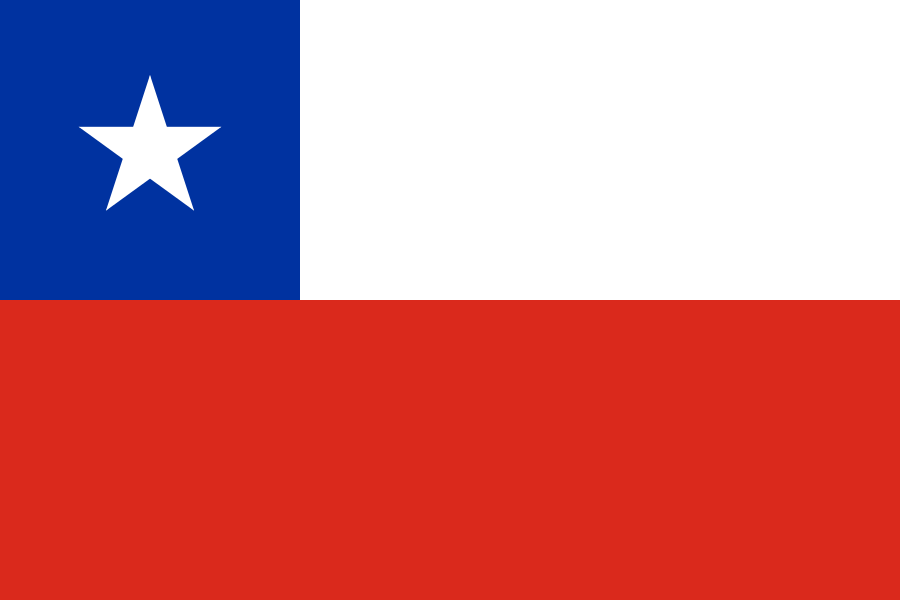
Father of the Chilean labour movement and pioneer of Latin American communism
"Reading is one of the best means of emancipation for the working classes. That is why we urge you to read much." — Recabarren's constant refrain at workers' gatherings throughout Chile.
A lifelong organizer and theorist who dedicated himself to building Chile's labour movement and socialist party. Witnessing the brutal conditions of nitrate miners, he joined the Democratic Party but broke with its reformism in 1912 to found the Socialist Workers' Party (POS). Despite repeated imprisonment and exile, he launched and edited workers' newspapers, toured the country raising class consciousness, and in 1922 affiliated the party to the Comintern, transforming it into the Communist Party of Chile. Beset by internal party conflicts and failing health, he took his own life in 1924, but the organizational, educational, and press foundations he laid became cornerstones of the Chilean and Latin American revolutionary tradition.
Career timeline
1894Joined the Chilean Democratic Party
1906Elected deputy for Tocopilla (denied seat)
1908–1909Exile in Argentina and Europe
1912Founded Socialist Workers' Party (POS) and El Despertar newspaper
1918Co-founded Communist Party of Argentina, first national directorate
1921Elected deputy for Antofagasta
1922Transformed POS into Communist Party (PCCh), attended 4th Comintern Congress
First elected Marxist head of state; pursued the peaceful 'Chilean road to socialism' (copper, land, cybernetics) until the 1973 coup
“I am not going to resign! Placed in a historic transition, I will pay for loyalty to the people with my life.” — last radio address, La Moneda, 11 September 1973
The world's first democratically elected Marxist head of state. His 'Chilean road to socialism', nationalizing copper, redistributing land, and building the Cybersyn cybernetic planning system, was cut short by the 1973 military coup.
Career timeline
1932Medical degree, University of Chile
1933Co-founded the Socialist Party; arrested, six months imprisoned
1938–1942Minister of Health, Popular Front — first healthcare access for the poor
1945–1970Senator; President of the Senate (1966–1969)
1952, 1958, 1964Presidential candidacies for FRAP — three defeats
1970Elected president (36.6%) leading Popular Unity; inaugurated 24 October
1970–1973Copper nationalization, land reform, Cybersyn — the 'Chilean road'
1973.09.11Military coup — final radio address from La Moneda; took his own life
The Ecuadorian UN envoy who shuttled through six years of Geneva talks to frame the Soviet withdrawal from Afghanistan
Gorbachev decided to withdraw 'because of perestroika and diplomacy,' he later wrote in his memoir, 'reinforced by military pressure': not because of Stinger missiles alone.
Cordovez was an Ecuadorian diplomat and UN Under-Secretary-General who, as Pérez de Cuéllar's Personal Representative on Afghanistan from 1982, spent six years shuttling between the Pakistani and Afghan delegations in Geneva to broker the accords that framed the Soviet withdrawal. He entered the UN in 1963 as part of Raúl Prebisch's team that founded UNCTAD, rose to head the ECOSOC secretariat, and handled crises from the Iran hostage affair to the Iran-Iraq war. The Geneva Accords were signed on 14 April 1988; Cordovez, nominated for the Nobel Peace Prize, later served as Ecuador's foreign minister and UN ambassador.
Career timeline
1935.11.03Born in Quito, Ecuador
1962Law degree with honors, University of Chile; admitted to the bar
1963Joined the UN; helped Raúl Prebisch found UNCTAD
1978UN Assistant Secretary-General for Economic and Social Matters
1981–1988Under-Secretary-General for Special Political Affairs; Personal Representative of the Secretary-General on Afghanistan
1988.04.14Brokered the signing of the Geneva Accords, framing the Soviet withdrawal
1988–1992Foreign Minister of Ecuador
2005–2007Permanent Representative of Ecuador to the UN