Activities and affiliations

What people did, and whom they served in that activity.

State, movement or organization

All 42 affiliations by country

Brazil

China

Czechoslovakia

Estonia

France

Germany

Greece

Hungary

International organizations

Poland

Russia

South Africa

Soviet Union

Spain

United Kingdom

United States

Vietnam

Yugoslavia

Social movements and organizing · French Communist Party (PCF) people 2

Clear all

Aimé Césaire

Aimé Césaire

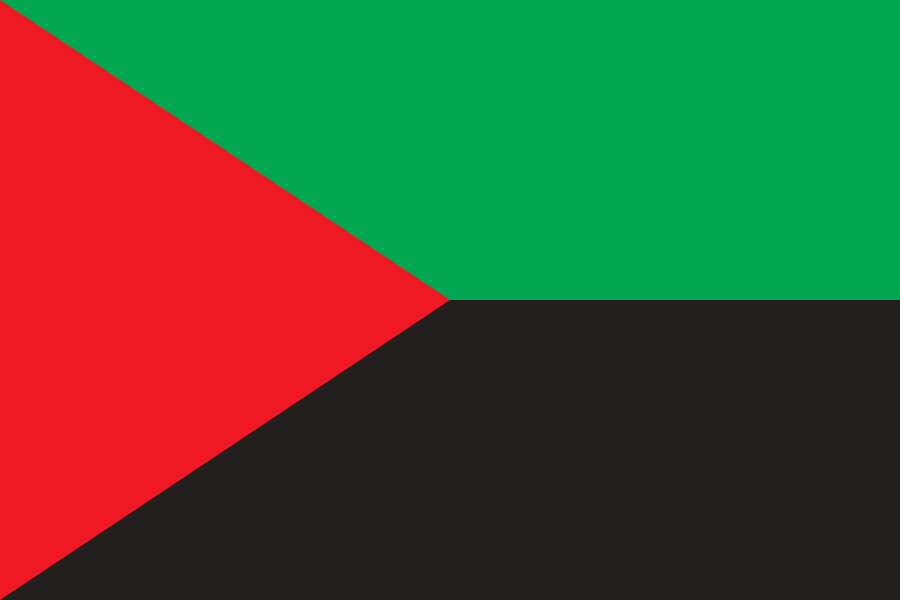
Literature and arts Communism France Martinique 1913–2008 ○ Natural causes

Co-founder of Négritude, pioneering critic of colonialism

"My turn to state an equation: colonization = 'thingification.'" In Discourse on Colonialism (1950) he argued that Europeans had already applied to colonized peoples the methods they later condemned as Nazism, and that Nazism was the natural conclusion of a civilization that justified colonization.

Born in Basse-Pointe, Martinique, the son of a tax inspector, he studied in Paris, where with Léopold Sédar Senghor and Léon Damas he launched the Négritude movement; the journal L'Étudiant noir (founded 1934–1935) first used the term in its present sense in May–June 1935. Frantz Fanon was his student. Elected with Communist Party support in 1945, he was mayor of Fort-de-France for 56 years and deputy for 47, and in 1946 secured the law making Martinique a French département. He broke with the PCF in his Lettre à Maurice Thorez (24 October 1956), citing the Khrushchev report and the repressive policy in the Maghreb; English-language accounts instead attribute the break to the Soviet suppression of the Hungarian Revolution. He founded the Parti Progressiste Martiniquais in 1958 and left politics in 2001.

Career timeline
  • 1935Co-founded L'Étudiant noir in Paris; coined the term 'négritude'
  • 1939Published Cahier d'un retour au pays natal
  • 1941Co-founded Tropiques review with Suzanne Roussi
  • 1945Elected PCF deputy to National Assembly and mayor of Fort-de-France
  • 1946Secured law departmentalizing Martinique as part of France
  • 1950Published Discours sur le colonialisme
  • 1956Resigned from PCF via Lettre à Maurice Thorez over Soviet suppression of Hungary
  • 1958Founded Parti Progressiste Martiniquais (PPM)
  • 1983–1988President of the Regional Council of Martinique
  • 1993Retired from National Assembly after 47 years
  • 2001Retired as mayor of Fort-de-France after 56 years

Pierre Félix Georges

Pierre Georges
Military command Francs-Tireurs et Partisans (FTP/FTPF) Communism France French 1919–1944 ✕ Killed in action

A communist pioneer of armed resistance to the Occupation

“We’ve avenged Titi!”

Pierre Georges was a French communist and Resistance fighter whose early anti-fascist experience included service with the International Brigades in the Spanish Civil War. On 21 August 1941 he shot the German naval officer Alfons Moser at Paris’s Barbès metro station, an action that made the French Communist Party’s armed resistance visible while intensifying the occupiers’ hostage executions and repression. Under the names Frédo and later Colonel Fabien, he organised clandestine fighters and maquis units, then led the Colonne Fabien toward the eastern front after the Liberation of Paris. He was killed by a mine explosion in 1944, leaving a legacy that joins the decision to fight the Occupation to the severe reprisals that followed.

Career timeline
  • 1936–1939International Brigades fighter in the Spanish Civil War
  • 1939–1940Cadre of the French Communist youth movement
  • 1940–1941Underground communist organiser in occupied France
  • 1941–1942Military commissioner of the Organisation spéciale
  • 1942–1943FTP maquis organiser in the Doubs
  • 1943–1944FTP maquis commander across eastern and central France
  • 1944FTP and FFI commander during and after the Liberation of Paris
  • 1944Commander of the Colonne Fabien, killed on the eastern front
  • 1941.08.21Shot German naval officer Alfons Moser at Barbès metro station
  • 1944.12.27Killed by a mine explosion at Habsheim, Alsace