
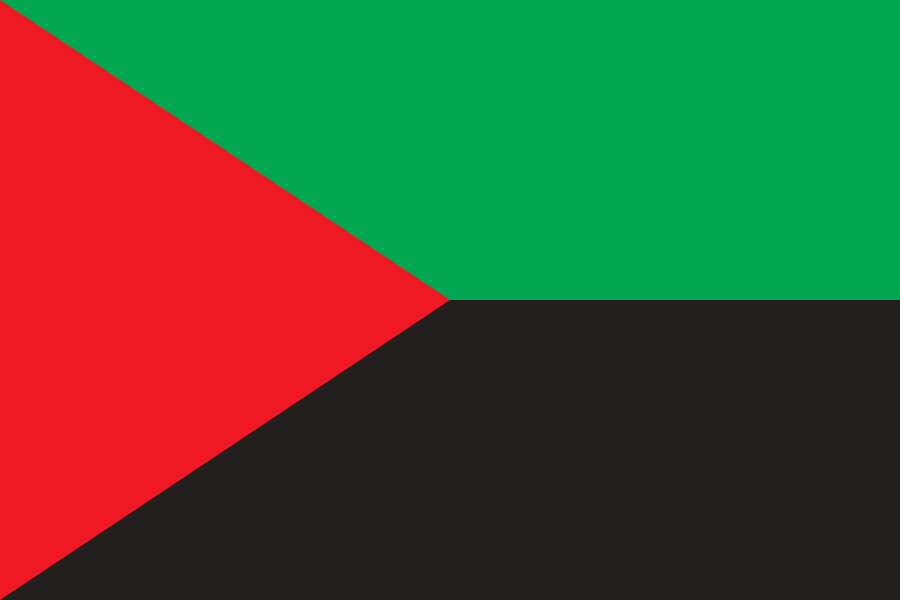
 1913–2008
○ Natural causes
1913–2008
○ Natural causes
Co-founder of Négritude, pioneering critic of colonialism
"My turn to state an equation: colonization = 'thingification.'" In Discourse on Colonialism (1950) he argued that Europeans had already applied to colonized peoples the methods they later condemned as Nazism, and that Nazism was the natural conclusion of a civilization that justified colonization.
Born in Basse-Pointe, Martinique, the son of a tax inspector, he studied in Paris, where with Léopold Sédar Senghor and Léon Damas he launched the Négritude movement; the journal L'Étudiant noir (founded 1934–1935) first used the term in its present sense in May–June 1935. Frantz Fanon was his student. Elected with Communist Party support in 1945, he was mayor of Fort-de-France for 56 years and deputy for 47, and in 1946 secured the law making Martinique a French département. He broke with the PCF in his Lettre à Maurice Thorez (24 October 1956), citing the Khrushchev report and the repressive policy in the Maghreb; English-language accounts instead attribute the break to the Soviet suppression of the Hungarian Revolution. He founded the Parti Progressiste Martiniquais in 1958 and left politics in 2001.
Activities and affiliations
Career Timeline
- 1935Co-founded L'Étudiant noir in Paris; coined the term 'négritude'
- 1939Published Cahier d'un retour au pays natal
- 1941Co-founded Tropiques review with Suzanne Roussi
- 1945Elected PCF deputy to National Assembly and mayor of Fort-de-France
- 1946Secured law departmentalizing Martinique as part of France
- 1950Published Discours sur le colonialisme
- 1956Resigned from PCF via Lettre à Maurice Thorez over Soviet suppression of Hungary
- 1958Founded Parti Progressiste Martiniquais (PPM)
- 1983–1988President of the Regional Council of Martinique
- 1993Retired from National Assembly after 47 years
- 2001Retired as mayor of Fort-de-France after 56 years
Related historical events
From négritude to Martinique politics
Born in Basse-Pointe, Martinique, his father was a tax inspector (contributions controller) and his mother a dressmaker. The family moved so that he could attend the island's only secondary school, the Lycée Victor Schœlcher in Fort-de-France; he then won a scholarship to the Lycée Louis-le-Grand in Paris, where he met Senghor and reconnected with Damas. With Senghor and Damas he founded L'Étudiant noir, whose third issue (May–June 1935) first used the term 'négritude' in its present sense. The founding date is disputed: English-language accounts place the review in 1935, while French Wikipedia dates it to September 1934. The Nardal sisters' salon and La Revue du Monde Noir were key intellectual influences on Négritude later minimized in accounts of the movement. He joined the Jeunesses communistes in 1935.
He taught at the Lycée Schœlcher in Fort-de-France, where Frantz Fanon was his student; he shaped Fanon's intellectual development and was the first to read his manuscripts, and Fanon testified in Black Skin, White Masks to the 'liberating effect of Césaire's word and action'.
In 1941 he and his wife Suzanne Roussi founded the review Tropiques with Martinican intellectuals including René Ménil and Aristide Maugée to contest cultural alienation; it faced censorship under the repressive Vichy regime of Admiral Robert and appeared only with difficulty until 1943. The book-length poem Cahier d'un retour au pays natal first appeared in Volontés in 1939; the book edition with André Breton's introduction, which called it 'the greatest lyrical monument of our times', followed in 1947.
In 1945, with the support of the French Communist Party, he was elected mayor of Fort-de-France and deputy for Martinique, and he secured the law departmentalizing Martinique, approved unanimously on 19 March 1946. French Wikipedia gives the mandates as mayor from 27 May 1945 to 19 March 2001 (55 years 9 months) and deputy from 6 November 1945 to 1 April 1993 (47 years 4 months), and states that he joined the PCF in December 1945. Britannica dates his PCF membership to 1946–56, a dating discrepancy to attribute rather than assert.
In Discours sur le colonialisme (1950) he argued that 'colonization = thingification' and that Nazism was not an exception in European history but the natural conclusion of a civilization that justified colonization: Europeans had legitimated against non-European peoples the methods they later condemned, and Hitler lives within 'the very distinguished, very humanistic, very Christian bourgeois of the twentieth century'. The essay is the origin of the imperial boomerang theory and a foundational text of postcolonial and anticolonial thought. It was first published in 1950 by Éditions Réclame, republished in Présence africaine in 1955, and translated into English by Joan Pinkham (Monthly Review, 1972).
On 24 October 1956 he broke with the PCF in Lettre à Maurice Thorez. French Wikipedia attributes the rupture to the Khrushchev report's revelations of Stalin's crimes, which plunged him into an 'abyss of stupefaction, pain and shame', to the party's ambiguity on de-Stalinization, and to its vote of full powers to the repressive Guy Mollet government in the Maghreb; he left the communist group the next day. English-language accounts instead attribute the break to disillusionment with the Soviet Union after the 1956 suppression of the Hungarian Revolution. The two framings materially differ, and the Maghreb ground appears only in the francophone account.
He founded the Parti progressiste martiniquais (PPM) on 22 March 1958, advocating Martinican autonomy, and presided over it until 14 June 2005; in the National Assembly he sat as non-inscrit from 1958 to 1978 and apparenté socialiste from 1978 to 1993. He was President of the Regional Council of Martinique from 1983 to 1988, declined to renew his National Assembly mandate in 1993 after 47 continuous years, and retired as mayor in 2001, ending his political career. In 2006 he refused to meet Nicolas Sarkozy because the UMP had voted for the law of 23 February 2005, whose article 4 alinéa 2 required textbooks to acknowledge the 'positive role' of the French presence abroad, notably in North Africa; that alinéa was abrogated by decree of 15 February 2006. French Wikipedia adds that after the repeal, and via Patrick Karam's mediation, he reversed his decision in March 2006 and received Sarkozy, commenting 'C'est un homme nouveau'.
He was hospitalised on 9 April 2008 for heart trouble at the Pierre Zobda-Quitman hospital, Fort-de-France, and died on 17 April 2008, aged 94. A state funeral was held at the Stade de Dillon on 20 April 2008, where his longtime friend and former deputy mayor Pierre Aliker delivered the oration. Martinique's airport at Le Lamentin was renamed Martinique Aimé Césaire International Airport on 15 January 2007, and a national commemoration and Panthéon plaque were held on 6 April 2011. French Wikipedia notes a retrospective assessment that his political path moved between assimilationism (departmentalism), independence and autonomy.