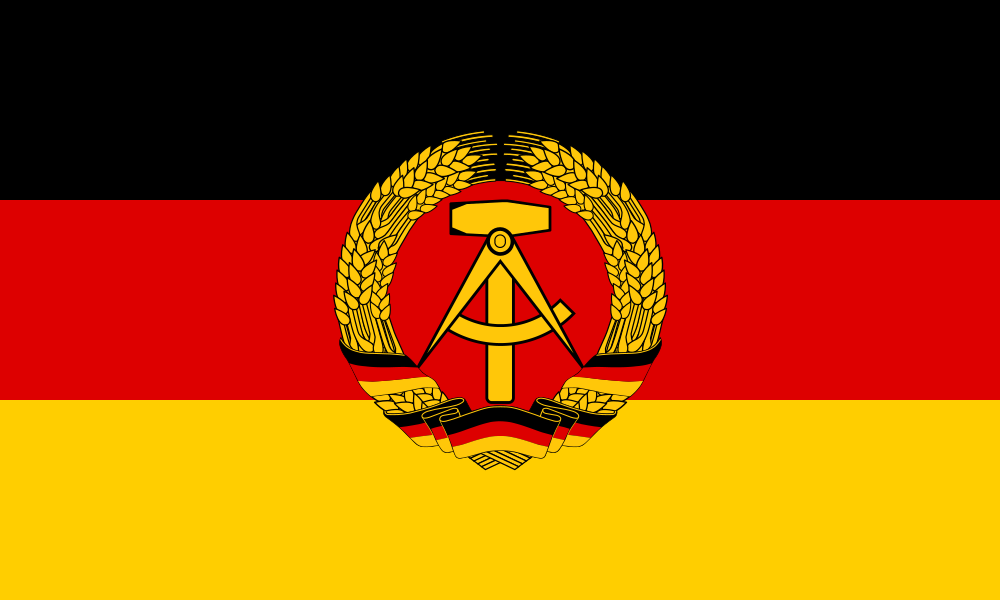
From the Spartacus League to GDR head of state, the sole founding member who lived the full arc of German communism
On the night of 15 January 1919, Pieck was arrested alongside Luxemburg and Liebknecht and taken to the Eden Hotel. He became the sole survivor — the last to witness his comrades alive.
A coachman's son turned carpenter, he joined the SPD in 1895 and was radicalized under Rosa Luxemburg's influence. Court-martialed for anti-war agitation, he co-founded the Spartacus League and the KPD. Arrested with Luxemburg and Liebknecht in January 1919, he alone survived. He served on the ECCI (1921) and its Presidium (1931), then led the KPD in Moscow exile as Comintern secretary. Returning after the war, he drove the SPD-KPD merger that created the SED and became the first President of the GDR in 1949, holding that office until his death.
Career timeline
- 1895Joins the Social Democratic Party of Germany (SPD)
- 1915Conscripted; court-martialed for anti-war agitation; flees to Amsterdam
- 1918–1919Co-founds Spartacus League and KPD; Central Committee member
- 1921ECCI member; elected to the Prussian Landtag
- 1928–1933Reichstag deputy
- 1931Elected to the ECCI Presidium
- 1934–1946KPD chairman (exile leadership)
- 1935–1943Secretary of the Comintern
- 1943Co-founds the National Committee for a Free Germany
- 1946–1950Co-chairman of the Socialist Unity Party (SED)
- 1949–1960President of the German Democratic Republic
German communist leader who built the GDR and erected the Berlin Wall
At a press conference on 15 June 1961 he declared, 'Nobody intends to build a wall'; two months later, on 13 August, his orders launched the Berlin Wall.
Born in Leipzig in 1893 to a tailor's family and trained as a joiner, he joined the SPD in 1912, passed through the USPD (1917) and the Spartacus League (1919) into the KPD (1920), and sat on the KPD Central Committee from 1923 and in the Reichstag from 1928 to 1933. After the Nazi takeover he fled via Paris and Prague to the Soviet Union to work for the Comintern, and returned on 30 April 1945 leading the 'Ulbricht Group'. He was pivotal in the forced 1946 merger of the KPD and SPD into the SED and became its First Secretary in 1950, the effective leader of East Germany. He backed the suppression of the June 1953 uprising, ordered the Berlin Wall in 1961, and launched the New Economic System in 1963. Forced out on 3 May 1971 'for health reasons' in favour of Erich Honecker, he died of a stroke on 1 August 1973.
Career timeline
- 1912Joins the Social Democratic Party of Germany (SPD)
- 1918Co-founds the Spartacus League and the KPD
- 1923–1933KPD Central Committee member, Reichstag deputy
- 1933–1945Exile in Paris, Prague and Moscow; works for the Comintern
- 1943Helps found the National Committee for a Free Germany
- 1950–1971First Secretary of the SED Central Committee
- 1960–1973Chairman of the GDR State Council
- 1971Forced to resign party leadership under Brezhnev pressure
A social democrat who moved from municipal politics into state power amid Germany's division
On 30 November 1948, he was elected Lord Mayor of the “provisional democratic magistrate” in Berlin's Soviet sector.
Friedrich Ebert Jr. was a German politician who moved from the Social Democratic Party to the leadership of the Socialist Unity Party, carrying both the symbolism of being the first president's son and the consequences of his own choices. The Nazis detained him in concentration camps for illegal political activity; after the war, he became a central figure in the Soviet zone as social democracy was forcibly fused with communism and the SED consolidated power. On 30 November 1948 he led the extraordinary assembly in the Soviet sector that deposed Berlin's elected magistrate and installed a rival East Berlin magistrate, then combined municipal reconstruction with senior work in East German state institutions.
Career timeline
- 1919–1925Editor of the Social Democratic daily Vorwärts
- 1927–1933Brandenburg an der Havel city councillor
- 1928–1933Member of the Reichstag
- 1946–1949President of the Brandenburg Landtag
- 1946–1979SED Central Committee and Politburo member
- 1948–1967First Lord Mayor of East Berlin
- 1949–1979People's Chamber and Council of State leadership
- 1971–1979Chairman of the SED People's Chamber faction
The East German Politburo spokesman whose mistake brought down the Berlin Wall
Asked 'When does it take effect?' at the press conference, he shuffled through his papers and replied: 'As far as I know… immediately, without delay.'
The GDR's leading propagandist, he rose from editor-in-chief of Neues Deutschland to SED Politburo member and First Secretary of East Berlin. On 9 November 1989, asked at a press conference when new travel regulations would take effect, he answered 'immediately, without delay,' triggering the rush that breached the Berlin Wall that night. He later called his mistake 'the final nail in the coffin' of the regime; after reunification he was convicted for the border deaths, but his public acceptance of moral guilt earned him a reduced sentence.
Career timeline
- 1947Began journalism career as editor at FDGB paper Tribüne
- 1952Joined the SED
- 1967–1968Studied at the CPSU party academy in Moscow
- 1978–1985Editor-in-chief of Neues Deutschland, the SED central organ
- 1981–1989SED Central Committee member and Politburo candidate, full member from 1984
- 1985–1989First Secretary of the SED East Berlin district
- 1989.11.09Triggered the Wall's fall by announcing travel rules effective immediately
- 1997–2000Sentenced to 3 years for border deaths; pardoned after serving one