Activities and affiliations

What people did, and whom they served in that activity.

State, movement or organization

All 112 affiliations by country

Afghanistan

Albania

Angola

Australia

Azerbaijan

Belgium

Brazil

Bulgaria

Cambodia

China

Congo - Brazzaville

Cuba

Czechoslovakia

Democratic People's Republic of Korea

DR Congo

East Germany

Estonia

Ethiopia

Finland

France

Germany

Greece

Grenada

Guinea-Bissau

Hungary

India

Indonesia

International organizations

Italy

Japan

Kazakhstan

Laos

Latvia

Lithuania

Mongolia

Mozambique

Poland

Portugal

Romania

Russia

South Africa

South Korea

Soviet Union

Spain

United Kingdom

United States

Vietnam

Yemen

Yugoslavia

Political and party leadership · Socialist Unity Party of Germany (SED) people 2

Clear all

Wilhelm Pieck

Wilhelm Pieck
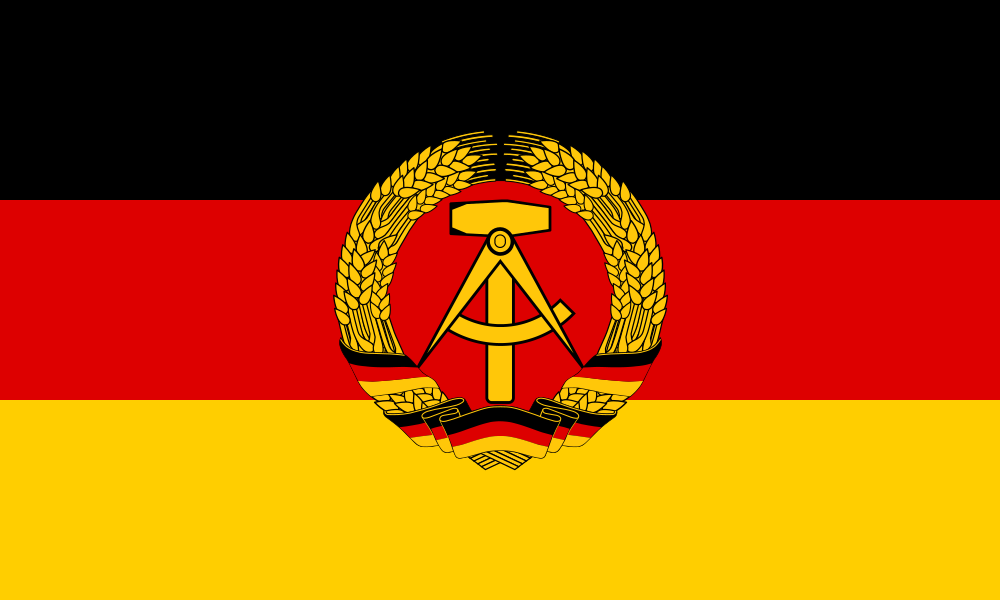

Political and party leadership East Germany East Germany Germany 1876–1960 ○ Natural causes

From the Spartacus League to GDR head of state, the sole founding member who lived the full arc of German communism

On the night of 15 January 1919, Pieck was arrested alongside Luxemburg and Liebknecht and taken to the Eden Hotel. He became the sole survivor — the last to witness his comrades alive.

A coachman's son turned carpenter, he joined the SPD in 1895 and was radicalized under Rosa Luxemburg's influence. Court-martialed for anti-war agitation, he co-founded the Spartacus League and the KPD. Arrested with Luxemburg and Liebknecht in January 1919, he alone survived. He served on the ECCI (1921) and its Presidium (1931), then led the KPD in Moscow exile as Comintern secretary. Returning after the war, he drove the SPD-KPD merger that created the SED and became the first President of the GDR in 1949, holding that office until his death.

Career timeline
  • 1895Joins the Social Democratic Party of Germany (SPD)
  • 1915Conscripted; court-martialed for anti-war agitation; flees to Amsterdam
  • 1918–1919Co-founds Spartacus League and KPD; Central Committee member
  • 1921ECCI member; elected to the Prussian Landtag
  • 1928–1933Reichstag deputy
  • 1931Elected to the ECCI Presidium
  • 1934–1946KPD chairman (exile leadership)
  • 1935–1943Secretary of the Comintern
  • 1943Co-founds the National Committee for a Free Germany
  • 1946–1950Co-chairman of the Socialist Unity Party (SED)
  • 1949–1960President of the German Democratic Republic

Friedrich Ebert Jr.

Friedrich Ebert junior
Political and party leadership East Germany Germany German 1894–1979 ○ Natural causes

A social democrat who moved from municipal politics into state power amid Germany's division

On 30 November 1948, he was elected Lord Mayor of the “provisional democratic magistrate” in Berlin's Soviet sector.

Friedrich Ebert Jr. was a German politician who moved from the Social Democratic Party to the leadership of the Socialist Unity Party, carrying both the symbolism of being the first president's son and the consequences of his own choices. The Nazis detained him in concentration camps for illegal political activity; after the war, he became a central figure in the Soviet zone as social democracy was forcibly fused with communism and the SED consolidated power. On 30 November 1948 he led the extraordinary assembly in the Soviet sector that deposed Berlin's elected magistrate and installed a rival East Berlin magistrate, then combined municipal reconstruction with senior work in East German state institutions.

Career timeline
  • 1919–1925Editor of the Social Democratic daily Vorwärts
  • 1927–1933Brandenburg an der Havel city councillor
  • 1928–1933Member of the Reichstag
  • 1946–1949President of the Brandenburg Landtag
  • 1946–1979SED Central Committee and Politburo member
  • 1948–1967First Lord Mayor of East Berlin
  • 1949–1979People's Chamber and Council of State leadership
  • 1971–1979Chairman of the SED People's Chamber faction