February 1985: the first General Secretary to receive a ballot in his hospital bed — a campaign won without a single speech
A Brezhnev aide who became General Secretary after Andropov, but whose failing health sharply limited his rule. His short tenure became the interlude before Gorbachev.
Career timeline
1984–1985General Secretary
1984–1985Chairman of the Presidium of the Supreme Soviet
Architect of 'goulash communism', enforcer of the 1956 reprisals
"Whoever is not against us is with us" (1961)
Born illegitimate in Fiume (now Rijeka), registered in Italian as Giovanni Giuseppe Czermanek, and took his mother Borbála Csermanek's surname. He began a typewriter-mechanic apprenticeship in 1927 and qualified as a journeyman in 1929. Joining the illegal KIMSZ and party in 1931, he did underground work and served prison terms. As Interior Minister (1948–50) he backed the Stalinist line and was involved in László Rajk's purge; arrested in 1951, sentenced to life in 1952 and released in 1954. First Secretary from 25 October 1956, he crossed to the Soviet side on 1 November, accepted the intervention, proclaimed a new government at Szolnok on the 4th and approved Imre Nagy's execution; hundreds were executed and tens of thousands imprisoned. In 1961 he launched 'whoever is not against us is with us', opening amnesty and reform. He resigned in 1988 and died in Budapest in 1989.
Career timeline
1931Joined illegal KPV and Communist youth league; underground work
1933–34Arrested, two-year term; met Rákosi in Szeged maximum-security prison
1942–44KPV CC member and secretary; co-founded antifascist Hungarian Front
1948–50Interior Minister — involved in Rajk's arrest; later demoted
1951–54Arrested as 'Titoist,' life sentence; freed July 1954
1956.10–11Minister in Nagy cabinet → negotiated with USSR, formed new government
1956–88MSZMP General Secretary — de facto leader of Hungary for 32 years
1956–58, 61–65Prime Minister (two terms) — reform, amnesty, 'goulash communism'
The long-serving East German leader of the walled republic
His removal in October 1989 showed that the GDR's collapse could no longer be contained even within its leadership.
A German communist trained at Moscow's International Lenin School, he rose through East Germany's youth organization and party leadership. He led the Socialist Unity Party from 1971 to 1989 as the GDR's long-serving ruler.
Career timeline
1930–1931Studies at Moscow's International Lenin School
The founder of North Korea returned from the Soviet Far East
On 14 October 1945, more than 100,000 gathered at Pyongyang's sports ground for a rally honouring the liberating Soviet army. A Soviet general introduced 'the national hero and famous partisan leader, comrade Kim Il Sung.' Onto the podium stepped a 33-year-old — the crowd stared in disbelief, having expected a legendary guerrilla in his fifties.
After guerrilla activity against Japanese rule, he served with the Soviet Far East’s 88th Separate Rifle Brigade in the 1940s and rose to the center of power in northern Korea under Soviet occupation authorities after 1945. Having founded the DPRK in 1948, he concentrated party, state, and military power over decades.
Career timeline
1930년대Anti-Japanese guerrilla activity in Manchuria
1942–1945Served with the Soviet 88th Separate Rifle Brigade
1945–1948Built a power base in northern Korea under Soviet occupation
1948–1972Premier and Workers’ Party leader
1961Treaty of Friendship, Cooperation and Mutual Assistance with the USSR
Czechoslovakia's longest-serving leader, who crushed the Prague Spring and built 'normalization'
On 10 December 1989, Husák swore in the first non-communist majority government in 41 years — and resigned the presidency hours later, personally witnessing the formal end of the regime he had built.
A Slovak communist lawyer, he served in the leadership of the 1944 Slovak National Uprising against the Nazis. After the war he consolidated communist rule in Slovakia, but was purged in 1950 for 'bourgeois nationalism' and imprisoned for a decade. Rehabilitated in 1963, he became vice-premier during Dubček's Prague Spring, then reversed after the Soviet invasion to lead the purge of reformers. As KSČ general secretary (1969–1987) and president (1975–1989), he presided over 'normalization': combining relative material stability with secret-police suppression of dissent. He resigned during the 1989 Velvet Revolution, handing power to the first non-communist government in 41 years.
Career timeline
1933Joined the Communist Party of Czechoslovakia
1944Led Slovak National Uprising; vice-chairman, Slovak National Council
1946–1950Chairman, Board of Commissioners for Slovakia; led suppression of Democratic Party
1954–1960Sentenced to life for 'bourgeois nationalism'; imprisoned at Leopoldov
1968Vice-premier during Prague Spring; switched to anti-reform after Soviet invasion
1969–1987First Secretary, then General Secretary of the KSČ; architect of normalization
A social democrat who made reconciliation a politics of divided cities
After the Wall was built, he said: “The Wall must go, but until it goes, the city must live.”
Willy Brandt was a German social-democratic politician shaped by exile and resistance to the Nazi dictatorship. As Governing Mayor of West Berlin, he defended the city’s morale after the Wall was built and pressed the West to honor its responsibilities, helping popularize the name “Wall of Shame.” As chancellor, he pursued Ostpolitik and “change through rapprochement,” easing Cold War confrontation and earning the 1971 Nobel Peace Prize.
Career timeline
1933–1945Exile and resistance activist against the Nazi dictatorship
1948–1953SPD representative in Berlin
1957–1966Governing Mayor of West Berlin
1964–1987Chairman of the SPD
1966–1969Foreign Minister and Vice Chancellor
1969–1974Federal Chancellor of the Federal Republic of Germany
First Secretary who led a decade of Western-credit modernisation: only for debt and Solidarity to bring the curtain down
To workers at a January 1971 rally — 'So, comrades, will you help?' (the hall answered with feeble applause)
A coal miner in France and Belgium, he became PZPR First Secretary after the 1970 workers' revolt and pursued a 'socialist consumer society' fuelled by Western credit. Living standards rose visibly — but the debt crisis and the 1980 strikes forced him out.
Career timeline
1931Joins French Communist Party in the Lens coalfield
1934Leads occupation strike at Leforest mine; deported to Poland
1937–46Moves to Belgium; joins Belgian CP and Witte Brigade resistance
1948–54Returns to Poland; Katowice party secretary, then head of Heavy Industry Dept, CC
1957–70First Secretary, Katowice Voivodeship — his pragmatic 'duchy'
1970–80First Secretary, PZPR — the 'Gierek decade'
1976–80Concurrently member of the Council of State
1981Expelled from PZPR; interned under martial law (Dec 1981–Dec 1982)
On 2 December 1975 the National Congress of People's Representatives elected Nouhak Deputy Prime Minister and Minister of Finance of the new Lao People's Democratic Republic government. Sources credit Kaysone Phomvihane, not Nouhak, as the presiding official who proclaimed the republic.
A founding figure of the Lao People's Revolutionary Party and a leading Pathet Lao revolutionary. Born in Mukdahan, Siam (now Thailand) to an ethnic Lao family, he was ranked second after Kaysone in the party's Politburo at its 1955 founding congress and joined the Politburo at the 2nd Congress in 1972 with responsibility for economic affairs. He served as Deputy Prime Minister and Minister of Finance after 1975, and was President from 1992 to 1998.
Career timeline
1945Founding member of the Lao revolutionary movement
1949Chairman of the Lao Resistance Committee for the Eastern Region
1950Minister of Finance in the Lao Resistance Government
1954Represented the Pathet Lao at the Geneva Conference
1955Ranked second after Kaysone in the party Politburo at the founding congress
1972Joined the Politburo at the 2nd Congress, assigned economic affairs
1975Deputy Prime Minister and Minister of Finance
1989President of the second Supreme People's Assembly
The reformist general secretary who rehabilitated the Cultural Revolution’s victims and freed thought; his death sparked the 1989 protests
He died on 15 April 1989, days after a heart attack; a day later unofficial mourners demanded the state reassess him, and within a week about 100,000 students marched on Tiananmen Square.
From Hunan, he joined the Red Army at fourteen, marched on the Long March and led the Communist Youth League after 1949. Persecuted in the Cultural Revolution, as head of the Organisation Department from 1977 he reviewed and reversed millions of unjust cases and in 1978 organised the “criterion of truth” debate that underpinned Deng Xiaoping’s return. Party chairman in 1981 and general secretary from 1982, he drove reform and opening, but after the student protests of late 1986 he was forced to resign in January 1987 for laxity toward “bourgeois liberalisation”. He died of a heart attack on 15 April 1989, and the mourning gatherings grew into the Tiananmen protests.
Career timeline
1977–1978Head of the Central Organisation Department
1981–1982Chairman of the Central Committee
1982–1987General Secretary of the Central Committee
The Eurocommunist architect who lit a cigarette at gunpoint
23 February 1981: 200 Civil Guards under Lt. Col. Tejero storm the Spanish parliament, firing submachine guns. As every deputy dives for cover, 66-year-old Santiago Carrillo remains seated, takes out a cigarette, and calmly lights it.
General Secretary of the Communist Party of Spain (1960–1982), Carrillo was a key architect of Eurocommunism alongside Berlinguer and Marchais. Breaking with Moscow after the 1968 invasion of Czechoslovakia, he argued in Eurocommunism and the State (1977) for a parliamentary path to socialism and guided Spain's peaceful democratic transition after Franco's death.
Career timeline
1930Begins at the Socialist Youth newspaper Renovación
1934Elected General Secretary of the Socialist Youth of Spain
1934–1936Imprisoned for participation in the 1934 revolutionary uprising
1936.11Joins the PCE; Councillor for Public Order, Madrid Defence Council
1937Candidate member of the PCE Political Bureau
1939–197638-year exile during the Franco dictatorship
1946–1947Minister without portfolio, Republican government-in-exile
1960Succeeds Dolores Ibárruri as PCE General Secretary
1968Opposes Soviet invasion of Czechoslovakia; breaks with Moscow
1976Returns secretly disguised in a wig; arrested and released
1977.3Launches Eurocommunism with Berlinguer and Marchais in Madrid
1977–1986Member of Congress of Deputies for Madrid
1981.2.2323-F coup — remains seated, lights cigarette as gunmen fire
1982Resigns as PCE General Secretary after electoral defeat
1985Expelled from PCE; forms splinter left party
1991Disbands splinter party; declines merger into ruling PSOE
He framed Mongolia's bond with the USSR as an 'elder brother–younger brother' (akh düü) one, and at Stalin's funeral in 1953 asked that Mongolia join the Soviet Union, a request Moscow rejected.
He became Mongolia’s head of government in 1952 after Choibalsan. Close Soviet political and economic ties supported industrialization and cooperative herding. His long rule combined modernization with exclusion of rivals and external dependence, ending with his removal in 1984.
Career timeline
1939Joined the Mongolian People's Revolutionary Party and became deputy finance minister.
1940Elected general secretary of the party Central Committee; the country's number two leader.
1941–1945Head of the Political Directorate and deputy commander-in-chief of the People's Army.
1945Chairman of the State Planning Commission.
1952–1974Chairman of the Council of Ministers (head of government).
1958–1984Regained party leadership as first secretary; general secretary title from 1981.
1974–1984Chairman of the Presidium of the People's Great Khural (head of state) and commander-in-chief.
1979Awarded the rank of Marshal of the Mongolian People's Republic.
Afghan communist founder whose overthrow and murder by his protégé Amin triggered the Soviet invasion
Taraki: 'We ask you to render practical and technical assistance with men and armament.' Kosygin: 'This is a very complicated problem.' Taraki: 'While you are taking counsel Herat will fall.' (telephone conversation, 18 March 1979, during the Herat uprising)
Nur Muhammad Taraki was the founding General Secretary of the People's Democratic Party of Afghanistan (PDPA) who became the first Chairman of the Revolutionary Council and Prime Minister of the Democratic Republic of Afghanistan after the Saur Revolution of April 1978. Born to a Pashtun peasant family, he encountered Marxism at night school in Bombay and later wrote the first social-realist novel in Pashto, The Journey of Bang, earning the label 'Afghanistan's Maxim Gorky.' Once in power he imposed radical land reform and secularization that ignited armed uprisings across the countryside, and his repeated pleas for Soviet military intervention were rebuffed by Kosygin and Brezhnev. In September 1979 his protégé Hafizullah Amin overthrew and suffocated him, a killing that became the proximate trigger for the Soviet invasion two months later.
Career timeline
1932–1937Clerk for Pashtun Trading Company in Bombay; encountered Marxism at night school
1940s–1958Writer and journalist; published De Bang Mosaferi, the first Pashto social-realist novel
1952–1953Press attaché, Afghan Embassy in Washington DC
1965Founded PDPA at his Kabul home; elected General Secretary
1967Led Khalq (Masses) faction after PDPA split
1978.04–12Saur Revolution: Chairman of Revolutionary Council and PM; signed 20-Year Soviet Friendship Treaty
1979.03Herat uprising: appealed for Soviet troops; Kosygin and Brezhnev refused
1979.09–10Overthrown by Amin; suffocated with pillows in custody
The party ideology secretary who signed the letter inviting Soviet tanks into his own country
Charged with treason, Biľak denied signing any invitation: "I never wrote to Brezhnev." The letter had been addressed to the CPSU Central Committee, not to Brezhnev personally. A defense that was technically true and entirely beside the point.
A neo-Stalinist of Rusyn origin who rose from tailor to the Presidium of the Czechoslovak Communist Party. In 1968 he was a core member of the conservative 'healthy forces': one of five who signed the invitation letter urging the Warsaw Pact to intervene against the Prague Spring reforms with 'all means at your disposal.' As the KSČ ideology secretary under Husák, he drafted 'Lessons from the Crisis Development' (1970), the doctrinal foundation of normalization that branded the reforms a counter-revolution and justified mass purges, remaining an unreconstructed hardliner until expelled during the Velvet Revolution.
Career timeline
1917Born to a Rusyn family; apprenticed as a tailor
1936–45Joined communist trade unions; worked as a tailor; Slovak National Uprising
1954–62Graduated Party Political School; regional secretary in Prešov; commissioner for education and culture
1962–68Ideology secretary, Central Committee of the Communist Party of Slovakia
1968.1–8General Secretary of Slovak party; joined KSČ Presidium in April; signed Warsaw Pact invitation letter
1968–88KSČ Presidium member and Central Committee secretary for foreign policy and ideology
1970Authored 'Lessons from the Crisis Development,' the doctrinal charter of normalization
1988.12Removed from Presidium and secretariat; expelled from the party in 1989
Romania's leader who combined independent diplomacy with a cult of personality
His 1968 criticism of the invasion publicly exposed fractures within the Eastern European socialist bloc.
Becoming leader of Romania's Communist Party in 1965, he built a nationalist independent line and a powerful cult of personality. He criticized the 1968 Warsaw Pact invasion of Czechoslovakia, but fell with his regime in the 1989 revolution.
The regime insider who fused political power with scientific prestige
“Together we fought, together we die!”
Elena Ceaușescu was a Romanian communist politician who exercised power alongside her husband, Nicolae Ceaușescu. She rose through the party and state leadership, where propaganda presented her as a symbol of women’s advancement and scientific achievement, while her position reinforced family rule and the personality cult. As the December 1989 uprising spread from Timișoara, she remained part of the regime’s ruling circle, fled with her husband on 22 December, and was captured. After a summary trial, the couple were executed together on 25 December.
Career timeline
1939–1947Communist activist and textile worker
1957–1967Chemical researcher, awarded engineering degree and doctorate
1972Member of the Romanian Communist Party Central Committee
1973–1974Member of the Political Executive Committee and its Permanent Bureau
1975–1989Deputy in the Great National Assembly and senior party-state leader
1980–1989First Deputy Prime Minister of Romania
1989.12Captured in the revolution and executed alongside her husband
From Sichuan’s farm reforms to general secretary, the reformer who opposed martial law in 1989 and died under house arrest
Premier 1980-1987 and general secretary from 1987, in charge of political reform; he lost power over the 1989 Tiananmen Square protests and lived under house arrest until his death
From Henan, he was a provincial cadre in Guangdong until purged in the Cultural Revolution, returned as Sichuan first secretary in 1975 and, with household contracting and enterprise autonomy, earned the saying “If you want to eat, look for Ziyang”. Premier from 1980 and general secretary from 1987, he pushed price reform and plans for political reform. In May 1989 he opposed martial law against the student protests, told students in the square “We have come too late”, and fell; he remained under house arrest in Beijing until his death in 2005. His secretly recorded memoirs were published posthumously in Hong Kong.
Career timeline
1975–1980First Secretary of the Sichuan Party Committee
1980–1987Premier of the State Council
1987–1989General Secretary of the Central Committee
From US-educated anthropologist to founder of Mozambique's liberation front
“Although I loved university life above all, I decided to devote the rest of my life to the war of liberation of my country, until it receives independence!”
A Mozambican anthropologist who earned his PhD in the United States, he gave up an academic career to fuse rival liberation groups into the Mozambican Liberation Front (FRELIMO). As its first president he launched the 1964 armed struggle and set the movement toward a socialist line, leading it until his assassination in 1969, six years before independence.
Career timeline
1953BA in anthropology and sociology, Oberlin College
1955MA, Northwestern University
1957–1961Research officer, UN Trusteeship Department; field research across Africa
1960PhD in anthropology, Northwestern University, under Melville J. Herskovits
1961–1963Assistant professor, Syracuse University; helped develop East African Studies Program
1962FRELIMO founded; elected first president
1964Launches armed liberation struggle against Portuguese colonial rule (25 September)
1968Second FRELIMO Congress adopts socialist line, protracted war strategy; re-elected president
1969.2.3Assassinated by letter bomb in Dar es Salaam, Tanzania
In December 1975 he proclaimed the abolition of the monarchy and the establishment of the Lao People's Democratic Republic before the National Congress of People's Representatives.
Lao People’s Revolutionary Party leader and prime minister after the republic’s establishment in 1975. He maintained close Vietnamese ties and led state reorganization and market-oriented reforms in the 1980s. He became president in 1991.
Career timeline
1942Joined the Indochinese Communist Party
1947Led resistance in northeastern Laos, organized armed forces
1949Founded the Lao People's Liberation Army
1950Minister of Defense of the Resistance Government
1955General Secretary of the Lao People's Revolutionary Party
1975First Prime Minister of the Lao People's Democratic Republic
1986Announced the 'new economic mechanism' (chin thanakan mai) reforms
The KSČ hardliner who signed the letter inviting Soviet intervention to end the Prague Spring
On the morning of 21 August 1968, Dubček was arrested 'in the name of the Workers' and Peasants' Government led by Comrade Indra.' But Indra's cabinet never materialized for a single day, and the invitation letter he signed would remain secret until the 1990s.
A neo-Stalinist politician of the Czechoslovak Communist Party. A core conservative during the 1968 Prague Spring, he was one of five who signed the 'invitation letter' urging the Warsaw Pact to intervene, and was designated head of a Soviet-backed 'workers' and peasants' government' immediately after the invasion. Under Husák he remained in the Presidium and chaired the Federal Assembly, driving the 'normalization' purges until expelled by the Velvet Revolution in 1989; he died the following year.
Career timeline
1937Joined the Communist Party of Czechoslovakia
1945–56Regional party secretary in Zlín (Gottwaldov)
1960–62Head of planning, KSČ Central Committee
1962–63Chairman, State Planning Commission
1963–68Minister of Transport of Czechoslovakia
1968.8Signed the invitation letter; designated head of 'workers' and peasants' government'
1968–71Secretary, KSČ Central Committee
1971–89KSČ Presidium member; Chairman, Federal Assembly
He dreamed of a human face, and was posted to the forestry service
Before dawn on August 21, 1968, Soviet officers burst into Dubček's office. The phone lines were cut, handcuffs went on. 'We will kill, if necessary, a million Czechs, to put an end to your counter-revolution,' an officer said.
The Slovak reform communist who led the Prague Spring. Raised in the USSR from childhood, he abolished censorship in 1968 and pursued 'socialism with a human face', only to be deposed by the Warsaw Pact invasion and spend fifteen years as a forestry clerk. In 1989 he stood beside Havel on the balcony once more.
Career timeline
1925–38Raised in a worker family in the USSR
1944Fights in the Slovak National Uprising
1963–68First Secretary of the Slovak party
1968.1First Secretary of Czechoslovakia; the Prague Spring
1968.8Taken to Moscow; forced to sign the protocol
1969–70Removed; ambassador to Turkey, then the forestry service
1989.12Returns as chairman of the Federal Assembly
Mao’s designated successor — “With you in charge, I am at ease” — who arrested the Gang of Four and was eased out by Deng Xiaoping
On 6 October 1976, a month after Mao died, Hua had the Gang of Four arrested at Zhongnanhai with Ye Jianying and Wang Dongxing, and took the party and Military Commission chairmanships. He then lost power to Deng Xiaoping by 1981.
From Shanxi, he rose as a provincial cadre in Hunan, caught Mao’s attention, and in 1976 became acting premier after Zhou Enlai’s death in January and first vice-chairman and premier after the April Tiananmen incident. After Mao died he arrested the Gang of Four in October with Ye Jianying and Wang Dongxing and took the party and Military Commission chairmanships. He sought legitimacy in the “two whatevers” — uphold every decision Chairman Mao made, follow every instruction he gave — but lost the initiative to Deng Xiaoping in the 1978 debate on the criterion of truth and at the Third Plenum, giving up the premiership and party chairmanship in 1980–1981. He remained on the Central Committee until 2002.
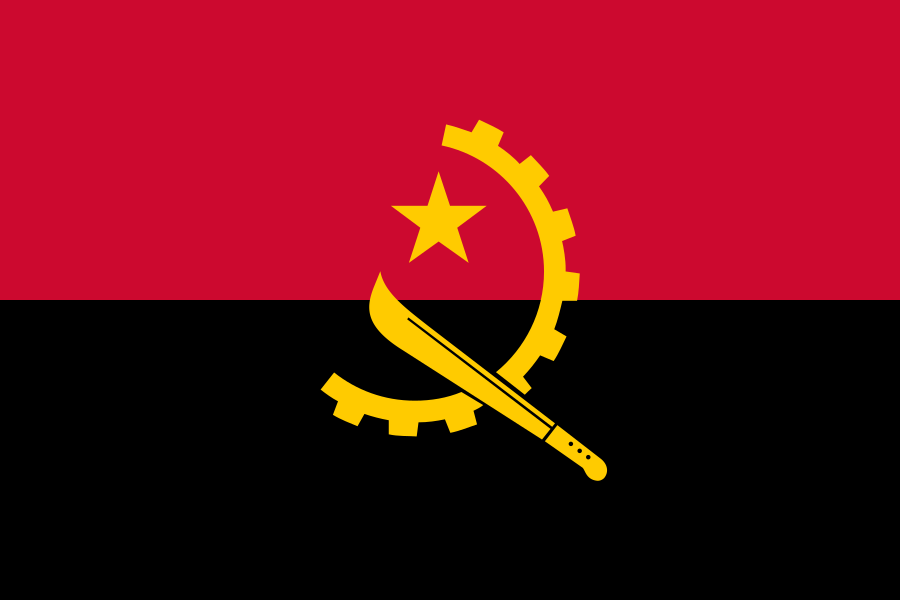
Physician-poet who led Angola's liberation struggle and became its first president
"Our land, our mother / we shall return." Lines from the poem "Havemos de voltar" in the 1974 collection Sacred Hope (Sagrada Esperança).
Physician and poet who led Angola's independence struggle. He was president of the MPLA at its founding in December 1956 and, after imprisonment and exile, was elected its effective chairman at the December 1962 conference, leading the independence war until 1974. He became the first president of the People's Republic of Angola on 11 November 1975, building a one-party socialist state in close alignment with the USSR and Cuba while crushing a 1977 coup attempt and carrying out mass purges.
Career timeline
1947Left for Portugal; studied medicine at Coimbra and Lisbon universities while joining anti-colonial student activism
1956Became the MPLA's president at its founding (Viriato da Cruz was secretary-general)
1960–1962Arrested by the PIDE, imprisoned in Lisbon; escaped in 1962 and went into exile in Congo-Léopoldville
1962–1974Elected effective chairman at the MPLA conference; led the independence war and built ties with the USSR, Cuba and Yugoslavia
1975Became first president of the People's Republic of Angola on 11 November; declared a socialist course
1975–1979Defended the state in civil war with Cuban troops and Soviet aid; suppressed Nito Alves's 1977 coup attempt
1977Reorganized the MPLA into the MPLA-Workers' Party, adopting Marxism-Leninism as official doctrine
Architect of Eurocommunism who led the West's largest non-ruling communist party
In a landmark interview with La Repubblica (28 July 1981), he named the structural corruption of Italy's party system the 'moral question' (questione morale): "Today's parties are above all machines of power and clientelism: scant or distorted knowledge of society and people's lives; ideas, ideals, programs few or vague; sentiments and civic passion — zero." The phrase became a reference point in Italian political discourse for decades.
Secretary-General of the Italian Communist Party (PCI, 1972–1984). Architect of Eurocommunism, a democratic, pluralist socialism independent of Moscow, who led the PCI to its historic peak of 34.4% in the 1976 general election.
Career timeline
1943Joined PCI; founded Sassari Communist Youth section
1944Arrested for anti-fascist bread protest; acquitted after 3 months
1949–1956Secretary, Italian Communist Youth Federation (FGCI)
1962Member of PCI Secretariat; head of international relations
1968–1984Member of Chamber of Deputies for Rome (5 terms)
1969PCI Deputy Secretary; designated successor to Luigi Longo
1972–1984Secretary-General, Italian Communist Party (PCI)
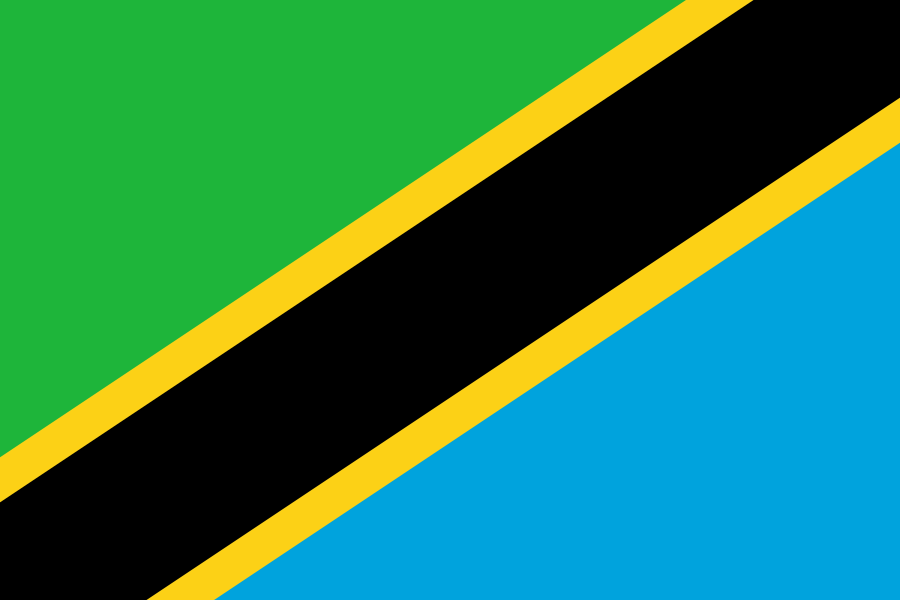
Founding president who theorized Ujamaa and led non-aligned socialist Tanzania for 24 years
“We, in Africa, have no more need of being 'converted' to socialism than we have of being 'taught' democracy. Both are rooted in our past — in the traditional society which produced us.” — essay 'Ujamaa', 1962
Founding president of Tanzania (1964–1985), anti-colonial leader, and the most influential theorist of African socialism. He founded TANU in 1954 and led Tanganyika to independence through non-violent struggle. The 1967 Arusha Declaration established Ujamaa, a homegrown development model fusing traditional communal life with modern socialism, nationalizing banks and industry while dramatically expanding education and healthcare. Throughout his presidency he backed southern African liberation movements and stood at the center of the Non-Aligned Movement. In 1985 he voluntarily stepped down, one of the few African leaders to orchestrate a peaceful transfer of power, and spent his final years mediating the Burundian Civil War.
Career timeline
1949–1952Studies at Edinburgh University — MA in education and politics
1954Founds the Tanganyika African National Union (TANU)
1960–1961Chief Minister then first Prime Minister of Tanganyika
1961.12Tanganyika wins independence
1962–1964First President of Tanganyika — republic proclaimed
1964Union with Zanzibar — United Republic of Tanzania
1967Arusha Declaration — Ujamaa socialism, nationalization of banks and major industries
1978–1979Tanzania–Uganda War — leads overthrow of Idi Amin
1985Voluntarily resigns the presidency — peaceful transition of power
1985–1990CCM party chair — criticizes successor's neoliberal turn
1996–1999UN-mandated mediator in the Burundian Civil War