Asked in 2005 to change the constitution for a third term, he answered, "If you don't leave power, power will leave you."
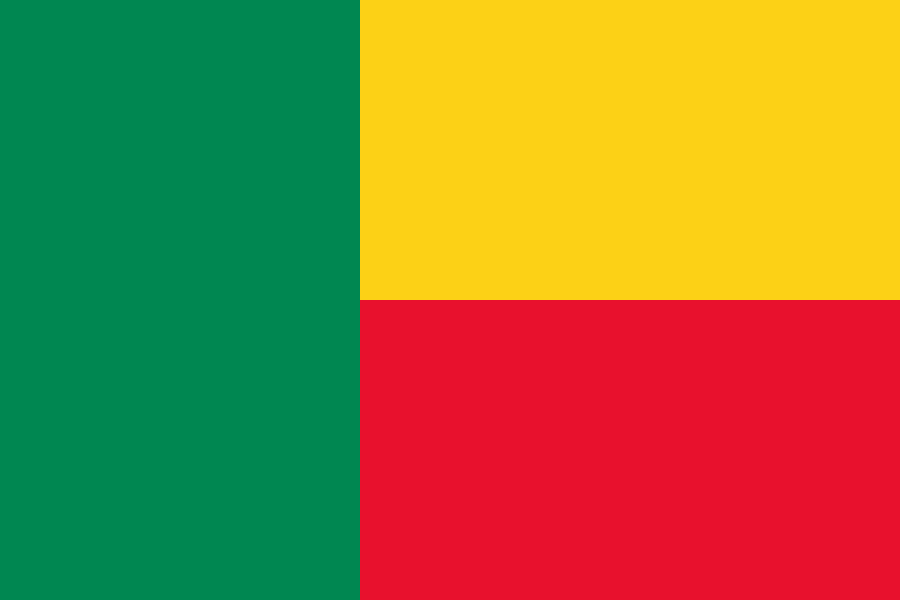
Beninese leader who took power in the 1972 coup. He declared Marxism-Leninism in 1974 and established a people’s republic the following year. Amid economic crisis he accepted the 1990 National Conference’s transition and transferred power after losing to Soglo in 1991.
Career timeline
1961Aide-de-camp to President Hubert Maga
1967Chairman of the Military Revolutionary Council
1972Seized power in a military coup
1974Declared Marxism-Leninism the state ideology
1975Founded the People's Republic of Benin and a one-party state
The reformist Politburo member who called 1956 a 'popular uprising' and dismantled his own party's orthodoxy
In West Berlin he said the East German 'anti-fascist protective rampart' was a 'disgrace' that had to come down.
A reformist member of the Hungarian Socialist Workers' Party (MSZMP) Politburo and the ideological patron of the reformers. On 28 January 1989 he told radio listeners that the 1956 Hungarian Revolution was a 'popular uprising,' demolishing the party's foundational lie; in May that year, in West Berlin, he called the Berlin Wall a 'disgrace.' Together with Otto von Habsburg he sponsored the Pan-European Picnic in August 1989, opening the first crack in the Iron Curtain, and later stood as the Socialist Party's presidential candidate but was defeated.
Career timeline
1950Joined the Hungarian Working People's Party
1957–1969Agitprop head and secretary, Bács-Kiskun County committee
1976–1980Minister of Culture
1980–1982Minister of Education
1982–1988Secretary-General, Patriotic People's Front
1988–1989MSZMP Politburo member and Minister of State
1989.01Declared the 1956 Revolution a 'popular uprising'
1990MSZP Deputy President and presidential candidate; defeated
The Soviet historian who laid the foundation of Leningrad Affair studies
His 1989 article 'The So-Called Leningrad Affair' in Voprosy istorii KPSS framed the purge as a factional struggle between the Zhdanov group and the Malenkov-Beria group. For over three decades, this framing remained the starting point of the debate.
A Soviet historian. After graduating with honors from Leningrad State University's History Faculty and working as a teacher and party functionary in Torzhok, he spent 25 years at the Leningrad Institute of Party History from 1966, researching the siege, postwar reconstruction, and the political biographies of party leaders. His 1989 article in Voprosy istorii KPSS, 'The So-Called Leningrad Affair,' was the first to frame the case as a factional struggle between the Zhdanov group and the Malenkov-Beria group with Stalin's sanction, launching the entire post-Soviet historiography. The book of the same name he co-compiled with Viktor Demidov in 1990 sold 200,000 copies and remains the most influential documentary study. He taught as professor at St. Petersburg University from 1991 until his death, training a generation of historians.
Career timeline
1933Born in Torzhok, Kalinin Oblast, to a working-class family
1952–1957Graduated with honors from Leningrad State University, History Faculty
1957–1962History teacher in Rzhev; then instructor and head of the propaganda department, Torzhok City Committee, CPSU
1965Candidate dissertation on CCC-RKI activities in Leningrad during the first Five-Year Plan
1966–1991Senior researcher, Leningrad Institute of Party History (later Institute of Historical-Political Research)
1987–1989First articles on Leningrad Affair in Dialog; landmark article in Voprosy istorii KPSS; doctoral dissertation; KGB USSR Prize
1990Co-compiled Leningradskoe delo with V. I. Demidov; 200,000-copy print run
1991–2016Professor of Modern Russian History, St. Petersburg University; over 150 publications
An ecologist who tracked Chernobyl’s long-term human costs
His Chernobyl study drew on more than 6,000 sources to estimate long-term harm, challenging accounts centered on the official death toll.
Alexei Yablokov was a Soviet and Russian biologist and environmental policy advocate whose work ranged from zoology and population biology to ecology. He became a prominent public voice on the long-term health and environmental consequences of Chernobyl, and the high mortality estimate in his co-authored study marked one end of the dispute over the disaster’s human toll. His career joined academic research to environmental activism, parliamentary work, and service as a presidential adviser, helping make ecological risk a matter of public policy.
Career timeline
1956Graduated from the biology and soil science faculty of Moscow State University
1966Earned a doctorate in biology and became a senior researcher at the Severtsov Institute of Animal Morphology
1969–1989Senior researcher and laboratory head at the Koltsov Institute of Developmental Biology
1984Elected a corresponding member of the USSR Academy of Sciences
1988–1991Founder and co-chair of Greenpeace USSR
1989–1991People’s Deputy of the USSR and deputy chair of the Supreme Soviet ecology committee
1992–1997Russian presidential adviser on ecology and health, and chair of the interagency commission on environmental security
2007–2009Co-editor and co-author of Chernobyl: Consequences of the Catastrophe for People and the Environment
An intelligence officer whose restraint mattered at the nuclear brink
Seeing unusual Soviet nuclear readiness, he advised against raising NATO's alert level.
Leonard H. Perroots was a U.S. Air Force general and military intelligence specialist whose career intersected with the management of nuclear danger late in the Cold War. As assistant chief of staff for intelligence, U.S. Air Forces in Europe, during Able Archer 83 in 1983, he observed unusual Soviet nuclear readiness but advised against raising NATO alert levels, avoiding a potentially dangerous escalation. He later directed the Defense Intelligence Agency and left a significant retrospective account of the war scare, illustrating how intelligence judgment can shape decisions at the nuclear brink.
Career timeline
1955Commissioned in the U.S. Air Force
1970년대Air Force command and intelligence assignments
1982–1984Assistant Chief of Staff for Intelligence, U.S. Air Forces in Europe
1983Advised against escalating NATO alert levels during Able Archer 83
1984–1985Deputy Chief of Staff for Intelligence, U.S. Air Force
1985–1988Director of the Defense Intelligence Agency
A poet in Russia is more than a poet: the stadium-filling voice of the Thaw and its contradictions
'No monument stands over Babi Yar' — the opening line of his 1961 poem cracked open the state narrative that buried the Holocaust inside a generic story of Soviet suffering.
A defining poet of the Thaw. 'Babi Yar' (1961) broke the Soviet silence on the Holocaust. His stadium readings drew mass popularity, and his line 'A poet in Russia is more than a poet' declared literature's public mission.
Career timeline
1949First poem published in Sovetsky Sport
1952First collection The Prospects of the Future; joins Union of Soviet Writers as youngest member
1952–1957Studies at Gorky Literary Institute; expelled for defending Dudintsev's novel
1961Publishes 'Babi Yar', breaking Soviet silence on the Holocaust
1962Publishes 'The Heirs of Stalin' in Pravda
1962Shostakovich's Symphony No. 13 'Babi Yar' premieres with Yevtushenko's text
1968Publishes 'Tanks Go Through Prague'; banned from performing and travelling abroad
1986–1991Secretary of the Board, Union of Soviet Writers
1989–1991People's Deputy of the USSR from Kharkiv
1991–2017Teaches Russian and European poetry and cinema at the University of Tulsa
The last Komsomol heavyweight who ran the Soviet publishing empire
The day after Yegorychev openly criticised Brezhnev's defence policy at the 1967 CC plenum, Pastukhov called him: "I'm proud of you." Yegorychev replied: "Borya, why did you do that? You've ruined your life."
A Soviet functionary who led the Komsomol as First Secretary from 1977 to 1982, heading the 40-million-strong youth organisation at the height of the Brezhnev era. He oversaw massive youth mobilisation (the BAM railway, the first ski expedition to the North Pole) and became a full member of the CPSU Central Committee in 1978. As chairman of Goskomizdat (1982–1986) he ran the Soviet publishing and censorship apparatus, then served as ambassador to Denmark and to Afghanistan during the withdrawal and its aftermath. After the Soviet collapse he continued as Russian First Deputy Foreign Minister, CIS Affairs Minister, and State Duma deputy, embodying the late Soviet elite's continuity into post-Soviet governance.
Career timeline
1958Graduated Bauman Moscow Higher Technical School (mechanical engineering); 2nd Secretary, Bauman District Komsomol
1959–1961First Secretary, Bauman District Komsomol, Moscow
1961–1962Second Secretary, Moscow City Komsomol Committee
1962–1964First Secretary, Moscow City Komsomol Committee
1964–1977Secretary, Komsomol Central Committee
1977–1982First Secretary, Komsomol Central Committee
1982–1986Chairman, USSR State Committee for Publishing, Printing and Book Trade (Goskomizdat)
1986–1989Ambassador of the USSR to Denmark
1989–1992Ambassador of the USSR/Russia to Afghanistan
1992–1996Deputy Minister of Foreign Affairs, Russian Federation
1996–1998First Deputy Minister of Foreign Affairs, Russian Federation
1998–1999Minister for CIS Affairs, Russian Federation
A Belarusian party organizer who sought continuity as the Union dissolved
After the 1991 coup failed, he called the State Committee's formation “a crime against the party.”
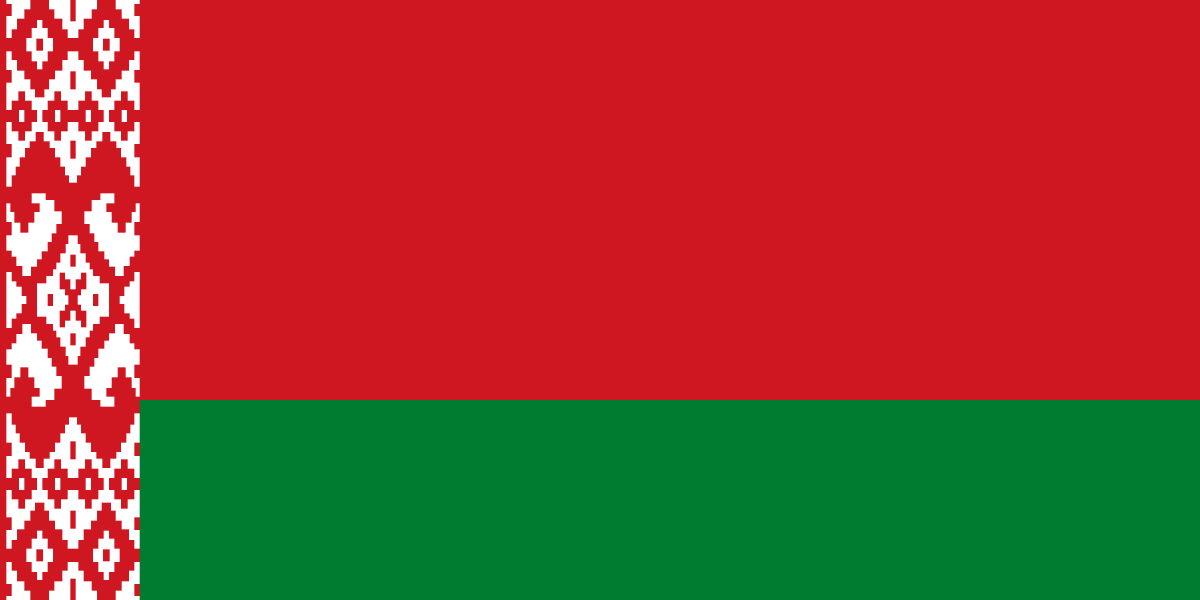
Anatoly Malofeyev was a Soviet and Belarusian politician who rose from industrial work through party administration to republican leadership. In the final years of perestroika, he led Belarus's Communist Party with a record of regional administration and a union-preserving party line, and supported the State Committee on the State of Emergency in 1991. After the coup's defeat, he sought to preserve the party organization and later worked in the parliamentary politics of independent Belarus.
Career timeline
1933Born in Gomel
1949–1952Mechanic at railway-car repair plants in Gomel and Minsk
1952–1956Served in the Soviet Navy
1962–1975Worked in Gomel and Mozyr party organizations, becoming Mozyr city first secretary and a Gomel regional party secretary
1978–1985Chairman of the Gomel regional executive committee and first secretary of the Communist Party of Belarus regional committee
1985–1990First secretary of the Communist Party of Belarus Minsk regional committee
1990–1991First secretary of the Communist Party of Belarus Central Committee and member of the CPSU Politburo
1996–2000First chairman of the House of Representatives of Belarus's National Assembly
Under the Mengistu government he worked on asylum and amnesty cases for emigres, helping dozens avoid torture and death; in 2018 he received the Knight Grand Cross of the Order of the Star of Honour.
American political scientist and Ethiopia specialist who was professor and then professor emeritus at Oklahoma State University. Sources disagree on when he joined the Peace Corps in Addis Ababa: the obituary and the Ethiopian Crown Council say 1963, publisher and library biographies say 1964. He later directed the Educational Resources Center in New Delhi, was dean of continuing education at Austin College and a senior visiting fellow at the University of Tulsa, and taught at OSU from 1988 to 2008. Under the Mengistu government he worked on asylum and amnesty cases for Ethiopian emigres, helping dozens avoid torture and death, and in 2018 he received the Knight Grand Cross of the Order of the Star of Honour. His books include Ethiopia: A Post-Cold War African State (1999) and The Lion of Judah in the New World (2011).
Career timeline
1933Born in Sherman, Texas
1963 또는 1964Joined the U.S. Peace Corps and served as Associate Director in Addis Ababa (dates disputed between sources)
1974 이후Advocacy on Ethiopian emigre asylum and amnesty cases
1988–2008Professor of Political Science, Oklahoma State University
1999Published Ethiopia: A Post-Cold War African State
2011Published The Lion of Judah in the New World
2018Awarded Knight Grand Cross of the Order of the Star of Honour
The most qualified female cosmonaut candidate, grounded by politics
She told Tereshkova, 'The Komsomol and the party have irreparably spoiled you,' Kamanin recorded in his diary.
A Moscow Aviation Institute graduate and the only pilot among the five women selected for the cosmonaut corps in 1962, she scored highest on her final exams, and medical director Yazdovsky ranked her first for flight. But Kamanin recorded her independent manner as 'arrogance,' her smoking and drinking as 'moral instability,' and Korolev told her a working-class woman was needed for the flight, so Tereshkova was chosen. She later trained for an all-female Voskhod mission with a spacewalk, but the program was cancelled, and she never flew.
Career timeline
1951–57Graduated Moscow girls' school No. 156 with gold medal; Moscow Aviation Institute (liquid rocket engines)
1957–62Assigned to OKB-1, then researcher at Academy of Sciences Applied Mathematics Division under Keldysh
1962.4Selected for women's cosmonaut group (5); enlisted in Soviet Air Force
1962–63Vostok-6 training; highest exam score; assigned second backup to Tereshkova
1965–66Trained for Voskhod-4 female spacewalk mission (cancelled)
1969–88Senior researcher at Gagarin Training Center; taught orbital mechanics to cosmonauts
1988–2023Senior researcher at Institute of History of Natural Science and Technology, RAS; head of cosmonautics history group
A politician who linked internationalism with regional rule
In February 1978, during an Asia-Africa people's solidarity session in Nicosia, Black September militants took him hostage; within forty minutes everyone except the Egyptian and Palestinian delegates was released.
Alexander Dzasokhov was a Soviet party and diplomatic politician whose career grew out of youth organizations and solidarity work with Asia and Africa. After serving as ambassador to Syria and leading the North Ossetian party organization, he reached a position where international politics and the nationality question converged. At the 28th CPSU Congress he was elected to the Politburo and Central Committee Secretariat, making him part of the last Soviet leadership as reform and the Union’s dissolution intersected. He later served in the Russian State Duma and as president of the Republic of North Ossetia–Alania, where he dealt with federal relations and interethnic tensions.
Career timeline
1957First Secretary, Ordzhonikidze City Komsomol Committee
1967–1986First Secretary, then First Deputy Chair, Soviet Committee of Solidarity of Asian and African Countries
1986–1988Soviet Ambassador to Syria
1988–1990First Secretary, North Ossetian Regional Committee of the CPSU
1989–1991People’s Deputy of the USSR; Chair of the Supreme Soviet Committee on International Affairs
1990–1991Member of the CPSU Politburo and Central Committee Secretariat
1993–1998Deputy of the Russian State Duma
1998–2005President of the Republic of North Ossetia–Alania
Gagarin's second backup, the cosmonaut ranked third for the first flight who never reached orbit
On 18 February 1966, the note he left his wife before leaving home: "Zinok! You were always the best. You'd have to search to find a woman like you. Forgive me."
In January 1961 the State Commission ranked the first-flight candidates: Gagarin, Titov, Nelyubov. He was the second backup for Vostok 1 and later trained as backup for the Vostok 3/4 dual flight, but in March 1963 a clash with a military patrol at Chkalovskaya station (drunk, and refusing to apologize) cost him his place in the cosmonaut corps. Exiled to a fighter unit in the Far East, he fell into alcoholism and depression; on 18 February 1966 he stepped in front of a train, aged thirty-one. His existence was kept secret until glasnost, his image airbrushed from the 'Sochi Six' photograph and his name erased from official histories.
Career timeline
1957Graduated Yeysk Naval Aviation School; naval aviation pilot
1960.03Selected for first cosmonaut group (Vanguard Six)
A Soviet republican leader who asserted institutional authority in crisis
“A state of emergency was declared and troops were sent in without the republic’s consent.”
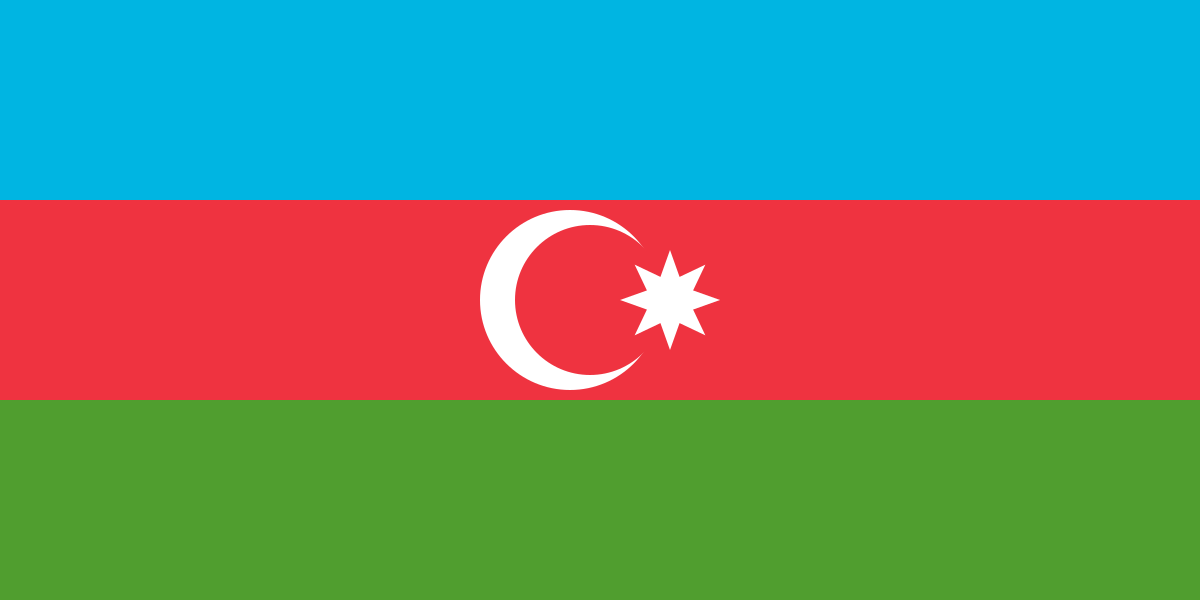
Elmira Kafarova was an Azerbaijani Soviet politician and diplomat who moved through education and foreign-affairs administration before leading the republic’s Supreme Soviet. In January 1990, she publicly protested the declaration of emergency in Baku and the entry of Soviet troops, stating that the decision had been taken while she was in Moscow and without her knowledge. Her institutional dissent, unusual within the Soviet republican leadership, illuminates how the nationalities crisis became a collision among republican institutions, a mass movement, and Union power.
Career timeline
1958Graduated from Azerbaijan State University; pursued philological research
1966–1970First Secretary of the Komsomol Central Committee of the Azerbaijan SSR
1971Ideology secretary of the Baku City Party Committee
1980–1983Minister of Education of the Azerbaijan SSR
1983–1987Minister of Foreign Affairs of the Azerbaijan SSR
1987–1989Deputy Chair of the Council of Ministers of the Azerbaijan SSR
1989–1990Chair of the Presidium of the Supreme Soviet of the Azerbaijan SSR
1990–1992Chair of the Supreme Soviet of Azerbaijan
A dissident socialist who linked workers’ self-management to civic solidarity
When the strikes began in 1980, he declared that the stranglehold on workers’ organisation and free information had finally been broken.
Jacek Kuroń was a Polish historian and organiser who tried to separate socialist ideals from the rule of party bureaucracy. His Open Letter to the Party, written with Karol Modzelewski, argued that the bureaucracy dominated workers and proposed workers’ councils and democratic pluralism. A co-founder of the Workers’ Defence Committee in 1976, he connected intellectuals with workers and became a leading adviser to Solidarity in 1980, advocating a programme of self-management. Interned on the first night of martial law in December 1981, he continued to support the underground union and later served as labour and social policy minister during Poland’s post-1989 transition.
Career timeline
1955–1961Co-organiser of the socialist scout movement and commander of the Walterowcy troop
1965–1967Co-author of the Open Letter to the Party; political prisoner
1968–1971Organiser of the March student protests; political prisoner
1976–1977Co-founder of the Workers’ Defence Committee (KOR)
1980–1981Adviser to Solidarity’s National Commission
1981–1984Martial-law internee and defendant in the KOR trial
An Austrian Europeanist who helped open the Iron Curtain
On 27 June 1989, Mock and Gyula Horn cut the fence near Sopron, making the border opening visible to the world.
Alois Mock was an Austrian People's Party politician who made European integration a central aim of Austrian foreign policy. As foreign minister, he pursued Hungary's border opening and Austria's entry into the European Communities, helping shape Central Europe's reordering at the end of the Cold War. On 27 June 1989, he and Gyula Horn symbolically cut the border fence, creating an international image of the openings that enabled East German escapes and preceded the collapse of the Eastern bloc.
Career timeline
1957Doctor of law, University of Vienna
1961–1966EEC and EFTA adviser in the Federal Chancellery; Austrian OECD mission in Paris
1966–1969Cabinet secretary to Chancellor Josef Klaus
1969–1970Federal minister for education, science, research, arts, culture and sport
1979–1989Federal chairman of the Austrian People's Party
The communist propagandist who became Ukraine's first president and signed the Soviet Union out of existence
It was a long road we walked to Belavezha. It was not by accident; it was our deliberate choice because we had no other option.
A party man who spent three decades climbing the propaganda and ideology apparatus of the Ukrainian Communist Party, Kravchuk pivoted to 'national communism' after becoming chairman of the Supreme Soviet in 1990. At the Novo-Ogaryovo negotiations he insisted on a confederation, not a federation, and delayed the signing of the new Union Treaty until September; after the August 1991 coup collapsed, he presided over Ukraine's Declaration of Independence on 24 August. Elected Ukraine's first president on 1 December 1991, he signed the Belavezha Accords with Yeltsin and Shushkevich a week later, formally ending the Soviet Union. His presidency saw the surrender of Ukraine's nuclear arsenal and a deep economic slump, but he stepped down after a peaceful electoral defeat and remained active in politics as a deputy.
Career timeline
1958–70From political-economy teacher to head of agitation and propaganda, Chernivtsi region
1970–80Rose through CC CPU agitation and propaganda department
1980–88Head of CC CPU agitation and propaganda department
1988–89Head of CC CPU ideology department
1989–90.6CC CPU secretary, Politburo member, second secretary
1990.7–1991.8Chairman of Supreme Soviet of Ukraine; presided over independence declaration
1991.12–1994.7First President of Ukraine; signed Belavezha Accords; lost to Kuchma
1994–2006People's Deputy, parliamentary leader of SDPU(o)
The revisionist historian who overturned the Cold War coup thesis with archival evidence
Rather, I would emphasize the party's internally relatively democratic, tolerant and decentralised structure and method of operation, as well as its responsiveness to the prevailing mass mood.
A leading American historian of the revisionist school on the Russian Revolution. One of the first Western researchers granted access to Soviet archives from the 1960s, his 1976 work The Bolsheviks Come to Power demonstrated empirically that the October Revolution was not a minority coup but was carried out with broad popular support for peace, land, and bread, directly challenging the Cold War coup thesis identified with Richard Pipes. His finding that the Bolshevik Party of 1917 was 'a relatively open, democratic, and decentralized organization' reshaped the paradigm of revolution studies, and he was respected for accepting conclusions contrary to his own political convictions on the strength of the archival record.
Career timeline
1968–1999Professor of History, Indiana University Bloomington
1975–1984Director, Russian and East European Institute, Indiana University
1986–1993Dean for International Programs, Indiana University
1976The Bolsheviks Come to Power published, a turning point in Western revolution studies
2007The Bolsheviks in Power published, reconstructing Petrograd's first year of Soviet rule from archival records
2013–2026Affiliated Research Scholar, St. Petersburg Institute of History, Russian Academy of Sciences
2026The Bolsheviks Survive published, completing his tetralogy with a study of Petrograd 1919
At the December 1978 Kratie congress he proclaimed the overthrow of the Pol Pot regime and an independence moving toward socialism, and was elected president of the National Salvation Front.
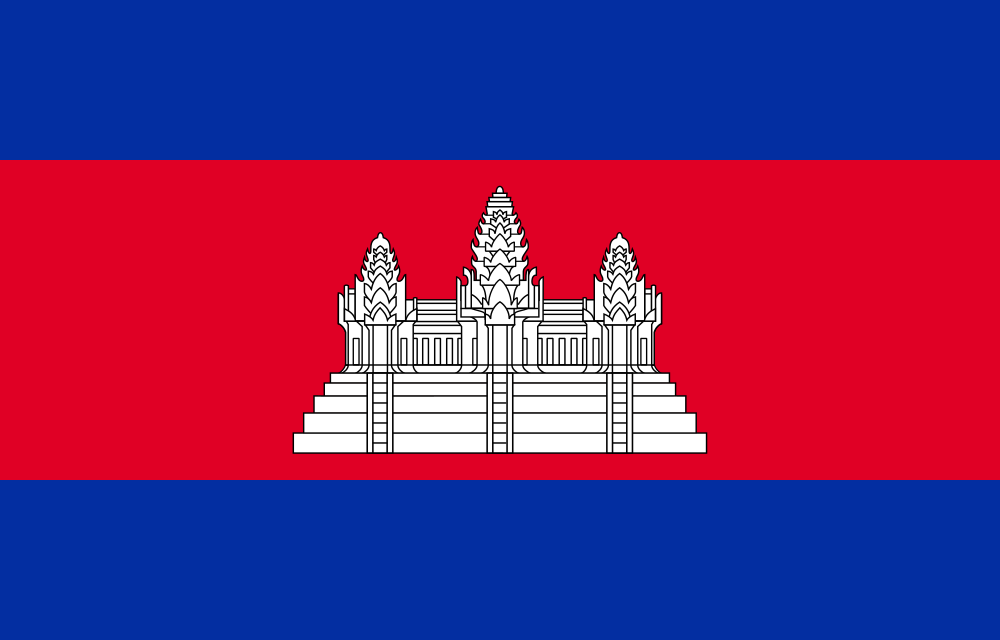
A Cambodian leader who broke with the Khmer Rouge and cooperated with Vietnam. He led the People’s Republic of Kampuchea after the 1979 regime change. Reconstruction combined state, cooperative and household activity while war and international disputes over representation continued.
Career timeline
1979Chairman of the People's Revolutionary Council
1981Chairman of the Council of State and General Secretary of the People's Revolutionary Party
1991Stepped down as party general secretary
1992Stepped down as chairman of the Council of State
For Stalin, the 'creation of the idea of the perpetual enemy' was indispensable.
Martin McCauley is an Irish-born historian of Soviet and East European politics. A former senior lecturer at UCL's School of Slavonic and East European Studies, he wrote widely on Stalinism, the Khrushchev era, the Cold War, and the rise and fall of the Soviet Union. He interpreted the 20th Party Congress speech both as an effort to restore a functioning Party, freeing officials from fear of repression, and as a move in Khrushchev's struggle to weaken rivals.
Career timeline
1953–1956Studied surveying at the University of Westminster
1961Studied French civilisation at the Sorbonne in Paris
1962–1968Studied at the University of London and earned a PhD
1968–1978Senior lecturer at the University of London's School of Slavonic and East European Studies
1975Edited and published The Russian Revolution and the Soviet State
1976Published Khrushchev and the Development of Soviet Agriculture
1995Published The Khrushchev Era: 1953–1964
2007Published The Rise and Fall of the Soviet Union
The jurist who draughted Benin’s 1990 constitution
On 9 August 1990 the constitutional commission he chaired adopted the draft constitution; it was approved by referendum on 2 December 1990 and promulgated on 11 December 1990.
A Beninese jurist and legal scholar born in 1934 at Zinvié, Dahomey. He chaired the National Conference’s constitutional affairs commission in February 1990 and prepared the draft of the constitution of 11 December 1990. He presided over the constituent assembly in 1990–1991, worked at UNESCO, wrote on the political and social history of Dahomey, and served on UN human rights bodies.
Career timeline
1965–1966Adviser to the UNESCO Director-General
1967–1992UNESCO official
1975–Professor of law at the Sorbonne
1989–1993Deputy Director-General of UNESCO
1990Chair of the National Conference’s Commission on Laws and Constitutional Affairs
1990–1991President of the constituent assembly
1994–2002UN Special Rapporteur on contemporary forms of racism
In the 1991 runoff he won 67.7% against Kérékou, becoming the first opposition candidate in post-colonial Francophone Africa to win an election.
A Beninese politician and former World Bank official. He became transitional prime minister after the 1990 National Conference and defeated Kérékou in the 1991 presidential election. He led the transition from the socialist regime, rather than founding it.
The last minister who tried to preserve the Soviet machine-tool industry through perestroika
Asked in 2012 about the state of the industry, Panichev answered: 'Many development programs have already been adopted. Over thirty government documents on machine-tool building alone. Nothing has budged.'
Nikolai Panichev was the last Minister of Machine Tool and Instrument Building Industry of the USSR (1986–1991), a production administrator who rose from lathe operator to director at the Leningrad Ilyich plant over twenty-five years before joining the ministry. As minister he sought to keep Soviet machine-tool manufacturing competitive by introducing CNC machines, flexible manufacturing modules, and robotic complexes, but the sector was caught between the old command system and the half-built market reforms. After the Soviet collapse he founded the Russian machine-tool association Stankoinstrument and chaired the public council of former USSR and RSFSR ministers. His 2004 memoir Razlom (Fracture) offers a first-hand account of late-Soviet industrial achievement and the failure of reform.
Career timeline
1953–1955Served in the Soviet Army
1955–1956Chairman, Dribin District DOSAAF Committee
The general who sent men onto the Chernobyl roof when the robots died
'How is this possible?' I still cannot stop asking myself. 'Did we come from the Stone Age, to collect sheets of lead and cut makeshift protection for vital organs?'
A Soviet civil defence general and doctor of technical sciences. Four months after the Chernobyl explosion, when every remote-controlled robot had failed, the government commission handed him the most dangerous decontamination zone. He ordered lead sheeting stripped from the walls of government offices and improvised into protective gear, then ran 3,828 soldiers through the roofs of reactor 3 in 40–90-second shifts; they cleared 200 tonnes of highly radioactive debris by hand. He developed radiation sickness, wrote two books about the operation, and was nominated for Hero of the Soviet Union, only to be struck from the list after a conflict with the chief of staff of the Kiev Military District.
Career timeline
1953Graduated Kharkov Military Technical School
1963Graduated Kharkov Automobile and Highway Institute, mechanical engineering
1967–72Instructor at Moscow Military School of Civil Defence; adjuncture at Kuibyshev Engineering Academy
1972–86Senior specialist, Military Technical Committee; First Deputy Chief, All-Union Civil Defence Research Institute; Deputy Chief of Civil Defence Staff, RSFSR
1986Commander, removal of highly radioactive debris from Chernobyl danger zones
1988Commander, rescue operations after the Spitak earthquake
1990s–Published memoirs; member of Union of Russian Writers; Sholokhov Literary Prize
Youngest KGB general turned its highest-ranking defector-critic
"I like Americans very much. But after seven months here I am convinced more than ever that the Communist system is better than yours." — 24-year-old KGB officer Kalugin, posing as a Fulbright scholar to Newsweek, 1959.
A KGB Major General who, as the youngest general in the agency's history, headed foreign counterintelligence (Directorate K) and directed Cold War espionage against the United States. He broke with the service in the late 1980s, publicly denouncing its corruption, backed Yeltsin during the 1991 coup, and emigrated to the US, where his memoirs exposed the inner workings of the KGB.
Career timeline
1952–1956KGB Foreign Languages Institute, Leningrad
1956–1958Higher Intelligence School No. 101, KGB
1958–1959Operational trainee, Columbia University under Fulbright cover
1960–1964Operative, KGB New York residency (Radio Moscow cover)
1965–1970Deputy resident / acting chief, KGB Washington residency
1971–1973Deputy head, 2nd Service (later Directorate K), First Chief Directorate
1973–1980Head, Directorate K (foreign counterintelligence), First Chief Directorate
1980–1987First deputy chief, KGB Leningrad Directorate
1990Elected People's Deputy, Supreme Soviet of the USSR