The Haitian Revolution
How did the slaves of Saint-Domingue, France's richest colony, rise in 1791 and force their own emancipation ahead of any decree from Paris, and why did the revolution lead through the abolition of 1794 to the independent state of Haiti in 1804, and then to a history of forced labour and indemnity?
The slave rising on the northern plain of Saint-Domingue in August 1791 preceded every decree from Paris. Facing British and Spanish invasion, the civil commissioners Sonthonax and Polverel proclaimed the abolition of slavery in 1793, and the National Convention extended it to all the colonies on 4 February 1794. Toussaint Louverture drove out the British, united the island and made himself governor-general for life by the constitution of 1801, but was arrested by Napoleon's Leclerc expedition and died in prison. The attempt to restore slavery provoked the war of independence led by Dessalines; victorious at Vertières in November 1803, the rebels proclaimed the independence of Haiti on 1 January 1804.
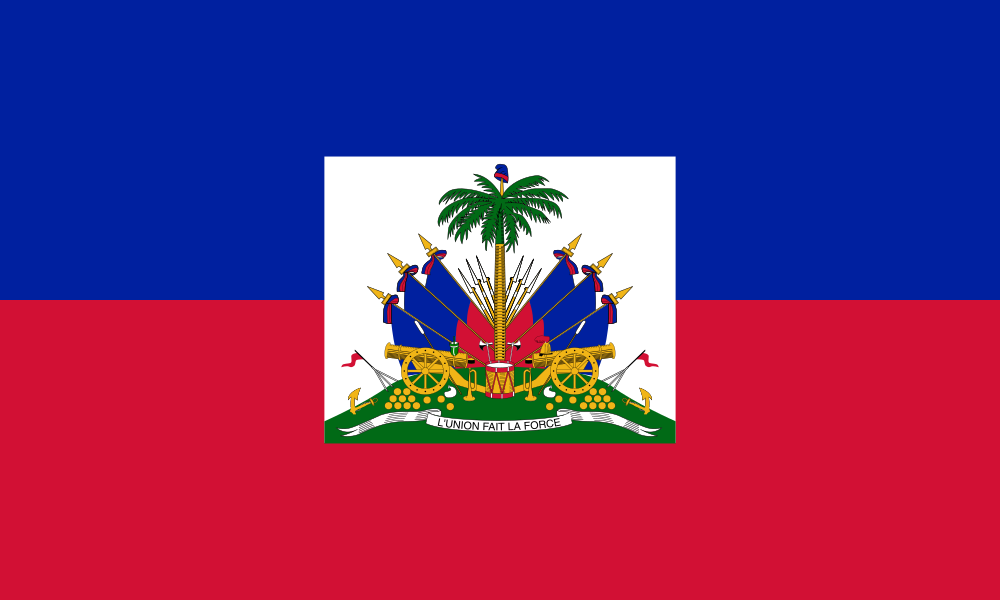
 The "Pearl of the Antilles": the slave society of Saint-Domingue
Saint-Domingue was the French colony on the western third of Hispaniola, whose French possession Spain formally recognised in the Treaty of Ryswick of 1697. Sugar and coffee plantations multiplied through the eighteenth century: in 1767 the colony exported 72 million pounds of raw sugar and 51 million pounds of refined sugar, and by the 1780s it produced about 40 percent of the sugar and 60 percent of the coffee consumed in Europe. Around 1789 it had some 8,000 plantations, and another source states that it produced 60 percent of the world's coffee and 40 percent of the sugar imported by France and Britain. An average of 600 ships a year carried its products to Bordeaux, and the livelihood of one million of France's roughly 25 million people in 1789 depended directly on imports from the island. Nicknamed the "Pearl of the Antilles", it was the most profitable of all European colonies in the eighteenth century. 1 2
This wealth rested on slave labour. Between 1681 and 1791 an estimated 790,000 to 860,000 enslaved people were brought in, and in 1783–1791 the colony absorbed a third of the entire Atlantic slave trade. Annual imports rose from 10,000–15,000 in 1764–1771 to about 28,000 in 1786 and to more than 30,000 a year from 1787. Mortality was so high, with one estimate that at least half of the Africans died of yellow fever within a year of arrival, that the slave population fell by two to five percent a year, and planters calculated that buying new slaves was cheaper than keeping the old ones alive. The population around 1789 is put at 40,000–45,000 whites, 28,000–32,000 free people of colour and 406,000–465,000 slaves; the article on the revolution gives 452,000 slaves. Two thirds of the slaves were African-born, and the Kongolese, at about 40 percent, were the largest group among them. 1 2
Society was divided into three castes. The grands blancs, who held the administrative posts and the great estates, and the petits blancs, artisans, overseers and small traders, made up the white population; the free people of colour were wealthy enough to own a third of the plantation property and a quarter of the slaves by 1789, but from the 1760s discriminatory statutes barred them from public office and certain professions and from wearing European clothing or carrying arms. At the bottom, the enslaved outnumbered all the other groups together by about ten to one. Louis XIV's Code Noir of 1685 prescribed baptism and Sunday rest for slaves while ordering that runaways have their ears cut off and be executed on a third attempt, and planters openly broke its protective clauses. Bands of runaway slaves, the Maroons, raided plantations from the hills, and the Vodou priest Mackandal led a rebellion from 1751 until he was burned at the stake in 1758. "Haiti was hell, but Haiti was rich," wrote the French historian Paul Fregosi. 2 1 3
The revolution in Paris and the free people of colour's fight for rights (1789–1791)
The Declaration of the Rights of Man and of the Citizen published by the National Assembly on 26 August 1789 declared all men free and equal, but it was ambiguous as to whether that equality extended to women, slaves or the inhabitants of the colonies. White planters saw the Revolution as a chance to escape France's trade restrictions and rule the island as they pleased, while the enslaved, understanding that independence led by slave masters would mean harsher treatment, mostly sided with the royalists and the British. In Paris the Society of the Friends of the Blacks, founded by Brissot and Clavière in 1788, argued for abolition, but a measure to abolish slavery proposed at the start of the Revolution was dropped under noble opposition, and in 1790 the National Assembly affirmed its support for the continuation of slavery. Mirabeau remarked that the whites of Saint-Domingue "slept at the foot of Vesuvius". 2 4
The free people of colour, led by Julien Raimond, had been petitioning France for full civil equality with whites since the 1780s. Vincent Ogé, a wealthy coffee merchant of Cap-Français, went to Paris in 1788 and joined the revolutionary camp; when the absentee planters rejected his proposals to abolish the discriminatory laws in August 1789, he and Raimond demanded representation and voting rights for free people of colour from the National Constituent Assembly. Both men were slaveholders and supported the continued existence of slavery. In March 1790 the Assembly approved an ambiguously worded law that could be read as granting voting rights to free people of colour, and Ogé, after consulting Clarkson in London, returned secretly to the colony in October 1790. When the governor and the colonial assembly refused to implement the law, Ogé and Jean-Baptiste Chavannes gathered about 300 free men of colour outside Cap-Français. They repulsed a first force of 600 militia but were routed by a second attack of 1,500 men and fled to Spanish Santo Domingo, where they were captured at Hinche on 20 November and handed over to the French. On 6 February 1791 Ogé was broken on the wheel at Cap-Français and his head was displayed on a pike. 5 2
Ogé's execution moved opinion in Paris. In May 1791 the Constituent Assembly decided to grant citizenship to wealthy free people of colour, and when the white planters refused to comply, isolated fighting broke out between mulattoes and whites within two months. The conflict up to this point was between factions of whites, and between whites and free people of colour, while the enslaved watched from the sidelines. Ogé had not fought against slavery, but his treatment was later cited by the slave rebels as one of the reasons they rose in August 1791 and refused treaties with the colonists. 2 5
August 1791: the rising of the northern plain
On the night of 14 August 1791 some 200 representatives of the plantations of the northern plain met at a plantation near Cap-Français, at Bois Caïman by Morne-Rouge. At this gathering, said to have been presided over by the Vodou priest Dutty Boukman and the priestess Cécile Fatiman, a black pig was sacrificed and an oath taken, and Boukman is said to have prayed: "Throw away the image of the God of the whites who thirsts for our tears. Listen to the liberty that speaks in all our hearts." No first-hand contemporary account exists: the ceremony was first recorded in 1814 by the white colonist Antoine Dalmas, Boukman's prayer comes from oral testimony collected by Hérard Dumesle in 1824, and critics such as Léon-François Hoffmann suggest that the ceremony may never have taken place at all. The same night, at Morne-Rouge, about 200 privileged slaves such as drivers and coachmen, who could move between the plantations, are said to have met separately and fixed the date of the rising; Toussaint Louverture's biography records that Jean-François, Biassou, Jeannot and Boukman gathered there to choose a leader and that Toussaint nominated Georges Biassou in his own place. 6 7 8
The rising began on the night of 21 August and the morning of Monday 22 August. Boukman gathered the slaves of the Dutilh, Héron and Noé estates and set fire to the Noé sugar works; the next night he moved north from plantation to plantation, and a force of around fifteen thousand marched on Cap-Français to lay siege to it. Within ten days the slaves controlled the whole Northern Province and the whites held only a few fortified camps. Within weeks the number of slaves who had joined the revolt in the north reached 100,000, and in the next two months they killed 4,000 whites and burned or destroyed 180 sugar plantations and hundreds of coffee and indigo plantations, including at least 900 coffee estates. In September 1791 the surviving whites organised militias and struck back, killing about 15,000 Blacks. In the south, from September, thirteen thousand rebels led by Romaine-la-Prophétesse occupied and burned Léogâne and Jacmel. Boukman was killed by French troops at Fond Bleu on 7 November 1791, and the colonial authorities displayed his head at Cap-Français with the inscription "The head of Boukman, leader of the rebels". 7 2
Though they demanded freedom from slavery, the rebels did not at this stage demand independence from France. Most of their leaders professed to be fighting for the king of France, who they believed had issued a decree freeing the slaves that the colonial governor had suppressed, and they wore white cockades and crosses of St Louis. In December 1791 Toussaint took part in negotiations offering the release of white prisoners and a return to work in exchange for a ban on the whip, an extra free day a week and the freedom of imprisoned leaders, but the colonial assembly refused. By 1792 the rebels controlled a third of Saint-Domingue. The order of events matters: the rising preceded every emancipation decree from Paris. The Legislative Assembly's decree of 4 April 1792 granting rights to free people of colour came seven months after the rising, Sonthonax's emancipation of the north two years after it, and the Convention's abolition of slavery two and a half years after it. 2 8
The civil commissioners and emancipation: from the rising to 4 February 1794
Alarmed by the success of the rebellion, the Legislative Assembly in Paris passed on 4 April 1792 a decree granting full civil and political rights to free people of colour in the colonies, and sent the civil commissioners Sonthonax, Polverel and Ailhaud with troops to enforce it (6,000 men according to one source, about 10,000 according to another). The three commissioners reached Cap-Français on 17 September 1792 and announced that they had not come to abolish slavery but to ensure that free men had equal rights whatever their colour. When France went to war with Britain and Spain in 1793 the situation on the island was transformed. Spain recruited the rebels from Santo Domingo in the east: Jean-François and Biassou formally allied with the Spanish in May 1793 and Toussaint probably in early June, after an offer of land, privileges and freedom for the soldiers and their families. To the commissioners' proclamation of 20 June, which offered freedom only to male slaves who would fight for them, Toussaint replied that "the blacks wanted to serve under a king and the Spanish king offered his protection." 2 9 8
On 20 June 1793 the new governor Galbaud led sailors and white residents in an attack on Cap-Français to seize the commissioners. Massively outnumbered, Sonthonax and Polverel declared that all Blacks who fought for them would be granted French citizenship; some of the rebel slaves, many free Blacks and the white troops who stayed loyal retook the city, most of which burned. To keep the colony from Britain, Spain and the French royalists they needed still wider support. On 29 August 1793 Sonthonax proclaimed the abolition of slavery in the Northern Province; the same day Toussaint issued his declaration of Camp Turel: "Brothers and friends, I am Toussaint Louverture. I want Liberty and Equality to reign in St. Domingue." On 31 October Polverel did the same in the western and southern provinces. Polverel required the freed to keep working on their plantations for a year, and Sonthonax's proclamation also imposed plantation labour on those who did not fight. Both commissioners were abolitionists, but they had received no authority from Paris to abolish slavery, and historians debate whether their motives lay in ideals of equality or in the need to hold on to power. 9 8 4 2
Sonthonax sent three deputies elected by the Northern Province, the white colonist Louis Dufay, the free Black officer Jean-Baptiste Belley and the free man of colour Jean-Baptiste Mills, to Paris to seek endorsement of emancipation. Belley, born on the island of Gorée in Senegal and sold at the age of two, had bought his own freedom and became the first Black deputy to sit in the Convention. On 4 February 1794 (16 Pluviôse Year II) Dufay argued that abolishing slavery was the only way to keep the colony French; Delacroix exclaimed that the Convention should not "dishonor itself by a long discussion", and the decree passed by acclamation: "The National Convention declares slavery abolished throughout all the colonies: consequently, it decrees that all men, without distinction of color, domiciliated in the colonies, are French citizens, and entitled to the enjoyment of all the rights secured by the Constitution." Danton declared, "today we proclaim it to the universe. The English are dead, today." The constitutions of 1793 and 1795 both included the abolition of slavery. The decree could not be applied in British-occupied Martinique, and the colonial authorities of Isle de France and Réunion refused to implement it. Toussaint came over to the French in May 1794. The date and motive are debated: one account has him raising the republican flag over Gonaïves on 4 May, another has him ambushing the Spanish as they left mass at San Raphael on 6 May, and a letter to General Laveaux confirms that he was already fighting officially for France by 18 May. 2 10 4 8 11
 British and Spanish intervention and the rule of Louverture (1793–1801)
The grands blancs, unhappy with Sonthonax, pleaded with the British authorities in Jamaica for help, and the Pitt ministry and the Secretary of State for War Henry Dundas planned an invasion, mindful of the colony's financial value, its use as a bargaining chip in peace negotiations and the risk that the slave rebellion would spread to the British West Indies. Lieutenant-governor Williamson of Jamaica signed an agreement with the colonists' representatives promising to restore the ancien régime, discrimination against free people of colour and the protection of slavery, which drew criticism from Wilberforce and Clarkson. On 20 September 1793 about 600 British soldiers landed at Jérémie, and on 22 September Môle-Saint-Nicolas, the main French naval base, surrendered to the Royal Navy without a fight; there were only 3,500 French soldiers on the island. Whyte's troops arrived on 19 May 1794 and took Port-au-Prince in June, but of Grey's 7,000 men about 5,000 died of yellow fever and the Royal Navy reported "forty-six masters and eleven hundred men dead". Fortescue wrote that "it is probably beneath the mark to say that twelve thousand Englishmen were buried in the West Indies in 1794". In the south Rigaud checked the British, retook Léogâne and stormed Tiburon on Christmas Day 1794. 2
Once Toussaint had come over to the French, the Spanish threat soon ended. By the Treaty of Basel of July 1795 Spain left the war and ceded Santo Domingo to France; Jean-François and Biassou fought Toussaint until November and then left for Spain and Florida, and most of their men joined him. Pitt had decided on "the great push" of 1795, the largest expedition Britain had yet mounted, about 30,000 men in 200 ships, but the attack on Léogâne in 1796 was routed by the guns of the artilleryman Pétion, and the 10,000 who had arrived by June stayed in Port-au-Prince and the coastal enclaves while yellow fever ravaged them. Maitland, who landed at Port-au-Prince in April 1797, wrote that the British forces had been "annihilated" by yellow fever; on 10 May 1798 he agreed an armistice with Toussaint and on 18 May the British left Port-au-Prince. On 31 August the two signed a secret agreement under which Britain withdrew from all of Saint-Domingue in exchange for Toussaint's promise not to "meddle in the affairs of Jamaica", and at the end of 1798 the last British troops left Môle-Saint-Nicolas. One source puts the cost of the 1793–1798 expedition at four million pounds and 100,000 men dead, wounded or permanently disabled by yellow fever. 2 8 12
Allied with the French commander Laveaux, Toussaint drove out the mulatto commander Villatte, who had arrested Laveaux at Cap-Français in March 1796, was proclaimed lieutenant governor, and in 1797 was appointed the colony's top-ranking officer. Sonthonax, who returned in 1796, promoted him to general, but the two fell out over the return of the émigré white planters and in the summer of 1797 Toussaint arranged for Sonthonax's return to France. Hédouville, sent by the Directory in 1798, tried to divide him from André Rigaud, the free coloured general who ruled the south, and was driven out in October. In June 1799 Rigaud attacked Petit-Goâve and Grand-Goâve and the War of the South began. Toussaint's 45,000–50,000 troops outnumbered Rigaud's 15,000, and the United States frigate General Greene supported him with its guns. Jacmel, defended by Pétion, fell on 11 March 1800 and Rigaud fled to France in July. The scale of Dessalines' reprisals is disputed, between the 10,000 deaths suggested by the contemporary French general Lacroix and the few hundred claimed by C. L. R. James. In December 1800 Toussaint invaded Spanish Santo Domingo, and by January 1801 he held the whole island and had freed its slaves. 8 13 2
In 1801 Toussaint had a central assembly composed chiefly of white planters draft a constitution, which he promulgated at Cap-Français in early July (sources give 3, 7 or 12 July). Article 1 described Saint-Domingue as a single colony "which forms part of the French Empire, but is subject to particular laws", and Article 3 declared: "There cannot exist slaves in this territory; servitude is forever abolished. All men are born, live and die free and French." Yet the constitution made Toussaint governor-general for life with the power to name his successor, established by Article 6 the Catholic faith as the only publicly professed religion, banned divorce, and confirmed forced labour binding cultivators to the plantations and the importation of workers through the slave trade. The historian Jeremy Popkin described the society it built as one with "a peasantry subjected to repressive control, exercised by a military caste that was monopolising landed property". When a rising against forced labour broke out in the north in October 1801, Toussaint had his nephew General Moïse, who had supported it, shot on 21 November. Napoleon took the constitution as an affront to French imperial authority. 8 14 15
The Leclerc expedition and the war of independence (1802–1804)
In 1801 Napoleon appointed his brother-in-law Charles Leclerc to command an expedition. At first he intended only to reassert Paris's authority while confirming the ranks and lands of Toussaint's officers and guaranteeing freedom to the former slaves, but by October he secretly directed Leclerc to disarm Toussaint's government and deport the Black officers to France, and planned to restore slavery once Toussaint had been detained. On 14 December 1801 Villaret de Joyeuse's fleet of 35 ships of the line and 21 frigates left Brest with 7,000–8,000 troops, and with the reinforcements that followed 31,131 troops were landed in all (Leclerc's biography says 40,000 and Toussaint's 20,000). The free coloured officers Rigaud and Pétion, expelled by Toussaint, returned with it. When the fleet appeared off Cap-Français on 3 February 1802 Henri Christophe wrote to Leclerc, "you will only enter the city of Cap, after having watched it reduced to ashes", and carried out his orders to burn the town; the French landed on 5 February and within ten days held the ports and most of the towns. 15 16 8
Toussaint's plan was to burn the coastal towns and the plains, retreat into the mountains and wait for the rainy season and yellow fever to destroy the French. After being forced back at Ravine-à-Couleuvres after six hours of hand-to-hand fighting, Dessalines held the fort of Crête-à-Pierrot in the Artibonite valley under siege from 4 to 24 March 1802. Standing on a powder keg with a lit torch he declared, "if the French put their feet in here, I shall blow everything up", and his men replied, "We shall die for liberty!" The French lost about 2,000 dead, among them General Dugua, and Leclerc was wounded; when food and ammunition ran out Dessalines slipped through the siege lines on the night of 24 March. Even Rochambeau reported that "this miraculous retreat from our trap was an incredible feat of arms". But on 25 April Christophe went over to the French and Dessalines followed; on 6 May Toussaint acknowledged Leclerc's authority in return for an amnesty and withdrew to his plantation at Ennery. On 7 June General Brunet arrested him under cover of a meeting and shipped him to France with a hundred members of his circle. Boarding the ship, Toussaint said: "In overthrowing me you have cut down in Saint Domingue only the trunk of the tree of liberty; it will spring up again from the roots, for they are numerous and they are deep." He died in the Fort de Joux in the Jura on 7 April 1803. 2 17 18 8
With the rains of March came yellow fever. By the end of March 5,000 French soldiers were dead and another 5,000 in hospital; by mid-July the dead numbered about 10,000, and in September Leclerc wrote that he had only 8,000 fit men left. Meanwhile the Law of 20 May 1802 confirmed slavery in Martinique and the other colonies returned by the Peace of Amiens, and in Guadeloupe Richepanse re-established it. When the news from Guadeloupe reached Saint-Domingue the Black cultivators revolted in the summer of 1802, and from August the Black and mulatto troops deserted en masse. In October Leclerc proposed a war of annihilation to Napoleon: "We must destroy all the blacks of the mountains, men and women, and spare only children under 12 years of age. We must destroy half of those in the plains and must not leave a single colored person in the colony who has worn an epaulette." At Cap-Français he had 1,000 Black soldiers drowned by tying sacks of flour to their necks and pushing them from the ships. After a secret conference at Arcahaie in October Dessalines and Pétion joined the rebels, and in November Leclerc died of yellow fever on Tortuga (the date is given as 1 or 2 November). His successor Rochambeau imported man-hunting dogs from Cuba, had Blacks drowned in the bay of Cap-Français and devised "fumigational-sulphurous baths", gassing hundreds in the holds of ships. When Rochambeau hanged 500 Blacks at Le Cap, Dessalines killed 500 whites and set their heads on spikes. Rochambeau's atrocities united Blacks and free people of colour against the French. 2 15 16 11 19 20
When war between Britain and France resumed on 18 May 1803, the Royal Navy sent Duckworth's squadron to blockade Saint-Domingue, cutting the French off from reinforcements and supplies and beginning to arm the Haitians. The same day, at Arcahaie, Dessalines became general-in-chief of the Indigenous Army. On 8 October the French abandoned Port-au-Prince to concentrate at Le Cap, and on 18 November the last great battle was fought at Vertières, just south of the city. When François Capois's horse was shot he drew his sword and ran on shouting "Forward! Forward!"; Rochambeau had the drums beat a cease-fire and sent a staff officer to salute his bravery before the fighting resumed. Under cover of a storm Rochambeau withdrew, and the next day the terms of surrender were settled. The article on the battle gives 27,000 rebels against 2,000 French, with 1,200 rebels killed and 2,000 wounded against 130 French killed and 400 wounded. On the night of 30 November 8,000 French soldiers and hundreds of white civilians boarded British ships and left; the French wounded left behind were drowned by the rebels a few days later. On 3 December Noailles at Môle-Saint-Nicolas tried to escape to Cuba and was mortally wounded by a Royal Navy frigate. On 1 January 1804 at Gonaïves Dessalines proclaimed the independence of the country, renamed "Haiti" after its Taíno name; the declaration read by his secretary Boisrond-Tonnerre ended, "we must live independent or die." Of the roughly 31,000 French soldiers sent to Saint-Domingue, little more than 7,000 to 8,000 survived and over twenty generals died; France lost more troops on the island than it would later lose at Waterloo. 2 17 21 15 22
Independent Haiti: massacre, empire, division and indemnity
After the declaration Dessalines ordered the massacre of the remaining French from February until 22 April 1804. On 22 February he signed a decree that all whites in every town be put to death, with knives and bayonets rather than gunfire so that the victims would not be warned, and in February and March he toured the towns to see it carried out. In Port-au-Prince about 800 were killed after his arrival on 18 March and some 50 survived, and the same happened at Le Cap after 18 April. Estimates of the dead run from 3,000 to 5,000 (the revolution and Dessalines articles) or 3,000 to 7,000 (the massacre article). Exempted were the Polish soldiers who had deserted the French, whom Dessalines called "the White Negroes of Europe", German settlers unconnected with the slave trade, some doctors and priests, and women who agreed to marry non-white men. On 22 September 1804 the generals proclaimed Dessalines emperor and on 6 October he was crowned Jacques I at Le Cap; the constitution of 20 May 1805 declared all citizens "black" and forbade whites to own land. Dessalines enforced a regime of plantation labour that bound every citizen to be either a soldier or a labourer, which Trouillot called "agrarian militarism", and alienated both the newly freed and the old free population. On 17 October 1806 he was assassinated at Pont-Rouge north of Port-au-Prince in a conspiracy involving Pétion and Gérin, and a mob dismembered his body. 23 17 2
After the assassination the country split in two. In the north Henri Christophe was elected president of the State of Haiti on 17 February 1807 and on 26 March 1811 proclaimed a kingdom, reigning as Henry I. He built the Citadelle Laferrière and the Sans-Souci Palace, drew revenue from sugar grown under corvée labour, filled his treasury through trade with Britain and corresponded with Wilberforce and Clarkson, but on 8 October 1820, ill, unpopular and fearing a coup, he shot himself. In the south Alexandre Pétion was elected president of the Republic of Haiti in 1807 and made himself president for life in 1816; he seized the commercial plantations and redistributed the land to his supporters and the peasantry, earning the name Papa Bon-Cœur, while exports and state revenue fell sharply. He gave sanctuary, troops and supplies to the exiled Simón Bolívar in 1815 and died of yellow fever on 29 March 1818. His successor Jean-Pierre Boyer reunited the country after Christophe's death in 1820, and in February 1822 occupied Santo Domingo, ruling the whole island until the Dominican War of Independence of 1844. 24 20 2
France did not accept the loss of its colony. At the Congress of Vienna in 1814–1815 it inserted a secret clause reserving the right to recover Saint-Domingue "by whatever means possible, including that of arms", and in the United States Jefferson, fearing the spread of slave revolt, refused diplomatic relations and imposed an embargo. On 3 July 1825 the Baron de Mackau appeared off Port-au-Prince with fourteen warships and 528 guns and presented the ordinance of Charles X of 17 April: France recognised Haiti's independence on condition that it pay 150 million francs in five instalments to the former slave owners, a sum calculated on articles 44 and 48 of the Code Noir. Haiti had to borrow the first 30 million from French banks; the balance was reduced in 1838 (to 90 million according to one source, 60 million according to another) and paid off in 1883, but the loans taken to pay it were not cleared until 1947. In 2022 the New York Times estimated the indemnity actually paid at about 112 million francs. The United States recognised Haiti only in 1862, under Lincoln. 25 2 8
Assessment
Casualty estimates vary widely. Robert L. Scheina estimated 350,000 Haitian and 50,000 European military dead; the Encyclopedia of African American Politics gives nearly 200,000 Blacks, thousands of mulattoes and as many as 100,000 French and British soldiers; another passage of the revolution article puts Haitian dead at about 200,000 for 1791–1803 and French soldiers killed in action at 37,000. Most European deaths were from yellow fever (Geggus holds that at least three in five British troops sent in 1791–1797 died of disease), while most Haitian deaths were from violence. The size of the Leclerc expedition (20,000, 31,000 or 40,000), the date of the 1801 constitution, the day of Leclerc's death, the toll of the 1804 massacre and the indemnity as reduced in 1838 also differ between sources, and the text gives the ranges with their sources. The Bois Caïman ceremony was not recorded until 1814, and whether it took place at all is debated. 2 6 15
Michel-Rolph Trouillot wrote that the historiography of the Haitian Revolution had been "silenced" by that of the French Revolution. In The Black Jacobins (1938) the Trinidadian Marxist C. L. R. James placed the revolution in the context of the French Revolution and argued that Toussaint, born a slave, embodied the ideals of liberty and equality more purely than the French revolutionaries, ideals that "meant far more to them than to any Frenchman". "Had the monarchists been white, the bourgeoisie brown, and the masses of France black," he wrote, "the French Revolution would have gone down in history as a race war." Historians also differ on the revolution's impact: David Geggus concludes that it made a limited difference, since slavery flourished in the western hemisphere for decades more, whereas W. E. B. Du Bois held that without it the British parliament would not have accepted abolitionism as readily. Laurent Dubois argues that the War of the South "was not driven by differences in racial identity" but was "a conflict over territorial and political power"; Philippe Girard analyses the 1804 massacre as the outcome of a genocidal strategy openly considered by both sides, and some scholars call it a "subaltern genocide" of the oppressed against their oppressors. The role of women in the revolution has recently drawn attention. 2 26 13 23
The Haitian Revolution left three legacies for the socialist movement. First, the abolition of 4 February 1794 is sometimes counted as the first abolition of slavery in history, but it was not an act of Parisian goodwill: it ratified after the fact a rising that had begun in Saint-Domingue and the decisions of the commissioners on the spot, and Napoleon reversed it in 1802. Emancipation was a case of a rising from below pulling the revolution of the metropole along with it. Second, Haiti after emancipation was a state "free from slavery (though not from forced labour)". Toussaint's constitution of 1801, Dessalines' regime of plantation labour and Christophe's corvée all bound the former slaves to the estates to revive the export economy, while Pétion's land distribution created a subsistence peasantry but ruined state revenue; the problem of how to organise freed labour remained unsolved after the revolution ended. Third, as James set out to write a history in which "Africans or people of African descent instead of constantly being the object of other peoples' exploitation and ferocity would themselves be taking action on a grand scale", the revolution became a reference point for twentieth-century anti-colonial and Pan-African movements and for Marxist historiography. The American socialist magazine Jacobin uses a portrait of Toussaint Louverture as its logo. 4 2 26 8 24
Consequences
France brought home only 7,000–8,000 of the roughly 31,000 soldiers it sent, and Napoleon gave up his American empire and sold Louisiana to the United States. Haiti became the only state founded by a slave rebellion and the first independent nation of Latin America, but passed through the massacre of the French in 1804, Dessalines' empire and assassination, and the split between Christophe's kingdom and Pétion's republic, while the regime of forced plantation labour from Toussaint to Christophe left the organisation of freed labour unresolved. France recognised independence in 1825 in exchange for an indemnity of 150 million francs, a debt not cleared until 1947.
Timeline & Map
- 1685.03Code Noir promulgated
Louis XIV promulgated the ordinance defining slavery in the French islands of the Americas; it was registered before the council of Saint-Domingue in May 1687.
- 11790.10Ogé's rising
Back from Paris, Vincent Ogé and Chavannes gathered some 300 free men of colour near Cap-Français, were defeated and fled to Spanish territory.
- 21791.02.06Execution of Ogé
Ogé was broken on the wheel at Cap-Français and his head displayed on a pike.
- 1791.05Citizenship for free people of colour
The Constituent Assembly decided to grant citizenship to wealthy free people of colour; the white planters refused to comply.
- 31791.08.14Ceremony at Bois Caïman
Some 200 slave representatives met near Cap-Français to plan the rising; Boukman and Cécile Fatiman are said to have presided.
- 41791.08.21–22The slave rising of the North begins
Boukman burned the Noé sugar works and the rising began; within ten days the whole Northern Province was in rebel hands.
- 51791.11.07Boukman killed
Boukman was killed by French troops at Fond Bleu and his head displayed at Cap-Français.
- 1792.04.04Decree of 4 April 1792
The Legislative Assembly granted full civil and political rights to free people of colour in the colonies and sent civil commissioners.
- 61792.09.17Civil commissioners arrive
Sonthonax, Polverel and Ailhaud reached Cap-Français and declared that they had not come to abolish slavery.
- 71793.06.20Galbaud's attack and the burning of Cap-Français
Governor Galbaud attacked the commissioners, who promised citizenship to Blacks who fought for them; most of the city burned.
- 81793.08.29Sonthonax proclaims emancipation in the North
Sonthonax proclaimed the abolition of slavery in the Northern Province; the same day Toussaint issued his declaration of Camp Turel.
- 91793.09.20–22The British land
About 600 British troops landed at Jérémie and Môle-Saint-Nicolas surrendered to the Royal Navy.
- 101793.10.31Polverel frees the West and South
Polverel proclaimed the abolition of slavery in the western and southern provinces.
- 1794.02.04The Convention abolishes slavery
After the Saint-Domingue deputies Dufay, Belley and Mills spoke, the Convention abolished slavery in all the colonies by acclamation.
- 111794.05Toussaint joins the French
Toussaint left the Spanish for the French Republic; sources give 4, 6 or 18 May.
- 1795.07.22Treaty of Basel
Spain left the war and ceded Santo Domingo to France.
- 121798.05.10–08.31Maitland and the British withdrawal
Maitland agreed an armistice with Toussaint and left Port-au-Prince; by the secret agreement of 31 August Britain withdrew from all of Saint-Domingue.
- 131799.06–1800.07War of the South
In the civil war begun by Rigaud's attack, Toussaint took Jacmel (11 March 1800) and drove Rigaud to France.
- 141801.01Occupation of Santo Domingo
Toussaint occupied Spanish Santo Domingo, taking the whole island and freeing its slaves.
- 151801.07Constitution of 1801
Toussaint promulgated a constitution making him governor-general for life, abolishing slavery, establishing Catholicism and confirming forced plantation labour (dated 3, 7 or 12 July).
- 1801.12.14The expedition sails
Leclerc's expedition left Brest; some 31,000 troops would be landed in all.
- 161802.02.03–05Cap-Français burned, the French land
Christophe burned the city as ordered and the French landed.
- 171802.03.04–24Siege of Crête-à-Pierrot
Dessalines held the fort for twenty days and broke out; the French lost about 2,000 men.
- 181802.06.07Arrest of Toussaint
General Brunet arrested Toussaint under cover of a meeting and shipped him to France.
- 191802.10Dessalines and Pétion join the rebels
After news of the restoration of slavery in Guadeloupe, Dessalines and Pétion turned against the French at a secret conference at Arcahaie.
- 201802.11Death of Leclerc
Leclerc died of yellow fever on Tortuga and Rochambeau took command.
- 1803.04.07Toussaint dies in prison
Toussaint died in the Fort de Joux in the Jura.
- 211803.05.18War with Britain resumes; general-in-chief of the Indigenous Army
The Royal Navy blockaded Saint-Domingue; the same day at Arcahaie Dessalines became general-in-chief of the Indigenous Army.
- 221803.11.18Battle of Vertières
The army of Dessalines and Capois defeated Rochambeau south of Le Cap; the terms of surrender were settled the next day.
- 231803.11.30The French evacuate
8,000 French soldiers and hundreds of white civilians boarded British ships and left Le Cap.
- 241804.01.01Haitian Declaration of Independence
At Gonaïves Dessalines proclaimed the independence of Haiti.
- 251804.02–04.22Massacre of the French
On Dessalines' orders 3,000–7,000 of the remaining French were killed; Poles, Germans and some others were spared.
- 261804.10.06Coronation of Dessalines
Proclaimed emperor on 22 September, Dessalines was crowned Jacques I at Le Cap.
- 271806.10.17Assassination of Dessalines
Dessalines was assassinated at Pont-Rouge north of Port-au-Prince, and the country split between Christophe's north and Pétion's south.
- 281825.07.03French recognition and the indemnity
Backed by fourteen warships, France recognised independence on condition of an indemnity of 150 million francs.
Related people 17
Slave insurgents and Louverture's forces4
Leadership4
Joined the rising of 1791, served Spain and came over to France in 1794, drove out the British, defeated Rigaud and ruled the whole island under the constitution of 1801. Arrested in 1802, he died in the Fort de Joux in 1803.
General-in-chief of the Indigenous Army, Emperor Jacques IJean-Jacques Dessalines1758–1806Held Crête-à-Pierrot, rose again in October 1802 and defeated Rochambeau at Vertières. Proclaimed independence on 1 January 1804, ordered the massacre of the French, became emperor and was assassinated in 1806.
Commander in the North, later King Henry I of HaitiHenri Christophe1767–1820Burned Cap-Français before Leclerc's expedition in February 1802, submitted and rose again in October. President of the State of Haiti in 1807 and king in 1811.
Leader of the rising of August 1791Dutty Boukmanc. 1767–1791Said to have presided at Bois Caïman, he opened the rising by burning the Noé sugar works on 22 August and was killed on 7 November.
The French Republic and its civil commissioners3
Participants2
Founded the Society of the Friends of the Blacks with Clavière in 1788 and lobbied for the dispatch of Sonthonax and Polverel.
Convention deputy on 4 February 1794Georges Danton1759–1794On the day the abolition decree passed he declared, "today we proclaim it to the universe".
The French expedition (Leclerc, Rochambeau)4
Leadership2
Arrested Toussaint in 1802 and shipped him to France; after the desertion of the Black troops proposed a war of annihilation to Napoleon, and died of yellow fever in November.
First Consul who ordered the expeditionNapoleon Bonaparte1769–1821Answered Toussaint's constitution by sending the Leclerc expedition in 1801 with secret plans to restore slavery, and reinstated colonial slavery by the Law of 20 May 1802.
Participants2
Re-established slavery in Guadeloupe in 1802, news of which set off the new rising in Saint-Domingue. Died of yellow fever in September.
General of the expeditionJean Joseph Amable Humbert1767–1823Landed at Port-de-Paix in February 1802, climbed the Trois Rivières gorge and received Maurepas's surrender.
Free people of colour (Rigaud, Pétion)3
Participants3
Repulsed the British at Léogâne in 1796 and defended Jacmel in the War of the South. Returned with Leclerc, joined Dessalines in October 1802 and became president of the south in 1807.
Commander of the free coloured army of the SouthAndré Rigaud1761–1811Checked the British, retaking Léogâne and Tiburon, lost the War of the South to Toussaint in 1799–1800 and left for France. Returned with Leclerc in 1802 and was deported again.
Leader of the free coloured rising of 1790Vincent Ogéc. 1757–1791Demanded voting rights for free people of colour in Paris, rose near Cap-Français in October 1790 and was broken on the wheel in February 1791.
Outside the camps
Historians & interpreters2
In 1938 placed the revolution in the context of the French Revolution and portrayed Toussaint as the embodiment of its ideals.
Historian on the revolution's impactW. E. B. Du Bois1868–1963Held that without the Haitian Revolution the British parliament would not have accepted abolitionism as readily.
Related terms
Sources: reference 1reference 2reference 3reference 4reference 5reference 6reference 7reference 8reference 9reference 10reference 11reference 12reference 13reference 14reference 15reference 16reference 17reference 18reference 19reference 20reference 21reference 22reference 23reference 24reference 25reference 26
← Historical events