The Parcham leader installed by the Soviet invasion who presided over seven years of war but never won legitimacy
"The Soviet comrades love me boundlessly, and for the sake of my personal safety, they don't obey even my own orders": the puppet president's confession to a friend about his gilded imprisonment.
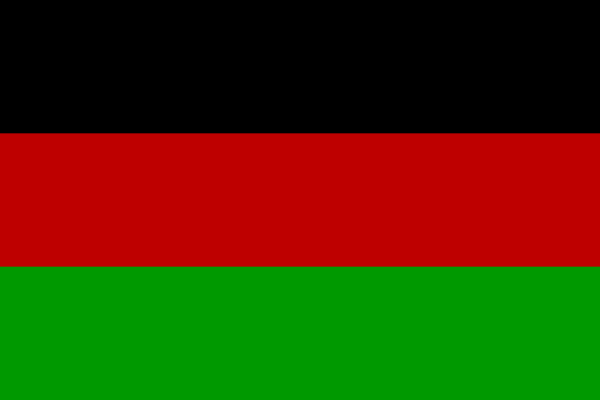
Babrak Karmal was a founding member of the People's Democratic Party of Afghanistan (PDPA) and leader of its Parcham (Banner) faction, serving as deputy prime minister after the 1978 Saur Revolution before being purged by the Khalq faction and exiled as ambassador to Czechoslovakia. Dismissed from that post and hunted by an Afghan hit squad, he spent months hiding in a remote forest lodge under the protection of the Czechoslovak secret police until the Soviet invasion of December 1979 installed him as president. During his rule he attempted to broaden the regime's base through amnesties, a new tricolor flag, and a constitutional framework, but was widely dismissed as a Soviet puppet as the war against the mujahideen bogged down. In 1986 Mikhail Gorbachev engineered his removal; he spent his final decade in Moscow exile, dying of liver cancer in 1996.
Activities and affiliations
Career Timeline
- 1965Co-founded the PDPA, led the Parcham faction
- 1965–1973Member of Parliament
- 1978.4–6Deputy Chairman, Revolutionary Council
- 1978.7–9Ambassador to Czechoslovakia
- 1979.12–1986.11Chairman, Revolutionary Council; PDPA General Secretary
- 1979.12–1981.6Chairman of the Council of Ministers
- 1986–1996Exile in Moscow
Related historical events
1986-1996: Semi-exile in Moscow, return to Kabul, and death
Removed from the general secretaryship and the Revolutionary Council chairmanship in November 1986 and sent to Moscow, Karmal was not immediately stripped of all influence. He still had support within the party and used that base to curb the powers of his successor, Najibullah, spreading rumours that he would be reappointed general secretary. Najibullah complained to the Soviet leadership that Karmal spent most of his spare time looking for his errors and 'speaking against the National Reconciliation programme'. On 13 November 1986 the Soviet Politburo decided that Najibullah should remove him, and a PDPA meeting that month relieved Karmal of the Revolutionary Council chairmanship. In Moscow he was given a state-owned apartment and a dacha; Haji Mohammad Tsamkani, who succeeded him as Revolutionary Council chairman, was not even a PDPA member.
Invited back by Najibullah, Karmal returned to Kabul on 20 June 1991. If Najibullah's aim in rebranding the PDPA as the Watan Party and appeasing the pro-Karmal Parchamites was to strengthen his own position, the plan failed: Karmal's apartment became a centre of opposition to his government. When Najibullah was toppled in 1992, Karmal briefly emerged as the most powerful politician in Kabul through his leadership of the Parcham faction, but his negotiations with the rebels collapsed quickly, and on 16 April 1992 insurgents led by Gulbuddin Hekmatyar took the capital. Karmal then based himself in Hairatan; accounts claim he spent his time there trying to found a new party or steering people toward Abdul Rashid Dostum's National Islamic Movement, though it is unknown how much control he actually exercised over Dostum. In June 1992 reports that he had died in a plane crash alongside Dostum proved false.
In early December 1996 Karmal died of liver cancer in Moscow's Central Clinical Hospital. Sources report the death date variously as 1 December and as 3 December. The Taliban framed his rule as one that 'committed all kinds of crimes during his illegitimate rule' and used his death for propaganda.