The people's democracies with their reformers and dissidents, decolonization and national liberation, Cold War statesmen and anti-communist regimes, 1956, 1968, 1989 and after.
Albanian communist economic planner who led domestic criticism of Yugoslav economic control
On 18–19 November 1947 Xoxe accused him of 'anti-Party, nationalist activity' at the Politburo; the next day he was found shot in his State Planning Commission office. Accounts range from accident to suicide or killing, so the manner of death is unresolved.
Born Athanas Spiru in Durrës to a wealthy Orthodox family, he studied on Corfu and in Turin, joined the newly founded Communist Party of Albania in 1941 and led its Youth section. A Politburo member from 1944, he became Minister of Economy on 22 March 1946 and in 1947 Minister of Industry and chairman of the State Planning Commission, the only trained economist in the party leadership. He signed the July 1946 economic agreement with Yugoslavia reluctantly, then opposed the economic union plan with its customs union and monetary integration, using the 1947 Belgrade talks and a Moscow visit to secure a basis for refusing Yugoslav aid. This brought him into sharp conflict with Koçi Xoxe, leader of the 'Yugoslav lobby'. The Albanian institute studying communist crimes also lists him as directly responsible for repression by the party and the National Liberation Army.
Career timeline
1926–1929Boys' primary school in Durrës
1929–1937Schooling at an Italian institute on Corfu
1937Began economics studies in Turin
1941Joined the Communist Party and headed its Youth section
1944Politburo member and delegate to the Përmet Congress
1946Deputy and Presidium secretary of the People's Assembly; Minister of Economy from 22 March
1947Minister of Industry and State Planning Commission chairman; led Belgrade economic talks
The KPA's first Chief of General Staff who finalized the invasion plan with Soviet advisers
Col. Yu Song-chol, operations director, recalled: 'The jeep carrying Chief of Staff Kang Kon, right ahead of mine, flipped to the side of the road with an ear-splitting explosion. A land mine. Kang was killed on the spot.'
Comrade-in-arms to Kim Il Sung through the Manchurian anti-Japanese guerrillas and the Soviet 88th Separate Rifle Brigade, Kang became the first Chief of the General Staff of the Korean People's Army upon its founding in 1948. On 29 May 1950, together with Lt. Gen. Nikolai Vasiliev, head of the Soviet military advisory group, he finalized the 'Preemptive Strike Operation Plan' that launched the invasion of South Korea; after the war began, as chief of staff of the Front Command he directed the advance down to the Pusan Perimeter. On 8 September 1950, as UN forces counterattacked, his jeep struck a land mine laid by retreating ROK troops near the Kum River, killing him instantly. Kim Il Sung and Pak Hon-yong personally carried his coffin at the funeral, and he was posthumously awarded the title Hero of the Republic.
Career timeline
1933–1940Anti-Japanese guerrilla in Manchuria; Northeast Anti-Japanese United Army
1942–1945Served in the Soviet 88th Separate Rifle Brigade, rank of captain
1946Returned from Yanbian, directed the founding of the Korean People's Army
1948–1950First Chief of the General Staff, Korean People's Army
1950.05Finalized the invasion operation plan with Lt. Gen. Vasiliev
1950.06–09Chief of staff of the Front Command, directing the Naktong front
Romania's leader who combined independent diplomacy with a cult of personality
His 1968 criticism of the invasion publicly exposed fractures within the Eastern European socialist bloc.
Becoming leader of Romania's Communist Party in 1965, he built a nationalist independent line and a powerful cult of personality. He criticized the 1968 Warsaw Pact invasion of Czechoslovakia, but fell with his regime in the 1989 revolution.
The thinker who found a new continent in Marx: founder of structural Marxism
“Ideology 'hails' the individual — like a policeman shouting 'Hey, you there!' — and the moment one turns around, one becomes a subject.” — 'Ideology and Ideological State Apparatuses'
French Marxist philosopher who argued an 'epistemological break' separates Marx's scientific works from his early humanism, founding structural Marxism through concepts of ideological state apparatuses (ISAs) and overdetermination. As philosophy professor at the École Normale Supérieure, he taught a generation of French intellectuals: Derrida, Foucault, Bourdieu, and Badiou among them. He sought to fill the theoretical vacuum of Stalinism, and despite tensions with the Communist Party and lifelong mental illness, he pushed postwar Marxism to the center of philosophy. His strangling of his wife Hélène Rytmann during a psychotic episode in 1980 long overshadowed his intellectual legacy.
Career timeline
1945Enters ENS, studies under Gaston Bachelard
1948Appointed philosophy tutor at the ENS
1948Joins the French Communist Party (PCF)
1954Secrétaire de l'école littéraire at the ENS
1965Publishes For Marx and Reading Capital — founding structural Marxism
1968Hospitalized during May 68 — "Of what use is Althusser?" graffitied on walls
1970Publishes 'Ideology and Ideological State Apparatuses'
1976Openly opposes PCF's abandonment of the dictatorship of the proletariat
1980Strangles his wife Hélène Rytmann during a psychotic episode — declared unfit for trial
The regime insider who fused political power with scientific prestige
“Together we fought, together we die!”
Elena Ceaușescu was a Romanian communist politician who exercised power alongside her husband, Nicolae Ceaușescu. She rose through the party and state leadership, where propaganda presented her as a symbol of women’s advancement and scientific achievement, while her position reinforced family rule and the personality cult. As the December 1989 uprising spread from Timișoara, she remained part of the regime’s ruling circle, fled with her husband on 22 December, and was captured. After a summary trial, the couple were executed together on 25 December.
Career timeline
1939–1947Communist activist and textile worker
1957–1967Chemical researcher, awarded engineering degree and doctorate
1972Member of the Romanian Communist Party Central Committee
1973–1974Member of the Political Executive Committee and its Permanent Bureau
1975–1989Deputy in the Great National Assembly and senior party-state leader
1980–1989First Deputy Prime Minister of Romania
1989.12Captured in the revolution and executed alongside her husband
The deputy interior minister who arrested Dubček and handed him to the Soviets
At the 1987 May Day parade in Bratislava, a student threw two eggs at Šalgovič as he stood on the reviewing stand. He had to leave the platform and hand his soiled jacket to a bodyguard.
A Slovak security officer and politician in Czechoslovakia. During the war he deserted from the pro-Nazi Slovak army to the Soviets and served in the Czechoslovak corps; after the war he joined the StB and took part in political repression. In June 1968 Dubček, considering him a personal friend, appointed him deputy interior minister with oversight of the StB. Šalgovič instead coordinated with the KGB, drew up arrest lists for the reformers, and on 21 August handed Dubček and his colleagues to the Soviet occupiers. Under 'normalization' he was shunted to the ceremonial post of chairman of the Slovak National Council (1975–1989); after the Velvet Revolution he hanged himself in the basement of his home.
Career timeline
1943Deserted from Slovak army to Soviet partisans
1945–1951Czechoslovak army counter-intelligence; ally of Bedřich Reicin
1950–1962Member, KSČ Central Committee
1962–1968Vice-chair, KSS Central Control and Auditing Commission
1968.6–8Deputy interior minister and StB head; planned suppression of Prague Spring
The National Security Advisor who chose not to wake the president on the first night of the Cuban Missile Crisis
Ray Cline's voice on the phone: 'Those things we've been worrying about, it looks as though we've really got something.' Bundy asked, 'You're sure?'
National Security Advisor (1961–1966) under Kennedy and Johnson, and a key architect of the Vietnam War escalation. On the evening of October 15, 1962, the CIA informed him of Soviet missile bases in Cuba; he decided to wait until morning to tell the president, fearing that a hastily called nighttime meeting would blow secrecy. After leaving government in 1966, he served as president of the Ford Foundation and, in his later years, helped lead the campaign to renounce first use of nuclear weapons.
Career timeline
1940AB in Mathematics, Yale University
1943–1946US Army intelligence officer
1949–1953Professor of Government, Harvard University
1953–1961Dean of the Faculty of Arts and Sciences, Harvard
1961–1966US National Security Advisor
1966–1979President, Ford Foundation
1979–1989Professor of History, New York University
Czechoslovak economist who designed a 'third way' between plan and market
At the December 1967 Central Committee plenum, Šik became the first to openly demand Antonín Novotný's resignation, declaring that economic reform was impossible without political change, two decades before Gorbachev.
A Czechoslovak economist and politician who was the architect of the Prague Spring's economic reforms. His 1964 book on socialist commodity relations outlined a New Economic Model combining planning with market mechanisms, and in December 1967 he publicly denounced the Novotný regime before the Central Committee, arguing that economic reform was impossible without political change. Appointed deputy premier in Dubček's 1968 cabinet, he was on holiday in Yugoslavia when Warsaw Pact tanks rolled into Prague and spent the rest of his life in Swiss exile, theorizing a 'third way' between capitalism and Soviet-style socialism.
Career timeline
1940Joined the Communist Party and the anti-Nazi resistance
1940~1945Imprisoned at Mauthausen concentration camp
1961Director, Economics Institute, Czechoslovak Academy of Sciences
1962Member, Central Committee of the KSČ
1968.04~1968.12Deputy Premier and coordinator of economic reforms
1970~1990Professor of Economics, University of St. Gallen
From US-educated anthropologist to founder of Mozambique's liberation front
“Although I loved university life above all, I decided to devote the rest of my life to the war of liberation of my country, until it receives independence!”
A Mozambican anthropologist who earned his PhD in the United States, he gave up an academic career to fuse rival liberation groups into the Mozambican Liberation Front (FRELIMO). As its first president he launched the 1964 armed struggle and set the movement toward a socialist line, leading it until his assassination in 1969, six years before independence.
Career timeline
1953BA in anthropology and sociology, Oberlin College
1955MA, Northwestern University
1957–1961Research officer, UN Trusteeship Department; field research across Africa
1960PhD in anthropology, Northwestern University, under Melville J. Herskovits
1961–1963Assistant professor, Syracuse University; helped develop East African Studies Program
1962FRELIMO founded; elected first president
1964Launches armed liberation struggle against Portuguese colonial rule (25 September)
1968Second FRELIMO Congress adopts socialist line, protracted war strategy; re-elected president
1969.2.3Assassinated by letter bomb in Dar es Salaam, Tanzania
A career diplomat who worked the front lines of détente
On March 4, 1974, he presented his credentials as the U.S. ambassador to Moscow.
Walter Stoessel was a career American diplomat whose work centered on the Soviet Union and Europe during the Cold War. As ambassador in Moscow from 1974 to 1976, he represented Washington on the ground during détente and the negotiations surrounding the Helsinki process. He later served as ambassador to West Germany and Deputy Secretary of State.
Career timeline
1942–1944Served in the U.S. Army
1947–1953Worked on Eastern European and Soviet affairs at the State Department
1963–1965Deputy Chief of Mission, U.S. Embassy in Moscow
1968–1972U.S. Ambassador to Poland
1972–1974Assistant Secretary of State for European and Canadian Affairs
In December 1975 he proclaimed the abolition of the monarchy and the establishment of the Lao People's Democratic Republic before the National Congress of People's Representatives.
Lao People’s Revolutionary Party leader and prime minister after the republic’s establishment in 1975. He maintained close Vietnamese ties and led state reorganization and market-oriented reforms in the 1980s. He became president in 1991.
Career timeline
1942Joined the Indochinese Communist Party
1947Led resistance in northeastern Laos, organized armed forces
1949Founded the Lao People's Liberation Army
1950Minister of Defense of the Resistance Government
1955General Secretary of the Lao People's Revolutionary Party
1975First Prime Minister of the Lao People's Democratic Republic
1986Announced the 'new economic mechanism' (chin thanakan mai) reforms
Following the 1991 collapse, Kulmiye and other Hawiye officers were neither arrested nor expelled from Mogadishu.
A Somali police officer and politician who joined Barre’s regime after the 1969 coup. He became interior minister in 1970 and one of the revolutionary council’s vice-presidents in 1971. His career illustrates the military-police leadership’s control over state administration.
Career timeline
1945Joined the Italian colonial police
1950–1954Instructor and translator at the Mogadishu police school, then trained at the Rome officer academy
1960Aide-de-camp to President Aden Abdulle Osman
1970Interior minister (to 1974)
1971Vice-president of the Supreme Revolutionary Council
1976Vice-president and Politburo member of the Revolutionary Socialist Party
1987Deputy prime minister and national planning minister
Revolutionary poet laureate who, as the Party's ideology chief, policed its writers
After his failed 1985 monetary reform, people passed around the jeer: "A poet does economics, a marshal fits a birth-control ring."
A revolutionary poet who began writing in colonial prisons, he rendered the nation's struggle in lyrical verse through two wars and became the standard-bearer of Vietnam's revolutionary poetry. From 1968 he headed the Party's central propaganda and culture work, holding that literature must serve politics, and directed the harsh suppression of writers and intellectuals for which his name is now remembered in the Nhân Văn-Giai Phẩm affair. Elected an alternate Politburo member at the 1976 congress, he oversaw the merging of the south's press and cultural institutions into the unified state after reunification, then rose to deputy premier only to fall over the failed 1985 monetary reform.
Career timeline
1938Joined the Indochinese Communist Party
1945Chair of the Thừa Thiên-Huế uprising committee
1948Deputy general secretary, Vietnam Arts Association
1954Deputy minister of propaganda
1968–1982Head, Central Propaganda and Culture Commission
1976Alternate Politburo member; chair, Central Reunification Board
1980–1986Deputy premier (first deputy chairman of the Council of Ministers)
In the resolution he recorded for 31 October, the workers' councils opened with 'The factory is the property of the workers.'
Balázs Nagy was a Hungarian revolutionary socialist and exile writer who documented how workers’ councils created an autonomous political and economic organisation outside the state apparatus and party bureaucracy during the 1956 revolution. He left a firsthand account of the formation of the Central Workers’ Council of Greater Budapest, its strike after 4 November, and its negotiations with the new government; the study was published in French in Brussels in 1961. His work shows both how working-class self-organisation functioned as an alternative political form amid defeat and the limits imposed on it by military intervention and repression.
Career timeline
1956Participated in Budapest’s workers’ council movement
1956.11Documented the formation and resistance of the Central Workers’ Council of Greater Budapest
1961Published the French study La formation du Conseil Central Ouvrier de Budapest en Brussels
1964Published Budapest 1956: The Central Workers’ Council in International Socialism
“Let your Spirit descend and renew the face of the earth!” he appealed in Warsaw.
Karol Józef Wojtyła was a Polish priest and philosopher who was elected John Paul II in 1978 and led the Catholic Church until 2005. Having lived through Nazi occupation and state socialism, he made human dignity, religious freedom, and national memory central to his pastoral and political language. About 11 million people saw him during his 1979 pilgrimage to Poland, helping a society dispersed under communist rule recognize itself as a community. He was an important factor in creating the conditions for Solidarity, while the movement’s workers and political actors remained its own agents.
Career timeline
1946Ordained priest of the Archdiocese of Kraków
1958Auxiliary Bishop of Kraków
1964Archbishop of Kraków
1967Made a cardinal
1978Elected the 264th pope, John Paul II
1979First papal pilgrimage to Poland
1980Witnessed the emergence of the Solidarity movement
The Secretary of State who pushed Reagan toward dialogue with Gorbachev and helped end the Cold War
Over dinner with the Reagans, snowbound at the White House, Shultz listened to the president's relentless questions about Soviet leaders and realized: 'This man has never had a real conversation with a big-time communist leader, and he is dying to have one.'
George Shultz is one of only two Americans to have held four different Cabinet posts, serving as Labor Secretary, OMB Director, Treasury Secretary, and finally as Reagan's Secretary of State for six and a half years, reshaping the direction of U.S. diplomacy with the Soviet Union. Against the opposition of Defense Secretary Weinberger and CIA Director Casey, Shultz insisted that Reagan engage Gorbachev directly, laying the diplomatic groundwork for the Geneva (1985) and Reykjavik (1986) summits. The result was the 1987 INF Treaty, the first abolition of an entire class of nuclear weapons; Shultz then watched the Soviet withdrawal from Afghanistan and the unraveling of Moscow's hold on Eastern Europe, witnessing the end of the Cold War from the front row. His memoir Turmoil and Triumph remains an essential primary source for the diplomacy of the 1980s.
Career timeline
1920Born in New York City, raised in Englewood, New Jersey
1942–1945Marine Corps officer; saw action at Angaur in the Pacific
1969–1974Labor Secretary → OMB Director → Treasury Secretary; ended the Bretton Woods system
1974–1982Bechtel president and director; expanded Middle East operations
1982–1989Secretary of State; Geneva and Reykjavik summits, INF Treaty
1989–2021Hoover Institution distinguished fellow; nuclear disarmament and carbon tax advocacy
1993Published Turmoil and Triumph: My Years as Secretary of State
An airman whose small act of kindness became an international symbol
When the children asked how they would recognize his plane, he promised to wiggle its wings.
Gail Halvorsen was a U.S. Air Force pilot who flew transport missions in the 1948–49 Berlin Airlift, helping sustain West Berlin during the blockade. After meeting children at the Tempelhof fence, he gave them gum and began dropping candy beneath handkerchief parachutes, an initiative that grew into Operation Little Vittles and gave the airlift a human face. The voluntary gesture stood at the boundary between military regulations and Cold War propaganda, yet it mobilized Berliners and American children and strengthened the West's political appeal. He later worked in air and space development and commanded Tempelhof Airport before retiring as a colonel in 1974.
Career timeline
1942Joined the U.S. Army Air Forces and trained as a pilot
1948–1949C-54 pilot in the Berlin Airlift; initiated Operation Little Vittles
1952–1957Project engineer for cargo-aircraft research and development
1958–1962Served in the Air Force Systems Command space systems division
1965–1969Worked in the Air Staff Directorate of Space and Technology on reusable spacecraft planning
1970–1972Commander of the 7350th Air Base Group at Tempelhof Airport, Berlin
In July 1975 he proposed a united front of 'all the forces that rejected the ancient regime, built from the base'; Mengistu and his supporters opposed this strategy.
An Ethiopian officer who became Derg chairman in late 1974. He served as head of state during nationalization of land and major industries but could not contain the internal military struggle. He was killed in February 1977, after which Mengistu consolidated predominance.
Career timeline
1941Joined the Ethiopian Army
1967Military attaché in Washington, D.C.
1974Brigadier general, 4th Division
1974–1977Chairman of the Derg (PMAC) and head of state
The KSČ hardliner who signed the letter inviting Soviet intervention to end the Prague Spring
On the morning of 21 August 1968, Dubček was arrested 'in the name of the Workers' and Peasants' Government led by Comrade Indra.' But Indra's cabinet never materialized for a single day, and the invitation letter he signed would remain secret until the 1990s.
A neo-Stalinist politician of the Czechoslovak Communist Party. A core conservative during the 1968 Prague Spring, he was one of five who signed the 'invitation letter' urging the Warsaw Pact to intervene, and was designated head of a Soviet-backed 'workers' and peasants' government' immediately after the invasion. Under Husák he remained in the Presidium and chaired the Federal Assembly, driving the 'normalization' purges until expelled by the Velvet Revolution in 1989; he died the following year.
Career timeline
1937Joined the Communist Party of Czechoslovakia
1945–56Regional party secretary in Zlín (Gottwaldov)
1960–62Head of planning, KSČ Central Committee
1962–63Chairman, State Planning Commission
1963–68Minister of Transport of Czechoslovakia
1968.8Signed the invitation letter; designated head of 'workers' and peasants' government'
1968–71Secretary, KSČ Central Committee
1971–89KSČ Presidium member; Chairman, Federal Assembly
He dreamed of a human face, and was posted to the forestry service
Before dawn on August 21, 1968, Soviet officers burst into Dubček's office. The phone lines were cut, handcuffs went on. 'We will kill, if necessary, a million Czechs, to put an end to your counter-revolution,' an officer said.
The Slovak reform communist who led the Prague Spring. Raised in the USSR from childhood, he abolished censorship in 1968 and pursued 'socialism with a human face', only to be deposed by the Warsaw Pact invasion and spend fifteen years as a forestry clerk. In 1989 he stood beside Havel on the balcony once more.
Career timeline
1925–38Raised in a worker family in the USSR
1944Fights in the Slovak National Uprising
1963–68First Secretary of the Slovak party
1968.1First Secretary of Czechoslovakia; the Prague Spring
1968.8Taken to Moscow; forced to sign the protocol
1969–70Removed; ambassador to Turkey, then the forestry service
1989.12Returns as chairman of the Federal Assembly
The miner's son and technocrat who led the Prague Spring government, then signed the Moscow Protocol under duress
In July 1968, amid controversy over the 'Two Thousand Words' manifesto, Černík told parliament: 'This declaration is certainly not an expression of counterrevolution but only the opinion of one segment of the Party.'
Reform communist prime minister of Czechoslovakia (1968–1970). A technocrat from a mining family, he served as minister of fuels and energy and chairman of the State Planning Commission before his appointment as premier at the April 1968 Central Committee plenum that adopted the Action Programme. Together with Dubček he led the Prague Spring; after the August invasion he was seized and taken to Moscow, where he signed the Moscow Protocol. He promised to continue reforms upon his return, but under Husák was removed and expelled from the party in 1970, spending the next twenty years as a deputy director of a research institute.
Career timeline
1921Born into a mining family in Ostrava, works as a lathe operator
1945~49Joins KSČ, graduates from Ostrava Higher School of Mining
1956~60Secretary of the KSČ Central Committee
1960~63Minister of Fuels and Energy
1963~68Deputy PM and Chairman of the State Planning Commission
The GDR State Planning Commission chief who warned of bankruptcy but could not save the system
When I warned Honecker against this policy in the Politburo I was brushed aside as a 'saboteur'.
Gerhard Schürer was the economic official who chaired the GDR State Planning Commission from 1965 to 1989. He warned that Honecker's 'unity of economic and social policy' was tilting the country toward insolvency by favouring consumption over investment, but was denounced as a 'saboteur' in the Politburo and remained a candidate member for 18 years. Summoned by Egon Krenz, on 30 October 1989 he presented the 'Analysis of the Economic Condition of the GDR' revealing 49 billion Valutamark in Western debt and impending insolvency, and proposed looser border controls in exchange for West German loans: a document that laid bare the regime's desperation. After reunification he was jailed for 18 days on charges of 'breach of trust,' released without trial, and later published his memoir Gewagt und verloren (Dared and Lost).
Career timeline
1936–1939Trained as a machinist
1939–1945Luftwaffe service, flight instructor
1948Joined the SED
1955–1958Studied at the CPSU Party Academy, Moscow
1960–1962Head of Planning, Finance and Technical Dept, SED CC
1962–1965Deputy Chairman, State Planning Commission; promoted to Chairman 1965
1965–1989Chairman, State Planning Commission & Presidium of the Council of Ministers
1973–1989Candidate member, SED Politburo; full member Nov 1989
Physician-poet who led Angola's liberation struggle and became its first president
"Our land, our mother / we shall return." Lines from the poem "Havemos de voltar" in the 1974 collection Sacred Hope (Sagrada Esperança).
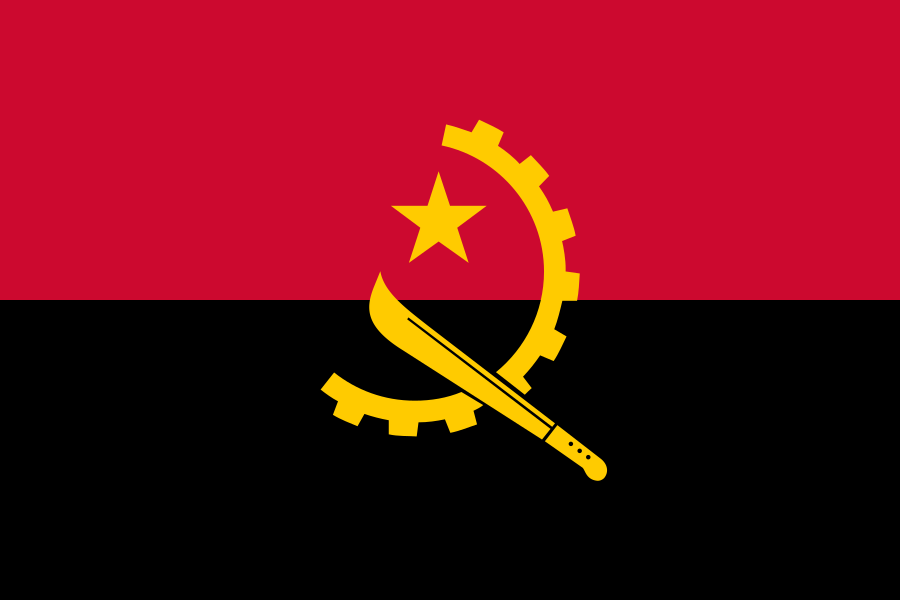
Physician and poet who led Angola's independence struggle. He was president of the MPLA at its founding in December 1956 and, after imprisonment and exile, was elected its effective chairman at the December 1962 conference, leading the independence war until 1974. He became the first president of the People's Republic of Angola on 11 November 1975, building a one-party socialist state in close alignment with the USSR and Cuba while crushing a 1977 coup attempt and carrying out mass purges.
Career timeline
1947Left for Portugal; studied medicine at Coimbra and Lisbon universities while joining anti-colonial student activism
1956Became the MPLA's president at its founding (Viriato da Cruz was secretary-general)
1960–1962Arrested by the PIDE, imprisoned in Lisbon; escaped in 1962 and went into exile in Congo-Léopoldville
1962–1974Elected effective chairman at the MPLA conference; led the independence war and built ties with the USSR, Cuba and Yugoslavia
1975Became first president of the People's Republic of Angola on 11 November; declared a socialist course
1975–1979Defended the state in civil war with Cuban troops and Soviet aid; suppressed Nito Alves's 1977 coup attempt
1977Reorganized the MPLA into the MPLA-Workers' Party, adopting Marxism-Leninism as official doctrine
Architect of Eurocommunism who led the West's largest non-ruling communist party
In a landmark interview with La Repubblica (28 July 1981), he named the structural corruption of Italy's party system the 'moral question' (questione morale): "Today's parties are above all machines of power and clientelism: scant or distorted knowledge of society and people's lives; ideas, ideals, programs few or vague; sentiments and civic passion — zero." The phrase became a reference point in Italian political discourse for decades.
Secretary-General of the Italian Communist Party (PCI, 1972–1984). Architect of Eurocommunism, a democratic, pluralist socialism independent of Moscow, who led the PCI to its historic peak of 34.4% in the 1976 general election.
Career timeline
1943Joined PCI; founded Sassari Communist Youth section
1944Arrested for anti-fascist bread protest; acquitted after 3 months
1949–1956Secretary, Italian Communist Youth Federation (FGCI)
1962Member of PCI Secretariat; head of international relations
1968–1984Member of Chamber of Deputies for Rome (5 terms)
1969PCI Deputy Secretary; designated successor to Luigi Longo
1972–1984Secretary-General, Italian Communist Party (PCI)