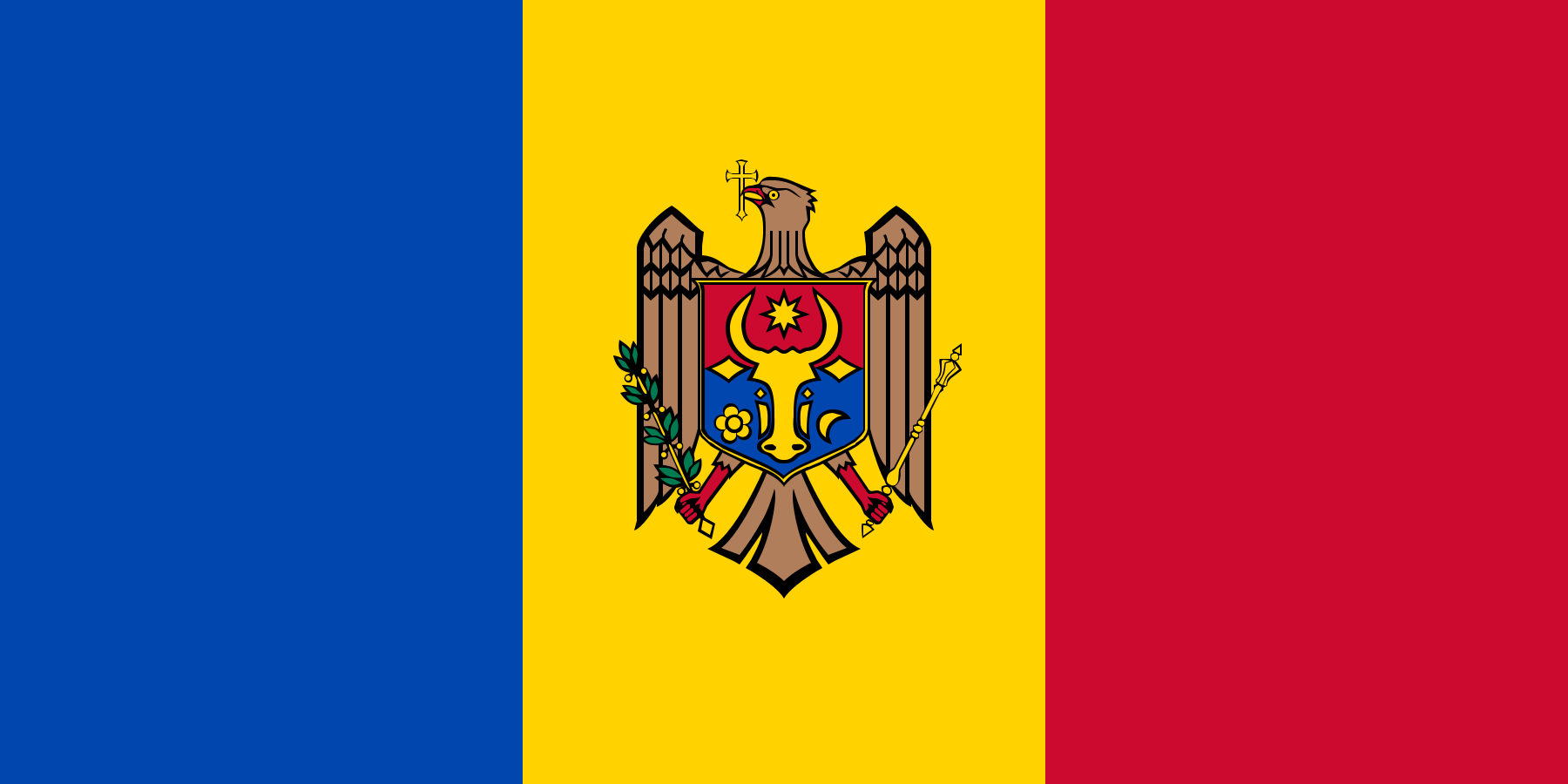
A politician who moved from Soviet party leadership to Moldova's presidency
In the 1996 runoff, backed by left and centrist forces, he defeated Mircea Snegur to win the presidency.
Pyotr Luchinsky rose through the party apparatus of the Moldavian Soviet republic and became a link between late Soviet republican politics and the making of the independent Moldovan state. He became first secretary of the Communist Party of Moldova's Central Committee in 1989 and served on the CPSU Politburo from 1990 to 1991. After independence, he was ambassador to Russia and speaker of parliament before winning the 1996 presidential election and serving as Moldova's second president from 1997 to 2001. His career shows how Soviet institutional continuity and the adjustment of a new state's sovereignty and foreign orientation could converge in one politician.
Also known as: Petru Lucinschi · Pyotr Kirillovich Luchinsky
Activities and affiliations
Career Timeline
- 1960–1971Instructor, department head, secretary and first secretary of the Moldavian Leninist Komsomol Central Committee
- 1971–1976Secretary of the Communist Party of Moldova Central Committee and member of its Politburo
- 1976–1978First secretary of the Communist Party's Chișinău City Committee
- 1978–1986Deputy chief of a department of the CPSU Central Committee
- 1986–1989Second secretary of the Communist Party of Tajikistan Central Committee
- 1989–1990First secretary of the Communist Party of Moldova Central Committee
- 1990–1991Secretary of the CPSU Central Committee and member of its Politburo
- 1997–2001President of Moldova
The Soviet Politburo
- Full member 1990.07–1991.08
served until the party ban of 1991.11
Related historical events
The presidency of independent Moldova and political conflict
After winning the 1996 presidential election, Luchinsky took office on 15 January 1997 and served until 2001. The Communist Party won the largest share of the vote in the 1998 parliamentary election, and political confrontations in parliament intensified afterward. Moldpres reports that privatization of state property continued and rapprochement with the West advanced during his presidency, while also noting that low living standards and economic crisis fueled public discontent. In 2000, parliament amended the constitution, shifting to a parliamentary system in which the president was elected by parliament. The Communist Party won a sweeping victory in the 2001 snap election, and its leader Vladimir Voronin was elected president, ending Luchinsky's term. His presidency thus encompassed both the rule of a politician with a Soviet-era party career amid independent Moldova's institutional transition and economic crisis, and the replacement of a presidential-centered system by a parliamentary one.